
Topology Optimization: A Compact Review and Comparation on Level Set Technique Development in Single and Multi-material
Abstract
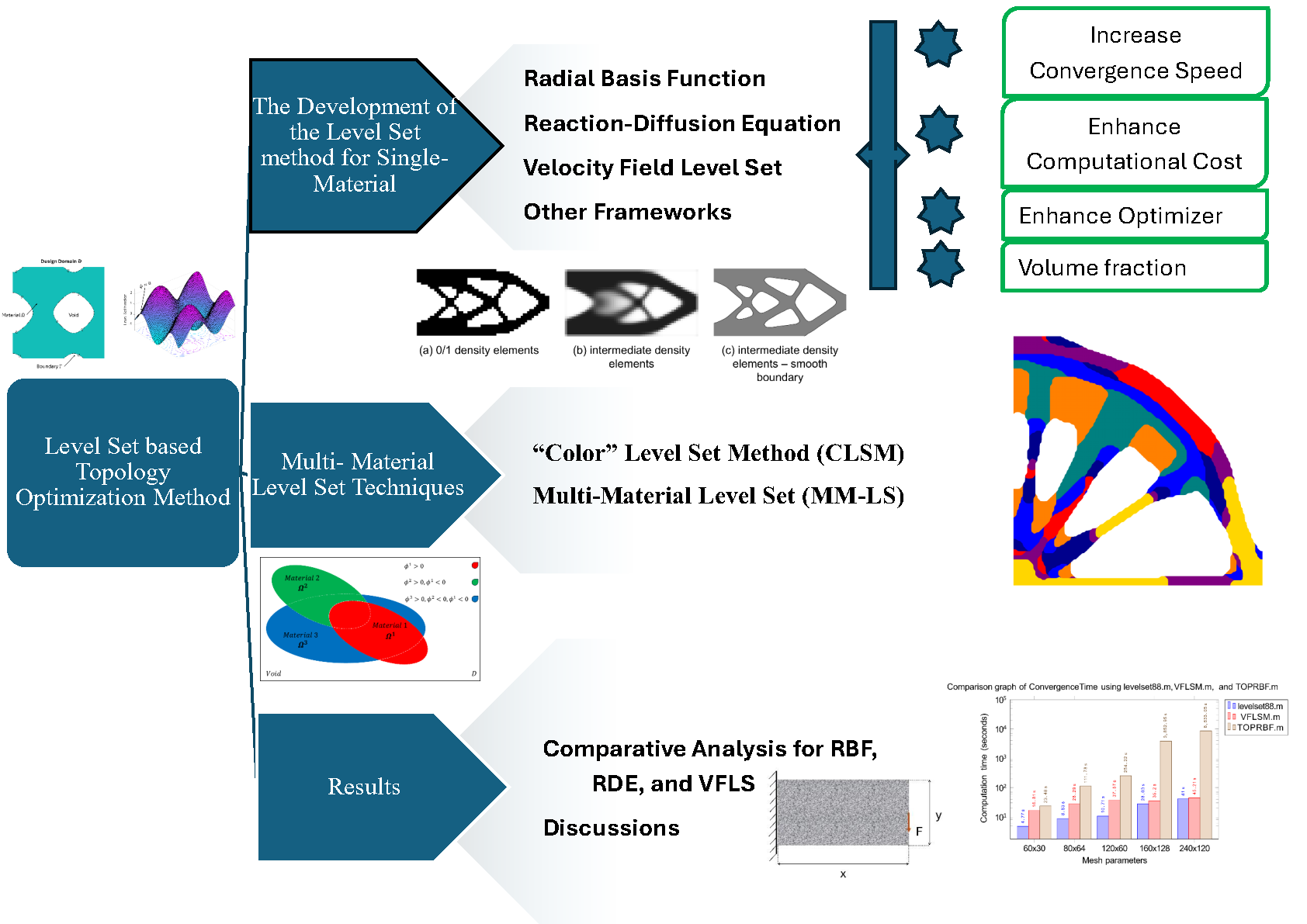
Lightweight structural design is being researched and applied across many fields, including mechanical engineering, aerospace, and manufacturing. Among the many methods used to reduce material weight while ensuring structural strength, topology optimization has become a common choice due to its ability to optimize single-material, multi-material, and other multi-material structures such as composites or porous materials. In this review article, a summary of recent research on variants of the Level Set-based topology optimization method and their effects on structural topology optimization is presented. Among the variations and extensions of the level set method, three approaches are highlighted in this study: Radial Basis Functions, Reaction-Diffusion Equation, and Velocity Field Level Set Method, with emphasis on computation speed, computational cost, optimizer, and volume fraction. This is a new aspect of this review, as it synthesizes quantitative results from studies to clarify the optimization capabilities of each approach. This optimization capability will influence more complex studies, such as multi-material optimization. Furthermore, this study compares the three selected approaches on the same system using open-source code for education to complete previously unpublished results, thereby clarifying the advantages and disadvantages of each approach in greater detail. From this, this review provides clear reasons for new studies to develop methods for more complex computational domains
How to Cite
Loc Tan Le, Annisa Jusuf, Lavi Rizki Zuhal, Tatacipta Dirgantara (2026). Topology Optimization: A Compact Review and Comparation on Level Set Technique Development in Single and Multi-material. Journal of Engineering and Technological Sciences, Vol. 58 No. 6 (2026): Vol. 58 No. 6(2026): December (In Progress), 812-835. https://doi.org/10.5614/j.eng.technol.sci.2026.58.6.5
Metrics
Download data is not yet available.
References
Allaire, G., Dapogny, C., & Frey, P. (2014). Shape optimization with a level set based mesh evolution method. Computer Methods in Applied Mechanics and Engineering, 282, 22–53. https://doi.org/10.1016/j.cma.2014.08.028
Allaire, G., Jouve, F., & Michailidis, G. (2013, June 12). Structural and multi-functional optimization using multiple phases and a level-set method. 3rd South-East European Conference on Computational Mechanics.
Allaire, G., Jouve, F., & Toader, A. M. (2004). Structural optimization using sensitivity analysis and a level-set method. Journal of Computational Physics, 194(1), 363–393. https://doi.org/10.1016/j.jcp.2003.09.032
Andrade, G. C., & Santos, S. A. (2022). A level-set-based topology optimization strategy using radial basis functions and a Hilbertian velocity extension. Applied Mathematical Modelling, 111, 108–125. https://doi.org/10.1016/j.apm.2022.06.026
Andreassen, E., Clausen, A., Schevenels, M., Lazarov, B. S., & Sigmund, O. (2011). Efficient topology optimization in MATLAB using 88 lines of code. Structural and Multidisciplinary Optimization, 43(1), 1–16. https://doi.org/10.1007/s00158-010-0594-7
Azari Nejat, A., Held, A., Trekel, N., & Seifried, R. (2022). A modified level set method for topology optimization of sparsely-filled and slender structures. Struct Multidisc Optim 65, 85. https://doi.org/10.1007/s00158-022-03184-2
Bai, J., & Zuo, W. (2022). Multi-material topology optimization of coated structures using level set method. Composite Structures, 300, 116074. https://doi.org/10.1016/j.compstruct.2022.116074
Belytschko, T., Xiao, S. P., & Parimi, C. (2003). Topology optimization with implicit functions and regularization. International Journal for Numerical Methods in Engineering, 57(8), 1177–1196. https://doi.org/10.1002/nme.824
Bohrer, R., & Kim, I. Y. (2021). Multi-material topology optimization considering isotropic and anisotropic materials combination. Structural and Multidisciplinary Optimization, 64(3), 1567–1583. https://doi.org/10.1007/s00158-021-02941-z
Bruggi, M., Ismail, H., Lógó, J., & Paoletti, I. (2022). Lightweight design with displacement constraints using graded porous microstructures. Computers and Structures, 272, 106873. https://doi.org/10.1016/j.compstruc.2022.106873
Burger, M., Hackl, B., & Ring, W. (2004). Incorporating topological derivatives into level set methods. Journal of Computational Physics, 194(1), 344–362. https://doi.org/10.1016/j.jcp.2003.09.033
Challis, V. J. (2010). A discrete level-set topology optimization code written in Matlab. Structural and Multidisciplinary Optimization, 41(3), 453–464. https://doi.org/10.1007/s00158-009-0430-0
Cheng, W., Zhang, X., Hu, T., Li, J., & Wang, Y. (2024). Stress-constrained topology optimization using the velocity field level set method. Computers and Structures, 305, 107577. https://doi.org/10.1016/j.compstruc.2024.107577
Chung, H., Hwang, J. T., Gray, J. S., & Kim, H. A. (2019). Topology optimization in OpenMDAO. Structural and Multidisciplinary Optimization, 59(4), 1385–1400. https://doi.org/10.1007/s00158-019-02209-7
Cui, M., Chen, H., & Zhou, J. (2016). A level-set based multi-material topology optimization method using a reaction diffusion equation. CAD Computer Aided Design, 73, pages 41–52. https://doi.org/10.1016/j.cad.2015.12.002
Cui, Y., Takahashi, T., & Matsumoto, T. (2023). An exact volume constraint method for topology optimization via reaction–diffusion equation. Computers and Structures, 280, 106986. https://doi.org/10.1016/j.compstruc.2023.106986
Doan, Q. H., Lee, D., Lee, J., & Kang, J. (2020). Multi-material structural topology optimization with decision making of stiffness design criteria. Advanced Engineering Informatics, 45, 101098. https://doi.org/10.1016/j.aei.2020.101098
Du, X., Zhou, Y., Li, L., Persson, C., & Ferguson, S. J. (2023). The porous cantilever beam as a model for spinal implants: Experimental, analytical and finite element analysis of dynamic properties. Mathematical Biosciences and Engineering, 20(4), 6273–6293. https://doi.org/10.3934/mbe.2023270
Dunning, P. D., & Alicia Kim, H. (2013). A new hole insertion method for level set based structural topology optimization. International Journal for Numerical Methods in Engineering, 93(1), 118–134. https://doi.org/10.1002/nme.4384
Feng, J., Fu, J., Lin, Z., Shang, C., & Li, B. (2018). A review of the design methods of complex topology structures for 3D printing. Visual Computing for Industry, Biomedicine, and Art, 1, 5. Springer Science and Business Media B.V. https://doi.org/10.1186/s42492-018-0004-3
Ghasemi, H., Park, H. S., & Rabczuk, T. (2018). A multi-material level set-based topology optimization of flexoelectric composites. Computer Methods in Applied Mechanics and Engineering, 332, 47–62. https://doi.org/10.1016/j.cma.2017.12.005
Gibou, F., Fedkiw, R., & Osher, S. (2018). A review of level-set methods and some recent applications. Journal of Computational Physics, 353, 82–109. Academic Press Inc. https://doi.org/10.1016/j.jcp.2017.10.006
Gomes, A. A., & Suleman, A. (2006). Application of spectral level set methodology in topology optimization. Structural and Multidisciplinary Optimization, 31(6), 430–443. https://doi.org/10.1007/s00158-006-0005-2
Han, Y., Xu, B., & Liu, Y. (2021). An efficient 137-line MATLAB code for geometrically nonlinear topology optimization using bi-directional evolutionary structural optimization method. Structural and Multidisciplinary Optimization, 63(5), 2571–2588. https://doi.org/10.1007/s00158-020-02816-9
Hassan, H. Z., & Saeed, N. M. (2024). Advancements and applications of lightweight structures: a comprehensive review. Discover Civil Engineering, 1, 47. https://doi.org/10.1007/s44290-024-00049-z
He, L., Kao, C. Y., & Osher, S. (2007). Incorporating topological derivatives into shape derivatives based level set methods. Journal of Computational Physics, 225(1), 891–909. https://doi.org/10.1016/j.jcp.2007.01.003
Huang, X. (2020). Smooth topological design of structures using the floating projection. Engineering Structures, Volume 208, Article 110330. https://doi.org/10.1016/j.engstruct.2020.110330
Huang, X. (2021). On smooth or 0/1 designs of the fixed-mesh element-based topology optimization. Advances in Engineering Software, 151, 102942. https://doi.org/10.1016/j.advengsoft.2020.102942
Jankovics, D., & Barari, A. (2019). Customization of Automotive Structural Components using Additive Manufacturing and Topology Optimization. IFAC-PapersOnLine, 52(10), 212–217. https://doi.org/10.1016/j.ifacol.2019.10.066
Jauregui, C. M., Hyun, J., Neofytou, A., Gray, J. S., & Kim, H. A. (2023). Avoiding reinventing the wheel: reusable open-source topology optimization software. Structural and Multidisciplinary Optimization, 66, 145. https://doi.org/10.1007/s00158-023-03589-7
Jia, S., Li, Z., Liu, R., Wang, Y., & Kang, Z. (2026). Velocity field level set method for topology optimization on irregular level set grid. Engineering Structures, 349, 121874. https://doi.org/10.1016/j.engstruct.2025.121874
Kumar, H., & Rakshit, S. (2025). Multi-material topology optimization using isogeometric method based reaction–diffusion level set techniques. Mathematics and Computers in Simulation, 233, 530–552. https://doi.org/10.1016/j.matcom.2025.02.010
Laurain, A. (2018). A level set-based structural optimization code using FEniCS. Structural and Multidisciplinary Optimization, 58(3), 1311–1334. https://doi.org/10.1007/s00158-018-1950-2
Li, H., Wang, C., Zhang, X., Li, J., Shen, J., & Zhou, S. (2023). A Mini Review on Fluid Topology Optimization. Materials, 16(18), 1–16. https://doi.org/10.3390/ma16186073
Liu, J., Gaynor, A. T., Chen, S., Kang, Z., Suresh, K., Takezawa, A., Li, L., Kato, J., Tang, J., Wang, C. C. L., Cheng, L., Liang, X., & To, A. C. (2018). Current and future trends in topology optimization for additive manufacturing. Structural and Multidisciplinary Optimization, 57(6), 2457–2483. https://doi.org/10.1007/s00158-018-1994-3
Liu, J., & Ma, Y. (2018). A new multi-material level set topology optimization method with the length scale control capability. Computer Methods in Applied Mechanics and Engineering, 329, 444–463. https://doi.org/10.1016/j.cma.2017.10.011
Liu, P., Luo, Y., & Kang, Z. (2016). Multi-material topology optimization considering interface behavior via XFEM and level set method. Computer Methods in Applied Mechanics and Engineering, 308, 113–133. https://doi.org/10.1016/j.cma.2016.05.016
Lu, H., Lee, T. U., Ma, J., Chen, D., & Xie, Y. M. (2023). Designing 2D stochastic porous structures using topology optimisation. Composite Structures, 321, 117305. https://doi.org/10.1016/j.compstruct.2023.117305
Luo, Z., Tong, L., & Kang, Z. (2009). A level set method for structural shape and topology optimization using radial basis functions. Computers and Structures, 87(7–8), 425–434. https://doi.org/10.1016/j.compstruc.2009.01.008
Luo, Z., Wang, M. Y., Wang, S., & Wei, P. (2008). A level set-based parameterization method for structural shape and topology optimization. International Journal for Numerical Methods in Engineering, 76(1), 1–26. https://doi.org/10.1002/nme.2092
Nguyen, K. C., Tran, P., & Nguyen, H. X. (2019). Multi-material topology optimization for additive manufacturing using polytree-based adaptive polygonal finite elements. Automation in Construction, 99, 79–90. https://doi.org/10.1016/j.autcon.2018.12.005
Nguyen-Tran, B. D., Phan, D. H., Nguyen-Thoi, T., & Nguyen, S. H. (2025). Multi-Material Structural Topology Optimization via Dynamic Body-Fitted Multi-Trimmed Mesh Evolution and Reaction–Diffusion-Based Level-Set Method. International Journal for Numerical Methods in Engineering, 126(20), e70167. https://doi.org/10.1002/nme.70167
Noda, M., Noguchi, Y., & Yamada, T. (2022). Extended level set method: A multiphase representation with perfect symmetric property, and its application to multi-material topology optimization. Computer Methods in Applied Mechanics and Engineering, 393, 114742. https://doi.org/10.1016/j.cma.2022.114742
Oka, T., & Yamada, T. (2023). Topology optimization method with nonlinear diffusion. Computer Methods in Applied Mechanics and Engineering, Volume 408, 115940. https://doi.org/10.1016/j.cma.2023.115940
Osher, S., & Sethian, J. A. (1988). Fronts Propagating with Curvature-Dependent Speed: Algorithms Based on Hamilton-Jacobi Formulations. Journal of Computational Physics, 79(1), 12–49. https://doi.org/10.1016/0021-9991(88)90002-2
Otomori, M., Yamada, T., Izui, K., & Nishiwaki, S. (2015). Matlab code for a level set-based topology optimization method using a reaction diffusion equation. Structural and Multidisciplinary Optimization, 51(5), 1159–1172. https://doi.org/10.1007/s00158-014-1190-z
Plocher, J., & Panesar, A. (2019). Review on design and structural optimisation in additive manufacturing: Towards next-generation lightweight structures. In Materials and Design, 183, 108164. Elsevier Ltd. https://doi.org/10.1016/j.matdes.2019.108164
Prathyusha, A. L. R., & Raghu Babu, G. (2022). A review on additive manufacturing and topology optimization process for weight reduction studies in various industrial applications. Materials Today: Proceedings, 62, 109–117. https://doi.org/10.1016/j.matpr.2022.02.604
Rozvany, G. I. N., Zhou, M., & Birker, T. (1992). Generalized shape optimization without homogenization. Structural Optimization, 4, 250–252. https://doi.org/10.1007/BF01742754
Schmidt, M. P., Pedersen, C. B. W., & Gout, C. (2019). On structural topology optimization using graded porosity control. Structural and Multidisciplinary Optimization, 60(4), 1437–1453. https://doi.org/10.1007/s00158-019-02275-x
Seong, H. K., Shin, H., Yoo, J., Yamada, T., & Nishiwaki, S. (2018). Reaction-diffusion equation based topology optimization combined with the modified conjugate gradient method. Finite Elements in Analysis and Design, 140, 84–95. https://doi.org/10.1016/j.finel.2017.11.009
Sethian, J. A., & Wiegmann, A. (2000). Structural Boundary Design via Level Set and Immersed Interface Methods. Journal of Computational Physics, 163(2), 489–528. https://doi.org/10.1006/jcph.2000.6581
Sha, W., Xiao, M., Gao, L., & Zhang, Y. (2021). A new level set based multi-material topology optimization method using alternating active-phase algorithm. Computer Methods in Applied Mechanics and Engineering, 377, 113674. https://doi.org/10.1016/j.cma.2021.113674
Shah, V., Pamwar, M., Sangha, B., & Kim, I. Y. (2023). All-terrain vehicle chassis design using multi-material topology optimization. Structural and Multidisciplinary Optimization, 66(3). https://doi.org/10.1007/s00158-023-03489-w
Shen, Y., & Feng, J. (2018). Parametric Level Set-Based Multimaterial Topology Optimization of Heat Conduction Structures. Mathematical Problems in Engineering, 2018. https://doi.org/10.1155/2018/9804123
Sigmund, 0, & Torquato, S. (1997). Design of materials with extreme thermal expansion using a three-phase topology optimization method. Journal of the Mechanics and Physics of Solids, 45(6), 1037–1067. https://doi.org/10.1016/S0022-5096(96)00114-7
Sigmund, O. (2001). A 99 line topology optimization code written in Matlab. Struct Multidisc Optim 21, 21, 120–127. https://doi.org/10.1007/s001580050176
Sigmund, O. (2007). Morphology-based black and white filters for topology optimization. Structural and Multidisciplinary Optimization, 33(4–5), 401–424. https://doi.org/10.1007/s00158-006-0087-x
Sobczak, P., & Sokół, T. (2024). Level-set based shape optimization for plane elastic structures using radial basis functions and Hilbertian descent direction. Structural and Multidisciplinary Optimization, 67, 174. https://doi.org/10.1007/s00158-024-03868-x
Subedi, S. C., Singh Verma, C., & Suresh, K. (2020). A Review of Methods for the Geometric Post-Processing of Topology Optimized Models. ASME. J. Comput. Inf. Sci. Eng., 20, 060801. https://doi.org/10.1115/1.4047429
Sugimoto, S., Sakane, S., & Takaki, T. (2024). Multi-phase-field framework for multi-material topology optimization. Computational Materials Science, 244, 113201. https://doi.org/10.1016/j.commatsci.2024.113201
Svanberg, K. (1987). The method of moving asymptotes - A new method for structural optimization. International Journal for Numerical Methods in Engineering, 24(2), 359–373. https://doi.org/10.1002/nme.1620240207
Tajs-Zielińska, K., & Bochenek, B. (2021). Multi-domain and multi-material topology optimization in design and strengthening of innovative sustainable structures. Sustainability, 13(6), 3435. https://doi.org/10.3390/su13063435
Tian, J., Li, M., Han, Z., Chen, Y., Gu, X. D., Ge, Q. J., & Chen, S. (2022). Conformal topology optimization of multi-material ferromagnetic soft active structures using an extended level set method. Computer Methods in Applied Mechanics and Engineering, 389, 114394. https://doi.org/10.1016/j.cma.2021.114394
Van Dijk, N. P., Langelaar, M., & Van Keulen, F. (2012). Explicit level-set-based topology optimization using an exact Heaviside function and consistent sensitivity analysis. International Journal for Numerical Methods in Engineering, 91(1), 67–97. https://doi.org/10.1002/nme.4258
Van Dijk, N. P., Maute, K., Langelaar, M., & Van Keulen, F. (2013). Level-set methods for structural topology optimization: A review. Structural and Multidisciplinary Optimization, 48(3), 437–472. https://doi.org/10.1007/s00158-013-0912-y
Vogiatzis, P., Chen, S., Wang, X., Li, T., & Wang, L. (2017). Topology optimization of multi-material negative Poisson’s ratio metamaterials using a reconciled level set method. CAD Computer Aided Design, 83, 15–32. https://doi.org/10.1016/j.cad.2016.09.009
Wang, C., Xie, Y. M., Lin, X., & Zhou, S. (2022). A reaction diffusion-based B-spline level set (RDBLS) method for structural topology optimization. Computer Methods in Applied Mechanics and Engineering, 398, 115252. https://doi.org/10.1016/j.cma.2022.115252
Wang, C., Zhao, Z., Zhou, M., Sigmund, O., & Zhang, X. S. (2021). A comprehensive review of educational articles on structural and multidisciplinary optimization. Structural and Multidisciplinary Optimization, 64(5), 2827–2880. Springer Science and Business Media Deutschland GmbH. https://doi.org/10.1007/s00158-021-03050-7
Wang, F., Lazarov, B. S., & Sigmund, O. (2011). On projection methods, convergence and robust formulations in topology optimization. Structural and Multidisciplinary Optimization, 43(6), 767–784. https://doi.org/10.1007/s00158-010-0602-y
Wang, M. Y., & Wang, X. (2004). “Color” level sets: A multi-phase method for structural topology optimization with multiple materials. Computer Methods in Applied Mechanics and Engineering, 193(6–8), 469–496. https://doi.org/10.1016/j.cma.2003.10.008
Wang, M. Y., Wang, X., & Guo, D. (2003). A level set method for structural topology optimization. Computer Methods in Applied Mechanics and Engineering, 192(1–2), 227–246. https://doi.org/10.1016/S0045-7825(02)00559-5
Wang, S., & Wang, M. Y. (2006). Radial basis functions and level set method for structural topology optimization. International Journal for Numerical Methods in Engineering, 65(12), 2060–2090. https://doi.org/10.1002/nme.1536
Wang, Y., & Kang, Z. (2018). A velocity field level set method for shape and topology optimization. International Journal for Numerical Methods in Engineering, 115(11), 1315–1336. https://doi.org/10.1002/nme.5845
Wang, Y., & Kang, Z. (2021). MATLAB implementations of velocity field level set method for topology optimization: an 80-line code for 2D and a 100-line code for 3D problems. Structural and Multidisciplinary Optimization, 64(6), 4325–4342. https://doi.org/10.1007/s00158-021-02958-4
Wang, Y., Luo, Z., Kang, Z., & Zhang, N. (2015). A multi-material level set-based topology and shape optimization method. Computer Methods in Applied Mechanics and Engineering, 283, 1570–1586. https://doi.org/10.1016/j.cma.2014.11.002
Wegert, Z. J., Manyer, J., Mallon, C. N., Badia, S., & Challis, V. J. (2025). GridapTopOpt.jl: a scalable Julia toolbox for level set-based topology optimisation. Structural and Multidisciplinary Optimization, 68, 22. https://doi.org/10.1007/s00158-024-03927-3
Wei, P., Li, Z., Li, X., & Wang, M. Y. (2018). An 88-line MATLAB code for the parameterized level set method based topology optimization using radial basis functions. Structural and Multidisciplinary Optimization, 58(2), 831–849. https://doi.org/10.1007/s00158-018-1904-8
Wei, P., & Paulino, G. H. (2020). A parameterized level set method combined with polygonal finite elements in topology optimization. Structural and Multidisciplinary Optimization, 61, 1913–1928. https://doi.org/10.1007/s00158-019-02444-y/Published
Wu, J., Aage, N., Westermann, R., & Sigmund, O. (2018). Infill Optimization for Additive Manufacturing-Approaching Bone-Like Porous Structures. IEEE Transactions on Visualization and Computer Graphics, 24(2), 1127–1140. https://doi.org/10.1109/TVCG.2017.2655523
Xie, X., & Mirmehdi, M. (2011). Radial basis function based level set interpolation and evolution for deformable modelling. Image and Vision Computing, 29(2–3), 167–177. https://doi.org/10.1016/j.imavis.2010.08.011
Xie, Y. M., & Steven, G. P. (1993). A simple evolutionary procedure for structural optimization. Computers and Structures, 49(5), 885–896. https://doi.org/10.1016/0045-7949(93)90035-c
Xu, S., Liu, J., & Ma, Y. (2022). Residual stress constrained self-support topology optimization for metal additive manufacturing. Computer Methods in Applied Mechanics and Engineering, 389, 114380. https://doi.org/10.1016/j.cma.2021.114380
Xu, X., Gu, X. D., & Chen, S. (2022). Shape and topology optimization of conformal thermal control structures on free-form surfaces: A dimension reduction level set method (DR-LSM). Computer Methods in Applied Mechanics and Engineering, 398. https://doi.org/10.1016/j.cma.2022.115183
Xu, X., Gu, X. D., & Chen, S. (2023). Topology optimization of thermal cloaks in euclidean spaces and manifolds using an extended level set method. International Journal of Heat and Mass Transfer, 202, 123720. https://doi.org/10.1016/j.ijheatmasstransfer.2022.123720
Yago, D., Cante, J., Lloberas-Valls, O., & Oliver, J. (2022). Topology Optimization Methods for 3D Structural Problems: A Comparative Study. Archives of Computational Methods in Engineering, 29(3), 1525–1567. https://doi.org/10.1007/s11831-021-09626-2
Yamada, T., Izui, K., Nishiwaki, S., & Takezawa, A. (2010). A topology optimization method based on the level set method incorporating a fictitious interface energy. Computer Methods in Applied Mechanics and Engineering, 199(45–48), 2876–2891. https://doi.org/10.1016/j.cma.2010.05.013
Yang, W., Chen, H., Bai, H., Sun, Y., Zhang, A., Liu, Y., Song, Y., Han, Q., & Wang, J. (2024). Additive manufactured osseointegrated screws with hierarchical design. In Bio-Design and Manufacturing, 7(2), 206–235. Zhejiang University. https://doi.org/10.1007/s42242-024-00269-3
Yi, G., & Kim, N. H. (2017). Identifying boundaries of topology optimization results using basic parametric features. Structural and Multidisciplinary Optimization, 55(5), 1641–1654. https://doi.org/10.1007/s00158-016-1597-9
Zhao, Z., & Zhang, X. S. (2021). Design of graded porous bone-like structures via a multi-material topology optimization approach. Structural and Multidisciplinary Optimization, 64(2), 677–698. https://doi.org/10.1007/s00158-021-02870-x
Zheng, J., Zhu, S., & Soleymani, F. (2024). A new efficient parametric level set method based on radial basis function-finite difference for structural topology optimization. Computers and Structures, 297, 107364. https://doi.org/10.1016/j.compstruc.2024.107364
Zheng, R., Yi, B., Peng, X., & Yoon, G. H. (2024). An Efficient Code for the Multi-Material Topology Optimization of 2D/3D Continuum Structures Written in Matlab. Applied Sciences, 14(657), 1–23. https://doi.org/10.3390/app14020657
Zhou, Y., Li, H., Li, X., & Gao, L. (2022). Design of multiphase auxetic metamaterials by a parametric color level set method. Composite Structures, 287, 115385. https://doi.org/10.1016/j.compstruct.2022.115385
Zhu, J. H., Zhang, W. H., & Xia, L. (2016a). Topology Optimization in Aircraft and Aerospace Structures Design. Archives of Computational Methods in Engineering, 23, 595–622. https://doi.org/10.1007/s11831-015-9151-2
Zhuang, Z., Xie, Y. M., Li, Q., & Zhou, S. (2023). A 172-line Matlab code for structural topology optimization in the body-fitted mesh. Structural and Multidisciplinary Optimization, 66, 11. https://doi.org/10.1007/s00158-022-03464-x
Zhuang, Z., Xie, Y. M., & Zhou, S. (2021). A reaction diffusion-based level set method using body-fitted mesh for structural topology optimization. Computer Methods in Applied Mechanics and Engineering, 381, 113829. https://doi.org/10.1016/j.cma.2021.113829
Zhuang, Z., Xu, F., Ye, J., Tong, W., Chen, Z., & Weng, Y. (2024). A 262-line Matlab code for the level set topology optimization based on the estimated gradient field in the body-fitted mesh. Structural and Multidisciplinary Optimization, 67(9), 1–23. https://doi.org/10.1007/s00158-024-03891-y
License
Copyright (c) 2026 by Authors

This work is licensed under a Creative Commons Attribution 4.0 International License.
Downloads
Date Log
- Submitted
- April 21, 2026
- Accepted
- August 13, 2026
- Published
- September 25, 2026
Keywords
- computation speed
- computational cost
- multi-material level set
- radial basis functions
- reaction-diffusion equation
- velocity field level set method


