Chloride Salt-Intercalated Ti2C Membranes for Ultraquick Cationic Dye Removal
Downloads
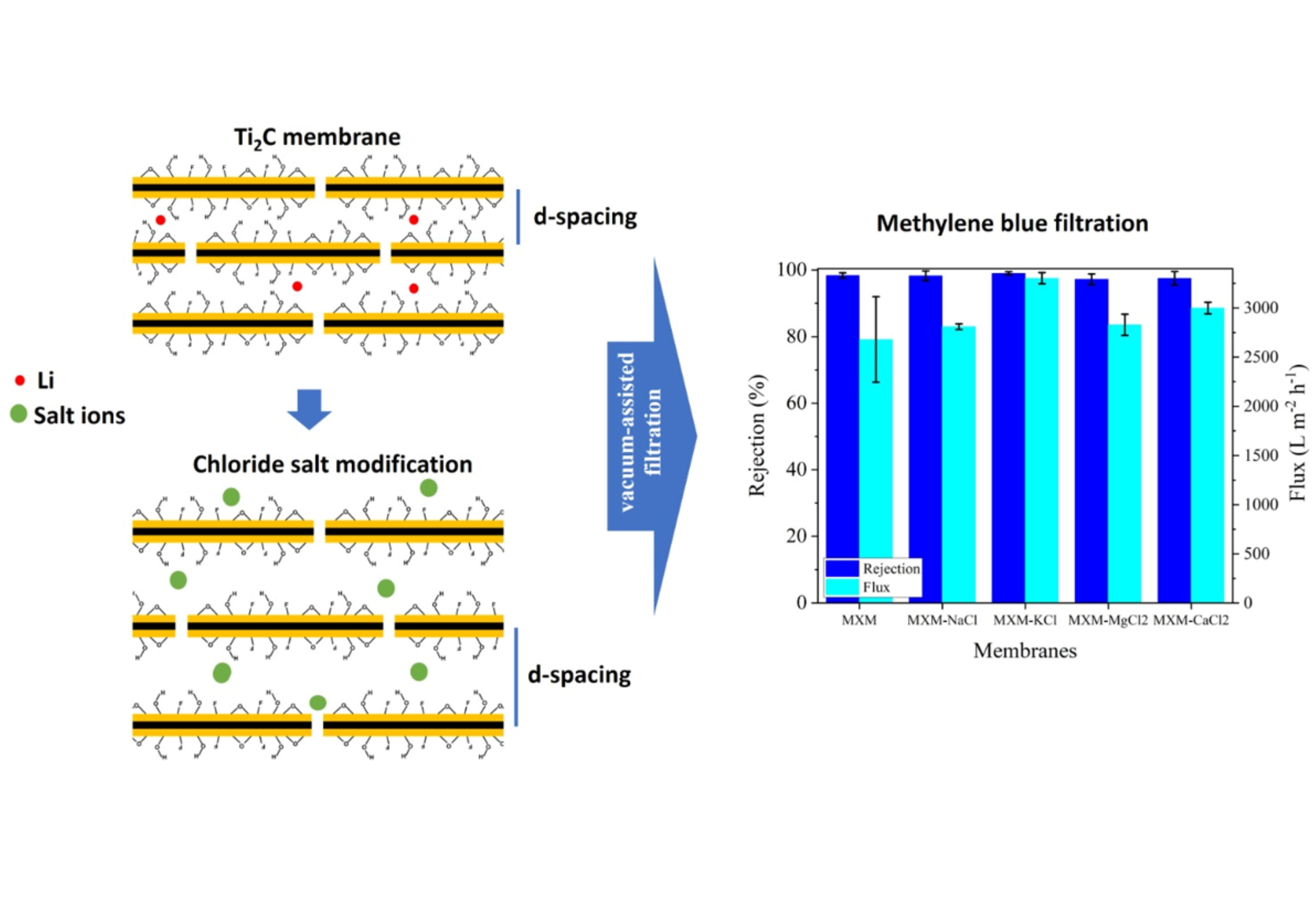
Ti2C is a 2D nanomaterial with an ultrathin layered structure. This material has remarkable properties due to the -O, -F, and -OH functional groups in surface termination, which makes it hydrophilic and suitable for membrane applications. Herein, we reported the chloride salt-intercalated Ti2C membrane for methylene blue (MB) removal. The modification was done by a simple mixing method between chloride salt and Ti2C. First, Ti2C was synthesized from its parent phase of Ti2AlC using in-situ HF etchant. Then, Ti2C was modified using chloride salt (NaCl, KCl, MgCl2, and CaCl2), and mixed cellulose ester (MCE) was used as a membrane support to produce a MXene-based membrane (MXM). The results show that chloride salt ions enhance the interlayer spacing of Ti2C due to the ability of salt cation to be inserted and replace the Li+ as intercalant. This result is also evidenced by the difference in d-spacing in XRD analysis. In methylene blue removal, the flux of the membrane was excellent, around 2000-3000 L m-2 h-1, with a dye removal value above 97%. The high dye removal is correlated with the electrostatic interaction between the negative surface of Ti2C and the positive charge of MB. Then, the remarkable performance was reached by MXM-KCl with flux and rejection of 3303.31 L m-2 h-1 and 99.01%, respectively. The excellent flux of MXM-KCl correlated with the Gibbs free energy hydration of K+ is lower than the other salt cations (Na+, Mg2+, and Ca2+). In addition, all membranes exhibit great fouling resistance, with an FRR value of about 90%.
Adapa, S., & Malani, A. (2018). Role of hydration energy and co-ions association on monovalent and divalent cations adsorption at mica-aqueous interface. Scientific Reports, 8(1), 12198. https://doi.org/10.1038/s41598-018-30549-9
Ahmad, A. L., Pang, W. Y., Mohd Shafie, Z. M. H., & Zaulkiflee, N. D. (2019). PES/PVP/TiO2 mixed matrix hollow fiber membrane with antifouling properties for humic acid removal. Journal of Water Process Engineering, 31, 100827. https://doi.org/10.1016/j.jwpe.2019.100827
Ahmad, H., Mohd Makhfuz, M. J., Yusoff, N., Azam, A. D., & Samion, M. Z. (2023). Synthesis of 2D titanium carbide Ti2C, its characteristics, and nonlinear optical properties. Optical Materials, 135, 113340. https://doi.org/10.1016/j.optmat.2022.113340
Al-Hamadani, Y. A. J., Jun, B.-M., Yoon, M., Taheri-Qazvini, N., Snyder, S. A., Jang, M., Heo, J., & Yoon, Y. (2020). Applications of MXene-based membranes in water purification: A review. Chemosphere, 254, 126821. https://doi.org/10.1016/j.chemosphere.2020.126821
Berdiyorov, G. R., & Mahmoud, K. A. (2017). Effect of surface termination on ion intercalation selectivity of bilayer Ti 3 C 2 T 2 (T = F, O and OH) MXene. Applied Surface Science, 416, 725–730. https://doi.org/10.1016/j.apsusc.2017.04.195
Din, M. I., Khalid, R., Najeeb, J., & Hussain, Z. (2021). Fundamentals and photocatalysis of methylene blue dye using various nanocatalytic assemblies- a critical review. Journal of Cleaner Production, 298, 126567. https://doi.org/10.1016/j.jclepro.2021.126567
Gautam, S., Agrawal, H., Thakur, M., Akbari, A., Sharda, H., Kaur, R., & Amini, M. (2020). Metal oxides and metal organic frameworks for the photocatalytic degradation: A review. Journal of Environmental Chemical Engineering, 8(3), 103726. https://doi.org/10.1016/j.jece.2020.103726
Gogotsi, Y., & Anasori, B. (2019). The Rise of MXenes. ACS Nano, 13(8), 8491–8494. https://doi.org/10.1021/acsnano.9b06394
Haider, S., Uddin Khan, S., Najeeb, J., Naeem, S., Rafique, H., Munir, H., Al-Masry, W. A., & Nazar, M. F. (2022). Synthesis of cadmium oxide nanostructures by using Dalbergia sissoo for response surface methodology based photocatalytic degradation of methylene blue. Journal of Cleaner Production, 365, 132822. https://doi.org/10.1016/j.jclepro.2022.132822
Halim, J., Persson, I., Moon, E. J., Kühne, P., Darakchieva, V., Persson, P. O. Å., Eklund, P., Rosen, J., & Barsoum, M. W. (2019). Electronic and optical characterization of 2D Ti 2 C and Nb 2 C (MXene) thin films. Journal of Physics: Condensed Matter, 31(16), 165301. https://doi.org/10.1088/1361-648X/ab00a2
Ibrahim, Y., Meslam, M., Eid, K., Salah, B., Abdullah, A. M., Ozoemena, K. I., Elzatahry, A., Sharaf, M. A., & Sillanpää, M. (2022). A review of MXenes as emergent materials for dye removal from wastewater. Separation and Purification Technology, 282, 120083. https://doi.org/10.1016/j.seppur.2021.120083
Jabbar, Z. H., Graimed, B. H., Okab, A. A., Issa, M. A., Ammar, S. H., Khadim, H. J., & Shafiq, Y. A. (2023). A review study summarizes the main characterization techniques of nano-composite photocatalysts and their applications in photodegradation of organic pollutants. Environmental Nanotechnology, Monitoring & Management, 19, 100765. https://doi.org/10.1016/j.enmm.2022.100765
Kadja, G. T. M., Dwihermiati, E., Sagita, F., Mukhoibibah, K., Umam, K., Ledyastuti, M., & Radiman, C. L. (2023). Mercapto functionalized–natural zeolites/PVDF mixed matrix membrane for enhanced removal of methylene blue. Inorganic Chemistry Communications, 157, 111263. https://doi.org/10.1016/j.inoche.2023.111263
Karahan, H. E., Goh, K., Zhang, C. (John), Yang, E., Yıldırım, C., Chuah, C. Y., Ahunbay, M. G., Lee, J., Tantekin‐Ersolmaz, Ş. B., Chen, Y., & Bae, T. (2020). MXene Materials for Designing Advanced Separation Membranes. Advanced Materials, 32(29), 1906697. https://doi.org/10.1002/adma.201906697
Kishor, R., Purchase, D., Saratale, G. D., Saratale, R. G., Ferreira, L. F. R., Bilal, M., Chandra, R., & Bharagava, R. N. (2021). Ecotoxicological and health concerns of persistent coloring pollutants of textile industry wastewater and treatment approaches for environmental safety. Journal of Environmental Chemical Engineering, 9(2), 105012. https://doi.org/10.1016/j.jece.2020.105012
Kumar, J., Justa, P., Jaswal, N., Kumar, H., Pani, B., & Kumar, P. (2024). Peroxidase like activity of Prussian blue nanoparticles and visible light mediated catalytic degradation of methylene blue dye. Chemical Physics Impact, 8(June 2024),100575. https://doi.org/10.1016/j.chphi.2024.100575
Lan, L., Fan, X., Yu, S., Gao, J., Zhao, C., Hao, Q., & Qiu, T. (2022). Flexible Two-Dimensional Vanadium Carbide MXene-Based Membranes with Ultra-Rapid Molecular Enrichment for Surface-Enhanced Raman Scattering. ACS Applied Materials & Interfaces, 14(35), 40427–40436. https://doi.org/10.1021/acsami.2c10800
Li, J., & Wang, F. (2017). Accurate Prediction of the Hydration Free Energies of 20 Salts through Adaptive Force Matching and the Proper Comparison with Experimental References. The Journal of Physical Chemistry B, 121(27), 6637–6645. https://doi.org/10.1021/acs.jpcb.7b04618
Li, L., Wang, F., Zhu, J., & Wu, W. (2017). The facile synthesis of layered Ti 2 C MXene/carbon nanotube composite paper with enhanced electrochemical properties. Dalton Transactions, 46(43), 14880–14887. https://doi.org/10.1039/C7DT02688A
Li, Y., Zhou, X., Wang, J., Deng, Q., Li, M., Du, S., Han, Y.-H., Lee, J., & Huang, Q. (2017). Facile preparation of in situ coated Ti 3 C 2 T x /Ni 0.5 Zn 0.5 Fe 2 O 4 composites and their electromagnetic performance. RSC Advances, 7(40), 24698–24708. https://doi.org/10.1039/C7RA03402D
Manzoor, K., Batool, M., Naz, F., Nazar, M. F., Hameed, B. H., & Zafar, M. N. (2024). A comprehensive review on application of plant-based bioadsorbents for Congo red removal. Biomass Conversion and Biorefinery, 14(4), 4511–4537. https://doi.org/10.1007/s13399-022-02741-5
Melchior, S. A., Raju, K., Ike, I. S., Erasmus, R. M., Kabongo, G., Sigalas, I., Iyuke, S. E., & Ozoemena, K. I. (2018). High-Voltage Symmetric Supercapacitor Based on 2D Titanium Carbide (MXene, Ti 2 CT x )/Carbon Nanosphere Composites in a Neutral Aqueous Electrolyte. Journal of The Electrochemical Society, 165(3), A501–A511. https://doi.org/10.1149/2.0401803jes
Naguib, M., Kurtoglu, M., Presser, V., Lu, J., Niu, J., Heon, M., Hultman, L., Gogotsi, Y., & Barsoum, M. W. (2011). Two-Dimensional Nanocrystals Produced by Exfoliation of Ti 3 AlC 2. Adv. Mater., 23, 4248–4253. https://doi.org/10.1002/adma.201102306
Naseem, K., Aziz, A., Anwar, A., Ameen, A., Faizan Nazar, M., Haider, S., & Saeed Akhtar, M. (2023). Role of bioinorganic metal nanoparticles as catalyst for the treatment of dyes polluted wastewater. Inorganic Chemistry Communications, 157, 111370. https://doi.org/10.1016/j.inoche.2023.111370
Naseem, K., Wakeel Manj, Q., Akram, S., Shabbir, S., Noor, A., Farooqi, Z. H., Urooge Khan, S., Ali, M., Faizan Nazar, M., Haider, S., & Alam, K. (2024). Spectroscopic monitoring of polyurethane-based nanocomposite as a potential catalyst for the reduction of dyes. Spectrochimica Acta Part A: Molecular and Biomolecular Spectroscopy, 317, 124450. https://doi.org/10.1016/j.saa.2024.124450
Oladoye, P. O., Ajiboye, T. O., Omotola, E. O., & Oyewola, O. J. (2022). Methylene blue dye: Toxicity and potential elimination technology from wastewater. Results in Engineering, 16, 100678. https://doi.org/10.1016/j.rineng.2022.100678
Priyadharsini, P., SundarRajan, P., Pavithra, K. G., Naveen, S., SanjayKumar, S., Gnanaprakash, D., Arun, J., & Pugazhendhi, A. (2023). Nanohybrid photocatalysts in dye (Colorants) wastewater treatment: Recent trends in simultaneous dye degradation, hydrogen production, storage and transport feasibility. Journal of Cleaner Production, 426, 139180. https://doi.org/10.1016/j.jclepro.2023.139180
Sagita, F., Mukhoibibah, K., Lestari, W. W., Patah, A., Radiman, C. L., & Kadja, G. T. M. (2024). Fast and highly selective anionic azo dye removal over unique PVDF/MIL-100(Cr) mixed matrix membranes. Journal of Hazardous Materials Letters, 5, 100107. https://doi.org/10.1016/j.hazl.2024.100107
Sagita, F., Radiman, C. L., Ledyastuti, M., Khalil, M., & Kadja, G. T. M. (2022). Salt-modified MXene membrane for ultrafast and efficient cationic and anionic dyes removal. Journal of Water Process Engineering, 49, 103133. https://doi.org/10.1016/j.jwpe.2022.103133
Schmid, R., Miah, A. M., & Sapunov, V. N. (2000). A new table of the thermodynamic quantities of ionic hydration: values and some applications (enthalpy–entropy compensation and Born radii). Physical Chemistry Chemical Physics, 2(1), 97–102. https://doi.org/10.1039/a907160a
Umam, K., Sagita, F., Pramono, E., Ledyastuti, M., Kadja, G. T. M., & Radiman, C. L. (2023). Polyvinylidenefluoride (PVDF)/surface functionalized-mordenite mixed matrix membrane for congo red dyes removal: Effect of types of organosilane. JCIS Open, 11, 100093. https://doi.org/10.1016/j.jciso.2023.100093
Wei, S., Xie, Y., Xing, Y., Wang, L., Ye, H., Xiong, X., Wang, S., & Han, K. (2019). Two-dimensional graphene Oxide/MXene composite lamellar membranes for efficient solvent permeation and molecular separation. Journal of Membrane Science, 582, 414–422. https://doi.org/10.1016/j.memsci.2019.03.085
Zafar, S., Sultan Rana, A., Ud-Din Khan, S., Haider, S., Ud-Din Khan, S., Haider, A., Ur Rehman, S., Ali, M., Nazeer, M., & Faizan Nazar, M. (2024). Photocatalytic membranes as water decontamination agents. Inorganic Chemistry Communications, 170, 113522. https://doi.org/10.1016/j.inoche.2024.113522
Zhang, S., Liao, S., Qi, F., Liu, R., Xiao, T., Hu, J., Li, K., Wang, R., & Min, Y. (2019). Direct deposition of two-dimensional MXene nanosheets on commercially available fi lter for fast and e ffi cient dye removal. Journal of Hazardous Materials, 384, July, 121367. https://doi.org/10.1016/j.jhazmat.2019.121367
Zhao, J., Liu, H., Xue, P., Tian, S., Sun, S., & Lv, X. (2021). Highly-efficient PVDF adsorptive membrane filtration based on chitosan@CNTs-COOH simultaneous removal of anionic and cationic dyes. Carbohydrate Polymers, 274, 118664. https://doi.org/10.1016/j.carbpol.2021.118664
Zheng, Y., Zhang, H., Yu, S., Zhou, H., Chen, W., & Yang, J. (2024). Covalently bridged MXene/COF hybrid membrane toward efficient dye separation. Separation and Purification Technology, 349, 127908. https://doi.org/10.1016/j.seppur.2024.127908
Copyright (c) 2026 Journal of Engineering and Technological Sciences

This work is licensed under a Creative Commons Attribution-NonCommercial-NoDerivatives 4.0 International License.