Emissions Analysis of Railway Transportation in Java Island Indonesia for Climate Change Mitigation – Study Case in 2023
Downloads
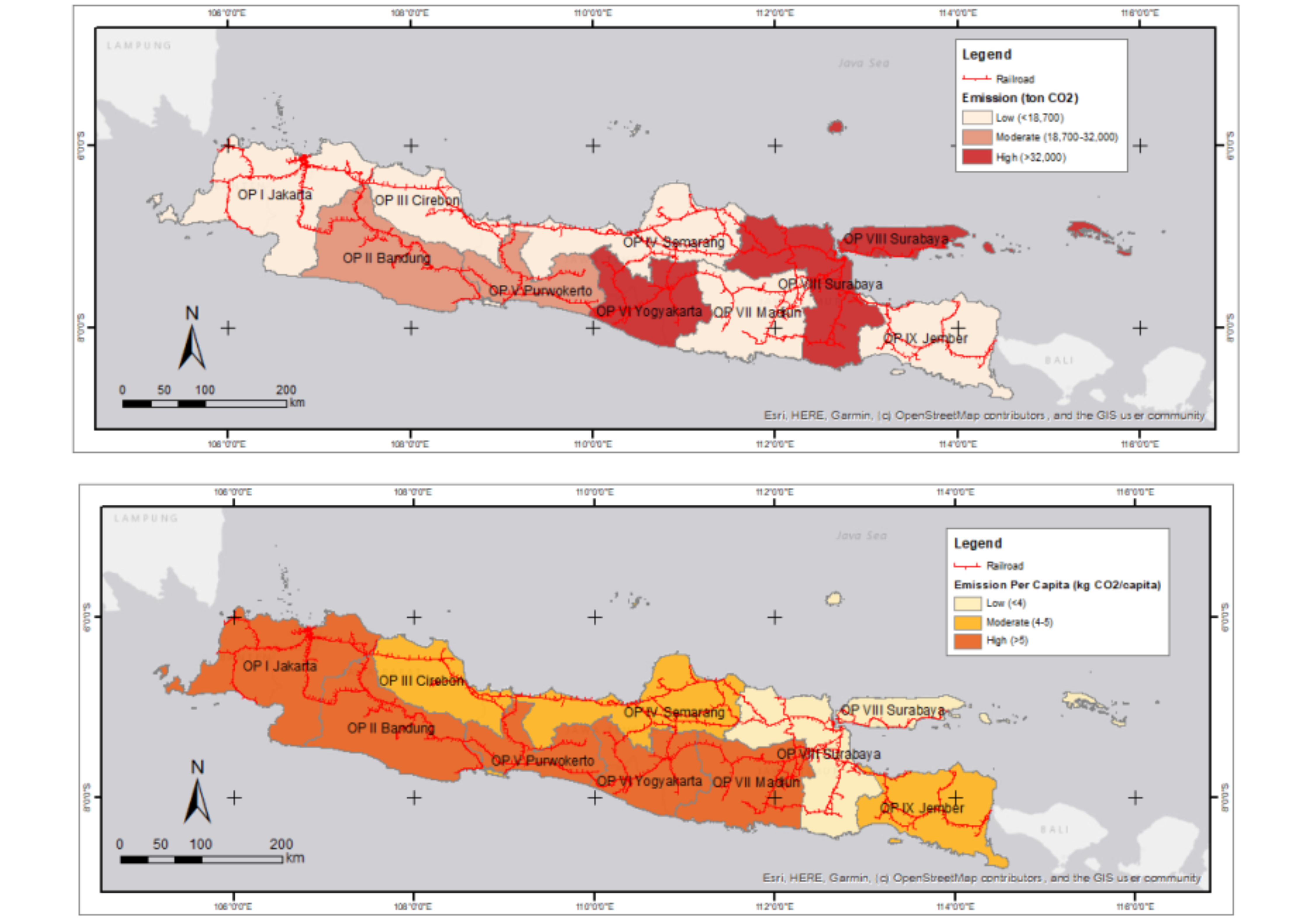
Rail transportations are among the most environmentally friendly modes of transportation due to their low per capita emissions and carbon footprint. This study aims to analyze the total CO2 emissions and per capita emissions of long-distance and local rail transports operating on the island of Java in 2023. Emission calculations were conducted using the IPCC methodology and Sebos’s approach, incorporating factors such as locomotive types, which predominantly use B30 biodiesel and electricity as energy sources. The results are presented in the form of spatial maps for a comprehensive visualization. Key findings indicate that high emissions and per capita emissions are not exclusively associated with rail transports operating in urban areas. Areas with high long-distance train emissions (> 30,000 tons of CO2) are OP VI Yogyakarta and OP VIII Surabaya. High per capita emissions (> 0.005 tons of CO2/capita/year) are OP I Jakarta and OP VII Madiun. Instead, factors such as travel frequency, route length, locomotive type, fuel type, and passenger volume significantly influence emission outcomes. Commuter trains contribute higher emissions than long-distance trains and local non-commuter trains. The highest total emissions were recorded for the Jabodetabek Commuter Line, amounting to 14,545,676 tons of CO2. This line also exhibited the highest per capita emissions due to its high operational frequency and daily service schedule. These findings highlight the need for strategies to optimize rail transports operations and minimize environmental impacts, particularly in high-frequency commuter services.
Ahsan, N., Hewage, K., Razi, F., Hussain, S. A., & Sadiq, R. (2023). A critical review of sustainable rail technologies based on environmental, economic, social, and technical perspectives to achieve net zero emissions. Renewable and Sustainable Energy Reviews, 185, 113621. https://doi.org/10.1016/j.rser.2023.113621
Apriyana, M., Ergantara, R. I., & Nasoetion, P. (2023). Analysis of carbon monoxide emissions due to vehicle congestion in Bandar Lampung City (Case study: Railway crossing gate on Hj. Komarudin street). Jurnal Serambi Engineering, 8(3). https://ojs.serambimekkah.ac.id/index.php/jse/article/view/5512 (Text in Indonesian)
Ćetković, J., Lakić, S., Bogdanović, P., Vujadinović, R., & Žarković, M. (2020). Assessing environmental benefits from investment in railway infrastructure. Polish Journal of Environmental Studies, 29(3). https://doi.org/10.15244/pjoes/109849
Chan, L., McGarey, P., & Sclafani, J. A. (2018). Using large data sets for population-based health research. In Principles and Practice of Clinical Research (pp. 293–302). https://doi.org/10.1016/B978-0-12-849905-4.00020-4
Çolak, E., Baykal, T. M., & Genç, N. (2024). Production of fuel-based carbon footprint distribution map using spatial interpolation methods based on GIS. International Journal of Engineering and Geosciences, 9(1), 99–114. https://doi.org/10.26833/ijeg.1330784
da Fonseca-Soares, D., Eliziário, S. A., Galvincio, J. D., & Ramos-Ridao, A. F. (2024). Greenhouse gas emissions in railways: Systematic review of research progress. Buildings, 14(2). https://doi.org/10.3390/buildings14020539
Damanik, N., Octavia, R. C., & Hakam, D. F. (2024). Powering Indonesia’s future: Reviewing the road to electric vehicles through infrastructure, policy, and economic growth. Energies, 17(24), 6408. https://doi.org/10.3390/en17246408
Data Explorer | Climate Watch. (n.d.). Retrieved August 6, 2025, from https://www.climatewatchdata.org/data-explorer/historical-emissions?historical-emissions-data-sources=cait&historical-emissions-gases=co2&historical-emissions-regions=All%20Selected&historical-emissions-sectors=total-including-lucf%2Ctransportation&page=1&sort_col=country&sort_dir=ASC
Dincer, I., & Zamfirescu, C. (2016). A review of novel energy options for clean rail applications. Journal of Natural Gas Science and Engineering, 28, 461–478. https://doi.org/10.1016/j.jngse.2015.12.007
Dsikowitzky, L., Damar, A., Ferse, S. C. A., Irianto, H. E., Jennerjahn, T. C., Lukas, M. C., Nordhaus, I., Pohlmann, T., Schwarzbauer, J., Sugama, K., & Sumiono, B. (2019). Chapter 21—Java Island, Indonesia. In C. Sheppard (Ed.), World Seas: An Environmental Evaluation (Second Edition) (pp. 459–490). Academic Press. https://doi.org/10.1016/B978-0-08-100853-9.00029-4
Ellram, L. M., & Tate, W. L. (2016). The use of secondary data in purchasing and supply management (P/SM) research. Journal of Purchasing and Supply Management, 22(4), 250–254. https://doi.org/10.1016/j.pursup.2016.08.005
Erahman, Q. F., Reyseliani, N., Purwanto, W. W., & Sudibandriyo, M. (2019). Modeling future energy eemand and CO2 emissions of passenger cars in Indonesia at the provincial level. Energies, 12(16). https://doi.org/10.3390/en12163168
Esters, T., & Marinov, M. (2014). An analysis of the methods used to calculate the emissions of rolling stock in the UK. Transportation Research Part D: Transport and Environment, 33, 1–16. https://doi.org/10.1016/j.trd.2014.08.012
Fajar, R., Sukra, K. F. A., Hidiyanto, F., Octaviani, N. S., & Sugeng, D. A. (2024). A data-driven machine learning approach to identify end-of-Life vehicles in Indonesia. https://catalog.lib.kyushu-u.ac.jp/ja/recordID/7236891/?repository=yes
Farooq, M. A., Meena, N. K., Punetha, P., Nimbalkar, S., & Lam, N. (2024). Experimental and computational analyses of sustainable approaches in railways. Infrastructures, 9(3). https://doi.org/10.3390/infrastructures9030053
Givoni, M., Brand, C., & Watkiss, P. (2009). Are railways climate friendly?. Built Environment, 35(1), 70–86. http://www.jstor.org/stable/23289645
Gkiotsalitis, K., & and Cats, O. (2021). Public transport planning adaption under the COVID-19 pandemic crisis: Literature review of research needs and directions. Transport Reviews, 41(3), 374–392. https://doi.org/10.1080/01441647.2020.1857886
Hidayat, J. A., Sugiarto, B., Anggarani, R., Aisyah, L., Fathurrahman, N. A., Yogi, P., Riza, F. M., & Hasfi, N. M. (2023). Evaluation of quality biodiesel and diesel fuel with high ratio blends. IOP Conference Series: Earth and Environmental Science, 1187(1). https://iopscience.iop.org/article/10.1088/1755-1315/1187/1/012018/meta
Hu, X., Zhang, X., Dong, L., Li, H., He, Z., & Chen, H. (2022). Carbon emission factors identification and measurement model construction for railway construction projects. International Journal of Environmental Research and Public Health, 19(18). https://doi.org/10.3390/ijerph191811379
IEA. (2023). CO2 emissions from rail in the Net Zero Scenario, 2010-2030 – Charts – Data & Statistics. IEA. https://www.iea.org/data-and-statistics/charts/co2-emissions-from-rail-in-the-net-zero-scenario-2010-2030
IPCC. (2006). Chapter 2.3: Mobile Combustion. In 2006 IPCC Guidelines National Greenhouse Gas Inventories (pp. 1–78).
Irawan, M. Z., Putri, M. K., Belgiawan, P. F., & Dwitasari, R. (2017). Analyzing commuters’ behavior on egress trip from railway stations in Yogyakarta, Indonesia. The Open Transportation Journal, 11, 53–66. https://doi.org/10.2174/1874447801711010053
Jansakoo, T., Surapipith, V., & Macatangay, R. (2022). 2019 emission inventory development in the northern part of Thailand. EnvironmentAsia, 15(Special issue), 26–32. https://doi.org/10.14456/ea.2022.19
Kusuma, S. A. P., Permadi, D. A., & Dirgawati, M. (2023). Development of emission reduction measures of trace gas emissions from coal-fired power plants in Indonesia. IOP Conference Series: Earth and Environmental Science, 1239(1). https://doi.org/10.1088/1755-1315/1239/1/012013
Lubis, H. A., Pantas, V. B., & Farda, M. (2019). Demand forecast of Jakarta-Surabaya high speed rail based on stated preference method. Int. J. Technol, 10(2). https://www.academia.edu/download/92219116/2442.pdf
Maskun, Napang, M., Susyanti Nur, S., Achmad, Naswar, Ilmar, A., & Assidiq, H. (2022). The legal framework for climate change on power generating policy in Indonesia. IOP Conference Series: Earth and Environmental Science, 1016(1). https://doi.org/10.1088/1755-1315/1016/1/012045
McFadden, G. (2010). Sustainability and carbon reduction on electrified railways. IET Conference on Railway Traction Systems (RTS 2010), 1–9. https://ieeexplore.ieee.org/abstract/document/5552135/
Ministry of Energy and Mineral Resources. (n.d.). Greenhouse Gas Emission Factor Value of Electricity System in 2019. Retrieved December 5, 2024, from https://gatrik.esdm.go.id/assets/uploads/download_index/files/96d7c-nilai-fe-grk-sistem-ketenagalistrikan-tahun-2019.pdf (Text in Indonesian)
Ministry of Energy and Mineral Resources. (2020). Energy Sector Greenhouse Gas Emissions Inventory 2020. Indonesian Energy and Mineral Resources Data and Information Technology Center. https://www.esdm.go.id/assets/media/content/content-inventarisasi-emisi-gas-rumah-kaca-sektor-energi-tahun-2020.pdf (Text in Indonesian)
Nugroho, S. B., Fujiwara, A., & Zhang, J. (2012). Comparison analysis of idle emissions measurement program in Jabodetabek, Indonesia. 238–255. https://doi.org/10.1061/41123(383)21
Pamudji, T., Kencono, A. W., Mujiyanto, S., & Supriadi. (2015). Energy Sector GHG Emissions Inventory Data. Indonesian Energy and Mineral Resources Data and Information Technology Center. https://www.esdm.go.id/assets/media/content/KEI-Data_Inventory_Emisi_GRK_Sektor_Energi.pdf (Text in Indonesian)
Putra, A. S., Garniwa, I., Arilanggaaji, E. S., & Pradana, S. S. (2021). A study on carbon cap and trade effect to cost of electricity in accordance with the Merit Order of 300-400 MW coal power plants. IOP Conference Series: Earth and Environmental Science, 880(1). https://doi.org/10.1088/1755-1315/880/1/012049
Putri, R. F., Cherlys, C., Fachrizal, H. R., Raihan, H. S., Putri, N., Nugraha, H. A., Istiqomah, E. W., Islami, I. N., Hasanah, D., & Baihaqy, S. B. (2023). Improvement of the feasibility of developing transit-oriented development for Yogyakarta commuter line stations. E3S Web of Conferences, 468. https://www.e3s-conferences.org/articles/e3sconf/abs/2023/105/e3sconf_icstugm2023_03005/e3sconf_icstugm2023_03005.html
Riza, Ramanel, T. A., Nurrohim, A., Prawitasari, A., & Putri, A. I. (2023). Energy demand and emission analysis of train electrification in Java Island. Proceedings of 2023 4th International Conference on High Voltage Engineering and Power Systems, ICHVEPS 2023, 488–492. https://doi.org/10.1109/ICHVEPS58902.2023.10257416
Rizkia, A., & Haryatiningsih, R. (2023). Analysis of factors which influence educated unemployment in large cities on Java Island. Jurnal Riset Ilmu Ekonomi Dan Bisnis, 125–132. https://doi.org/10.29313/jrieb.v3i2.2821 (Text in Indonesian)
Roy, S., Debnath, P., Vulevic, A., Roy, S., Debnath, P., Vulevic, A., & Mitra, S. (2023). Incorporating climate change resilience in India’s railway infrastructure: Challenges and potential. Mechatronics and Intelligent Transportation Systems, 2(2). https://doi.org/10.56578/mits020205
Sebos, I. (2022). Fossil fraction of CO2 emissions of biofuels. Carbon Management, 13(1), 154–163. https://doi.org/10.1080/17583004.2022.2046173
U.S. Global Change Research Program. (n.d.). Global Climate Change | Global Climate Change Impacts in the United States 2009 Report Legacy site. Retrieved November 19, 2024, from https://nca2009.globalchange.gov/global-climate-change/index.html
Watson, I., Ali, A., & Bayyati, A. (2018). An investigation into the benefits and constraints of shifting freight traffic from roads onto high-speed railways. WIT Transactions on The Built Environment, 181, 541–551. https://doi.org/10.2495/CR180481
Wibisono, M. S. (2011). Prediction of the amount of CO2 emissions from railway activities specifically for railways. Lembaran Publikasi Minyak Dan Gas Bumi, 45(3), 211–222. https://doi.org/10.29017/LPMGB.45.3.701 (Text in Indonesian)
Wijayanto, Y., Fauzi, A., & Rustiadi, E. (2022). Development of sustainable urban railway service model using micmac-mactor: A case study in Jabodetabek mega-region Indonesia. International Journal of Sustainable Development & Planning, 17(1). https://doi.org/10.18280/ijsdp.170113
Wiloso, E. I., Wiloso, A. R., Setiawan, A. A. R., Jupesta, J., Fang, K., Heijungs, R., & Faturay, F. (2024). Indonesia’s contribution to global carbon flows: Which sectors are most responsible for the emissions embodied in trade? Sustainable Production and Consumption, 48, 157–168. https://doi.org/10.1016/j.spc.2024.05.005
Xu, X., Kent, S., & Schmid, F. (2021). Carbon-reduction potential of electrification on China’s railway transport: An analysis of three possible future scenarios. Proceedings of the Institution of Mechanical Engineers, Part F: Journal of Rail and Rapid Transit, 235(2), 226–235. https://doi.org/10.1177/0954409720921989
Yang, G., & Jia, L. (2022). Estimation of carbon emissions from tourism transport and analysis of its influencing factors in Dunhuang. Sustainability, 14(21). https://doi.org/10.3390/su142114323
Yunani, A., Sakti, M. R. P., Pradana, M., & Putra, A. (2024). Facilities and service quality’s impacts on satisfaction: A case of Indonesian train service customers. WSEAS Transactions on Business and Economics, 21, 2091–2099. https://doi.org/10.37394/23207.2024.21.171
Żak, J., Jacyna-Gołda, I., Merkisz-Guranowska, A., Lewczuk, K., Kłodawski, M., Pyza, D., Szczepański, E., & Wasiak, M. (2014). The role of railway transport in designing a proecological transport system. WIT Transactions on The Built Environment, 155, 15–25. https://doi.org/10.2495/CRS140021
Zimakowska-Laskowska, M., & Laskowski, P. (2022). Emission from internal combustion engines and battery electric vehicles: Case study for Poland. Atmosphere, 13(3). https://doi.org/10.3390/atmos13030401
Copyright (c) 2025 Emilya Nurjani, Bernadetta Indri Dwi Astuti, Anugrah Jorgi Firmansyah, Annisa Ayu Fawzia, Andung Bayu Sekaranom, Utia Suarma

This work is licensed under a Creative Commons Attribution 4.0 International License.