
Effect of Bolting on the Face of a Crushed Soft Rock Tunnel
Abstract
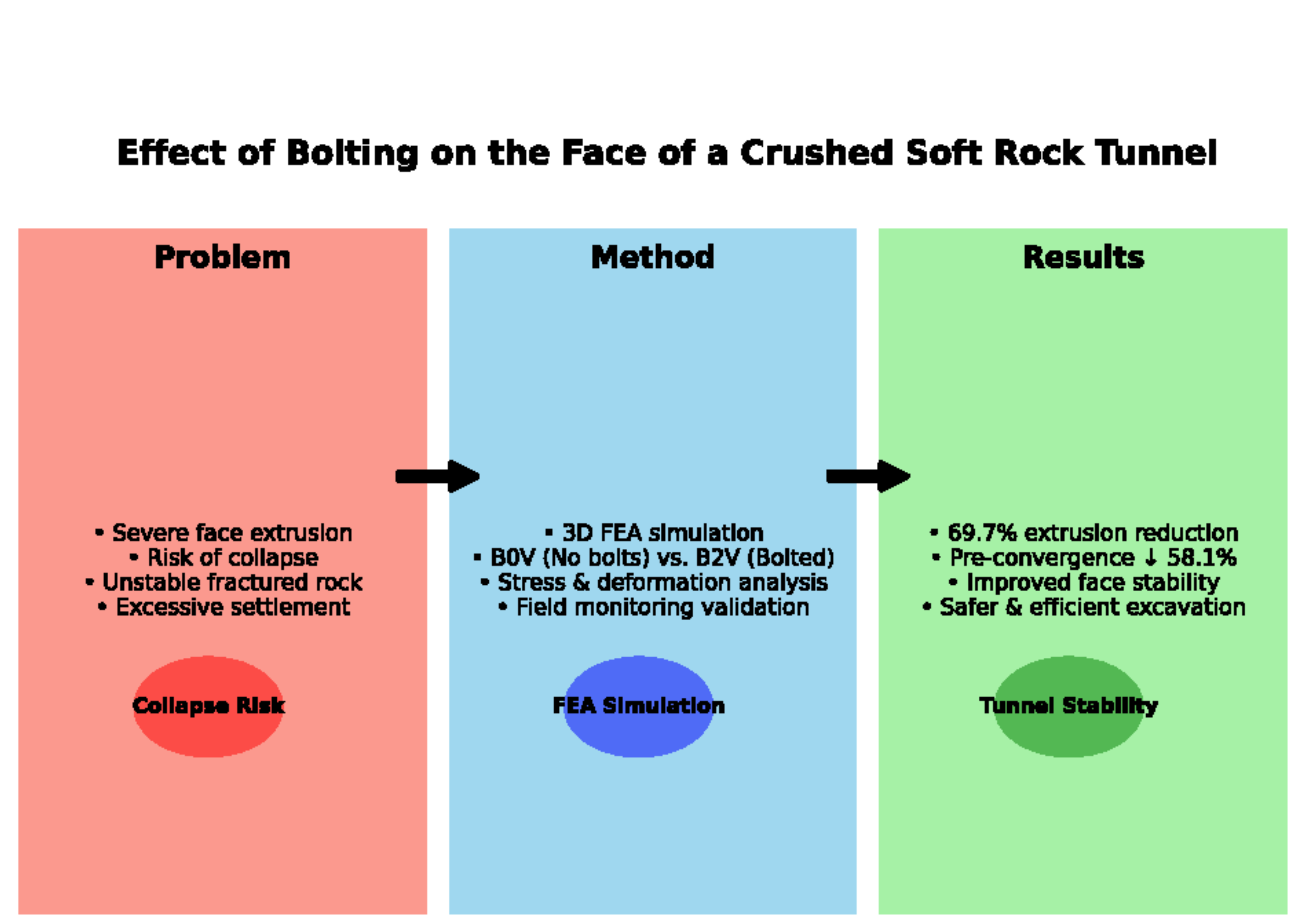
To study the large deformation of surrounding rock during the passage of a soft rock tunnel through a fractured zone, a numerical simulation analysis was conducted on a specific tunnel section. The investigation focused on the extrusion deformation at the face, settlement deformation of the arch roof, and stress in the surrounding rock, considering the two support types used in the New Austrian Tunneling Method. The results show that the use of anchor bolts can reduce the pre-convergence deformation by 58.1% and its proportion by 23.5%, significantly increasing the minimum principal stress at the palm surface, maintaining the advanced core soil in the three-way stress state, and enhancing the longitudinal arch effect. These factors enhance the overall stability of the tunnel. Field monitoring data reveal that the convergence deformation of each part of the tunnel remains within a reasonable range, demonstrating the effectiveness of the face bolt in controlling deformation and adjusting the surrounding rock stress in the stratum, characterized by low quality and high degree of crushing.
How to Cite
Lei Chen, Yuxuan Cao, Tongkai Wen, Haobin Zhang, Zhanping Song (2025). Effect of Bolting on the Face of a Crushed Soft Rock Tunnel . Journal of Engineering and Technological Sciences, Vol. 58 No. 1 (2026): Vol. 58 No. 1(2026): February , 47-57. https://doi.org/10.5614/j.eng.technol.sci.2026.58.1.4
Metrics
References
Alejano, L. R., Rodríguez-Dono, A., & Veiga, M. (2012). Plastic radii and longitudinal deformation profiles of tunnels excavated in strain-softening rock masses. Tunnelling and Underground Space Technology, 30, 169–182.
Chambon, P., & Corte, J. F. (1994). Shallow tunnels in cohesionless soil: Stability of tunnel face. Journal of geotechnical Engineering, 120(07), 1148–1165.
Cui, R.R., Yang, Q.X., & Jiang, Y.J. (2015). Study on reinforcement parameters of fiber glass anchor bar at soft-rock tunnel face. Railway Standard Design, 59(11),79–83.
Tan, S., Ding, W.Q., Liu, C., Liu, T., & Guo, H.Y. (2017). Analysis of deformation of Yezhushan highway tunnel construction based on analysis of controlled deformation in rocks and soils (ADECO-RS). Tunnel Construction, 37(05), 593–599.
Kamata, H., & Mashimo, H. (2003). Centrifuge model test of tunnel face reinforcement by bolting. Tunnelling and Underground Space Technology, 18(2-3), 205–212.
Li, B., Hong, Y., Gao, B., Qi, T.Y., Wang, Z.Z. & Zhou, J.M. (2015). Numerical parametric study on stability and deformation of tunnel face reinforced with face bolts. Tunnelling and Underground Space Technology, 47, 73–80.
Lunardi, P., (2008). Design and construction of tunnels: Analysis of controlled deformations in rock and soils (ADECO-RS), Berlin, Springer.
Mei, Z.R., & Chen, T. (2008). Research on application of full-face pre-reinforcing technology in high speed railway tunnel. Tunnel Construction, 28(05), 542–547.
Mollon, G., Dias, D., & Soubra A H. (2010). Face stability analysis of circular tunnels driven by a pressurized shield. Journal Of Geotechnical And Geoenvironmental Engineering, 136(01), 215–229.
Oke, J., Vlachopoulos, N., & Diederichs, M. (2018). Improvement to the convergence-confinement method: Inclusion of support installation proximity and stiffness. Rock Mechanics And Rock Engineering, 51, 1495–1519.
Peila, D. (1994). A theoretical study of reinforcement influence on the stability of a tunnel face. Geotechnical & Geological Engineering, 12, 145-168.
Song, Z.P., Pei, J.F., Pan, H.W., Sun, Z., & Ding, L.B. (2022). Analysis on the support effect of advance large pipe umbrella at portal section of shallow tunnel under unsymmetrical load. Modern Tunnel Technology, 59(06), 86–96.
Song, Z.P., Tian, X.X., Zhou, G.N., & Li, W.W. (2020). Theoretical analysis of mechanical behavior of advance pre-support of pipe-roof in tunnel. China Journal of Highways, 33(04), 89–98.
Wang, K.Z., Zhu, H.B., Kong, L.M., Liang, Q.D., & Zhang, H.J. (2017). An application study on the ADECO-RS approach in the construction of Yezhu mountain tunnel. Journal of Zhejiang University of Technology, 45(03), 237–242.
Ye, F., Song, J., Tang, Y.S., Lin, J.F., & Jia, T. (2017). Research on extrusion displacement of face and advanced core in tunnel with weak surrounding rock. Geotechnical Mechanics, 38(S1), 323–330.
Yoo, C. (2002). Finite-element analysis of tunnel face reinforced by longitudinal pipes. Computers and Geotechnics, 29(01), 73–94.
Zhang, M.Q., Huang, H.J., Miao, D.H., & Tian, S.M. (2008). Analyses of the sloughing of tunnel portal of Yichang-Wanzhou railway and its treatment. Journal of Railway Engineering, 25(2), 54–60.
License
Copyright (c) 2025 by Authors

This work is licensed under a Creative Commons Attribution 4.0 International License.
Downloads
Date Log
- Submitted
- January 15, 2025
- Accepted
- October 28, 2025
- Published
- December 10, 2025
Keywords
- face bolt
- novelty method
- palm surface extrusion deformation
- pre-convergence deformation
- surrounding rock stress


