Analysis of Mechanical Properties and Acoustic-Thermal Response Characteristics of Water-Soaked Gabbro
Downloads
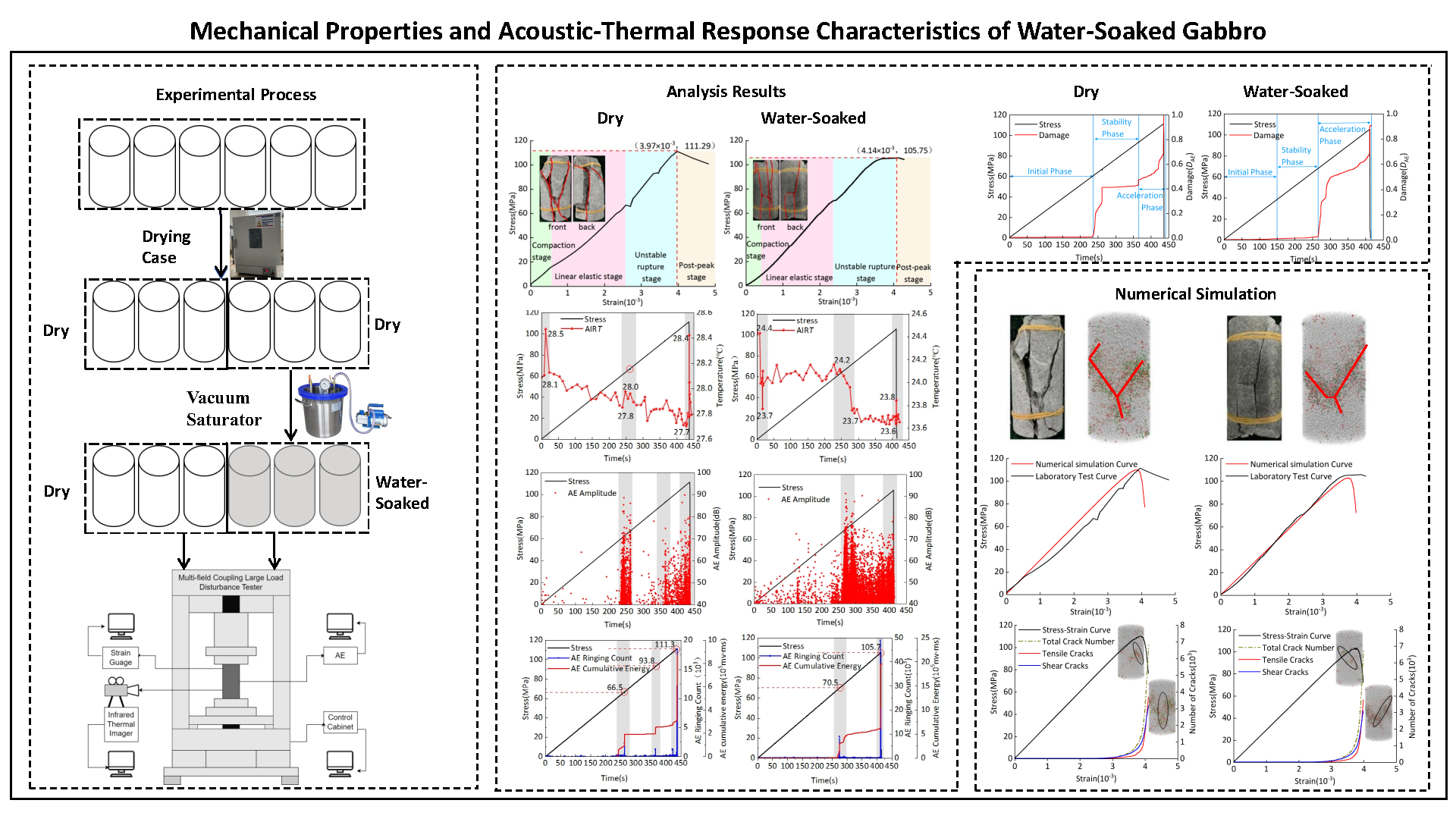
With the national strategy being implemented and taking root in the infrastructure sector, the increased of water erosion in rock formations during railway construction has risen significantly, posing a considerable risk to the stability and structural integrity of engineering rock formations. Consequently, there is a critical need to investigate how water influences the mechanical properties of gabbro. Uniaxial compression experiments were performed on both arid and water-soaked gabbro pieces, simultaneously monitoring the characteristics of acoustic emission (AE) and infrared radiation (IR) response. The Particle Flow Code (PFC) was utilized to examine the microscopic processes of crack propagation, coalescence, and damage progression in the rock pieces. Observations show that water considerably impacts the mechanical characteristics of gabbro. In comparison to arid pieces, the peak strength of water-soaked pieces showed a reduction of 4.98%, while the elastic modulus was diminished by 16.5%. The failure behavior of the pieces shifted progressively from tensile splitting in the arid condition to tensile-shear failure. Both arid and water-soaked pieces displayed pre-shock-main shock patterns in their AE parameters. By creating a damage variable based on cumulative AE ring counts, the damage evolution of the pieces was categorized into three phases: incipient damage, steady damage, and expedited damage phases. Throughout loading and fracturing, the AIRT (average infrared radiation temperature) curve exhibited a downward trend, followed by a sharp rise, featuring a "V"-shaped turn prior to piece failure. The evolution of AIRT in water-soaked pieces showed strong alignment with stress variations. Numerical simulations using PFC revealed that the quantity of shear cracks in water-soaked pieces increased, constituting a larger share of the total cracks in contrast to arid pieces. After loading, water-soaked pieces generated more strong force chains, with the load borne by bonds gradually increasing, making them more susceptible to failure.
Cao, K., Ma, L., Wu, Y., Spearing, A. J. S. (Sam), Khan, Naseer. M., Hussain, S., & Ur Rehman, F. (2022). Statistical damage model for dry and saturated rock under uniaxial loading based on infrared radiation for possible stress prediction. Engineering Fracture Mechanics, 260, 108134. https://doi.org/10.1016/j.engfracmech.2021.108134
Chen G, Li T, Wang W, Zhu Z., Chen Z., & Tong O. (2024). Weakening effects of the presence of water on the brittleness of hard sandstone. Bulletin of Engineering Geology and the Environment, 78(3), 1471-1483. https://doi.org/10.1007/s10064-017-1184-3
Cheng, Y., Song, Z., Liu, Z., Tian, X., Qian, W., Lu, X., & Yang, T. (2024). Micro-cracking morphology and dynamic fracturing mechanism of natural brittle sandstone containing layer structure under compression. Construction and Building Materials, 425, 136051. https://doi.org/10.1016/j.conbuildmat.2024.136051
Cheng, Y., Song, Z., Yang, T., Han, J., Wang, B., & Zhang, Z. (2022). Investigating the aging damage evolution characteristics of layered hard sandstone using digital image correlation. Construction and Building Materials, 353, 128838. https://doi.org/10.1016/j.conbuildmat.2022.128838
Fan, S., Song, Z., Xu, T., & Zhang, Y. (2022). Investigation of the microstructure damage and mechanical properties evolution of limestone subjected to high-pressure water. Construction and Building Materials, 316, 125871. https://doi.org/10.1016/j.conbuildmat.2021.125871
Ge, Z., & Sun, Q. (2021). Acoustic emission characteristics of gabbro after microwave heating. International Journal of Rock Mechanics and Mining Sciences, 138, 104616. https://doi.org/10.1016/j.ijrmms.2021.104616
Huang S, He Y, Liu X, & Xin Z. (2021). Experimental investigation of the influence of dry-wet, freeze-thaw and water immersion treatments on the mechanical strength of the clay-bearing green sandstone. International Journal of Rock Mechanics and Mining Sciences, 138: 104613. https://doi.org/10.1016/j.ijrmms.2021.104613
Huang S., Yu S. (2022). Effect of water saturation on the strength of sandstones: Experimental investigation and statistical analysis. Bulletin of Engineering Geology and the Environment, 81(8), 323. https://doi.org/10.1007/s10064-022-02822-9
Jia H, Wang T, Xiang W, Tan L, Shen Y, Yang G. (2018). Influence of water content on the physical and mechanical behaviour of argillaceous siltstone and some microscopic explanations. Chinese Journal of Rock Mechanics and Engineering, 37(7), 1618-1628. 10.13722/j.cnki.jrme.2017.1037
Li W, Cao J, Liu Z, Ma L., Li S., Liu Y., Yue L., & Wang J. (2025). Numerical Simulation of Water-Sand Flow Characteristics in Fractured and Porous Media Within Coal Mining Areas. Mine Water and the Environment, 44, 338-351. https://doi.org/10.1007/s10230-025-01047-y
Liu, X., Jia, H., Wang, C., Han, L., & Sun, Q. (2024). Dynamic behavior of fractured gabbro treated by high temperatures. Heliyon, 10(19), e38934. https://doi.org/10.1016/j.heliyon.2024.e38934
Liu, X., Liang, Z., Zhang, Y., Liang, P., & Tian, B. (2018). Experimental study on the monitoring of rockburst in tunnels under dry and saturated conditions using AE and infrared monitoring. Tunnelling and Underground Space Technology, 82, 517–528. https://doi.org/10.1016/j.tust.2018.08.011
Ma, L., Muhammad Khan, N., Feroze, T., Sazid, M., Cao, K., Hussain, S., Gao, Q., Alarifi, S. S., & Wang, H. (2024). Prediction of rock loading phases using average IR temperature under shear and uniaxial loading. Infrared Physics & Technology, 136, 105084. https://doi.org/10.1016/j.infrared.2023.105084
Muhammad Khan, N., Ma, L., Feroze, T., Wang, D., Cao, K., Gao, Q., Wang, H., Hussain, S., Zhang, Z., & Alarifi, S. S. (2023). Investigating average IR temperature characteristics during shear and tensile cracks in sandstone under different water contents. Infrared Physics & Technology, 135, 104968. https://doi.org/10.1016/j.infrared.2023.104968
Song, Z., Xu, X., Tian, X., Wang, T., Song, W., & Cheng, Y. (2024). Study on acoustic emission fracture response and constitutive model of layered sandstone. Geomechanics and Engineering, 39(2), 157–170. https://doi.org/10.12989/gae.2024.39.2.173
Wu Z, Zhang C. (1996). Investigayion of Rock Damage Model and its Mechanical Behaviour. Chinese Journal of Rock Mechanics and Engineering, 1, 55-61.
Xiao, F., He, J., Liu, Z., Shen, Z., & Liu, G. (2019). Analysis on warning signs of damage of coal pieces with different water contents and relevant damage evolution based on AE and infrared characterization. Infrared Physics & Technology, 97, 287–299. https://doi.org/10.1016/j.infrared.2019.01.007
Xu R., Hu Y., Yan Z., Zhao Y., & Li Z. (2024). Experimental investigation on the effect of water saturation on the failure mechanism and acoustic emission characteristics of sandstone. International Journal of Geomechanics, 24(6), 04024102. https://doi.org/10.1061/IJGNAI.GMENG-8526
Yu Y., Guo W., Liu J., Wu Z., & Xu D. (2025). Experimental-simulation analysis on mechanical degradation and energy evolution characteristics of sandstone under water-rock coupling effects. Scientific Report, 15(1), 18713. https://doi.org/10.1038/s41598-025-02557-z
Zhang, H., Lu, K., Zhang, W., Zhou, Y., Yang, G., Li, J., & Huang, C. (2023). A comprehensive study of damage characteristics and AE response mechanism of sandstone with different water contents. Engineering Fracture Mechanics, 288, 109392. https://doi.org/10.1016/j.engfracmech.2023.109392
Zhao K., Yang D., Zeng P., Huang Z., & Teng T. (2021). Effect of water content on the failure pattern and acoustic emission characteristics of red sandstone. International Journal of Rock Mechanics and Mining Sciences, 142, 104709. https://doi.org/10.1016/j.ijrmms.2021.104709
Zhou, S., Sun, Q., Zhang, H., Meng, H., Gao, Q., & Zhou, Y. (2023). Elemental dissolution characteristics of granite and gabbro under high-temperature water-rock interactions. Science of The Total Environment, 897, 165455. https://doi.org/10.1016/j.scitotenv.2023.165455
Zhu, J., Chen, X., Chen, J., Chen, H., & Pak, R. Y. S. (2024). Effect of cyclic loading level on mechanical response and microcracking behavior of soaked sandstones: Correlation with water weakening phenomenon. Engineering Geology, 340, 107667. https://doi.org/10.1016/j.enggeo.2024.107667
Copyright (c) 2026 Journal of Engineering and Technological Sciences

This work is licensed under a Creative Commons Attribution-NonCommercial-NoDerivatives 4.0 International License.