
An Integrated Sliding Mode and Lyapunov-based Control Approach for Robust Quadcopter Trajectory Tracking
Abstract
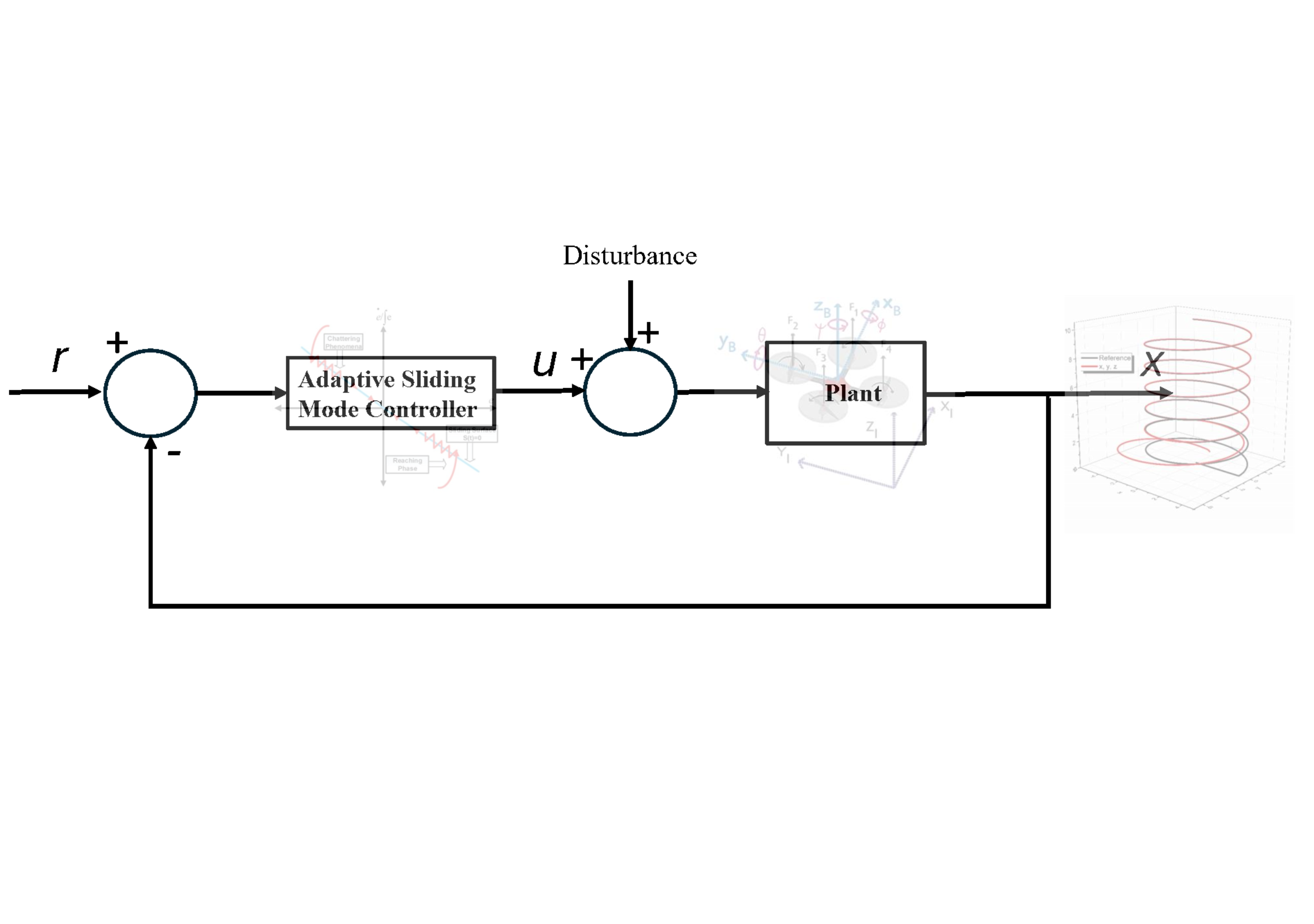
This paper addresses the challenges of low tracking accuracy in the attitude and position control of quadrotor unmanned aerial vehicles (UAVs). To overcome these issues, a nonlinear hybrid control strategy is proposed by combining adaptive sliding mode control with Lyapunov theory. Accounting for the nonlinearities associated with the coupling among the UAV degrees of freedom, unlike simplified control-oriented models, the proposed strategy is designed to enhance trajectory tracking performance while improving control flexibility and robustness against external disturbances. The proposed strategy expands the validity of the control-oriented model compared with the linear controllers. Moreover, the inherent robustness built into the paradigm of the sliding mode controller improves the robustness against external disturbances as well as uncaptured dynamics within the modeling process. The stability of the system is rigorously analysed using the Lyapunov stability theory, and the results confirm the stability of the proposed controller under various conditions. Extensive simulation tests are conducted to verify the effectiveness and feasibility of the control strategy. The simulation results demonstrate that the proposed method significantly improves tracking accuracy in both attitude and position control, providing a robust and reliable solution for quadrotor UAVs. This hybrid approach ensures precise trajectory tracking while maintaining stability, making it a promising technique for advanced UAV applications.
How to Cite
Mahdi Al Quran, Ahmad Al-Sheyyab , Mustafa Rawashdeh, Abdel rahman Alheyasat (2026). An Integrated Sliding Mode and Lyapunov-based Control Approach for Robust Quadcopter Trajectory Tracking. Journal of Engineering and Technological Sciences, Vol. 58 No. 2 (2026): Vol. 58 No. 2 (2026): April, 257-273. https://doi.org/10.5614/j.eng.technol.sci.2026.58.2.8
Metrics
References
Abdulkareem, A., Oguntosin, V., Popoola, O. M., & Idowu, A. A. (2022). Modeling and nonlinear control of a quadcopter for stabilization and trajectory tracking. Journal of Engineering, 2022(1), 2449901.
Abera, N., Abdissa, C., Lemma, L. (2024). An improved nonsingular adaptive super twisting sliding mode controller for quadcopter. Plos One, 19(10), e0309098. https://doi.org/10.1371/journal.pone.0309098.
Aldhaifallah, M., Al-Qahtani, F.M., El ferik, S., & Saif, A., (2023). Quadrotor Robust Fractional-Order Sliding Mode Control in Unmanned Aerial Vehicles for Eliminating External Disturbances. Aerospace. 10(8), 665. https://doi.org/10.3390/aerospace10080665.
Ali, R., Peng, Y., Iqbal, M. T., Ul Amin, R., Zahid, O., & Khan, O. I. (2019). Adaptive backstepping sliding mode control of coaxial octorotor unmanned aerial vehicle. IEEE Access, 7, 27526–27534. https://doi.org/10.1109/ACCESS.2019.2901366
Bayisa, A., & Li-Hui, G. (2019). Controlling quadcopter altitude using PID-control system. International Journal of Engineering Research & Technology (IJERT), 8(12), 195–199. https://doi.org/10.17577/IJERTV8IS120118
Cardenas, P., & De Barros, E. A. (2020). Estimation of AUV hydrodynamic coefficients using analytical and system identification approaches. IEEE Journal of Oceanic Engineering, 45(4), 1157–1176. https://doi.org/10.1109/JOE.2019.2930421
Elagib, R., & Karaarslan, A. (2023). Sliding mode control-based modeling and simulation of a quadcopter. Journal of Engineering Research and Reports, 24(3), 32–41. https://doi.org/10.9734/jerr/2023/v24i3806
El Ferik, S. E., Fahad M. Al-Qahtani, F., Saif, A. ,& Al-Dhaifallah M. (2023). Robust FOSMC of quadrotor in the presence of slung load. ISA Transactions, 139, 106–121. https://doi.org/10.1016/j.isatra.2023.04.023
Gedefaw, E., Abdissa, C., & Lemma, L. (2024). An improved trajectory tracking control of quadcopter using a novel sliding mode control with fuzzy PID surface. PLOS ONE, 9(11), e0308997. https://doi.org/10.1371/journal.pone.0308997
Gedefaw, E., Abera, N., & Abdissa, C. (2025). A review of modeling and control techniques for unmanned aerial vehicles. Engineering Reports, 7(6), e70215. https://doi.org/10.1002/eng2.70215
Huang, J., Zhang, T., & Sun, J.-Q. (2019). Data-driven backstepping control of underactuated mechanical systems. Journal of Dynamic Systems, Measurement, and Control, 141(9), 091003. https://doi.org/10.1115/1.4043154
Huo, X., Huo, M., & Karimi, H. R. (2014). Attitude stabilization control of a quadrotor UAV by using backstepping approach. Mathematical Problems in Engineering, 2014, 1–9. https://doi.org/10.1155/2014/749803
Jiang, F., Pourpanah, F., & Hao, Q. (2019). Design, implementation, and evaluation of a neural-network-based quadcopter UAV system. IEEE Transactions on Industrial Electronics, 67(3), 2076–2085. https://doi.org/10.1109/TIE.2019.2905808
Jing, Y., Mirza, A., Sipahi, R., & Lorenzo, J. (2023). Sliding mode controller with disturbance observer for quadcopters: Experiments with dynamic disturbances and in turbulent indoor space. Drones, 7(5), 328. https://doi.org/10.3390/drones7050328
Jinkun, L. (2011). Sliding mode variable structure control. Springer.
Kotch, W., Mancuso, R., West, R., & Bestavros, A. (2019). Reinforcement learning for UAV attitude control. ACM Transactions on Cyber-Physical Systems, 3(2), 1–21. https://doi.org/10.1145/3301273
Labbadi, M., & Cherkaoui, M. (2019). Robust adaptive backstepping fast terminal sliding mode controller for uncertain quadrotor UAV. Aerospace Science and Technology, 93, 105306. https://doi.org/10.1016/j.ast.2019.105306
Li, J., & Zhang, D. (2017). Backstepping and sliding-mode techniques applied to distributed secondary control of islanded microgrids. Asian Journal of Control, 20(3), 1288–1295. https://doi.org/10.1002/asjc.1629
Li, Z., Cui, G., Li, S., Zhang, N., Tian, Y. & Shang X. (2020). Lane keeping control based on model predictive control under region of interest prediction considering vehicle motion states. International Journal of Automotive Technology, 21(4), 1001–1011. https://doi.org/10.1007/s12239-020-0095-7
Masse, C., Gougeon, O., Nguyen, D.-T., & Saussie, D. (2018). Modeling and control of a quadcopter flying in a wind field: A comparison between LQR and structured H-infinity control techniques. In 2018 International Conference on Unmanned Aircraft Systems (ICUAS) (pp. 1408–1417). https://doi.org/10.1109/ICUAS.2018.8453402
Metekia, E., Asfaw, W., Abdissa, C., & Negash, L. (2025). Control of a fixed-wing unmanned aerial vehicle using a robust fractional order controller. Scientific Reports, 15, 19954. https://doi.org/10.1038/s41598-025-03552-0
Mofid, O., Mobayen, S., & Wong, W.K. (2020). Adaptive terminal sliding mode control for attitude and position tracking control of quadrotor UAVs in the existence of external disturbance. IEEE Access, 9, 3428–3440. https://doi.org/10.1109/ACCESS.2020.3047659
Mohammed, T., Asfaw, W., Abdissa, C., & Lemma, L. (2025). Constrained robust adaptive control design for fixed-wing UAV under parameter uncertainties and external disturbances. Engineering Research Express, 7(2). https://doi.org/10.1088/2631-8695/add643
Mousa, M. H., & Hussein, M. K. (2022). Efficient UAV-based mobile edge computing using differential evolution and ant colony optimization. PeerJ Computer Science, 8, e870. https://doi.org/10.7717/peerj-cs.870
Muliadi, J., & Kusumoputro, B. (2018). Neural network control system of UAV altitude dynamics and its comparison with the PID control system. Journal of Advanced Transportation, 2018, 1–18. https://doi.org/10.1155/2018/3823201
Nguyen, N., & Pitakwachara, P. (2024). Integral terminal sliding mode fault-tolerant control of quadcopter UAV systems. Scientific Reports, 14, 10786. https://doi.org/10.1038/s41598-024-61273-2
Niu, K., Yang, D., Chen, X. Wang, R.& Yu, J. (2022). Adaptive trajectory tracking algorithm of a quadrotor with sliding mode control and multilayer neural network. Complexity, 2022(1). https://doi.org/10.1155/2022/1457532
Pang, H., Zhang, X., & Xu, Z. (2018). Adaptive backstepping-based tracking control design for nonlinear active suspension systems with parameter uncertainties and safety constraints. ISA Transactions, 88, 23–36. https://doi.org/10.1016/j.isatra.2018.11.047
Podlubny, I. (1999). Fractional-order systems and PI/sup/spl lambda//D/sup/spl mu/-controllers. IEEE Transactions on Automatic Control, 44(1), 208–214. https://doi.org/10.1109/9.739144
Polvara, R., Patacchiola, M., Sharma, S., Wan, J., Manning, A., & Sutton, R. (2018). Toward end-to-end control for UAV autonomous landing via deep reinforcement learning. In 2018 International Conference on Unmanned Aircraft Systems (ICUAS) (pp. 115–123). https://doi.org/10.1109/ICUAS.2018.8453449
Rao, J., Li, B., Zhang, Z., & Chen, D. (2022). Position control of quadrotor UAV based on cascade fuzzy neural network. Energies, 15(5), 1763. https://doi.org/10.3390/en15051763
Sabatino, F. (2015). Quadrotor control: Modeling, nonlinear control design, and simulation [Master’s thesis]. KTH Royal Institute of Technology. http://kth.diva-portal.org/smash/record.jsf?pid=diva2:860649
Saif, A. (2017). Feedback linearization control of quadrotor with tiltable rotors under wind gusts. International Journal of Advanced and Applied Science, 4(10), 150–159. https://doi.org/10.21833/ijaas.2017.010.021
Sari, D. P., & Darwito, P. A. (2024). Control system for quadcopter UAV based SMC-RBFNN with external disturbance. E3S Web of Conferences, 482, 03004. https://doi.org/10.1051/e3sconf/202448203004
Yashede, F., Madebo, N., Abdissa, C., & Lemma, L. (2025). Trajectory tracking of fixed-wing UAV using ANFIS-based sliding mode controller. IEEE Access, 13, 61986–62003. https://doi.org/10.1109/ACCESS.2025.3557472
Yang, Y., & Xue, D. (2017). Grey differential system and control problems based on the fractional calculus. In 2017 34th Chinese Control and Decision Conference (CCDC) (pp. 129–134). https://doi.org/10.1109/CCDC.2017.7978079
Zhang, Y., Zhuang, B., Ma, C., & Zhang C. (2023). Backstepping sliding mode control algorithm for unmanned aerial vehicles based on fractional-order theory. Journal of Robotics, 2023, 1–11. https://doi.org/10.1155/2023/1388072
Zinober, A. S. I. (2005). An introduction to sliding mode variable structure control. In Springer eBooks (pp. 1–22). https://doi.org/10.1007/bfb0033676
License
Copyright (c) 2026 by Authors

This work is licensed under a Creative Commons Attribution 4.0 International License.
Downloads
Date Log
- Submitted
- April 7, 2025
- Accepted
- December 1, 2025
- Published
- January 15, 2026
Keywords
- external disturbances
- nonlinear control
- quadrotor
- sliding mode control
- UAV


