
Flash Emissions from Acrylonitrile Storage Tank and Their Impact on Ambient Air Quality
Abstract
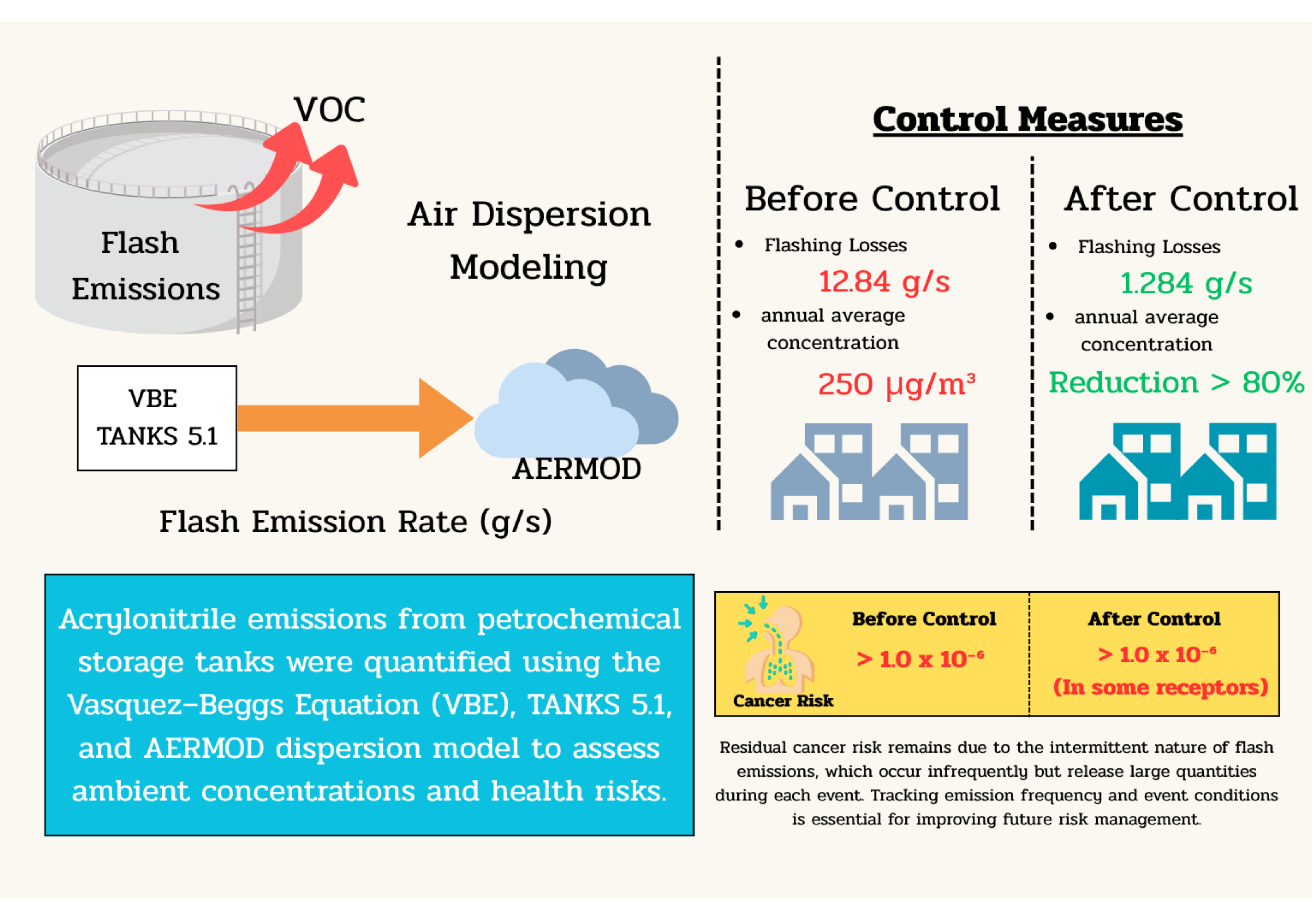
Flash emissions from chemical storage tanks are a major source of volatile organic compounds (VOCs), accounting for over 90% of total VOC releases during storage. This study evaluated acrylonitrile emissions at a petrochemical facility using the Vasquez-Beggs Equation (VBE), TANKS 5.1, and the AERMOD dispersion model. Under midrange conditions, flashing losses were estimated at 12.84 g/s, with peak emissions reaching 18.17 g/s under high-pressure, low-temperature conditions. In comparison, breathing and working losses contributed only 0.0986 g/s and 0.2776 g/s, respectively, in uncontrolled scenarios. Air dispersion modeling indicated acrylonitrile concentrations exceeding 800 µg/m³ for 24-hour exposure and surpassing 250 µg/m³ in annual averages near sensitive receptors under uncontrolled conditions. Implementing a 90% efficient emission control system reduced flashing losses to 1.284 g/s, effectively lowering ambient concentrations by more than 80%. However, even with substantial reductions, residual cancer risks at certain receptors remained above the acceptable threshold of 1.0 × 10⁻⁶, highlighting the need for additional mitigation measures. These findings underscore the importance of advanced emission control technologies and optimized operational practices to minimize the environmental and health impacts of acrylonitrile storage tanks, offering actionable insights for sustainable industrial air quality management.
How to Cite
Pornpavit Mapraditkul, Peemapat Jookjantra, Pavaris Charuchitsopon, Korn Premrungchet, Sirapong Sooktawee, Sarawut Thepanondh (2026). Flash Emissions from Acrylonitrile Storage Tank and Their Impact on Ambient Air Quality. Journal of Engineering and Technological Sciences, Vol. 58 No. 2 (2026): Vol. 58 No. 2 (2026): April, 274-286. https://doi.org/10.5614/j.eng.technol.sci.2026.58.2.9
Metrics
References
Abdel-Gawad, A. I., NourEldeen, M., Mahmaoud, H., & Hamouda, A. S. (2022). Assessment of Emissions from Cement Plants Using AERMOD Modeling. Applied Environmental Research, 44(1), 10–27. https://doi.org/10.35762/AER.2021.44.1.2
Alvarez, R. A., Zavala-Araiza, D., Lyon, D. R., Allen, D. T., Barkley, Z. R., Brandt, A. R., Davis, K. J., Herndon, S. C., Jacob, D. J., Karion, A., Kort, E. A., Lamb, B. K., Lauvaux, T., Maasakkers, J. D., Marchese, A. J., Omara, M., Pacala, S. W., Peischl, J., Robinson, A. L., . . . Hamburg, S. P. (2018). Assessment of methane emissions from the U.S. oil and gas supply chain. Science, 361(6398), 186–188. https://doi.org/10.1126/science.aar7204
American Petroleum Institute. (2009). Storage Tank Emissions. In Compendium of greenhouse gas emissions methodologies for the oil and natural gas industry. https://www.api.org/~/media/files/ehs/climate-change/2009_ghg_compendium.pdf
Chang, T., Wang, Y., Wang, Y., Zhalo, Z., Shen, Z., Huang, Y., Veerapandian, S. K. P., De Geyter, N., Wang, C., Chen, Q., & Morent, R. (2022). A critical review on plasma-catalytic removal of VOCs: Catalyst development, process parameters and synergetic reaction mechanism. Science of The Total Environment, 828, 154290. https://doi.org/10.1016/j.scitotenv.2022.154290
Cole, P., Mandel, J. S., & Collins, J. J. (2008). Acrylonitrile and cancer: A review of the epidemiology. Regulatory Toxicology and Pharmacology, 52(3), 342–351. https://doi.org/10.1016/j.yrtph.2008.09.004
Davis, R. J., & Zeiss, R. F. (2002). Cryogenic condensation: A cost-effective technology for controlling VOC emissions. Environmental Progress, 21(2), 111-115. https://doi.org/10.1002/ep.670210213
Department of Industrial Works. (2020). Guidelines for the management of highly hazardous chemicals: Acrylonitrile (Revised Edition 2020).
Fox, T., Barchyn, T., Risk, D., Ravikumar, A., & Hugenholtz, C. (2019). A review of close-range and screening technologies for mitigating fugitive methane emissions in upstream oil and gas. Environmental Research Letters, 14, 053002. https://doi.org/10.1088/1748-9326/ab0cc3
International Programme on Chemical Safety. (1983). Acrylonitrile (EHC 28). https://www.inchem.org/documents/ehc/ehc/ehc28.htm
Johnson, D., Clark, N., Heltzel, R., Darzi, M., Footer, T. L., Herndon, S., & Thoma, E. D. (2022). Methane emissions from oil and gas production sites and their storage tanks in West Virginia. Atmospheric Environment: X, 16, 100193. https://doi.org/10.1016/j.aeaoa.2022.100193
Koçak, T. K. (2022). A Modeling Framework to Quantify Routine VOC Emissions and Concentrations from Organic Liquid Tanks. International Journal of Environment and Geoinformatics.
Li, D., Yadav, A., Zhou, H., Roy, K., Thanasekaran, P., & Lee, C. (2024). Advances and Applications of Metal-Organic Frameworks (MOFs) in Emerging Technologies: A Comprehensive Review. Global Challenges, 8(2), 2300244. https://doi.org/10.1002/gch2.202300244
Liu, B., Ji, J., Zhang, B., Huang, W., Gan, Y., Leung, D. Y. C., & Huang, H. (2022). Catalytic ozonation of VOCs at low temperature: A comprehensive review. J Hazard Mater, 422, 126847. https://doi.org/10.1016/j.jhazmat.2021.126847
Long, G., Meek, M. E., Cureton, P., & International Programme on Chemical, S. (2002). Acrylonitrile. In. Geneva: World Health Organization.
Malakan, W., Thepanondh, S., & Kondo, A. (2022). Modeling of Inhalation Health Risk of Volatile Organic Compounds in the Vicinity of Maptaphut Petroleum and Petrochemical Industrial Estate, Thailand. Sustainability, 14(19), 12073. https://doi.org/10.3390/su141912073
Ministry of Public Health. (2012). Technical manual on volatile organic compounds in the atmosphere (VOCs).
Mu, Y., & Williams, P. T. (2022). Recent advances in the abatement of volatile organic compounds (VOCs) and chlorinated-VOCs by non-thermal plasma technology: A review. Chemosphere, 308, 136481. https://doi.org/10.1016/j.chemosphere.2022.136481
Mufara, K. (2021). Tanks Emissions Management: Everything You Need to Know about Tank Emissions. Retrieved April 2024, from https://www.era-environmental.com/blog/tanks-emissions-management
Nesvacil, D., Nettles, R., Gidney, B., & Pena, S. (2009). Flash Emission Model Evaluation. Retrieved April 2024, from https://19january2021snapshot.epa.gov/sites/static/files/2017-06/documents/06nesvacil.pdf
Pinthong, N., Thepanondh, S., & Kondo, A. (2022). Source Identification of VOCs and their Environmental Health Risk in a Petrochemical Industrial Area. Aerosol and Air Quality Research, 22, 210064. https://doi.org/10.4209/aaqr.210064
Qin, X., Meng, C., & Huang, Y. (2023). Modeling of pressure control in a cryogenic tank by a thermodynamic vent system considering flash evaporation. International Journal of Heat and Mass Transfer, 204, 123857. https://doi.org/10.1016/j.ijheatmasstransfer.2023.123857
Qu, G., Xu, Y., Zhao, C., Ning, P., & Li, J. (2024). Non-thermal Plasma for VOCs Abatement: Recent Advance. ChemistrySelect, 9(4), e202303822. https://doi.org/10.1002/slct.202303822
Texas Commission on Environmental Quality. (2012). Calculating Volatile Organic Compounds (VOC) Flash Emissions from Crude Oil and Condensate Tanks at Oil and Gas Production Sites (Air Permit Reference Guide, Issue. https://www.tceq.texas.gov/assets/public/permitting/air/Guidance/NewSourceReview/guidance_flashemission.pdf
Thepanondh, S., Varoonphan, J., Sarutichart, P., & Makkasap, T. (2011). Airborne Volatile Organic Compounds and Their Potential Health Impact on the Vicinity of Petrochemical Industrial Complex. Water Air and Soil Pollution, 214, 83-92. https://doi.org/10.1007/s11270-010-0406-0
U.S. Environmental Protection Agency. (1991). Acrylonitrile (Integrated Risk Information System (IRIS), Issue. https://iris.epa.gov/static/pdfs/0206_summary.pdf
U.S. Environmental Protection Agency. (2017). AERMOD Implementation Guide. https://gaftp.epa.gov/Air/aqmg/SCRAM/models/preferred/aermod/aermod_implementation_guide.pdf
U.S. Environmental Protection Agency. (1999). Carbon Adsorbers (Monitoring by Control Technique - Activated Carbon Adsorber, Issue. https://www.epa.gov/air-emissions-monitoring-knowledge-base/monitoring-control-technique-activated-carbon-adsorber
U.S. Environmental Protection Agency. (2020). Compilation of air pollutant emission factors, Volume I: Stationary point and area sources (AP-42). Retrieved from https://www.epa.gov/sites/default/files/2020-10/documents/ch07s01.pdf
U.S. Environmental Protection Agency. (2016). Compliance Monitoring Strategy for the Toxic Substances Control Act (TSCA). https://www.epa.gov/sites/default/files/2014-01/documents/tsca-cms.pdf
U.S. Environmental Protection Agency. (2000). Incinerators (Monitoring by Control Technique - Thermal Oxidizer, Issue. https://www.epa.gov/air-emissions-monitoring-knowledge-base/monitoring-control-technique-thermal-oxidizer
U.S. Environmental Protection Agency. (2006). Installing Vapor Recovery Units on Storage Tanks https://19january2017snapshot.epa.gov/sites/production/files/2016-06/documents/ll_final_vap.pdf
U.S. Environmental Protection Agency. (2024). Proposed Designation of Acrylonitrile as a High-Priority Substance for Risk Evaluation.
U.S. Environmental Protection Agency. (2009). Risk Assessment Guidance for Superfund. https://www.epa.gov/risk/risk-assessment-guidance-superfund-rags-part
U.S. Environmental Protection Agency. (2006). TANKS Emissions Estimation Software. In https://www.epa.gov/air-emissions-factors-and-quantification/tanks-emissions-estimation-software-version-409d
U.S. Environmental Protection Agency. (2024). USER’S GUIDE to TANKS 5.0 Storage Tank Emissions Calculation Application Version 5.0 https://www.epa.gov/system/files/documents/2024-02/tanks_users_guide.pdf
Vazquez, M., & Beggs, H. D. (1980). Correlations for Fluid Physical Property Prediction. Software - Practice and Experience.
License
Copyright (c) 2026 by Authors

This work is licensed under a Creative Commons Attribution 4.0 International License.
Downloads
Date Log
- Submitted
- May 15, 2025
- Accepted
- December 2, 2025
- Published
- January 15, 2026
Keywords
- acrylonitrile
- air dispersion
- ambient air quality
- flash emissions
- volatile organic compound


