Coolant Bleed Flow Modeling and Prediction for Aircraft Engines Based on TSO-RF Algorithm
Downloads
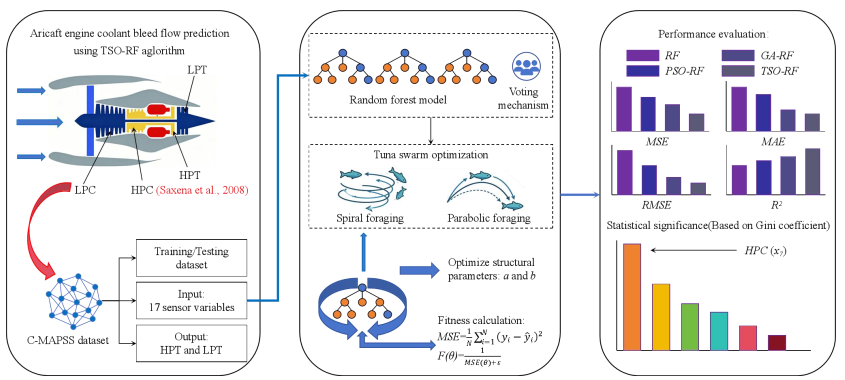
Coolant bleed flow forecasting is critical for the engineering health of aircraft engines. Using the datasets from Commercial Modular Aero-Propulsion System Simulation (C-MAPSS), this paper aims to establish high-precision coolant bleed flow models by the random forest (RF) algorithm combined with tuna swarm optimization (TSO). 17 sensor variables that are moderately or highly correlated with the low-pressure turbine (LPT) and high-pressure turbine (HPT) are selected as inputs with LPT and HPT as outputs. After being trained and validated on the FD002 and FD004 datasets, the TSO-RF model significantly reduces mean squared error, mean absolute error and root mean squared error, and improves the determination coefficient R² compared to other RF models. It verifies the superiority of the TSO-RF model in predicting engine coolant bleed flow, providing reliable technical support for subsequent evaluation and management in aircraft engine bleed air system.
Aldehim, G., Asiri, M.M., Aljebreen, M., Mohamed, A., Assiri, M. & Ibrahim, S. S.(2023). Tuna swarm algorithm with deep learning enabled violence detection in smart video surveillance systems. IEEE Access, 11, 95104–95113. https://doi.org/10.1109/ACCESS.2023.3310885
Amo, D. G. I., Pelta, A. D., Gonzalez, R. J., & Masegosa, D. A.(2012). An algorithm comparison for dynamic optimization problems. Applied Soft Computing Journal, 12(10), 3176–3192. https://doi.org/10.1016/j.asoc.2012.05.021
Ayazi, F. M., Singh, M., & Kumar, R. (2024). Prediction and modelling marshall stability of modified reclaimed asphalt pavement with rejuvenators using latest machine learning techniques. Engineering Research Express, 6(3), 035004-035004. https://doi.org/10.1088/2631-8695/AD65B7
Breiman, L.(2001). Random forests. Machine Learning, https://doi.org/10.1023/A:1010933404324
Bonnini, S., Borghesi, M.(2024). Nonparametric test for logistic regression with application to italian enterprises’ propensity for innovation. Mathematics, 12(18), 2955–2955. https://doi.org/10.3390/MATH12182955
Cai, W., Zhao, Y. P., Zhu, Y., Yin, J. & Xu, Z. Y.(2024). A novel hybrid aeroengine modeling method for combining data-driven modules. Journal of Aerospace Engineering, 37(5). https://doi.org/10.1061/JAEEEZ.ASENG-5531
Cristina, M. R.(2023). Theory and foundations of modeling and simulation. Simulation-Transactions of The Society for Modeling and Simulation International, 99, 431-432. https://doi.org/10.1177/00375497231171140
Duan, Y. T., Zhang, T., & Shi, D.(2024). Anomaly detection and remaining useful life prediction for turbofan engines with a key point-based approach to secure health management. Sensors, 24, 8022–8022. https://doi.org/10.3390/S24248022
Deng, H. T., Runger, C. G.(2012). Feature selection via regularized trees. In The 2012 International Joint Conference on Neural Networks (IJCNN). IEEE.
Guan, L. R., Sun, H. J., Chen, F. J., Shen, W. & Cai, Y. Z.(2024). CFD investigation of structural effects of internal gas intake on powder conveying performance in fuel supply systems for aerospace engines. Particuology, 92140–92154. https://doi.org/10.1016/j.partic.2024.04.016
Huang, Y., Guo, S., Xie, H. L., Wen, J. & Wang, J. R.(2025). Evaluation of machine learning models for predicting performance metrics of aero-engine combustors. Case Studies in Thermal Engineering, 65, 105627. https://doi.org/10.1016/J.CSITE.2024.105627
Khan, A., Sutanto, M. H., Khan, N., Baarimah, A. O., Wahab, M. M. A., Khan, M. I., Ramu, M. B., & Khan, R. (2025). Decision tree machine learning approach for the performance prediction of asphalt mixes modified with waste tyre metal fibre. Journal of Engineering and Technological Sciences, 57(3), 303–314. https://doi.org/10.5614/j.eng.technol.sci.2025.57.3.2
Kumar, S. M., Nagarajan, L., & Vasudevan, B.(2024). Machinability study on abrasive waterjet drilling of YSZ-coated inconel 718 superalloy: optimization and modelling by machine learning. Engineering Research Express, 6, 025425. https://doi.oth/10.1088/2631-8695/ad51d3
Liu, Y. L., Xu, G. Q., Fu, Y. C., Wen, J. & Huang, H. R.(2023). Thermal dynamic and failure research on an air-fuel heat exchanger for aero-engine cooling. Case Studies in Thermal Engineering, 42. https://doi.org/10.1016/J.CSITE.2023.102715
Lei, B.Y., Shen, N., Ji, D.Y., Ouyang, Z. R., Yang, L., & Liu, M. Q. (2024). A comprehensive review of key technologies for enhancing the reliability of aero-engine. IEEE Access, 12, 148315–148331. https://doi.org/10.1109/ACCESS.2024.3474737
Lin, R. H., Pei, Z. X., Ye, Z. Z., Wu, B. D., & Yang, D.(2020). A voted based random forests algorithm for smart grid distribution network faults prediction. Enterprise Information Systems, 14, 496–514. https://doi.org/10.1080/17517575.2019.1600724
Li, L.L., Ji, B.X., Lim, M.K., Tseng, & L. M.(2024). Active distribution network operational optimization problem: A multi-objective tuna swarm optimization model. Applied Soft Computing, 150, 111087. https://doi.org/10.1016/j.asoc.2023.111087
Madziel, M.(2024). Quantifying emissions in vehicles equipped with energy-saving start–stop technology: THC and NOx modeling insights. Energies, 17(12), 2815–2815. https://doi.org/10.3390/EN17122815.
Mahmoud, A. E., Bassel, S., Bou, A. N., Mohammad Noor, I.(2024). Comparative study of ML models for IIoT intrusion detection: impact of data preprocessing and balancing. Neural Computing & Applications, 36, 6955–6972. https://doi.org/10.1007/S00521-024-09439-X
Selvara, S., Thulasi, N. J., Vijayakumari, J. J. L. M., & Selvaraj, K.(2025). Deep residual ensemble model for predicting remaining useful life of turbo fan engines. International Journal of Turbo & Jet-Engines, 42(2), 229–239. https://doi.org/10.1515/TJJ-2024-0025
Stephen D, S., Iohn, S., Alexis, H., Kevin, D. & Ariana, M.(2022). Rotating detonation combustion for advanced liquid propellant space engines. Aerospace, 9(10), 581-581. https://doi.org/10.3390/AEROSPACE9100581
Sandhu, G., Singh, A., Bedi, S. P., Lamba, S. P. & Chaudhary, G.(2024). Improvement of random forest ensembling algorithm efficiency through cardinal tuning of n_estimators parameter. Journal of Multiple-Valued Logic and Soft Computing, 42, 67–93.
Saxena, A., Goebel, K., Simon, D., Eklund, N.(2008). Damage propagation modeling for aircraft engine run-to-failure simulation. 2008 International Conference on Prognostics and Health Management, Denver, CO, USA: 1-9. https://doi.org/10.1109/PHM.2008.4711414
Tian, E. L.,Lu, G. N. & Li, Z. H.(2024). Evaluation of emission of the hydrogen-enriched diesel engine through machine learning. Energy, 307132303-132303. https://doi.org/10.1016/J.ENERGY.2024.132303
Waqas, M., Humphries, W. U., Hlaing, T. P. & Ahmad, S.(2024). Seasonal WaveNet-LSTM: a deep learning framework for precipitation forecasting with integrated large scale climate drivers. Water, 16(22), 3194. https://doi.org/10.3390/W16223194
Waqas, M., Humphries, W. U., Wangwongchai, A., Dechpichai, P. & Ahmad, S.(2023). Potential of artificial intelligence-based techniques for rainfall forecasting in thailand: a comprehensive review. Water, 15, 2979. https://doi.org/10.3390/W15162979
Wang, H. R., Li, D. W., Li, D. J., Liu, C. Q., Yang, X. Q. & Zhu, G. F.(2023). Remaining useful life prediction of aircraft turbofan engine based on random forest feature selection and multi-Layer perceptron. Applied Sciences, 13,7186. https://doi.org/10.3390/APP13127186
Xie, L., Han, T., Zhou, H., Zhang, Z. R. & Han, B.(2021). Tuna swarm optimization: A novel swarm-based metaheuristic algorithm for global optimization. Computational Intelligence and Neuroscience, 9210050. https://doi.org/10.1155/2021/9210050
Xu,Y.Y., Xiao,H., Zhang, R.H., Wu, W. Z. & Wan, F.(2024). Matrix factorization with a sigmoid-like loss control. Neurocomputing, 576, 127338-. https://doi.org/10.1016/J.NEUCOM.2024.127338
Xiao, L., & Zeng, Y.(2024). Remaining life prediction of turbofan engines based on RF-SA-SDCNN. Agricultural equipment & vehicle engineering. 62(03), 153-158. https://doi.org/10.1038/s41598-022-10191-2
Xiu, X. Y., Ma, S. S., Guo, F. F., Liu, H. & Li, H. C.(2025). Performance analysis of a turbofan engine integrated with flame-assisted fuel cells for combined propulsion and power generation with more electric aircrafts. Energy Conversion and Management, 325, 119335–119335. https://doi.org/10.1016/J.ENCONMAN.2024.119335
Yang, H., Yang, X.D. & Li, G. H. (2023). Dual feature extraction system for ship-radiated noise and its application extension. Ocean Engineering, 285(2), 115352. https://doi.org/10.1016/j.oceaneng.2023.115352
Yuhas, A. J. & Ray, R. J.(2012). Effects of bleed air extraction of thrust levels on the F404-GE-400 turbofan engine. https://doi.org/10.2514/6.1992-3092
Yu, B., Shu, W., Cao, C.(2018). A novel modeling method for aircraft engine using nonlinear autoregressive exogenous (NARX) models based on wavelet neural networks. International Journal of Turbo & Jet-Engines, 35(2), 161–169. https://doi.org/10.1515/tjj-2017-0005
Zhu, Z., Wang, T., Hessam, S., Sarjoughian, H., Wang, W. P. & Zhao, Y.H.(2023). Knowledge-based and data-driven behavioral modeling techniques in engagement simulation. Simulation-Transactions of The Society for Modeling and Simulation International, 99(10), 1069–1089. https://doi.org/10.1177/00375497231177123
Zhang, S. P. & Gao, D.(2019). Flower pollination algorithm based on dynamic adjustment and cooperative. Search Computer Engineering and Applications, 55, 46–53.
Copyright (c) 2026 Journal of Engineering and Technological Sciences

This work is licensed under a Creative Commons Attribution-NonCommercial-NoDerivatives 4.0 International License.