Probabilistic vs Deterministic Foundation Design: Impact of PDA and SLT Data on Required Safety Factor in an Indonesian Project Case Study
Downloads
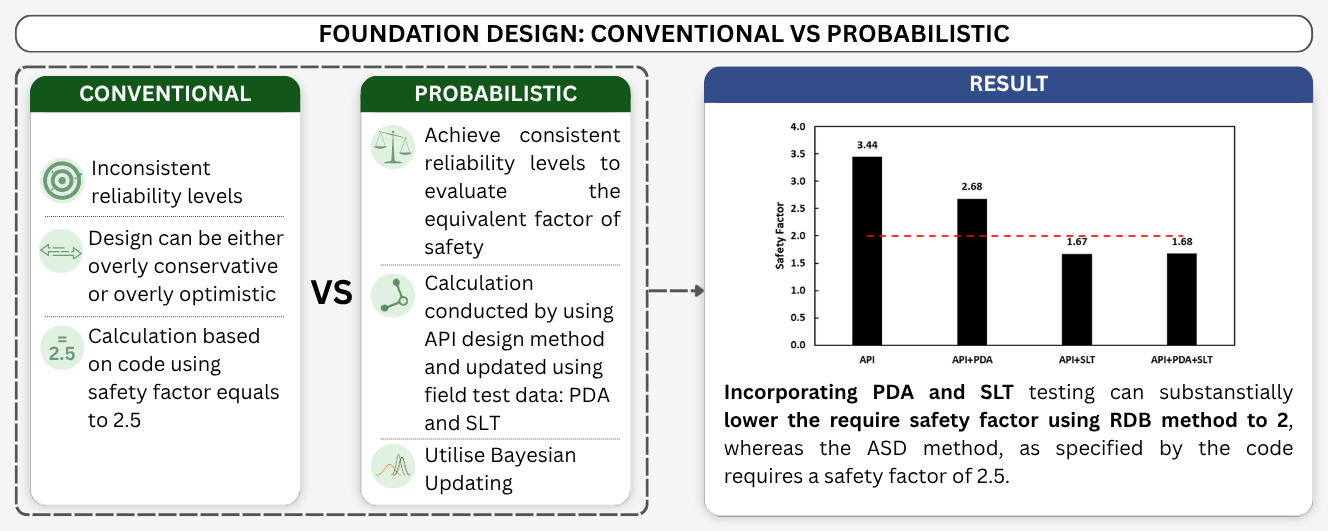
Foundation design using the Allowable Stress Design (ASD) method is characterized by less consistent reliability that is difficult to quantify, leading to overly conservative or optimistic design. Therefore, this study aimed to implement the Reliability-Based Design (RBD) method in foundation design to achieve consistent reliability levels and evaluate the equivalent safety factor generated. The design process was initially conducted based on API method and updated using field test data, namely the Pile Driving Analyzer (PDA) and Static Load Test (SLT). Statistical parameter updating was performed using a statistical analysis through the Bayesian updating method. The results showed that RBD method was capable of explicitly quantifying uncertainties. Furthermore, the availability of more and higher-quality data contributed to a more accurate representation of uncertainty, causing a greater reduction in the required equivalent factor of safety. This showed that the probabilistic method enabled the application of a lower safety factor compared to the conservative value of approximately 2.5 commonly adopted in ASD, without compromising the target reliability. Through the addition of data from PDA and SLT testing, this study showed that the RBD method could significantly reduce the required safety factor to a value of 1.68.
Ang, A. H.-S., & Tang, W. H. (2007). Probability Concepts in Engineering: Emphasis on Applications to Civil and Environmental Engineering (2nd ed.). John Wiley & Sons.
Barker, R. M., Duncan, J. M., Rojiani, K. B., Ooi, P. S. K., Tan, C. K., & Kim, S. G. (1991). Load factor design criteria for highway structure foundations. NCHRP Proj. 24-4.
Bea, R. G. (1983). Characterization of the reliability of offshore piles subjected to axial loadings. ASCE Structural Congress.
Becker, D. E. (1996). Eighteenth Canadian geotechnical colloquium: Limit states design for foundations. Part II. Development for the National Building Code of Canada. Canadian Geotechnical Journal, 33, 984–1007.
Chow, F. C., Jardine, R. J., Brucy, F., & Nauroy, J. F. (1998). Effects of Time on Capacity of Pipe Piles in Dense Marine Sand. Journal of Geotechnical and Geoenvironmental Engineering, 124(3), 254–264. https://doi.org/10.1061/(ASCE)1090-0241(1998)124:3(254)
Evangelista, A., Pellegrino, A., & Viggiani, C. (1977). Variability among piles of the same foundation. 9th International Conference on Soil Mechanics and Foundation Engineering.
Goble, G. G., Rausche, F., & Likins, G. E. (2008). What constitutes a good PDA test? Eighth International Conference on the Application of Stress-Wave Theory to Piles, 403–407.
Hannigan, P. J., Rausche, F., Likins, G. E., Robinson, B., & Becker, M. (1997). Design and Construction of Driven Pile Foundations – Volume I FHWA-HI-97-014.
Jong, S. C., & Ong, D. E. L. (2024). A Bayesian inference framework for geomaterial characterization and evaluation of complex soil-structure interactions. Computers and Geotechnics, 172, 106452. https://doi.org/10.1016/j.compgeo.2024.106452
Lastiasih, Y., Irsyam, M., Sidi, I. D., & Toha, F. X. (2013). Reliability of Bored Pile Bearing Capacity Based on the Reese & Wright Formula and a Proposed Load and Resistance Factor Design (LRFD) for Bored Pile Foundation Design: A Case Study of a Jakarta Project. MEDIA KOMUNIKASI TEKNIK SIPIL, 19(2), 135. (Text in Indonesian). https://doi.org/ 10.14710/mkts.v19i2.8422
Lastiasih, Y., & Sidi, I. D. (2014). Reliability of Estimation Pile Load Capacity Methods. Journal of Engineering and Technological Sciences, 46(1), 1–16. https://doi.org/10.5614/j.eng.technol.sci.2014.46.1.1
Liu, X., Liu, Y., Li, X., Yang, Z., & Jiang, S.-H. (2023). Efficient adaptive reliability-based design optimization for geotechnical structures with multiple design parameters. Computers and Geotechnics, 162, 105675. https://doi.org/10.1016/j.compgeo.2023.105675
Lumb, P. (1966). The Variability of Natural Soils. Canadian Geotechnical Journal, 3(2), 74–97. https://doi.org/10.1139/t66-009
McVay, M., Birgisson, B., Zhang, L., Perez, A., & Putcha, S. (2000). Load and Resistance Factor Design (LRFD) for Driven Piles Using Dynamic Methods—A Florida Perspective. Geotechnical Testing Journal, 23(1), 55–66. https://doi.org/10.1520/GTJ11123J
Pan, M., Jiang, S.-H., Liu, X., Song, G.-Q., & Huang, J. (2024). Sequential probabilistic back analyses of spatially varying soil parameters and slope reliability prediction under rainfall. Engineering Geology, 328, 107372. https://doi.org/10.1016/j.enggeo.2023.107372
Phoon, K.-K., Ching, J., & Tao, Y. (2024). Soil and rock parametric uncertainties. uncertainty, modeling, and desicion making in geotechnics. CRC Press. https://doi.org/10.1201/9781003333586
Reese, L. C., & O’Neill, M. W. (1988). Drilled Shafts: Construction Procedures and Design Methods (FHWA-HI-88-042). United States. Federal Highway Administration.
Roniar, L., Hartanto, C., Irsyam, M., Basarah, Y. I., & Sihite, T. B. (2023). Evaluation of Empirical Formulas to Estimate Axial Capacity of Bored Pile in West Java, Indonesia. Indonesian Geotechnical Journal, 2(3), 73–84. https://doi.org/10.56144/igj.v2i3.62
Shapiro, S. S., & Wilk, M. B. (1965). An Analysis of Variance Test for Normality (Complete Samples). Biometrika, 52(3/4), 591. https://doi.org/10.2307/2333709
Sidi, I. D. (2017). Probabilistic Modeling of Updating Epistemic Uncertainty in Pile Capacity Prediction with a Single Failure Test Result. Jurnal Teknik Sipil, 24(3), 195–198.
Tao, Y., Sun, H., & Cai, Y. (2021). Bayesian inference of spatially varying parameters in soil constitutive models by using deformation observation data. International Journal for Numerical and Analytical Methods in Geomechanics, 45(11), 1647–1663. https://doi.org/10.1002/nag.3218
Whitman, R. V. (1984). Evaluating Calculated Risk in Geotechnical Engineering. Journal of Geotechnical Engineering, 110(2), 143–188. https://doi.org/10.1061/(ASCE)0733-9410(1984)110:2(143)
Withiam, J. L., Voytko, E. P., Barker, R. M., Duncan, J. M., Kelly, B. C., Musser, S. C., & Elias, V. (1997). Load and resistance factor design (LRFD) for highway bridge substructures. FHWA Rep. DTFH61-94-C-00098.
Zhang, L. M., & Tang, W. H. (2001). Bias in axial capacity of single bored piles arising from failure criteria. ICOSSAR’2001 — International Conference on Structural Safety and Reliability.
Zhang, L. M., Tang, W. H., & Ng, C. W. W. (2001). Reliability of Axially Loaded Driven Pile Groups. Journal of Geotechnical and Geoenvironmental Engineering, 127(12), 1051–1060. https://doi.org/10.1061/(ASCE)1090-0241(2001)127:12(1051)
Copyright (c) 2026 Journal of Engineering and Technological Sciences

This work is licensed under a Creative Commons Attribution-NonCommercial-NoDerivatives 4.0 International License.