Design and Test of a Secondary Shearing Device for the Lentinus Edodes Stem
Downloads
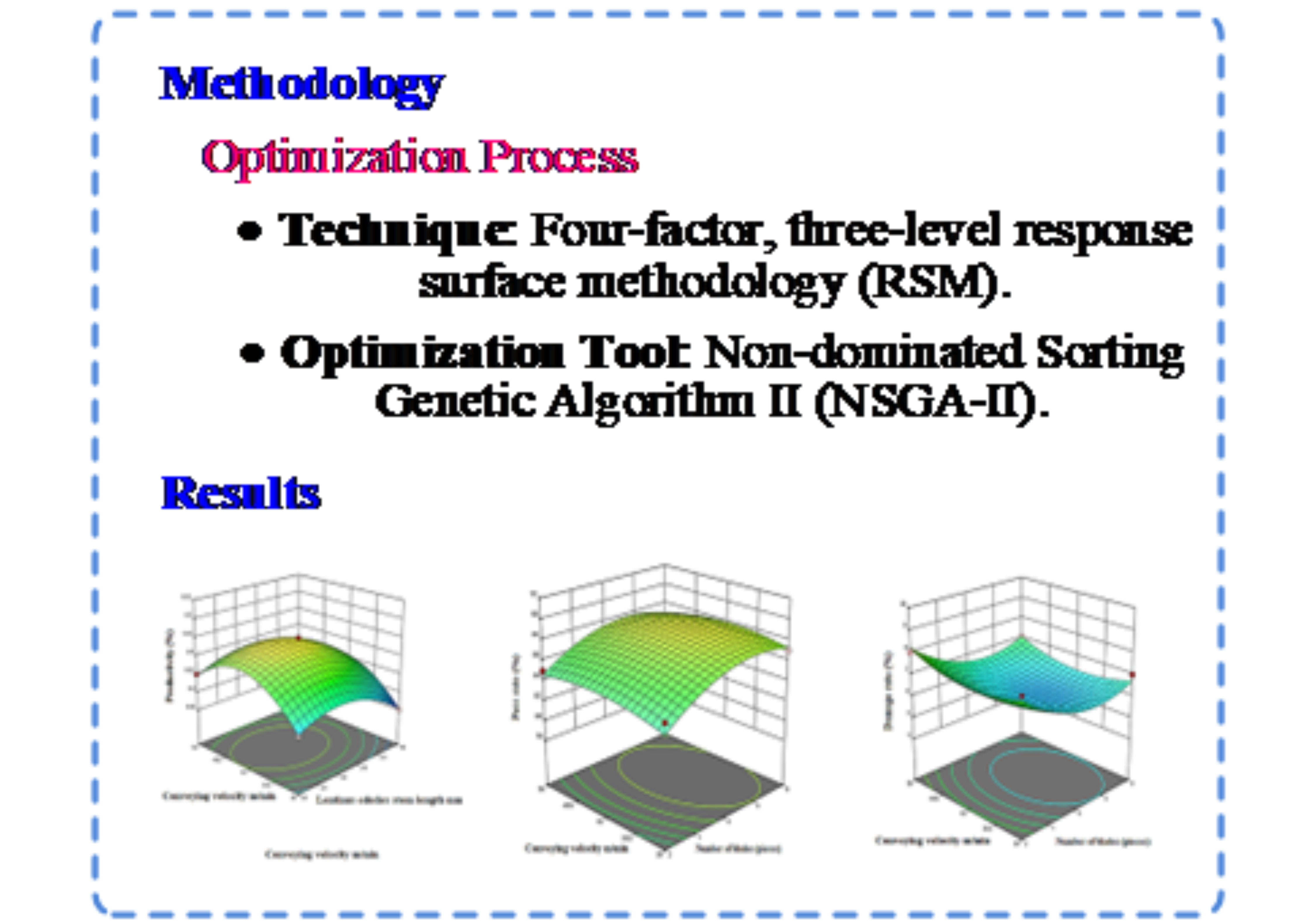
To address the high labor intensity and low efficiency in the manual stem cutting of Lentinus edodes (shiitake mushrooms), A secondary shearing device was designed. This device automated the shearing and separation of mushroom roots and stems, significantly improving the efficiency of the stem-cutting process. Evaluated through indicators such as productivity, pass rate, and damage rate, a four-factor and three-level response surface test was conducted. The test factors included tool velocity, stem length, number of blades, and conveying velocity. Using Design-Expert 12.0 software to analyze the test data, the optimal parameter combination was determined: a tool velocity of 5800 r/min, stem length of 28 mm, four blades, and a conveying velocity of 52.78 m/min. Under these conditions, the device achieved a productivity of 0.49 Kg/h, a pass rate of 91.18%, and a damage rate of 5.73%. Verification tests confirmed the reliability of these parameters, showing slight deviations from the experimental predictions but still meeting the requirements for Lentinus edodes stem cutting. This study demonstrated that the secondary shearing device could significantly reduce labor intensity and improve efficiency in mushroom cultivation practices. Future research should focus on integrating robotic systems for automation and exploring additional parameters to further enhance the device's performance.
Ahmad, I., Arif, M., Xu, M., Zhang, J., Ding, Y., & Lyu, F. (2023). Therapeutic values and nutraceutical properties of shiitake mushroom (Lentinula edodes): A review. Trends in Food Science & Technology, 134, 123–135.
Amin, Z. S., Abbas, S., Munir, A., Qadri, M. M. A., Raza, M., Danish, M., Khan, S., Hafey, B., Hanif, M. K., & Kashif, H. (2022). Role of Medicinal Mushroom Lentinula edodes in Nutrition, Nutraceutics and Ethnopharmacology. Journal of Pharmaceutical Research International, 34(30A), 18–35.
Fu Meizhen, Tian Junwei, & Chen Dejun. (2018). Design of a Small Rotary Mower. Agricultural Mechanization Research, 40(7), 116–130.
Ghahraei, O., Kheshtzarrin, M., & Saghafinia, A. (2023). Development of a Button Mushroom Harvesting Robot using Expert System and Image Processing in Shelf Cultivation Method. Majlesi Journal of Electrical Engineering, 17(4), 53–61.
Jinqing, L., Xinyu, W., Zihui, L., Jicheng, L., & Zhongyuan, L. (2020). Design and experiment of the grading device for a potato seed cutting machine. Transactions of the Chinese Society of Agricultural Engineering, 36(20), 76–83.
Li, F., Song, W., Ding, T., Wang, J., Wang, M., & Wu, J. (2018). Study on mechanical properties of fresh Lentinus edodes stem. Journal of Henan Agricultural Sciences, 47(6), 157–160.
Li, N., Li, H., Liu, Z., Lv, S., Xie, S., Shi, C., & Wu, Y. (2023). Preparation and product characterization of microwaveable food using Lentinus edodes protein through 3D printing. Polymers, 15(18), 3736.
Liu, L., Tan, H., Li, L., & Li, P. (2016). Design and experiment of machine for processing lentinus edodes stipe into floss. Transactions of the Chinese Society of Agricultural Engineering, 32(16), 265–272.
Nie, Y., Yu, M., Zhou, H., Zhang, P., Yang, W., & Li, B. (2020). Effect of boiling time on nutritional characteristics and antioxidant activities of Lentinus edodes and its broth. CyTA-Journal of Food, 18(1), 543–550.
Sibanda, N., Ruzvidzo, O., Zvidzai, C. J., Mashingaidze, A. B., Dikobe, T. B., Takundwa, M. M., Kawadza, D. T., Katata-Seru, L. M., Mlambo,
S. S., & Murungweni, C. (2020). The potential use of Lentinus edodes to manage and control water hyacinth in Zimbabwe. Journal of Yeast and Fungal Research, 11(1), 1–14.
Tao, K., Wang, Z., Yuan, J., & Liu, X. (2023). Design of a novel end-effector for robotic bud thinning of Agaricus bisporus mushrooms. Computers and Electronics in Agriculture, 210, 107880.
Tao, W., Xiaoli, Y., Guopeng, M., Suyuan, L., Zhenguo, Z., & Zhengdao, L. (2023). Research status of hard stem cutting device. Journal of Chinese Agricultural Mechanization, 44(8), 34.
Wang, L., Zhao, H., Brennan, M., Guan, W., Liu, J., Wang, M., Wen, X., He, J., & Brennan, C. (2020). In vitro gastric digestion antioxidant and cellular radical scavenging activities of wheat-shiitake noodles. Food Chemistry, 330, 127214.
Wang, X., Zhu, S., & Li, X. (2020). Design and experiment of directional arrangement vertical and horizontal cutting of seed potato cutter [J]. Transactions of the Chinese Society for Agricultural Machinery, 51(6), 334–345.
Wang, Z., Tao, K., Yuan, J., & Liu, X. (2024). Design and experiment on mechanized batch harvesting of Shiitake mushrooms. Computers and Electronics in Agriculture, 217, 108593.
Wu Suzhen, Liu Qingsong, & Chen Yang. (2023). Screening of shiitake mushrooms and design of secondary shearing device for shiitake mushrooms handle. Journal of Henan University of Engineering (Natural Science Edition), 35(1), 55–60.
Xiang, Q., Adil, B., Chen, Q., Gu, Y., Zeng, X., & Li, X. (2021). Shiitake mushroom (Lentinula edodes (Berk.) sing.) breeding in China. Advances in Plant Breeding Strategies: Vegetable Crops: Volume 10: Leaves, Flowerheads, Green Pods, Mushrooms and Truffles, 443–476.
Xiangyou, W., Weilong, L. I. U., Hao, Z., Guoliang, S. U., & Jiayi, R. E. N. (2023). Design and Experiment of Seed Potato Cutting Device of Sorting-positioning and Clamping-cutting Combined. Nongye Jixie Xuebao/Transactions of the Chinese Society of Agricultural Machinery, 54(11).
Xiaolong, H., Yong, Y. O. U., Decheng, W., Sibiao, L. I., Lu, Z. H. U., & Yangyang, L. (2022). Design and Experiment of Rotary Cutter Disc Type Flat Stubble Cutting Device for King Grass Harvester. Nongye Jixie Xuebao/Transactions of the Chinese Society of Agricultural Machinery, 53(5).
Zhang, Z., Song, H., Peng, Z., Luo, Q., Ming, J., & Zhao, G. (2012). Characterization of stipe and cap powders of mushroom (Lentinus edodes) prepared by different grinding methods. Journal of Food Engineering, 109(3), 406–413.
Zhou, H., Yu, M., Nie, Y., Zhang, P., Yang, W., & Li, B. (2021). Effects of heat processing methods on nutritional properties and antioxidant activity of Lentinus edodes.
Ziaja-Sołtys, M., Radzki, W., Nowak, J., Topolska, J., Jabłońska-Ryś, E., Sławińska, A., Skrzypczak, K., Kuczumow, A., & Bogucka-Kocka, A. (2020). Processed fruiting bodies of Lentinus edodes as a source of biologically active polysaccharides. Applied Sciences, 10(2), 470.
Copyright (c) 2025 Zhen Wang , Weizhong Xiao , Yuandong Liu , Yuting Zhang , Qin Liu , Xiao Cui, Weili Kong

This work is licensed under a Creative Commons Attribution 4.0 International License.