
Polyoxometalates as Catalysts for Biomass Conversion: Properties, Applications, and Regenerability
Abstract
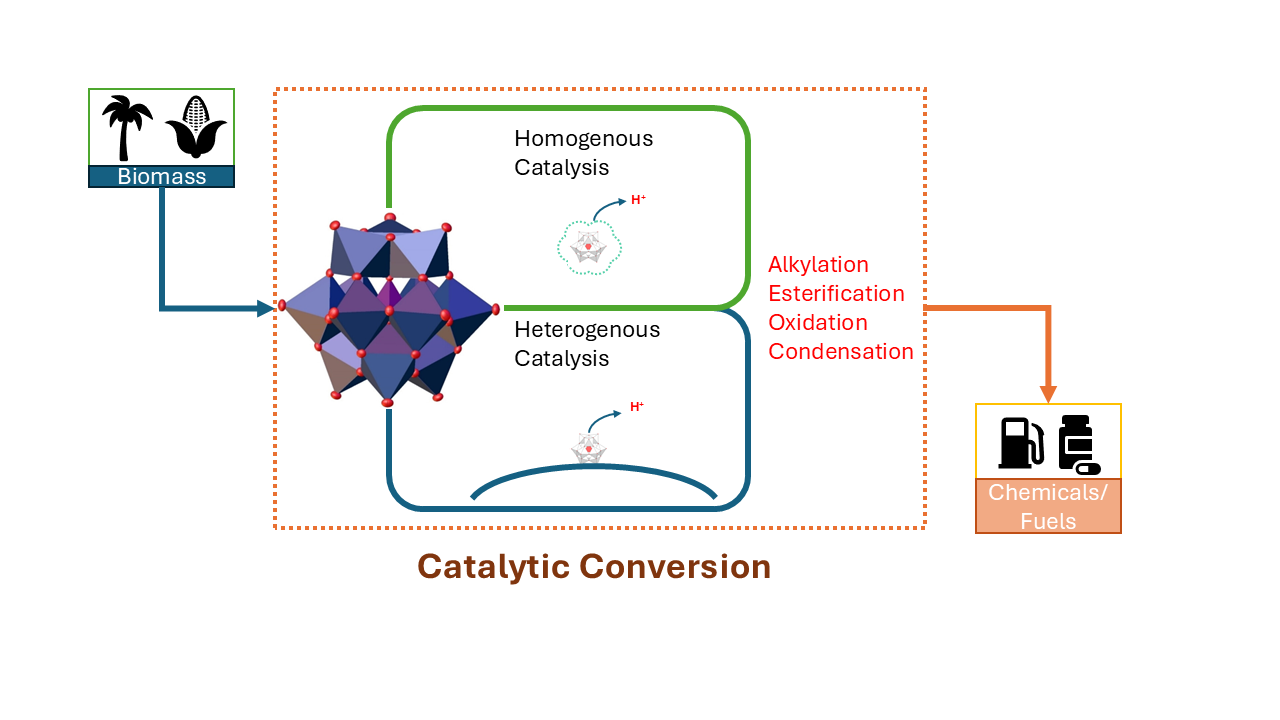
Polyoxometalates (POMs) have emerged as exceptionally versatile catalysts for green chemical reactions, demonstrating significant potential in the sustainable valorization of biomass. Their tunable Brønsted/Lewis acidity and redox properties enable a broad range of chemical transformations, offering remarkable flexibility in process design. This mini review provides a summary of recent advances in the thermocatalytic conversion of biomass using POMs, addressing their utilization as both homogeneous and heterogeneous catalysts. Key reaction pathways, including solvolysis, oxidation, esterification, and condensation, are highlighted as fundamental processes in biomass valorization. A central focus is placed on the crucial challenge of catalyst regenerability and stability, examining strategies to ensure the long-term viability and economic feasibility of these systems while facing the apparent low-temperature stability challenge of POMs. Finally, this review synthesizes current regeneration methods and presents a forward-looking perspective on the future challenges and opportunities in the field of biomass conversion catalyzed by polyoxometalates.
How to Cite
Haryo P. Winoto, Rezky O. Anggaswara, Dian H. Wahyudi, Rino R. Mukti, Veinardi Suendo, Ismunandar Ismunandar (2026). Polyoxometalates as Catalysts for Biomass Conversion: Properties, Applications, and Regenerability. Journal of Engineering and Technological Sciences, Vol. 58 No. 3 (2026): Vol. 58 No. 3(2026): June, 310-331. https://doi.org/10.5614/j.eng.technol.sci.2026.58.3.2
Metrics
References
Abdullah, F. Z., Ma’amor, A., Daud, N. A., & Abd. Hamid, S. B. (2017). Selective synthesis of PEG-monoester using cesium heteropoly acid as heterogeneous catalyst. Química Nova. https://doi.org/10.21577/0100-4042.20170040
ABU HASSAN, N. A. (2017). Synthesis of Dimerate Esters by Solvent-free Method. Journal of Oil Palm Research, 29(1), 110–119. https://doi.org/10.21894/jopr.2017.2901.12
Aghajani, S., Mohammadikish, M., & Khalaji-Verjani, M. (2023). Reusable and Highly Active Copper-Based
Lacunary-type Polyoxometalate (LPMo-Cu) as an Effective Catalyst for Nitroarene Reduction in Aqueous Solution. Langmuir, 39(24), 8484–8493. https://doi.org/10.1021/acs.langmuir.3c00766
Ahmad, W., Ahmad, N., Wang, K., Aftab, S., Hou, Y., Wan, Z., Yan, B., Pan, Z., Gao, H., Peung, C., Junke, Y., Liang, C., Lu, Z., Yan, W., & Ling, M. (2024). Electron‐Sponge Nature of Polyoxometalates for Next‐Generation Electrocatalytic Water Splitting and Nonvolatile Neuromorphic Devices. Advanced Science, 11(5). https://doi.org/10.1002/advs.202304120
Alasmari, A., Kozhevnikova, E. F., & Kozhevnikov, I. V. (2024). Dehydration of Isopropanol over Silica-Supported Heteropoly Acids. Catalysts, 14(1), 51. https://doi.org/10.3390/catal14010051
Albert, J., Lüders, D., Bösmann, A., Guldi, D. M., & Wasserscheid, P. (2014). Spectroscopic and electrochemical characterization of heteropoly acids for their optimized application in selective biomass oxidation to formic acid. Green Chem., 16(1), 226–237. https://doi.org/10.1039/C3GC41320A
Alemdar, A., Tan, B., Toksöz, O., Kurtuluş, G., Sesal, C., & Odabaş, Z. (2023). Systematically investigation on the spectral, antioxidant and antibacterial properties of fragrant methyl benzoate esters containing electron withdrawing and electron releasing groups. Journal of Molecular Structure, 1291, 136100. https://doi.org/10.1016/j.molstruc.2023.136100
Alhanash, A., Kozhevnikova, E. F., & Kozhevnikov, I. V. (2010). Gas-phase dehydration of glycerol to acrolein catalysed by caesium heteropoly salt. Applied Catalysis A: General, 378(1), 11–18. https://doi.org/10.1016/j.apcata.2010.01.043
Al-Shathr, A., Al-Zaidi, B. Y., Shehab, A. K., Shakoor, Z. M., Aal-Kaeb, S., Gomez, L. Q., Majdi, H. Sh., Al-Shafei, E. N., AbdulRazak, A. A., & McGregor, J. (2023). Experimental and kinetic studies of the advantages of coke accumulation over Beta and Mordenite catalysts according to the pore mouth catalysis hypothesis. Catalysis Communications, 181, 106718. https://doi.org/10.1016/j.catcom.2023.106718
Aouissi, A., Al-Othman, Z. A., & Al-Anezi, H. (2010). Reactivity of Heteropolymolybdates and Heteropolytungstates in the Cationic Polymerization of Styrene. Molecules, 15(5), 3319–3328. https://doi.org/10.3390/molecules15053319
Argyle, M., & Bartholomew, C. (2015). Heterogeneous Catalyst Deactivation and Regeneration: A Review. Catalysts, 5(1), 145–269. https://doi.org/10.3390/catal5010145
Ayati, A., Heravi, M. M., Daraie, M., Tanhaei, B., Bamoharram, F. F., & Sillanpaa, M. (2016). H3PMo12O40 immobilized chitosan/Fe3O4 as a novel efficient, green and recyclable nanocatalyst in the synthesis of pyrano-pyrazole derivatives. Journal of the Iranian Chemical Society, 13(12), 2301–2308. https://doi.org/10.1007/s13738-016-0949-0
Babahydari, A. K., Fareghi-Alamdari, R., Hafshejani, S. M., Rudbari, H. A., & Farsani, M. R. (2016). Heterogeneous oxidation of alcohols with hydrogen peroxide catalyzed by polyoxometalate metal–organic framework. Journal of the Iranian Chemical Society, 13(8), 1463–1470. https://doi.org/10.1007/s13738-016-0861-7
Betiha, M. A., Hassan, H. M. A., El-Sharkawy, E. A., Al-Sabagh, A. M., Menoufy, M. F., & Abdelmoniem, H.-E. M. (2016). A new approach to polymer-supported phosphotungstic acid: Application for glycerol acetylation using robust sustainable acidic heterogeneous–homogenous catalyst. Applied Catalysis B: Environmental, 182, 15–25. https://doi.org/10.1016/j.apcatb.2015.09.010
Breibeck, J., Gumerova, N. I., & Rompel, A. (2022). Oxo-Replaced Polyoxometalates: There Is More than Oxygen. ACS Organic & Inorganic Au, 2(6), 477–495. https://doi.org/10.1021/acsorginorgau.2c00014
Cardoso, A. L., Augusti, R., & Da Silva, M. J. (2008). Investigation on the Esterification of Fatty Acids Catalyzed by the H3PW12O40 heteropolyacid. Journal of the American Oil Chemists’ Society, 85(6), 555–560. https://doi.org/10.1007/s11746-008-1231-0
Chang, S., Chen, Y., An, H., Zhu, Q., Luo, H., & Xu, T. (2021). Highly Efficient Synthesis of p -Benzoquinones Catalyzed by Robust Two-Dimensional POM-Based Coordination Polymers. ACS Applied Materials & Interfaces, 13(18), 21261–21271. https://doi.org/10.1021/acsami.1c02558
Clemente-Juan, J. M., Coronado, E., & Gaita-Ariño, A. (2012). Magnetic polyoxometalates: from molecular magnetism to molecular spintronics and quantum computing. Chemical Society Reviews, 41(22), 7464. https://doi.org/10.1039/c2cs35205b
Costentin, C., Drouet, S., Passard, G., Robert, M., & Savéant, J.-M. (2013). Proton-Coupled Electron Transfer Cleavage of Heavy-Atom Bonds in Electrocatalytic Processes. Cleavage of a C–O Bond in the Catalyzed Electrochemical Reduction of CO 2. Journal of the American Chemical Society, 135(24), 9023–9031. https://doi.org/10.1021/ja4030148
da Silva, Marcio Jose, Rodrigues, A. A., & Lopes, N. P. G. (2023). Keggin Heteropolyacid Salt Catalysts in Oxidation Reactions: A Review. Inorganics, 11(4), 162. https://doi.org/10.3390/inorganics11040162
Dang, T.-Y., Tian, H.-R., Lu, Y., Li, R.-H., & Liu, S.-X. (2024). Revealing the roles of the dual active-sites on a polyoxometalate-based metal–organic framework in catalyzing Knoevenagel condensations. Applied Surface Science, 654, 159459. https://doi.org/10.1016/j.apsusc.2024.159459
Darekar, Dr. A. G., & Saptale, Dr. S. P. (2025). Organic Transformations using Heterogeneous Polyoxometalate Catalysts. International Journal of Environmental Sciences, 11(7s), 647–658. https://doi.org/10.64252/5qh8rt58
Dashtian, K., Shahsavarifar, S., Usman, M., Joseph, Y., Ganjali, M. R., Yin, Z., & Rahimi-Nasrabadi, M. (2024). A comprehensive review on advances in polyoxometalate based materials for electrochemical water splitting. Coordination Chemistry Reviews, 504, 215644. https://doi.org/10.1016/j.ccr.2023.215644
Devassy, B. M., & Halligudi, S. B. (2006). Effect of calcination temperature on the catalytic activity of zirconia-supported heteropoly acids. Journal of Molecular Catalysis A: Chemical, 253(1–2), 8–15. https://doi.org/10.1016/j.molcata.2006.02.068
Du, J., Lang, Z.-L., Ma, Y.-Y., Tan, H.-Q., Liu, B.-L., Wang, Y.-H., Kang, Z.-H., & Li, Y.-G. (2020). Polyoxometalate-based electron transfer modulation for efficient electrocatalytic carbon dioxide reduction. Chemical Science, 11(11), 3007–3015. https://doi.org/10.1039/C9SC05392A
El Nemr, A., Eleryan, A., Mashaly, M., & Khaled, A. (2021). Rapid synthesis of cellulose propionate and its conversion to cellulose nitrate propionate. Polymer Bulletin, 78(8), 4149–4182. https://doi.org/10.1007/s00289-020-03317-x
Esser, T., Huber, M., Voß, D., & Albert, J. (2022). Development of an efficient downstream process for product separation and catalyst recycling of a homogeneous polyoxometalate catalyst by means of nanofiltration membranes and design of experiments. Chemical Engineering Research and Design, 185, 37–50. https://doi.org/10.1016/j.cherd.2022.06.045
Fernández, A. M. L., Rehman, A., Saleem, F., Resul, M. F. M. G., Abbas, A., Ahmad, S., Eze, V. C., & Harvey, A. P. (2023). Environment-friendly epoxidation of limonene using tungsten-based polyoxometalate catalyst. Molecular Catalysis, 547, 113345. https://doi.org/10.1016/j.mcat.2023.113345
Ferreira, P., Fonseca, I. M., Ramos, A. M., Vital, J., & Castanheiro, J. E. (2010). Valorisation of glycerol by condensation with acetone over silica-included heteropolyacids. Applied Catalysis B: Environmental, 98(1–2), 94–99. https://doi.org/10.1016/j.apcatb.2010.05.018
Gao, A., Iwano, T., & Uchida, S. (2025). Emerging Functionalized Lindqvist‐Type Polyoxometalate‐Based Compounds: Design, Synthesis, and Applications. ChemCatChem, 17(8). https://doi.org/10.1002/cctc.202500066
Gao, D., Trentin, I., Schwiedrzik, L., González, L., & Streb, C. (2019). The Reactivity and Stability of Polyoxometalate Water Oxidation Electrocatalysts. Molecules, 25(1), 157. https://doi.org/10.3390/molecules25010157
Guo, Y., Li, K., Yu, X., & Clark, J. H. (2008). Mesoporous H3PW12O40-silica composite: Efficient and reusable solid acid catalyst for the synthesis of diphenolic acid from levulinic acid. Applied Catalysis B: Environmental, 81(3–4), 182–191. https://doi.org/10.1016/j.apcatb.2007.12.020
Gusmão, F. M. B., Mladenović, D., Radinović, K., Santos, D. M. F., & Šljukić, B. (2022). Polyoxometalates as Electrocatalysts for Electrochemical Energy Conversion and Storage. Energies, 15(23), 9021. https://doi.org/10.3390/en15239021
Han, X.-X., He, Y.-F., Hung, C.-T., Liu, L.-L., Huang, S.-J., & Liu, S.-B. (2013). Efficient and reusable polyoxometalate-based sulfonated ionic liquid catalysts for palmitic acid esterification to biodiesel. Chemical Engineering Science, 104, 64–72. https://doi.org/10.1016/j.ces.2013.08.059
He, D., Huang, W., Liu, J., & Zhu, Q. (1999). Condensation of formaldehyde and methyl formate to methyl glycolate and methyl methoxy acetate using heteropolyacids and their salts. Catalysis Today, 51(1), 127–134. https://doi.org/10.1016/S0920-5861(99)00014-0
He, Z., Hou, Y., Li, H., Wei, J., Ren, S., & Wu, W. (2023). Catalytic aerobic oxidation of carbohydrates to formic acid over H5PV2Mo10O40: Rate relationships among catalyst reduction, catalyst re-oxidation and acid-catalyzed reactions and evidence for the Mars-van Krevelen mechanism. Chemical Engineering Science, 280, 119055. https://doi.org/10.1016/j.ces.2023.119055
Heravi, M. M., Mirzaei, M., Beheshtiha, S. Y. S., Zadsirjan, V., Mashayekh Ameli, F., & Bazargan, M. (2018). H5BW12O40 as a green and efficient homogeneous but recyclable catalyst in the synthesis of 4 H ‐Pyrans via multicomponent reaction. Applied Organometallic Chemistry, 32(9). https://doi.org/10.1002/aoc.4479
Hou, Z., & Okuhara, T. (2003). Condensation of benzene and aqueous formaldehyde to diphenylmethane in a biphasic system consisting of an aqueous phase of heteropolyacid. Journal of Molecular Catalysis A: Chemical, 206(1–2), 121–130. https://doi.org/10.1016/S1381-1169(03)00416-3
Hu, Q., Li, K., Chen, X., Liu, Y., & Yang, G. (2024). Polyoxometalate catalysts for the synthesis of N-heterocycles. Polyoxometalates, 3(1), 9140048. https://doi.org/10.26599/POM.2023.9140048
Huang, L., Zhu, X., Zhou, S., Cheng, Z., Shi, K., Zhang, C., & Shao, H. (2021). Phthalic Acid Esters: Natural Sources and Biological Activities. Toxins, 13(7), 495. https://doi.org/10.3390/toxins13070495
Huo, Z., Akhsassi, B., Yu, J., Zheng, M., Lan, T., He, Q., Boudon, C., Xu, G., Proust, A., Izzet, G., & Ruhlmann, L. (2025). Photocatalytic Recovery of Noble Metals by Covalent Silyl Polyoxophosphotungstate–Porphyrin Copolymers. Inorganic Chemistry, 64(7), 3371–3383. https://doi.org/10.1021/acs.inorgchem.4c04890
Iftikhar, T., & Rosnes, M. H. (2024). Covalent organic-inorganic polyoxometalate hybrids in catalysis. Frontiers in Chemistry, 12. https://doi.org/10.3389/fchem.2024.1447623
Jagannivasan, G., Haridas, S., Marimuthu, B., & Mukundan, S. (2025). Heteropolyacid-Assisted Efficient One-Pot Synthesis of Ethyl Levulinate from Biorenewable Feedstocks. Energy & Fuels, 39(6), 3131–3139. https://doi.org/10.1021/acs.energyfuels.4c05189
Jaiswal, K. S., & Rathod, V. K. (2022). Process Intensification of Enzymatic Synthesis of Flavor Esters: A Review. The Chemical Record, 22(3). https://doi.org/10.1002/tcr.202100213
Ji, Y.-Q., Yang, J.-B., Zhu, Y.-H., Wang, Q., Wang, J.-L., Chen, X.-L., Wu, J.-Y., Mei, H., & Xu, Y. (2025). Three Distinct Iron-Doped POM-Based Hybrid Composites for the Hydroxylation of Benzene to Phenol. Inorganic Chemistry, 64(33), 16940–16949. https://doi.org/10.1021/acs.inorgchem.5c02575
Jia, T., Wang, W., Zhang, L., Zeng, D., Wang, J., & Wang, W. (2024). An efficient strategy for the partial oxidation of methane into methanol over POM-immobilized MOF catalysts under ambient conditions. Applied Catalysis B: Environmental, 340, 123168. https://doi.org/10.1016/j.apcatb.2023.123168
Jiang, Y., Chen, C.-J., Li, K., Cui, L.-P., & Chen, J.-J. (2025). Polyoxometalates for the catalytic reduction of nitrogen oxide and its derivatives: from novel structures to functional applications. Chemical Communications, 61(26), 4881–4896. https://doi.org/10.1039/D5CC00632E
Johar, M., Zarkasi, K. Z., Zaini, N. A. M., & Rusli, A. (2023). Enhancement of mechanical, rheological and antifungal properties of polylactic acid/ethylene–vinyl-acetate blend by triacetin plasticizer. Journal of Polymer Research, 30(7), 259. https://doi.org/10.1007/s10965-023-03630-9
Kai Walters. (2022). The synthesis and properties of organic-inorganic hybrid polyoxometalates hybridised with asymmetric perylenediimides. University of Nottingham .
Khenkin, A. M., Efremenko, I., Martin, J. M. L., & Neumann, R. (2013). Polyoxometalate-Catalyzed Insertion of Oxygen from O2 into Tin–Alkyl Bonds. Journal of the American Chemical Society, 135(51), 19304–19310. https://doi.org/10.1021/ja409559h
Kholdeeva, O. (2004). Co-containing polyoxometalate-based heterogeneous catalysts for the selective aerobic oxidation of aldehydes under ambient conditions. Journal of Catalysis, 226(2), 363–371. https://doi.org/10.1016/j.jcat.2004.05.032
Kozhevnikov, I. V. (2007). Sustainable heterogeneous acid catalysis by heteropoly acids. Journal of Molecular Catalysis A: Chemical, 262(1–2), 86–92. https://doi.org/10.1016/j.molcata.2006.08.072
Kozhevnikov, I. V, Holmes, S., & Siddiqui, M. R. H. (2001). Coking and regeneration of H3PW12O40/SiO2 catalysts. Applied Catalysis A: General, 214(1), 47–58. https://doi.org/10.1016/S0926-860X(01)00469-0
Lefebvre, F. (2016). Synthesis, Characterization and Applications in Catalysis of Polyoxometalate/Zeolite Composites. Inorganics, 4(2), 13. https://doi.org/10.3390/inorganics4020013
Leng, Y., Wang, J., & Jiang, P. (2012). Amino-containing cross-linked ionic copolymer-anchored heteropoly acid for solvent-free oxidation of benzyl alcohol with H2O2. Catalysis Communications, 27, 101–104. https://doi.org/10.1016/j.catcom.2012.07.007
Leng, Y., Wang, J., Zhu, D., Wu, Y., & Zhao, P. (2009). Sulfonated organic heteropolyacid salts: Recyclable green solid catalysts for esterifications. Journal of Molecular Catalysis A: Chemical, 313(1–2), 1–6. https://doi.org/10.1016/j.molcata.2009.08.011
Li, J., Wang, X., Zhu, W., & Cao, F. (2009). Zn1.2H0.6PW12O40 Nanotubes with Double Acid Sites as Heterogeneous Catalysts for the Production of Biodiesel from Waste Cooking Oil. ChemSusChem, 2(2), 177–183. https://doi.org/10.1002/cssc.200800208
Li, L., Yu, Y.-T., Zhang, N.-N., Li, S.-H., Zeng, J.-G., Hua, Y., & Zhang, H. (2024). Polyoxometalate (POM)-based crystalline hybrid photochromic materials. Coordination Chemistry Reviews, 500, 215526. https://doi.org/10.1016/j.ccr.2023.215526
Li, T., Jin, L., Zhang, W., Miras, H. N., & Song, Y.-F. (2018). Robust and Environmentally Benign Solid Acid Intercalation Catalysts for the Aminolysis of Epoxides. ChemCatChem, 10(20), 4699–4706. https://doi.org/https://doi.org/10.1002/cctc.201801119
Li, Z., Yi, X., Wang, Q., Li, Y., Li, D., Palkovits, R., Beine, A. K., Liu, C., & Wang, X. (2023). Selective Production of Glycolic Acid from Cellulose Promoted by Acidic/Redox Polyoxometalates via Oxidative Hydrolysis. ACS Catalysis, 13(7), 4575–4586. https://doi.org/10.1021/acscatal.2c05568
Ling, X., Zheng, H., Huang, J., Sun, H., Xu, S., Zeng, H., Cai, A., Wang, Q., & Deng, J. (2024). The novel application of polyoxometalates for achieving sludge deep dewatering using low-temperature thermal hydrolysis pretreatment. Journal of Cleaner Production, 444, 141125. https://doi.org/10.1016/j.jclepro.2024.141125
Liu, L., Yu, F., Wang, S., & Ye, X. P. (2023). Glycerol Dehydration to Acrolein Catalyzed by Silicotungstic Acid: Effect of Mesoporous Support. Eng, 4(1), 206–222. https://doi.org/10.3390/eng4010012
Liu, Q., Liu, H., & Gao, D.-M. (2022). Establishing a kinetic model of biomass-derived disaccharide hydrolysis over solid acid: A case study on hierarchically porous niobium phosphate. Chemical Engineering Journal, 430, 132756. https://doi.org/10.1016/j.cej.2021.132756
Liu, R., & Streb, C. (2021). Polyoxometalate‐Single Atom Catalysts (POM‐SACs) in Energy Research and Catalysis. Advanced Energy Materials, 11(25). https://doi.org/10.1002/aenm.202101120
Liu, W., Li, M., Wang, G., Ma, H., Mu, Y., Zheng, D., Huang, X., & Li, L. (2022). New Monoterpene Acid and Gallic Acid Glucose Esters with Anti-Inflammatory Activity from Blue Gum ( Eucalyptus globulus ) Leaves. Journal of Agricultural and Food Chemistry, 70(16), 4981–4994. https://doi.org/10.1021/acs.jafc.2c00828
Liu, Y., Song, D., Huang, Z., Liu, X., Yang, X., & Guo, Y. (2025). Dual-acidic Sn(IV)-based polyoxometalates for one-pot catalytic transfer hydrogenation−alcoholysis cascade reactions. Journal of Colloid and Interface Science, 699, 138247. https://doi.org/10.1016/j.jcis.2025.138247
Long, D., Tsunashima, R., & Cronin, L. (2010). Polyoxometalates: Building Blocks for Functional Nanoscale Systems. Angewandte Chemie International Edition, 49(10), 1736–1758. https://doi.org/10.1002/anie.200902483
Lu, M., Zhang, M., Liu, J., Yu, T.-Y., Chang, J.-N., Shang, L.-J., Li, S.-L., & Lan, Y.-Q. (2022). Confining and Highly Dispersing Single Polyoxometalate Clusters in Covalent Organic Frameworks by Covalent Linkages for CO 2 Photoreduction. Journal of the American Chemical Society, 144(4), 1861–1871. https://doi.org/10.1021/jacs.1c11987
Lu, Y., Zhang, T., Zhang, Y.-X., Sang, X.-J., Su, F., Zhu, Z.-M., & Zhang, L.-C. (2021). A POM-based copper-coordination polymer crystal material for phenolic compound degradation by immobilizing horseradish peroxidase. Dalton Transactions, 50(42), 15198–15209. https://doi.org/10.1039/D1DT02644E
Lukato, S., Wendt, O. F., Wallenberg, R., Kasozi, G. N., Naziriwo, B., Persson, A., Folkers, L. C., & Tebandeke, E. (2021). Selective oxidation of benzyl alcohols with molecular oxygen as the oxidant using Ag-Cu catalysts supported on polyoxometalates. Results in Chemistry, 3, 100150. https://doi.org/10.1016/j.rechem.2021.100150
Ma, M., Hou, P., Zhang, P., Guo, Q., Yue, H., Huang, J., Tian, G., & Feng, S. (2024). Tandem catalysis of furfural to γ-valerolactone over polyoxometalate-based metal-organic frameworks: Exploring the role of confinement in the catalytic process. Renewable Energy, 227, 120474. https://doi.org/10.1016/j.renene.2024.120474
Ma, S., Bao, W., Liu, B., Zhang, C., Wang, C., Liu, Y., Guo, H., Pan, Y., Sun, D., & Lu, Y. (2022). PMo11V polyoxometalate encapsulated into hollow mesoporous carbon spheres: A highly efficient and ultra-stable catalyst for oxidative desulfurization. Applied Surface Science, 606, 154781. https://doi.org/10.1016/j.apsusc.2022.154781
Ma, X., Jing, Z., Li, K., Chen, Y., Li, D., Ma, P., Wang, J., & Niu, J. (2022). Copper-Containing Polyoxometalate-Based Metal–Organic Framework as a Catalyst for the Oxidation of Silanes: Effective Cooperative Catalysis by Metal Sites and POM Precursor. Inorganic Chemistry, 61(9), 4056–4061. https://doi.org/10.1021/acs.inorgchem.1c03835
Ma, Y., Jiang, Y., Wei, X., Peng, Q., Dai, S., & Hou, Z. (2022). Hydrocarboxylation of Olefins Catalyzed by Polyoxometalate-Anchored Palladium Single-Atom Catalysts. ACS Sustainable Chemistry & Engineering, 10(47), 15389–15401. https://doi.org/10.1021/acssuschemeng.2c04089
Maerten, S., Kumpidet, C., Voß, D., Bukowski, A., Wasserscheid, P., & Albert, J. (2020). Glucose oxidation to formic acid and methyl formate in perfect selectivity. Green Chemistry, 22(13), 4311–4320. https://doi.org/10.1039/D0GC01169J
Magazova, G., Cho, Y., Muhlenkamp, J. A., & Hicks, J. C. (2022). Single-site, Ni-modified Wells–Dawson-type polyoxometalate for propylene dimerization. Catalysis Science & Technology, 12(19), 5970–5981. https://doi.org/10.1039/D2CY01065H
Maksimchuk, N. V., & Kholdeeva, O. A. (2023). H2O2-Based Selective Oxidations Catalyzed by Supported Polyoxometalates: Recent Advances. Catalysts, 13(2), 360. https://doi.org/10.3390/catal13020360
Malmir, M., Heravi, M. M., Yekke-Ghasemi, Z., & Mirzaei, M. (2022). Incorporating heterogeneous lacunary Keggin anions as efficient catalysts for solvent-free cyanosilylation of aldehydes and ketones. Scientific Reports, 12(1), 11573. https://doi.org/10.1038/s41598-022-15831-1
Maru, K., Kalla, S., & Jangir, R. (2022). MOF/POM hybrids as catalysts for organic transformations. Dalton Transactions, 51(32), 11952–11986. https://doi.org/10.1039/D2DT01895K
Masteri-Farahani, M., Najafi, Gh. R., Modarres, M., & Taghvai-Nakhjiri, M. (2016). Wells–Dawson heteropoly acid encapsulated into the nanocages of SBA-16 as heterogeneous catalyst for the oxidation of olefins and alcohols. Journal of Porous Materials, 23(1), 285–290. https://doi.org/10.1007/s10934-015-0080-0
Mateos, P. S., Ruscitti, C. B., Casella, M. L., Matkovic, S. R., & Briand, L. E. (2023). Phosphotungstic Wells-Dawson Heteropolyacid as Potential Catalyst in the Transesterification of Waste Cooking Oil. Catalysts, 13(9), 1253. https://doi.org/10.3390/catal13091253
Mbage, B., Qi, Y., & Frimpong, R. (2023). Self‐Synthesized POM‐Chitosan Material with Enzyme Mimetic Activities for Antioxidant Applications. ChemistrySelect, 8(21). https://doi.org/10.1002/slct.202300575
Mialane, P., Mellot-Draznieks, C., Gairola, P., Duguet, M., Benseghir, Y., Oms, O., & Dolbecq, A. (2021). Heterogenisation of polyoxometalates and other metal-based complexes in metal–organic frameworks: from synthesis to characterisation and applications in catalysis. Chemical Society Reviews, 50(10), 6152–6220. https://doi.org/10.1039/D0CS00323A
Mir, S., Yadollahi, B., Omidyan, R., & Azimi, G. (2020). DFT study of α-Keggin, lacunary Keggin, and iron II–VI substituted Keggin polyoxometalates: the effect of oxidation state and axial ligand on geometry, electronic structures and oxygen transfer. RSC Advances, 10(56), 33718–33730. https://doi.org/10.1039/D0RA05189F
Misra, A., Kozma, K., Streb, C., & Nyman, M. (2020). Beyond Charge Balance: Counter‐Cations in Polyoxometalate Chemistry. Angewandte Chemie International Edition, 59(2), 596–612. https://doi.org/10.1002/anie.201905600
Mizuno, N., Hikichi, S., Yamaguchi, K., Uchida, S., Nakagawa, Y., Uehara, K., & Kamata, K. (2006). Molecular design of selective oxidation catalyst with polyoxometalate. Catalysis Today, 117(1–3), 32–36. https://doi.org/10.1016/j.cattod.2006.05.002
Nakamura, M., Islam, Md. S., Rahman, M. A., Nahar, R. N., Fukuda, M., Sekine, Y., Beltramini, J. N., Kim, Y., & Hayami, S. (2021). Microwave aided conversion of cellulose to glucose using polyoxometalate as catalyst. RSC Advances, 11(55), 34558–34563. https://doi.org/10.1039/D1RA04426E
Ni, Z., Hojo, H., & Einaga, H. (2025). Microwave-Assisted Heating for Dehydration of Ethanol to Ethylene Using HPW/SBA-15. Industrial & Engineering Chemistry Research, 64(5), 2686–2695. https://doi.org/10.1021/acs.iecr.4c04420
Niatouri, A. D., & Yadollahi, B. (2023). A novel POM/LDH/GO nanocomposite as highly efficient heterogeneous catalyst in green epoxidation of alkenes with hydrogen peroxide. Catalysis Communications, 185, 106808. https://doi.org/10.1016/j.catcom.2023.106808
Nisar, S., Hanif, M. A., Rashid, U., Hanif, A., Akhtar, M. N., & Ngamcharussrivichai, C. (2021). Trends in Widely Used Catalysts for Fatty Acid Methyl Esters (FAME) Production: A Review. Catalysts, 11(9), 1085. https://doi.org/10.3390/catal11091085
Nlate, S., Plault, L., & Astruc, D. (2007). Peripheral functionalisation of dendrimers with polyoxotungstate complexes assembled by ionic bonding and their use as oxidation catalysts: Influence of the tether length. New Journal of Chemistry, 31(7), 1264. https://doi.org/10.1039/b616288f
Novais, C., Molina, A. K., Abreu, R. M. V., Santo-Buelga, C., Ferreira, I. C. F. R., Pereira, C., & Barros, L. (2022). Natural Food Colorants and Preservatives: A Review, a Demand, and a Challenge. Journal of Agricultural and Food Chemistry, 70(9), 2789–2805. https://doi.org/10.1021/acs.jafc.1c07533
Ogasawara, Y., Itagaki, S., Yamaguchi, K., & Mizuno, N. (2011). Saccharification of Natural Lignocellulose Biomass and Polysaccharides by Highly Negatively Charged Heteropolyacids in Concentrated Aqueous Solution. ChemSusChem, 4(4), 519–525. https://doi.org/10.1002/cssc.201100025
Okumura, K., Yamashita, K., Yamada, K., & Niwa, M. (2007). Studies on the identification of the heteropoly acid generated in the H3PO4–WO3–Nb2O5 catalyst and its thermal transformation process. Journal of Catalysis, 245(1), 75–83. https://doi.org/10.1016/j.jcat.2006.09.021
Orozco, J. C., Shuaib, D. T., Marshall, C. L., & Khan, M. I. (2020). Divanadium substituted keggin [PV2W10O40] on non-reducible supports-Al2O3 and SiO2: synthesis, characterization, and catalytic properties for oxidative dehydrogenation of propane. Reaction Kinetics, Mechanisms and Catalysis, 131(2), 753–768. https://doi.org/10.1007/s11144-020-01893-7
Ortega-Requena, S., Montiel, C., Máximo, F., Gómez, M., Murcia, M. D., & Bastida, J. (2024). Esters in the Food and Cosmetic Industries: An Overview of the Reactors Used in Their Biocatalytic Synthesis. Materials, 17(1), 268. https://doi.org/10.3390/ma17010268
Ortiz-Bustos, J., Pérez, Y., & Hierro, I. del. (2021). Structure, stability, electrochemical and catalytic properties of polyoxometalates immobilized on choline-based hybrid mesoporous silica. Microporous and Mesoporous Materials, 321, 111128. https://doi.org/10.1016/j.micromeso.2021.111128
Pandey, G. (1994). Zeolite, Clay, and Heteropoly Acid in Organic Reactions. Von Y. Izumi, K. Urabe und M. Onaka. VCH Verlagsgesellschaft, Weinheim, 1992. 166 S., geb. 128.00 DM. — ISBN 3‐527‐29011‐7. Angewandte Chemie, 106(21), 2316–2317. https://doi.org/10.1002/ange.19941062133
Patel, A., Joshi, M., & Sharma, S. (2024). Designing of a novel heterogeneous catalyst comprising 12-tungstophosphoric acid and zeolite HY for the synthesis of bio-based esters. Biomass Conversion and Biorefinery, 14(10), 11549–11567. https://doi.org/10.1007/s13399-022-03279-2
Peng, Q., Zhao, X., Chen, M., Wang, J., Cui, K., Wei, X., & Hou, Z. (2022). Cationic Ru complexes anchored on POM via non-covalent interaction towards efficient transfer hydrogenation catalysis. Molecular Catalysis, 517, 112049. https://doi.org/10.1016/j.mcat.2021.112049
Pesaresi, L., Brown, D. R., Lee, A. F., Montero, J. M., Williams, H., & Wilson, K. (2009). Cs-doped H4SiW12O40 catalysts for biodiesel applications. Applied Catalysis A: General, 360(1), 50–58. https://doi.org/10.1016/j.apcata.2009.03.003
Pietrzyk, P., Podolska-Serafin, K., Góra-Marek, K., Krasowska, A., & Sojka, Z. (2020). Redox states of nickel in zeolites and molecular account into binding of N2 to nickel(I) centers – IR, EPR and DFT study. Microporous and Mesoporous Materials, 291, 109692. https://doi.org/10.1016/j.micromeso.2019.109692
Pulido-Díaz, I. T., Guerrero-Ríos, I., & Agustin, D. (2025). Catalytic valorisation of d-fructose and alcohols using silica–PEI–polyoxometalate composites. Catalysis Science & Technology. https://doi.org/10.1039/D5CY00465A
Qi, Y., Chen, Y., Wang, J., Wang, Q., & Wang, X. (2025). Hydrolysis of Cellulose by Polyoxometalate Pickering Interfacial Catalysts Bearing a Flexible Surface and Hard Core. ACS Sustainable Chemistry & Engineering, 13(2), 1031–1041. https://doi.org/10.1021/acssuschemeng.4c08961
Qin, K., Zang, D., & Wei, Y. (2023). Polyoxometalates based compounds for green synthesis of aldehydes and ketones. Chinese Chemical Letters, 34(8), 107999. https://doi.org/10.1016/j.cclet.2022.107999
Rahaman, M. S., Tulaphol, S., Hossain, M. A., Evrard, C. N., Thompson, L. M., & Sathitsuksanoh, N. (2021). Kinetics of phosphotungstic acid-catalyzed condensation of levulinic acid with phenol to diphenolic acid: Temperature-controlled regioselectivity. Molecular Catalysis, 514, 111848. https://doi.org/10.1016/j.mcat.2021.111848
Ravi, M., Sushkevich, V. L., & van Bokhoven, J. A. (2020). Towards a better understanding of Lewis acidic aluminium in zeolites. Nature Materials, 19(10), 1047–1056. https://doi.org/10.1038/s41563-020-0751-3
Salazar Marcano, D. E., & Parac-Vogt, T. N. (2024). Hybrid functional materials merging polyoxometalates and biomolecules: From synthesis to applications. Coordination Chemistry Reviews, 518, 216086. https://doi.org/10.1016/j.ccr.2024.216086
Sánchez-Velandia, J. E., Baldoví, H. G., Sidorenko, A. Y., Becerra, J. A., & Martínez O, F. (2022). Synthesis of heterocycles compounds from condensation of limonene with aldehydes using heteropolyacids supported on metal oxides. Molecular Catalysis, 528, 112511. https://doi.org/10.1016/j.mcat.2022.112511
Schmid, P., Jost, G., Graß, X., Touraud, D., Diat, O., Pfitzner, A., & Bauduin, P. (2022). {2-Phases 2-reactions 1-catalyst} concept for the sustainable performance of coupled reactions. Green Chemistry, 24(6), 2516–2526. https://doi.org/10.1039/D1GC04265C
Schroeder, C., Siozios, V., Hunger, M., Hansen, M. R., & Koller, H. (2020). Disentangling Brønsted Acid Sites and Hydrogen-Bonded Silanol Groups in High-Silica Zeolite H-ZSM-5. The Journal of Physical Chemistry C, 124(42), 23380–23386. https://doi.org/10.1021/acs.jpcc.0c06113
Schwiedrzik, L., Rajkovic, T., & González, L. (2023). Regeneration and Degradation in a Biomimetic Polyoxometalate Water Oxidation Catalyst. ACS Catalysis, 13(5), 3007–3019. https://doi.org/10.1021/acscatal.2c06301
Shah, M. A., Farooq, W., Shahnaz, T., & Akilarasan, M. (2024). Bioenergy and Value-Added Chemicals Derived Through Electrocatalytic Upgradation of Biomass: a Critical Review. BioEnergy Research, 17(4), 2029–2049. https://doi.org/10.1007/s12155-024-10797-6
Siddiqui, M. R., Holmes, S., He, H., Smith, W., Coker, E., Atkins, M. P., & Kozhevnikov, I. (2000). Coking and regeneration of palladium-doped H3PW12O40/SiO2 catalysts. Catalysis Letters, 66(2000), 53–57. https://doi.org/10.1023/A:1019083103395
Silva, Márcio José da, Andrade, P. H. da S., & Miranda, L. D. (2025). Metal Phosphomolybdate-Catalyzed Condensation of Furfural with Glycerol. Processes, 13(8), 2665. https://doi.org/10.3390/pr13082665
Soria-Carrera, H., Atrián-Blasco, E., Martín-Rapún, R., & Mitchell, S. G. (2023). Polyoxometalate–peptide hybrid materials: from structure–property relationships to applications. Chemical Science, 14(1), 10–28. https://doi.org/10.1039/D2SC05105B
Srour, H., Alnaboulsi, A., Astafan, A., Devers, E., Toufaily, J., Hamieh, T., Pinard, L., & Batiot-Dupeyrat, C. (2019). Elimination of Coke in an Aged Hydrotreating Catalyst via a Non-Thermal Plasma Process: Comparison with a Coked Zeolite. Catalysts, 9(9), 783. https://doi.org/10.3390/catal9090783
Steven A. Bradley, Mark J. Gattuso, & Ralph J. Bertolacini. (1989). Characterization and Catalyst Development (S. A. Bradley, M. J. Gattuso, & R. J. Bertolacini, Eds.; Vol. 411). Washington, DC: American Chemical Society. https://doi.org/10.1021/bk-1989-0411
Tian, J., Wang, J., Zhao, S., Jiang, C., Zhang, X., & Wang, X. (2010). Hydrolysis of cellulose by the heteropoly acid H3PW12O40. Cellulose, 17(3), 587–594. https://doi.org/10.1007/s10570-009-9391-0
Timofeeva, M. N. (2003). Acid catalysis by heteropoly acids. Applied Catalysis A: General, 256(1–2), 19–35. https://doi.org/10.1016/S0926-860X(03)00386-7
Udayakumar, S., Ajaikumar, S., & Pandurangan, A. (2006). A protocol on yields to synthesize commercial imperative bisphenols using HPA and supported HPA: Effective condensation over solid acid catalysts. Applied Catalysis A: General, 302(1), 86–95. https://doi.org/10.1016/j.apcata.2005.12.026
Verdeş, O., Popa, A., Borcănescu, S., Suba, M., & Sasca, V. (2022). Thermogravimetry Applied for Investigation of Coke Formation in Ethanol Conversion over Heteropoly Tungstate Catalysts. Catalysts, 12(9), 1059. https://doi.org/10.3390/catal12091059
Veríssimo, M. I. S., Evtuguin, D. V., & Gomes, M. T. S. R. (2022). Polyoxometalate Functionalized Sensors: A Review. Frontiers in Chemistry, 10. https://doi.org/10.3389/fchem.2022.840657
Vilà, N., Nguyen, L., Lacroix, J.-C., Sun, X., Walcarius, A., & Mbomekallé, I. (2024). Assessing the Influence of Confinement on the Stability of Polyoxometalate-Functionalized Surfaces: A Soft Sequential Immobilization Approach for Electrochromic Devices. ACS Applied Materials & Interfaces, 16(20), 26521–26536. https://doi.org/10.1021/acsami.4c01859
Vilanculo, C. B., de Andrade Leles, L. C., & da Silva, M. J. (2020). H4SiW12O40-Catalyzed Levulinic Acid Esterification at Room Temperature for Production of Fuel Bioadditives. Waste and Biomass Valorization, 11(5), 1895–1904. https://doi.org/10.1007/s12649-018-00549-x
Viswanadham, B. (2023). Facile Synthesis of Ethyl Acetate over ZrO2.TiO2 Mixed Oxide Supported Vanadium Boasted Phosphomolybdic Acid Catalyst at Room Temperature. Journal of Chemistry, 2023, 1–9. https://doi.org/10.1155/2023/8888165
Vizcaíno‐Anaya, L., Giner‐Rajala, Ó., Herreros‐Lucas, C., Rodríguez, H., & Giménez‐López, M. del C. (2025). Optimizing Polyoxometalate Electrodes for Energy Storage via Cation Design and Thermal Activation. Chemistry–Methods, 5(9). https://doi.org/10.1002/cmtd.202500046
Vu, T. H. T., Au, H. T., Nguyen, T. M. T., Pham, M. T., Bach, T. T., & Nong, H. N. (2013). Esterification of 2-keto-l-gulonic acid catalyzed by a solid heteropoly acid. Catal. Sci. Technol., 3(3), 699–705. https://doi.org/10.1039/C2CY20497E
Wan, C., Wu, Y., Cheng, Q., Yu, X., Song, Y., Guan, C., Tan, X., Huang, C., Zhu, J., & Russell, T. P. (2023). Reversible Emulsions from Polyoxometalate–Polymer: A Robust Strategy to Cyclic Emulsion Catalysis and High-Internal-Phase Emulsion Materials. Journal of the American Chemical Society, 145(46), 25431–25439. https://doi.org/10.1021/jacs.3c10005
Wang, Changzhen, Sun, N., Zhao, N., Wei, W., Sun, Y., Sun, C., Liu, H., & Snape, C. E. (2015). Coking and deactivation of a mesoporous Ni–CaO–ZrO2 catalyst in dry reforming of methane: A study under different feeding compositions. Fuel, 143, 527–535. https://doi.org/https://doi.org/10.1016/j.fuel.2014.11.097
Wang, Chen, Gao, Z.-X., Zang, H.-Y., Dong, T.-W., & Su, Z.-M. (2023). Solid-state supercapacitors based on polyoxometalate-based crystalline materials modified with polyaniline. Inorganic Chemistry Frontiers, 10(12), 3641–3647. https://doi.org/10.1039/D3QI00451A
Wang, H., & Li, B. (2024). Recent Advances on the Functionalities of Polyoxometalate-Based Ionic Liquids. Molecules, 29(13), 3216. https://doi.org/10.3390/molecules29133216
Wang, J., Luo, G., Liu, C., & Lai, J. (2014). Polyvalent-metal Salts of Phosphotungstate as Efficient Heterogeneous Catalysts for the Esterification of Fatty Acids. Energy Sources, Part A: Recovery, Utilization, and Environmental Effects, 36(5), 479–488. https://doi.org/10.1080/15567036.2010.542441
Wang, Qian, Wang, G., Ren, H., Li, Z., Zhang, C., Chen, T., & Pang, H. (2025). Polyoxometalate-based materials for electrochemical energy storage and catalytic hydrogen production. Coordination Chemistry Reviews, 545, 217044. https://doi.org/10.1016/j.ccr.2025.217044
Wang, Qiwen, Bu, W., Li, Z., Qi, Y., & Wang, X. (2023). PIC catalysis based on polyoxometalates promoting 5-HMF oxidation in H2O/MIBK biphase. Chinese Chemical Letters, 34(5), 107548. https://doi.org/10.1016/j.cclet.2022.05.062
Wang, R., Zhang, L., & Wang, X. (2022). Tuning the redox activity of polyoxometalate by central atom for high-efficient desulfurization. Journal of Hazardous Materials, 440, 129710. https://doi.org/10.1016/j.jhazmat.2022.129710
Wang, S.-S., & Yang, G.-Y. (2015). Recent Advances in Polyoxometalate-Catalyzed Reactions. Chemical Reviews, 115(11), 4893–4962. https://doi.org/10.1021/cr500390v
Wang, T., Ju, Y., Cheng, Y., Wang, H., & Zang, D. (2025). Recent advances in polyoxometalates based strategies for green synthesis of drugs. Chinese Chemical Letters, 36(5), 109871. https://doi.org/10.1016/j.cclet.2024.109871
Wang, Y., Shi, J., Chen, X., Chen, M., Wang, J., & Yao, J. (2022). Ethyl levulinate production from cellulose conversion in ethanol medium over high-efficiency heteropoly acids. Fuel, 324, 124642. https://doi.org/10.1016/j.fuel.2022.124642
Wölfel, R., Taccardi, N., Bösmann, A., & Wasserscheid, P. (2011). Selective catalytic conversion of biobased carbohydrates to formic acid using molecular oxygen. Green Chemistry, 13(10), 2759. https://doi.org/10.1039/c1gc15434f
Xiao, Q., Jiang, Y., Yuan, W., Chen, J., Li, H., & Zheng, H. (2023). Styrene epoxidation catalyzed by polyoxometalate/quaternary ammonium phase transfer catalysts: The effect of cation size and catalyst deactivation mechanism. Chinese Journal of Chemical Engineering, 55, 192–201. https://doi.org/10.1016/j.cjche.2022.04.024
Xie, W., Wang, X., & Guo, L. (2024). Utilization of Keplerate-type polyoxomolybdates {Mo132} supported on hierarchical porous SOM-ZIF-8 as reusable catalyst boosts biodiesel production from acidic soybean oils by simultaneous transesterification-esterifications. Renewable Energy, 225, 120312. https://doi.org/10.1016/j.renene.2024.120312
Xue, R., Liu, Y.-S., Wang, M.-Y., Guo, H., Yang, W., & Yang, G.-Y. (2023). Combination of covalent organic frameworks (COFs) and polyoxometalates (POMs): the preparation strategy and potential application of COF–POM hybrids. Materials Horizons, 10(11), 4710–4723. https://doi.org/10.1039/D3MH00906H
Yamada, Y. M. A., Jin, C. K., & Uozumi, Y. (2010). H2O2 -Oxidation of Alcohols Promoted by Polymeric Phosphotungstate Catalysts. Organic Letters, 12(20), 4540–4543. https://doi.org/10.1021/ol101839m
Yekke-Ghasemi, Z., Heravi, M. M., Malmir, M., & Mirzaei, M. (2022). Monosubstituted Keggin as heterogeneous catalysts for solvent-free cyanosilylation of aldehydes and ketones. Catalysis Communications, 171, 106499. https://doi.org/10.1016/j.catcom.2022.106499
Zhang, H., & Fu, S. (2024). Polyoxometalate as an Effective Catalyst for Catalytic Lignin into Value‐Added Molecules. ChemCatChem, 16(1). https://doi.org/10.1002/cctc.202301204
Zhang, T., Solé‐Daura, A., Fouilloux, H., Poblet, J. M., Proust, A., Carbó, J. J., & Guillemot, G. (2021). Reaction Pathway Discrimination in Alkene Oxidation Reactions by Designed Ti‐Siloxy‐Polyoxometalates. ChemCatChem, 13(4), 1220–1229. https://doi.org/10.1002/cctc.202001779
Zhang, Yanmei, Degirmenci, V., Li, C., & Hensen, E. J. M. (2011). Phosphotungstic Acid Encapsulated in Metal–Organic Framework as Catalysts for Carbohydrate Dehydration to 5‐Hydroxymethylfurfural. ChemSusChem, 4(1), 59–64. https://doi.org/10.1002/cssc.201000284
Zhang, Yao, Li, Y., Guo, H., Guo, Y., & Song, R. (2024). Recent advances in polyoxometalate-based materials and their derivatives for electrocatalysis and energy storage. Materials Chemistry Frontiers, 8(3), 732–768. https://doi.org/10.1039/D3QM01000G
Zhang, Yu, Liu, J., Li, S.-L., Su, Z.-M., & Lan, Y.-Q. (2019). Polyoxometalate-based materials for sustainable and clean energy conversion and storage. EnergyChem, 1(3), 100021. https://doi.org/10.1016/j.enchem.2019.100021
Zhang, Yulin, Mo, T., Wang, H., Li, S., Lu, B., Zhao, J., & Cai, Q. (2022). Iron and molybdenum modified phosphotungstates towards selective oxidation of styrene to benzaldehyde. Colloids and Surfaces A: Physicochemical and Engineering Aspects, 642, 128736. https://doi.org/10.1016/j.colsurfa.2022.128736
Zhang, Yunfei, & Shen, Y. (2024). Electrochemical hydrogenation of levulinic acid, furfural and 5-hydroxymethylfurfural. Applied Catalysis B: Environmental, 343, 123576. https://doi.org/10.1016/j.apcatb.2023.123576
Zhao, J., Wang, B., Wang, R., Kozhevnikov, I. V., & Vladimir, K. (2023). Efficient Diesel Desulfurization by Novel Amphiphilic Polyoxometalate-Based Hybrid Catalyst at Room Temperature. Molecules, 28(6), 2539. https://doi.org/10.3390/molecules28062539
Zhao, L., Wang, S., Li, X., Zhang, D., Shi, J., & Xu, W. (2025). Selective oxidative depolymerization of lignin into aromatic monomers using a palladium-doped polyoxometalate catalyst. International Journal of Biological Macromolecules, 311, 143644. https://doi.org/10.1016/j.ijbiomac.2025.143644
Zhen, B., Li, H., Jiao, Q., Li, Y., Wu, Q., & Zhang, Y. (2012). SiW12O40 -Based Ionic Liquid Catalysts: Catalytic Esterification of Oleic Acid for Biodiesel Production. Industrial & Engineering Chemistry Research, 51(31), 10374–10380. https://doi.org/10.1021/ie301453c
Zheng, K., & Ma, P. (2024). Recent advances in lanthanide-based POMs for photoluminescent applications. Dalton Transactions, 53(9), 3949–3958. https://doi.org/10.1039/D3DT03999D
Zhong, J., Pérez-Ramírez, J., & Yan, N. (2021). Biomass valorisation over polyoxometalate-based catalysts. Green Chemistry, 23(1), 18–36. https://doi.org/10.1039/D0GC03190A
Zhou, Yansong, Ganganahalli, R., Verma, S., Tan, H. R., & Yeo, B. S. (2022). Production of C3–C6 Acetate Esters via CO Electroreduction in a Membrane Electrode Assembly Cell. Angewandte Chemie International Edition, 61(29). https://doi.org/10.1002/anie.202202859
Zhou, Yu, Chen, G., Long, Z., & Wang, J. (2014). Recent advances in polyoxometalate-based heterogeneous catalytic materials for liquid-phase organic transformations. RSC Adv., 4(79), 42092–42113. https://doi.org/10.1039/C4RA05175K
Zhu, W., Zhu, G., Li, H., Chao, Y., Zhang, M., Du, D., Wang, Q., & Zhao, Z. (2013). Catalytic kinetics of oxidative desulfurization with surfactant-type polyoxometalate-based ionic liquids. Fuel Processing Technology, 106, 70–76. https://doi.org/10.1016/j.fuproc.2012.07.003
Zuo, Y.-K., Li, Y.-R., Sun, Y.-Q., Li, X.-X., Sun, C., & Zheng, S.-T. (2024). Efficient catalysis of Knoevenagel condensation by 1D copper-containing heteropolyoxoniobate at room temperature. Inorganic Chemistry Frontiers, 11(7), 1993–1997. https://doi.org/10.1039/D4QI00260A
License
Copyright (c) 2026 by Authors

This work is licensed under a Creative Commons Attribution 4.0 International License.
Downloads
Date Log
- Submitted
- February 21, 2025
- Accepted
- December 1, 2025
- Published
- February 20, 2026
Keywords
- acid catalysis
- biomass
- catalytic process
- polyoxometalates
- redox catalysis


