
Design and Development of a Water Flow Monitoring Device using Mitsubishi FX3U-14MT PLC
Abstract
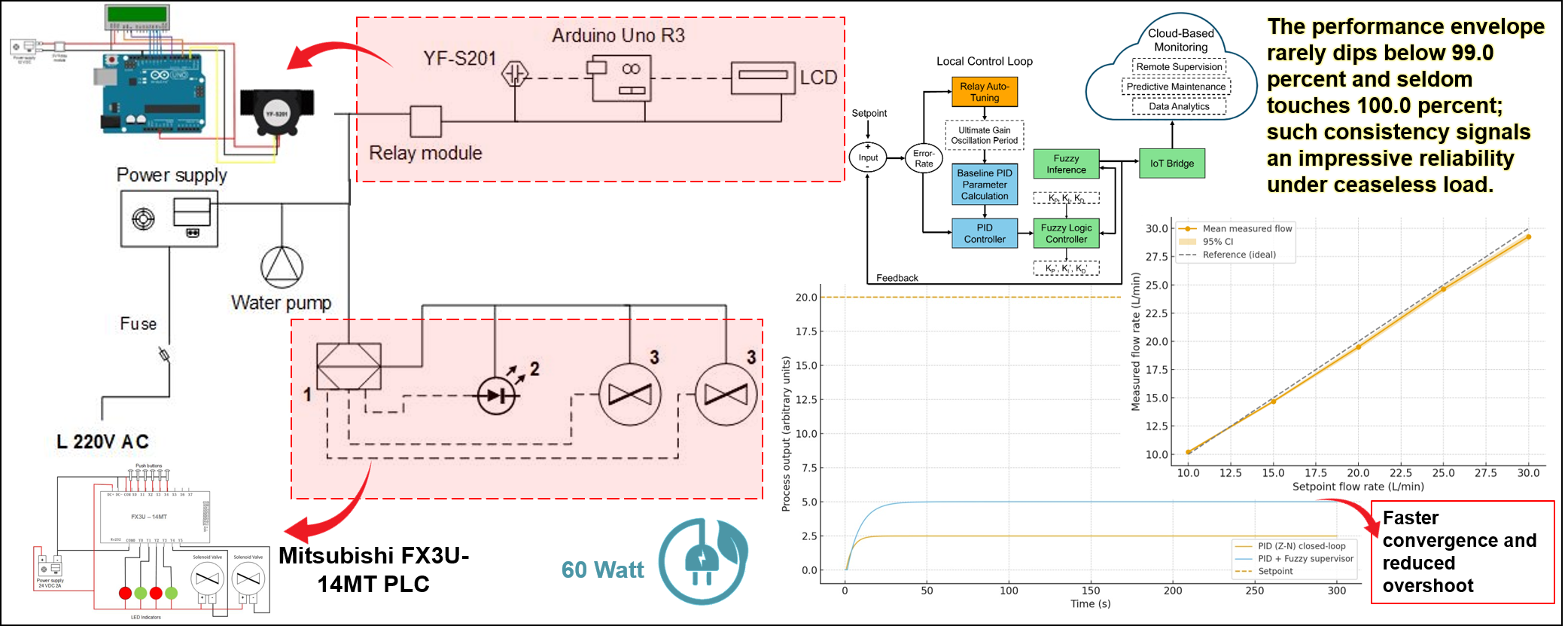
Efficient water management is essential for ensuring sustainability and reducing operational costs, especially in small to medium-scale buildings such as schools, health clinics, and office facilities. This paper presents the design and implementation of a cost-effective automated water flow monitoring system, integrating a Mitsubishi FX3U-14MT PLC with an Arduino module to facilitate real-time flow measurement and precise control of solenoid valves. The PLC is programmed using ladder logic, while the Arduino is responsible for processing sensor data, thereby enhancing measurement accuracy and contributing to overall system flexibility. In contrast to conventional industrial automation solutions, this system is specifically designed for small-scale applications, offering an effective balance of affordability, simplicity, and reliability. Experimental testing demonstrates that the system achieves high measurement accuracy, operational stability over extended use, and optimized energy efficiency, ensuring long-term reliability in water flow management. Additionally, the system’s modular design enables straightforward adaptation to various facility sizes and plumbing configurations. These findings validate the proposed system as an accessible yet effective automation solution, particularly suitable for environments where implementing large-scale industrial control systems may be impractical. Future research could focus on incorporating adaptive control algorithms and enhancing sensor integration to further improve system performance and flexibility.
How to Cite
Herri Trisna Frianto, Syahrul Humaidi, Kerista Tarigan, Dadan Ramdan, Doli Bonardo, Fauzan Amri (2026). Design and Development of a Water Flow Monitoring Device using Mitsubishi FX3U-14MT PLC. Journal of Engineering and Technological Sciences, Vol. 58 No. 3 (2026): Vol. 58 No. 3(2026): June, 332-347. https://doi.org/10.5614/j.eng.technol.sci.2026.58.3.3
Metrics
References
Abbas, F., Yan, Y., & Wang, L. (2021). Mass flow rate measurement of pneumatically conveyed solids through multimodal sensing and data-driven modeling. IEEE Transactions on Instrumentation and Measurement, 70, 1–16.
Abdullah, A. N., Kamarudin, K., Kamarudin, L. M., Adom, A. H., Mamduh, S. M., Mohd Juffry, Z. H., & Bennetts, V. H. (2022). Correction model for metal oxide sensor drift caused by ambient temperature and humidity. Sensors, 22(9), 3301.
Al Fahim, A., Rahman, M. M., Hridoy, M. W., & Uddin, K. R. (2023). Development of a PLC Based Automation Cell for Industry. Journal of Integrated and Advanced Engineering (JIAE), 3(2), 87–100.
Alsabbagh, W., & Langendörfer, P. (2023). Security of programmable logic controllers and related systems: today and tomorrow. IEEE Open Journal of the Industrial Electronics Society, 4, 659–693.
Anik, M. T. H., Ebrahimabadi, M., Danger, J.-L., Guilley, S., & Karimi, N. (2021). Reducing aging impacts in digital sensors via run-time calibration. Journal of Electronic Testing, 37(5), 653–673.
Azizan, M. M. (2024). Power Quality-New Insights: New Insights. BoD–Books on Demand.
Babu, C. G., Jayakar, S. A., Rajesh, T., Saran, G., Thayanithi, C., & Kumar, A. N. K. (2021). An investigation of HMI based PLC-PID for automatic quality water distribution system. 2021 Smart Technologies, Communication and Robotics (STCR), 1–7.
Bandyopadhyay, M., Kolay, S. C., & Chattopadhyay, S. (2024). Design of PLC Based Pressure Control System Using a Low Cost Non-Contact Ultrasonic Type Pressure Transducer. 2024 Fourth International Conference on Advances in Electrical, Computing, Communication and Sustainable Technologies (ICAECT), 1–4. https://doi.org/10.1109/ICAECT60202.2024.10469360
Bilancia, P., Schmidt, J., Raffaeli, R., Peruzzini, M., & Pellicciari, M. (2023). An overview of industrial robots control and programming approaches. Applied Sciences, 13(4), 2582.
Bwambale, E., Abagale, F. K., & Anornu, G. K. (2022). Smart irrigation monitoring and control strategies for improving water use efficiency in precision agriculture: A review. Agricultural Water Management, 260, 107324.
Cană, P., Ripeanu, R. G., Diniță, A., Tănase, M., Portoacă, A. I., & Pătîrnac, I. (2025). A Review of Safety Valves: Standards, Design, and Technological Advances in Industry. Processes, 13(1), 105.
Channi, H. K., Kumar, P., & Dhingra, A. (2024). Application of PLC in the Mechatronics Industry. Computational Intelligent Techniques in Mechatronics, 185–209.
Charishma Pathala, V. S., & Pappu, V. Y. (2023). Innovative measurement and noise reduction of voltage coupling in shielded cables for enhanced signal integrity. AIP Advances, 13(8), 1–14.
Christopoulos, C. (2022). Principles and techniques of electromagnetic compatibility. CRC press.
Chukwunweike, J. N., Anang, A. N., Adeniran, A. A., & Dike, J. (2024). Enhancing manufacturing efficiency and quality through automation and deep learning: addressing redundancy, defects, vibration analysis, and material strength optimization. World Journal of Advanced Research and Reviews, 23(3), 1272–1295.
Dutta, D., Arya, S., & Kumar, S. (2021). Industrial wastewater treatment: Current trends, bottlenecks, and best practices. Chemosphere, 285, 131245.
Ennawaoui, A., Rachidi, M. B., Guennouni, N., Mousaid, I., Daoud, M. A., Mastouri, H., Ennawaoui, C., Chhiti, Y., & Laayati, O. (2025). Water Treatment Technologies: Development of a Test Bench for Optimizing Flocculation-Thickening Processes in Laboratory Applications. Processes, 13(1), 198.
Euzébio, T. A. M., Ramirez, M. A. P., Reinecke, S. F., & Hampel, U. (2023). Energy price as an input to fuzzy wastewater level control in pump storage operation. IEEE Access, 11, 93701–93712.
Folgado, F. J., Calderón, D., González, I., & Calderón, A. J. (2024). Review of Industry 4.0 from the perspective of automation and supervision systems: Definitions, architectures and recent trends. Electronics, 13(4), 782.
Frianto, H. T., Humaidi, S., Tarigan, K., Ramdan, D., & Bonardo, D. (2025). Frequency response-based optimization of PID controllers for enhanced fluid control system performance. International Journal of Applied Power Engineering (IJAPE), 14(4), 1058.
Halstead, B., Koh, Y. S., Riddle, P., Pears, R., Pechenizkiy, M., Bifet, A., Olivares, G., & Coulson, G. (2022). Analyzing and repairing concept drift adaptation in data stream classification. Machine Learning, 111(10), 3489–3523.
Hu, Y.-C., Chen, Z.-Y., & Chang, P.-Z. (2021). Fluid–structure coupling effects in a dual U-tube coriolis mass flow meter. Sensors, 21(3), 982.
Huang, K.-C., Ku, H.-C., Chuang, T.-H., & Huang, W.-N. (2024). Improved Fault Diagnosis Method for PLC-Based Manufacturing Processes with Validation through a Cyber-Physical System. 2024 IEEE 4th International Conference on Electronic Communications, Internet of Things and Big Data (ICEIB), 705–710.
Hucko, S., Krampe, H., & Schmitz, K. (2023). Evaluation of a soft sensor concept for indirect flow rate estimation in solenoid-operated spool valves. Actuators, 12(4), 148.
Ismail, R. (2024). Improving wastewater treatment plant performance: An ann-based predictive model for managing average daily overflow and resource allocation optimization using tabu search. Asian Journal of Civil Engineering, 25(2), 1427–1441.
Jagtap, S., Skouteris, G., Choudhari, V., Rahimifard, S., & Duong, L. N. K. (2021). An internet of things approach for water efficiency: A case study of the beverage factory. Sustainability, 13(6), 3343.
Jasiūnas, J., Lund, P. D., & Mikkola, J. (2021). Energy system resilience – A review. Renewable and Sustainable Energy Reviews, 150, 111476. https://doi.org/10.1016/j.rser.2021.111476
Javaid, M., Haleem, A., Rab, S., Singh, R. P., & Suman, R. (2021). Sensors for daily life: A review. Sensors International, 2, 100121.
Javaid, M., Haleem, A., Singh, R. P., Rab, S., & Suman, R. (2021). Significance of sensors for industry 4.0: Roles, capabilities, and applications. Sensors International, 2, 100110.
Ji, G., & Huber, J. (2022). Recent progress in acoustic metamaterials and active piezoelectric acoustic metamaterials-a review. Applied Materials Today, 26, 101260.
Joffe, E. B., & Lock, K.-S. (2022). Grounds for Grounding: A Handbook from Circuits to Systems. John Wiley & Sons.
Krishna, V. Y., Roshan, B., Kracose Nishanth, J., Anbarasu, P., & Mohan Raj, C. (2024). Smart Reservoir Navigating Waters with Integrated Automation. 2024 10th International Conference on Advanced Computing and Communication Systems (ICACCS), 86–91. https://doi.org/10.1109/ICACCS60874.2024.10717175
Kumar, K., & Saini, R. P. (2022). A review on operation and maintenance of hydropower plants. Sustainable Energy Technologies and Assessments, 49, 101704.
Lee, J.-D., Hsu, H.-Y., Li, C.-Y., & Yang, J.-Y. (2021). Design and implementation of intelligent automated production-line control system. Electronics, 10(20), 2502.
Lisowiec, A., Habrych, M., Michalski, P., Miedzinski, B., & Wisniewski, G. (2023). Interference Level Detector with PCB HDI Rogowski Coil for PLC Narrow-Band Applications. Sensors, 23(15), 6682.
Lupinski, T., Ludwig, M., Fraden, S., & Tompkins, N. (2021). An Arduino-based constant pressure fluid pump. The European Physical Journal E, 44(2), 14. https://doi.org/10.1140/epje/s10189-020-00002-9
Mao, X., Li, X., Huang, Y., Shi, J., & Zhang, Y. (2021). Programmable logic controllers past linear temporal logic for monitoring applications in industrial control systems. IEEE Transactions on Industrial Informatics, 18(7), 4393–4405.
Martins, A. D. B. (2024). Industrial Sensors Online Monitoring and Calibration Through Hidden Markov Models.
Massaad, J., Van Neer, P. L. M. J., Van Willigen, D. M., Sabbadini, A., De Jong, N., Pertijs, M. A. P., & Verweij, M. D. (2021). Measurement of pipe and fluid properties with a matrix array-based ultrasonic clamp-on flow meter. IEEE Transactions on Ultrasonics, Ferroelectrics, and Frequency Control, 69(1), 309–322.
Nicol, M., Laurin, F., Hirsekorn, M., Kaminski, M., Feld-Payet, S., Paulmier, P., & Albouy, W. (2023). Automated crack detection in laminated composites by optical flow measurements. Composites Part B: Engineering, 255, 110599.
Oberascher, M., Rauch, W., & Sitzenfrei, R. (2022). Towards a smart water city: A comprehensive review of applications, data requirements, and communication technologies for integrated management. Sustainable Cities and Society, 76, 103442.
Oloruntoba, A., Zhang, Y., & Hsu, C. S. (2022). State-of-the-art review of fluid catalytic cracking (FCC) catalyst regeneration intensification technologies. Energies, 15(6), 2061.
Palermo, S. A., Maiolo, M., Brusco, A. C., Turco, M., Pirouz, B., Greco, E., Spezzano, G., & Piro, P. (2022). Smart technologies for water resource management: An overview. Sensors, 22(16), 6225.
Ryalat, M., Franco, E., Elmoaqet, H., Almtireen, N., & Al-Refai, G. (2024). The integration of advanced mechatronic systems into industry 4.0 for smart manufacturing. Sustainability, 16(19), 8504.
Rys, D., Więckowski, P., Wasilewska, M., & Dołęga, C. (2024). Impact of accuracy of weigh-in-motion data for pavement analysis and design: influence of temperature variations. Road Materials and Pavement Design, 1–18.
Savić, D. (2022). Digital water developments and lessons learned from automation in the car and aircraft industries. Engineering, 9, 35–41.
Saxena, A., Ali, A., & Abdulsada, Z. R. (2023). Integration of PLC and Robotic Operating System for Enhanced Automation Efficiency. 2023 2nd International Conference on Futuristic Technologies (INCOFT), 1–4.
Sharma, S. K., Chauhan, V. S., & Sinapius, M. (2021). A review on deformation-induced electromagnetic radiation detection: history and current status of the technique. Journal of Materials Science, 56(7), 4500–4551.
Silva, R. C. (2022). Experimental characterization techniques for solid-liquid slurry flows in pipelines: A review. Processes, 10(3), 597.
Su, M., Wang, K., Ke, J., Hou, Y., & Tang, S. (2023). Physical Clock Calibration of Wireless Sensor Node Based on Indoor LED Light. IEEE Sensors Journal, 23(22), 28141–28149.
Tomar, B., Kumar, N., & Sreejeth, M. (2023). Real Time Automation and Ratio Control Using PLC & SCADA in Industry 4.0. Computer Systems Science & Engineering, 45(2), 1495–1516.
Walter, D., Bülau, A., & Zimmermann, A. (2023). Review on excess noise measurements of resistors. Sensors, 23(3), 1107.
Wang, N., Li, C., Li, W., Chen, X., Li, Y., & Qi, D. (2021). Heat dissipation optimization for a serpentine liquid cooling battery thermal management system: An application of surrogate assisted approach. Journal of Energy Storage, 40, 102771.
Wang, R., Li, Y., Yang, F., Wang, Z., Dong, J., Yuan, C., & Lu, X. (2024). PLC based laser scanning system for conveyor belt surface monitoring. Scientific Reports, 14(1), 27914.
Watson, N. J., Bowler, A. L., Rady, A., Fisher, O. J., Simeone, A., Escrig, J., Woolley, E., & Adedeji, A. A. (2021). Intelligent sensors for sustainable food and drink manufacturing. Frontiers in Sustainable Food Systems, 5, 642786.
Wiegleb, G. (2023). Gas Measurement Technology in Theory and Practice: Measuring Instruments, Sensors, Applications. Springer.
Ye, J., Do, N. C., Zeng, W., & Lambert, M. (2022). Physics-informed neural networks for hydraulic transient analysis in pipeline systems. Water Research, 221, 118828.
Ying, D., & Hall, D. A. (2021). Current sensing front-ends: A review and design guidance. IEEE Sensors Journal, 21(20), 22329–22346.
Zaki, T. A. (2024). Turbulence from an observer perspective. Annual Review of Fluid Mechanics, 57, 311–334.
Zhai, H., Song, X., Wang, X., & Liu, G. (2024). Design of a Flow Automatic Calibration System Based on the Master Meter and Dynamic Weighing Methods. IEEE Access, 12, 37141–37151.
Zhai, L. (2021). Electromagnetic compatibility of electric vehicle. Springer Nature.
Zhang, S., Luo, M., Qian, H., Liu, L., Yang, H., Zhang, Y., Liu, X., Xie, Z., Yang, L., & Zhang, W. (2023). A review of valve health diagnosis and assessment: Insights for intelligence maintenance of natural gas pipeline valves in China. Engineering Failure Analysis, 153, 107581.
Zhang, X., Duan, N., Jiang, L., Xu, F., Yu, Z., Cheng, W., Lv, W., & Qiu, Y. (2023). Application of PLC-Based Spectrophotometric System Nitrogen Protection Device to Automated Direct Measurement of Target Substances in Zinc Hydrometallurgy. Processes, 11(3), 672.
License
Copyright (c) 2026 by Authors

This work is licensed under a Creative Commons Attribution 4.0 International License.
Downloads
Date Log
- Submitted
- March 6, 2025
- Accepted
- January 14, 2026
- Published
- February 20, 2026
Keywords
- Arduino
- Mitsubishi FX3U-14MT PLC
- PLC
- solenoid valve
- water flow monitoring


