Influence of NaOH Treatment Duration on the Properties of High-Loaded Coconut Shell Particle Epoxy Biocomposites
Downloads
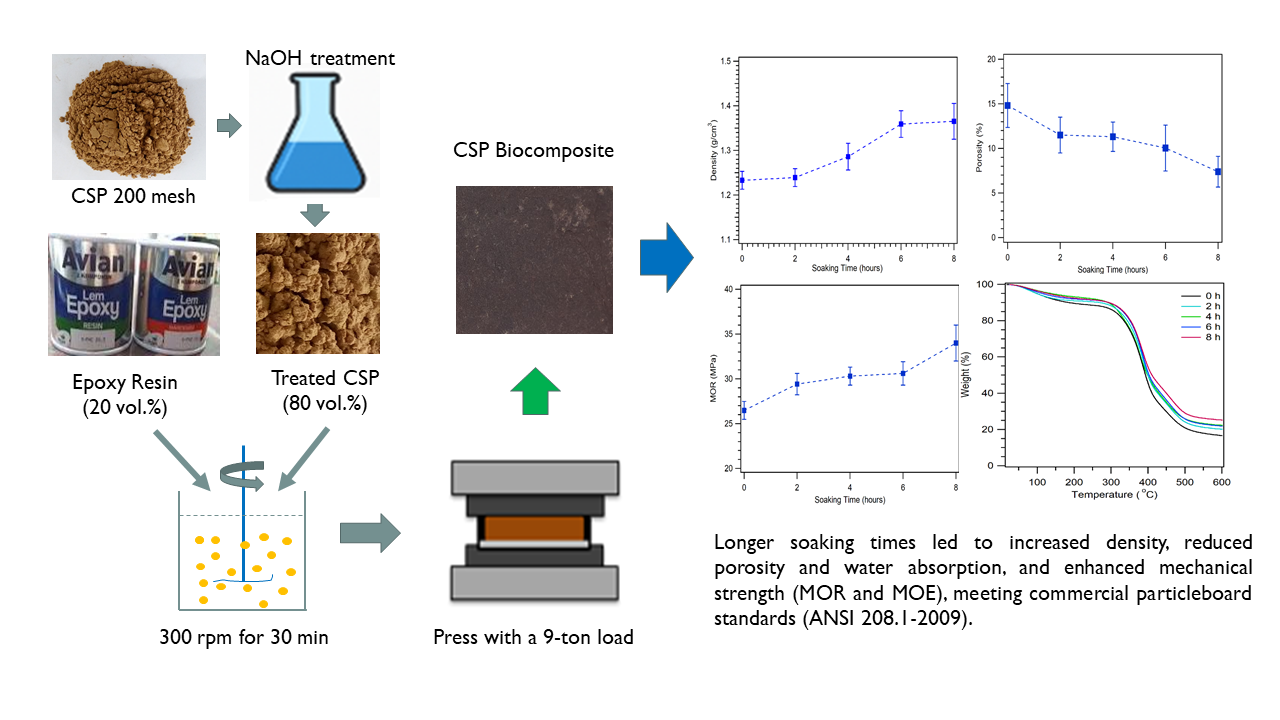
The objective of this work is to study the effect of soaking time of coconut shell particles in 10% NaOH solution on the performance of the biocomposites. The soaking time was varied from 0, 2, 4, 6, and 8 hours. The size of the coconut shell particles used in this study was 200 mesh. The chemical characterization of coconut shell particles before and after treatment with NaOH was performed using FTIR, XRF, and XRD. The coconut shell biocomposites were prepared by using the press method, consisting of 80 vol.% coconut shell particles and 20 vol.% epoxy resin. The density, porosity, water absorption, thickness swelling, modulus of rupture, modulus of elasticity, and thermal decomposition of biocomposites were measured. The results show that the performance of the biocomposites is significantly affected by the immersion time of coconut shell particles in the NaOH solution. Further, it has been observed that the notable improvements in the properties occur after NaOH treatment of the fillers. SEM images showed a significant reduction in particle agglomeration and porosity after NaOH treatment of the fillers. This indicates that the NaOH treatment modified the surface characteristics of the coconut shell particles by removing lignin, which improved their compatibility and interaction with the epoxy resin.
Ahmed, J.P.S., Karedla, S., R., R., Meenakshisundaram, O., & S., S. (2023). A comprehensive review on recent developments of natural fiber composites synthesis, processing, properties, and characterization. Engineering Research Express, 5, 032001. https://doi.org/10.1088/2631-8695/aceb2d
Ang, Q., Chen, T., Wang, X., Zheng, Y., Zheng, J., Song, G., & Liu, S. (2023). Recent progress on moisture absorption aging of plant fiber reinforced polymer composites. Polymers, 15(20), 4121. https://doi.org/10.3390/polym15204121
ANSI, 2009. American National Standards Institute, ANSI A208. 1; Composite Panel Association: Leesburg, Virginia, 2009. Available at: https://www.ansi.org/
Aravindh, M. A., Sathish, S., Raj, R. R., Karthick, A., Mohanavel, V., Patil, P. P., Muhibbullah, M., & Osman, S. M. (2022). A Review on the Effect of Various Chemical Treatments on the Mechanical Properties of Renewable Fiber-Reinforced Composites. Advances in Materials Science and Engineering, 2022, 1–24. https://doi.org/10.1155/2022/2009691
Bichang'a, D. O., Oladele, I. O., Alabi, O. O., Aramide, F. O., Oluseye, O., Borisade, S. G., Githinji, D. N., & Ojemaye, M. O. (2024). Comparative property investigation of raw and treated coconut shell biomass for potential polymer composite application. Heliyon, 10(23), e40704. https://doi.org/10.1016/j.heliyon.2024.e40704
Bledzki, A. K., Mamun, A. A., & Volk, J. (2010). Barley husk and coconut shell reinforced polypropylene composites: The effect of fibre physical, chemical, and surface properties. Composites Science and Technology, 70(5), 840–846. https://doi.org/10.1016/j.compscitech.2010.01.022
Brebu, M., & Vasile, C. (2010). Thermal Degradation of Lignin—A Review. Cellulose Chemistry and Technology, 44(1-3), 353-363.
Bumphenkiattikul, P., Limtrakul, S., Vatanatham, T., Khongprom, P., & Ramachandran, P. A. (2018). Heat transfer effect in scaling-up a fluidized bed reactor for propylene polymerization. RSC Advances, 8(50), 28293–28312. https://doi.org/10.1039/c8ra04834g
Chegdani, F., & Mansori, M. E. (2024). Perspectives on the robustness of the mechanical properties assessment of biocomposites. Journal of Applied Physics, 135, 080901. https://doi.org/10.1063/5.0189109
Checol, C. N., & Sendekie, Z. B. (2025). Effect of alkali treatment on physicochemical and microstructural properties of false banana fiber. Scientific Reports, 15, 25446. https://doi.org/10.1038/s41598-025-10825-1
Darawsheh, M. K., Beslemes, D., Kouneli, V., Tigka, E., Bilalis, D., Roussis, I., Karydogianni, S., Mavroeidis, A., Triantafyllidis, V., Kosma, C., Zotos, A., & Kakabouki, I. (2022). Environmental and Regional Effects on Fiber Quality of Cotton Cultivated in Greece. Agronomy, 12(4), 943. https://doi.org/10.3390/agronomy12040943
Dayan, M. A. R., Rahman, M. M., Ferdush, J., Kaysar, M. A., & Uddin, M. M. (2022). Effect of Harvesting Time on the Fiber Yield and Characterization of Jute Fiber. Journal of Natural Fibers, 19(15), 12434–12445. https://doi.org/10.1080/15440478.2022.2060405
Durowaye, S., Lawal, G., Akande, M., & Durowaye, V. (2014). Mechanical properties of particulate coconut shell and palm fruit polyester composites. International Journal of Materials Engineering, 4(4), 141–147. http://article.sapub.org/10.5923.j.ijme.20140404.04.html
Elfaleh, I., Abbassi, F., Habibi, M., Ahmad, F., Guedri, M., Nasri, M., & Garnier, C. (2023). A comprehensive review of natural fibers and their composites: An eco-friendly alternative to conventional materials. Results in Engineering, 19, 101271. https://doi.org/10.1016/j.rineng.2023.101271
Faizi, M. K., Shahriman, A. B., Abdul Majid, M. S., Ahmad, Z. A., Shamsul, B. M. T., & Ng, Y. G. (2017). The effect of alkaline treatments soaking time on oil palm empty fruit bunch (OPEFB) fibre structure. Journal of Physics: Conference Series, 908(1), 012033. http://doi.org/10.1088/1757-899X/429/1/012006
Faruk, O., Bledzki, A. K., Fink, H. P., & Sain, M. (2012). Biocomposites reinforced with natural fibers. Progress in Polymer Science, 37(11), 1552–1596. http://doi.org/10.1016/j.progpolymsci.2012.04.003
Geetanjali, R., & Singh, R. (2022). Chapter 6 - Polymer-based bio-composites and their applications. In T. Altalhi & Inamuddin (Eds.), Green sustainable process for chemical and environmental engineering and science (pp. 109–121). Elsevier. https://doi.org/10.1016/b978-0-323-99643-3.00017-6
Hoque, E., Rayhan, A. M., & Shaily, S. (2021). Natural Fiber-based Green Composites: Processing, Properties and Biomedical Applications. Applied Science and Engineering Progress, 14(4), 689-718. https://doi.org/10.14416/J.ASEP.2021.09.005
Ismail, I., Arliyani, S., Jalil, Z., Mursal, M., Olaiya, N. G., Abdullah, C. K., Fazita, M. R. N., & Abdul Khalil, H. P. S. (2020a). Properties and characterization of new approach organic nanoparticle‐based biocomposite board. Polymers, 12(10), 2236. https://doi.org/10.3390/polym12102236
Ismail, I., Arliyani, S., Fathmiyah, S., Mursal, M., Jalil, Z., & Khalil, H. P. S. A. (2020b). Effect of ball-milling time on chemical property of coconut shell powder. Journal of Physics: Conference Series, 1572(1), 012021. https://doi.org/10.1088/1742-6596/1572/1/012021
Ismail, I., Aini, Q., Jalil, Z., Olaiya, N. G., Mursal, M., Abdullah, C. K., & H.P.S., A. K. (2022). Properties Enhancement Nano Coconut Shell Filled in Packaging Plastic Waste Bionanocomposite. Polymers, 14(4), 772. https://doi.org/10.3390/polym14040772
Jawalkar, C. S., & Kant, S. (2021). Critical Review on Chemical Treatment of Natural Fibers to Enhance Mechanical Properties of Bio Composites. Silicon, 1, 22. https://doi.org/10.1007/S12633-021-01194-1
Jayabal, S., Sathiyamurthy, S., Loganathan, K. T., & Kalyanasundaram, S. (2012). Effect of soaking time and concentration of NaOH solution on mechanical properties of coir–polyester composites. Bulletin of Materials Science, 35(4), 567–574.
Kondo, Y., Arsyad, M., Ahmad, Soenoko, R., & Arman. (2023). Effects of alkali solution concentration and soaking time on mechanical properties of coconut fibre. Archives of Materials Science and Engineering, 124(2), 62–70. https://doi.org/10.5604/01.3001.0054.3232
Kudva, A., Mahesha, G. T., & Pai, D. (2024). Influence of Chemical Treatment on the Physical and Mechanical Properties of Bamboo Fibers as Potential Reinforcement for Polymer Composites. Journal of Natural Fibers, 21(1), 2332698. https://doi.org/10.1080/15440478.2024.2332698
Lawal, N., Danladi, A., Dauda, B., Kogo, A., Baba, M. A., & Busuguma, U. (2023). The effect of alkali treatment on the mechanical properties of date seed particulates waste polypropylene filled composites. The Scientific World Journal, 18(3), 348–355. https://doi.org/10.4314/swj.v18i3.4
Leman, A. S., Shahidan, S., Senin, M. S., & Hannan, N. I. R. R. (2016). A preliminary study on chemical and physical properties of coconut shell powder as a filler in concrete. IOP Conference Series: Materials Science and Engineering, 160(1), 012059. https://doi.org/10.1088/1757-899X/160/1/012059
Lou, C. W., Chao, T. H., Lu, C. T., Lu, P. C., & Lin, J.-H. (2013). Effects of Sodium Hydroxide Treatment Duration on the Physical Properties of IRM®/Polylactic Acid Composite Filling Materials. Applied Mechanics and Materials, 365, 999–1002.
Mahmud, S., Hasan, K. M. F., Jahid, M. A., Mohiuddin, K., Zhang, R. and Zhu, J. (2021). Comprehensive review on plant fiber-reinforced polymeric biocomposites. Journal of Materials Science, 56(12), 7231–7264. https://doi.org/10.1007/s10853-021-05774-9
Marzuki, H. F. A., Engku Ubaidillah, E. A., Wahid, A. F., Jaffar, N. A. S., Mohd Saufi, N. F., & Syed Bakar, S. S. (2017). Effect of NaOH soaking time on kenaf/glass fiber hybrid epoxy composites. AIP Conference Proceedings, 1901(1), 030023. https://doi.org/10.1063/1.5010488
McKay, I., Vargas, J., Yang, L., & Felfel, R. M. (2024). A Review of Natural Fibres and Biopolymer Composites: Progress, Limitations, and Enhancement Strategies. Materials, 17(19), 4878. https://doi.org/10.3390/ma17194878
Mohanty, A.K., Vivekanandhan, S., Pin, J.M., Misra M. (2018). Composites from renewable and sustainable resources: Challenges and Innovations. Science, 362, pp. 536–542. https://doi.org/10.1126/science.aat9072
Mylsamy, B., Shanmugam, S. K. M., Aruchamy, K., Palanisamy, S., Nagarajan, R., & Ayrilmis, N. (2024). A review on natural fiber composites: Polymer matrices, fiber surface treatments, fabrication methods, properties, and applications. Polymer Engineering & Science, 64(6), 2345–2373. https://doi.org/10.1002/pen.26713
Nadzri, S. N. I. H. A., Sultan, M. T. H., Shah, A. U. M., Safri, S. N. A., Talib, A. R. A., Jawaid, M., and Basri, A. A. (2022). A comprehensive review of coconut shell powder composites: Preparation, processing, and characterization. Journal of Thermoplastic Composite Materials, 35(12), 2641–2664. https://doi.org/10.1177/0892705720930808
Natrayan, L., Chinta, N. D., Gogulamudi, B., Swamy Nadh, V., Muthu, G., Kaliappan, S., & Srinivas, C. (2024). Investigation on mechanical properties of the green synthesis bamboo fiber/eggshell/coconut shell powder-based hybrid biocomposites under NaOH conditions. Green Processing and Synthesis, 13(1), 20230185. https://doi.org/10.1515/gps-2023-0185
Nhuapeng, W., Chintonguyad, T., & Thamjaree, W. (2022). The Influence of Alkaline Treatment on Tensile Properties of Short Bamboo Fiber Reinforced Epoxy Resin Biocomposites. Journal of Physics: Conference Series, 2175(1), 012004. https://doi.org/10.1088/1742-6596/2175/1/012004
Onwumere, R. A., Nnakwo, K. C., & Okorie, B. A. (2019). Effect of alkaline treatment on mechanical and thermal properties of coconut shell particulates reinforced epoxy composite. American Journal of Chemistry and Materials Science, 6(1), 10–14.
Patel, R. H., Kapatel, P. M., Machchhar, A. D., & Kapatel, Y. A. (2016). Studies on natural fiber reinforced polymer matrix composites. AIP Conference Proceedings, 1728(1), 020233. https://doi.org/10.1063/1.4946284
Pokharel, A., Falua, K. J., Babaei-Ghazvini, A., & Acharya, B. (2022). Biobased Polymer Composites: A Review. Journal of Composites Science, 6(9), 255. https://doi.org/10.3390/jcs6090255
Sahai, R. S. N., Biswas, D., Yadav, M. D., Samui, A., & Kamble, S. (2022). Effect of alkali and silane treatment on water absorption and mechanical properties of sisal fiber reinforced polyester composites. Metallurgical and Materials Engineering, 28(4), 641–656. https://doi.org/10.56801/MME864
Samanth, M., & Bhat, K. S. (2023). Conventional and unconventional chemical treatment methods of natural fibres for sustainable biocomposites. Sustainable Chemistry for Climate Action, 3, 100034. https://doi.org/10.1016/j.scca.2023.100034
Santhosh, N., Praveena, B. A., Gowda, A. C., Duhduh, A. A., Rajhi, A. A., Alamri, S., Berwal, P., Khan, M. A., & Wodajo, A. W. (2024). Innovative eco-friendly bio-composites: A comprehensive review of the fabrication, characterization, and applications. Reviews on Advanced Materials Science, 63(1), 20240057. https://doi.org/10.1515/rams-2024-0057
Singh, A., Singh, S., & Kumar, A. (2013). Study of mechanical properties and absorption behaviour of coconut shell powder-epoxy composites. International Journal of Materials Science and Applications, 2(5), 157–161. https://doi.org/10.11648/j.ijmsa.20130205.12
Singh, A., Singh, S., Kumar, A., & Kumar, A. (2014). Characterization of novel coconut shell powder reinforced epoxy composite. Journal of Engineering and Technology Research, 2(5), 1–7.
Siraj, M. T., Alshybani, I., Payel, S. B., Shahadat, M. R. B., & Rahman, M. Z. (2024). Advances in biocomposite fabrication: Emerging technologies and their potential applications. In S. Hashmi (Ed.), Comprehensive materials processing (Second Edition), 648–671. https://doi.org/10.1016/b978-0-323-96020-5.00076-5
Somashekhar, T. M., Naik, P., Nayak, V., Mallikappa, M., & Rahul, S. (2018). Study of mechanical properties of coconut shell powder and tamarind shell powder reinforced with epoxy composites. IOP Conference Series: Materials Science and Engineering, 376(1), 012105. https://doi.org/10.1088/1757-899X/376/1/012105
Udhayasankar, R., Karthikeyan, B., & Balaji, A. (2020). Comparative mechanical, thermal properties and morphological study of untreated and NaOH-treated coconut shell-reinforced cardanol environmentally friendly green composites. Journal of Adhesion Science and Technology, 34(16), 1720–1740. https://doi.org/10.1080/01694243.2020.1727643
Yang, H., Yan, R., Chen, H., Lee, D. H., & Zheng, C. (2007). Characteristics of hemicellulose, cellulose and lignin pyrolysis. Fuel, 86(12-13), 1781–1788. https://doi.org/10.1016/j.fuel.2006.12.013
Yang, Y., Zhang, L., Zhang, J., Ren, Y., Huo, H., Zhang, X., Huang, K.-Y., & Zhang, Z. (2023). Reengineering Waste Boxwood Powder into Light and High-Strength Biodegradable Composites to Replace Petroleum-Based Synthetic Materials. ACS Applied Materials & Interfaces, 15(3), 4505–4515. https://doi.org/10.1021/acsami.2c19844
Yeh, S.-K., Hsieh, C.-C., Chang, H.-C., Yen, C. C. C., & Chang, Y.-C. (2015). Synergistic effect of coupling agents and fiber treatments on mechanical properties and moisture absorption of polypropylene–rice husk composites and their foam. Composites Part A: Applied Science and Manufacturing, 68, 313–322. https://doi.org/10.1016/j.compositesa.2014.10.019
Yew, B. S., Muhamad, M., Mohamed, S. B., & Wee, F. H. (2019). Effect of alkaline treatment on structural characterisation, thermal degradation and water absorption ability of coir fibre polymer composites. Sains Malaysiana, 48(3), 653–659. https://doi.org/10.17576/jsm-2019-4803-19
Yousif, E., & Haddad, R. (2013). Photodegradation and photostabilization of polymers, especially polystyrene: Review. SpringerPlus, 2, 398. https://doi.org/10.1186/2193-1801-2-398
Copyright (c) 2026 Journal of Engineering and Technological Sciences

This work is licensed under a Creative Commons Attribution-NonCommercial-NoDerivatives 4.0 International License.