
Enhanced Finite Element Numerical Analysis of Rigid Inclusion Lateral Resistance for Embankment on Slightly Overconsolidated Soft Clay
Abstract
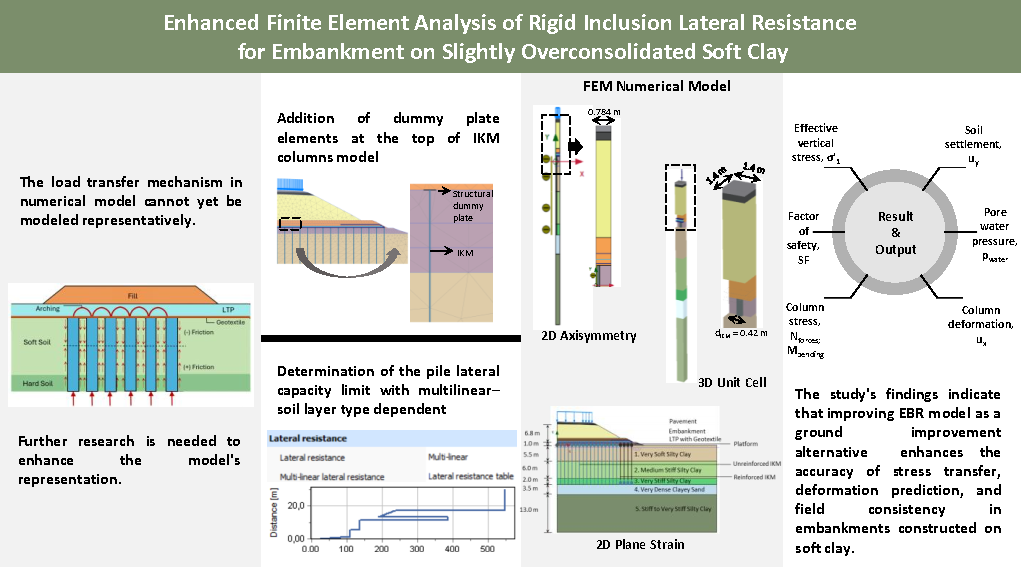
Soft clay soils represent a significant challenge for embankment construction due to high compressibility, low shear strength, low bearing capacity, and excessive settlement potential. This study presents an enhanced finite-element model to evaluate the performance of Mortar Column Inclusion (Inklusi Kolom Mortar, or IKM) as a rigid inclusion supporting embankments over slightly overconsolidated soft clays, as implemented in the Serang-Panimbang Toll Road Project (STA 75+600 to STA 75+800). The propose approach integrates depth-dependent multilinear lateral resistance with structural “dummy” plate elements to capture soil arching within the Load Transfer Platform (LTP) and lateral column-soil interaction—an approach not previously applied in rigid inclusions modeling for soft clays. Studies on numerical modeling of IKM systems in slightly overconsolidated soft clays remain limited. Finite element analyses are conducted using PLAXIS 2D and 3D with axisymmetric, unit-cell, and plane strain approaches. The results show that the "dummy" plate simulates soil arching in the LTP and improves the representation of negative skin friction, neutral-plane transition, and axial load distribution. Depth-dependent lateral resistance enhances predictions of column bending moments and horizontal deformation within varying soil layers. Field validation indicates good agreement, with inclinometer displacement predicted at 40.79 mm (difference < 10%). Predicted vertical settlements of 20.71 cm (centerline) and 19.38 (edge) are also consistent with settlement plate readings of 15.80 and 11.00 cm, respectively. These findings confirm that the enhanced model provides a comprehensive evaluation of stress distribution, pile deformation, and global stability for ground improvement design in soft clays
How to Cite
Kanti Haskarini, Agus Himawan, Masyhur Irsyam, Sugeng Krisnanto, Darmawan Adi Susanto, Bintang Putra Nusantara (2026). Enhanced Finite Element Numerical Analysis of Rigid Inclusion Lateral Resistance for Embankment on Slightly Overconsolidated Soft Clay. Journal of Engineering and Technological Sciences, Vol. 58 No. 3 (2026): Vol. 58 No. 3(2026): June, 366-378. https://doi.org/10.5614/j.eng.technol.sci.2026.58.3.5
Metrics
References
ASIRI National Project. (2012). Recommendations for the Design, Construction, and Control of Rigid Inclusion Ground Improvements. Presses des Ponts. Paris, France.
Bo, M.W., Arulrajah, A., & Samingthong, W. (2017). Research-oriented Ground Investigation Projects at Changi, Singapore. Geotechnical Research, 4(1), 30-46. E-ISSN 2052-6156. https://doi.org/10.1680/jgere.16.00018 .
British Standards Institution. (2004). EN 1992-1-1: 2004 Design of Concrete Structures - Part 1-1. British Standards Institution. London, United Kingdom.
British Standards Institution. (2010). BS 8006-1:2010 Code of Practice for Strengthened/Reinforced Soils and Other Fills. British Standards Institution. London, United Kingdom.
Broms, B.B. (1964a). Lateral Resistance of Piles in Cohesionless Soils. Journal of Soil Mechanics and Foundations Div., ASCE, 90, 123–156.
Broms, B.B. (1964b). Lateral Resistance of Piles in Cohesive Soils. Journal of Soil Mechanics and Foundations Div., ASCE, 90, 27–63.
Goudar, S., & Kamatagi, A. (2022). An Experimental Evaluation of Axial Load Bearing Capacity of Belled and Straight Piles Embedded in Sand. International Journal of Engineering, 35(8), 1599-1607. doi:10.5829/IJE.2022.35.08B.16.
Han, J. (2015). Principles and Practices of Ground Improvement. John Wiley & Sons, Inc. New Jersey, United States.
Liu, Z. L. & Mi, C. (Eds). (2018). Application in Cement Soil of Stabilizer in Silt Soft Soil of Wuxi in China. Advances in Sustainable Port and Ocean Engineering. Journal of Coastal Research, 83, 316–323. https://doi.org/10.2112/SI83-052.1.
Marjanović et al. (2016). Modeling of Laterally Loaded Piles using Embedded Beam Elements. International Conference on Contemporary Achievements in Civil Engineering 2016. doi:10.14415/konferencijagfs 2016.035.
Nweke, C.C., & Pestana, J.M. (2018). Modeling Bio-Cemented Sands: A Strength Index for Cemented Sands. International Foundation Congress and Equipment Expo 2018.
PT. ADHI KARYA (Persero) Tbk. (2024). Geotechnical Report and Construction Documents for Serang–Panimbang Toll Road Section 3.
Randolph, M., & Gouvernec, S. (2011). Offshore Geotechnical Engineering. Spon Press. Abingdon, United Kingdom.
Sluis, J. J. M. (2012). Validation of Embedded Pile Row in PLAXIS 2D. Delft University of Technology. Delft, Netherlands.
Smulders, C. M., Hosseini, S., & Brinkgreve, R. (2019). Improved Embedded Beam with Interaction surface (Poutre Incorporée Améliorée avec Aurface d’Interaction). XVII ECSMGE-2019: Geotechnical Engineering Foundation of the Future,193,1-8. https://doi.org/10.32075/17ECSMGE-2019-0139.
Tinjum, J. M., & Schittone, J. V. (2012). Landfill Construction through Peat and Organic Silt. Soft Ground Technology Conference,388–398. https://doi.org/10.1061/40552(301)30.
van Der Kwaak, B. (2015). Modelling of Dynamic Pile Behaviour During an Earthquake using PLAXIS 2D: Embedded Beam (Rows). Delft University of Technology. Delft, Netherlands.
van Eekelen, S. J. M., Bezuijen, A., Lodder, H. J., & van Tol, A. F. (2012a). Model Experiments on Piled Embankments Part I. Geotextiles and Geomembranes,32, 69–81. https://doi.org/10.1016/j.geotexmem.2011.11.002.
van Eekelen, S. J. M., Bezuijen, A., Lodder, H. J., & van Tol, A. F. (2012b). Model Experiments on Piled Embankments Part II. Geotextiles and Geomembranes,32, 82–94. https://doi.org/10.1016/j.geotexmem.2011.11.003
van Eekelen, S. J. M., Bezuijen, A., Lodder, H. J., & van Tol, A. F. (2013). An Analytical Model for Arching in Piled Embankments. Geotextiles and Geomembranes, 39, 78–102. https://doi.org/10.1016/j.geotexmem.2013.07.005
License
Copyright (c) 2026 by Authors

This work is licensed under a Creative Commons Attribution 4.0 International License.
Downloads
Date Log
- Submitted
- June 5, 2025
- Accepted
- December 2, 2025
- Published
- February 27, 2026
Keywords
- finite element numerical modeling
- ground improvement
- lateral resistance
- mortar column inclusion
- slightly overconsolidated clay


