Damage Tolerance Characteristics of Woven-Carbon/Epoxy Laminates under Low-Velocity Impact: Insights from Tests and Simulations
Downloads
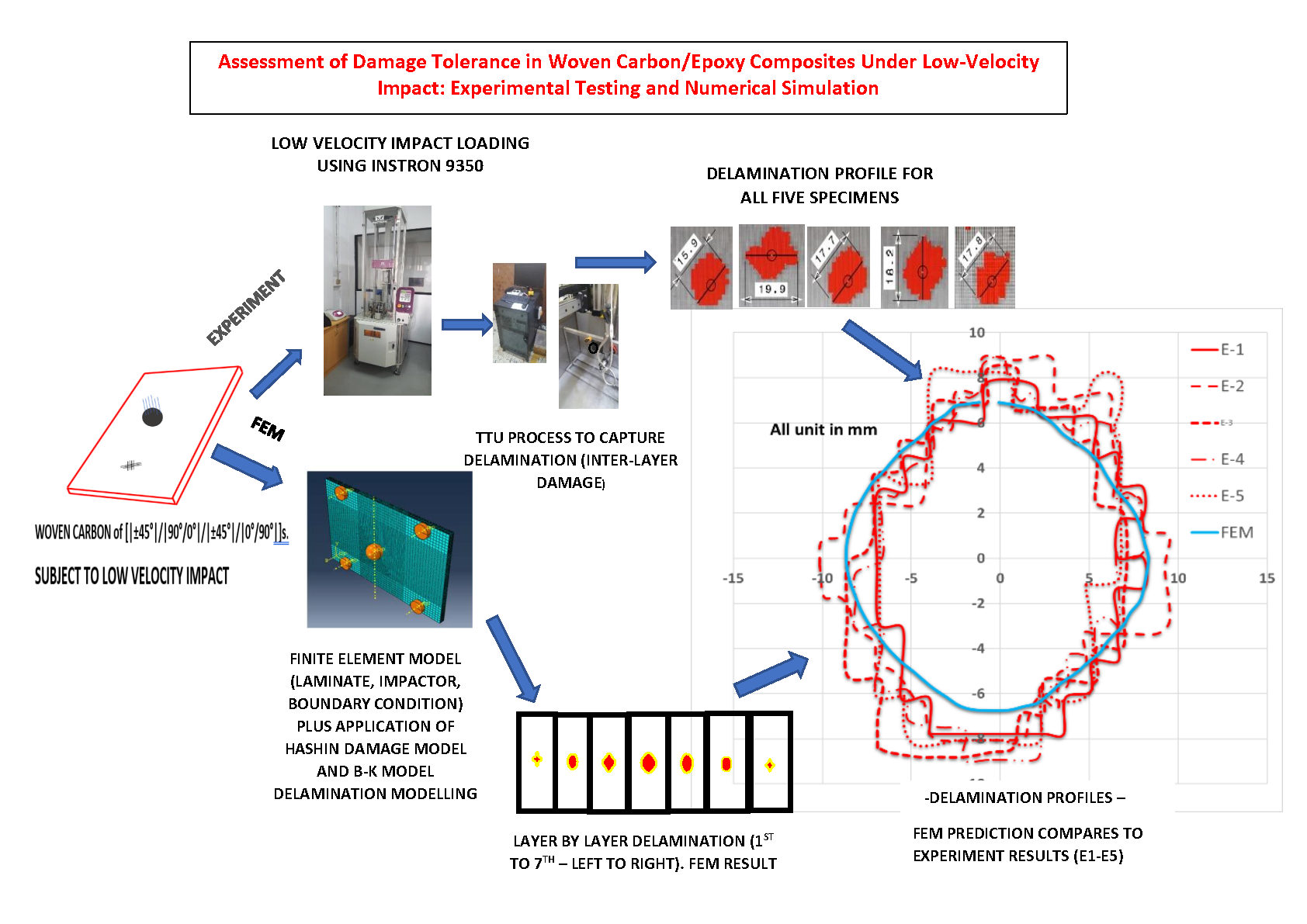
This study investigated the low-velocity impact damage tolerance of woven AS4/8552 carbon/epoxy laminates through combined drop-weight testing and finite element simulation. Five eight-layer [|±45°|/|90°/0°|/|±45°|/|0°/90°|]s specimens were impacted at 8.25 J, and the resulting internal damage was characterized using ultrasonic C-scanning. A detailed FEM model was developed in ABAQUS using SC8R continuum-shell elements for the laminae and COH3D8 cohesive-zone elements for interlaminar delamination, with Hashin failure criteria and the Benzeggagh–Kenane mixed-mode fracture law governing damage initiation and propagation. The numerical model reproduced the main experimental impact response, predicting a peak force of 4950 N compared with the experimental mean of 4360 N, corresponding to a 13% overestimation. The predicted delamination footprint also agreed well with C-scan observations, which showed delamination diameters ranging from 15.9 to 19.9 mm, with an average of 17.9 mm. However, the simulation underestimated absorbed energy by approximately 40% and produced smoother delamination boundaries than those observed experimentally. These discrepancies are attributed to the homogeneous cohesive-zone representation and continuum-shell formulation, which cannot fully capture fiber bridging, microcracking, interlaminar friction, and local stress perturbations caused by woven yarn undulations. The results demonstrate that the proposed framework is effective for predicting the global delamination extent and impact response of aerospace-representative woven laminates, while highlighting key improvements required for higher-fidelity damage-tolerance assessment.
Andrew, J. J., Srinivasan, S. M., Arockiarajan, A., & Dhakal, H. N. (2019). Parameters influencing the impact response of fiber-reinforced polymer matrix composite materials: A critical review. Composite Structures, 224, 111007. https://doi.org/10.1016/j.compstruct.2019.111007
Anuse, V. S., Shankar, K., Velmurugan, R., & Ha, S. K. (2022). Compression-After-Impact analysis of carbon fiber reinforced composite laminate with different ply orientation sequences. International Journal of Impact Engineering, 167, 104277. DOI: 10.1016/j.ijimpeng.2022.104277.
Ao, W., Zhuang, W., Xing, B., Zhou, Q., & Xia, Y. (2022). Finite element method of a progressive intralaminar and interlaminar damage model for woven fibre laminated composites under low velocity impact. Materials & Design, 223, 111256. https://doi.org/10.1016/j.matdes.2022.111256
ASTM D7136/D7136M-25. (2025). Standard Test Method for Measuring the Damage Resistance of a Fiber-Reinforced Polymer Matrix Composite to a Drop Weight Impact Event.
Benzeggagh, M. L., & Kenane, M. (1996). Measurement of mixed-mode delamination fracture toughness of unidirectional glass/epoxy composites with mixed-mode bending apparatus. Composites Science and Technology, 56(4), 439–449. https://doi.org/10.1016/0266-3538(96)00005-x
Dassault Systems Simulia Corp. (2024). Abaqus 2024 Documentation. https://help.3ds.com
Fanteria, D., Lazzeri, L., Panettieri, E., Mariani, U., & Rigamonti, M. (2017). Experimental characterization of the interlaminar fracture toughness of a woven and a unidirectional carbon/epoxy composite. Composites Science and Technology, 142, 20–29. https://doi.org/10.1016/j.compscitech.2017.01.028
Fawcett, A. J., & Oakes, G. D. (2006). Boeing Composite Airframe Damage Tolerance and Service Experience. Proceedings of the FAA Composite Damage Tolerance and Maintenance Workshop, Chicago, IL, 19–21 July 2006. Boeing Commercial Airplanes.
Grasso, M., Xu, Y., Ramji, A., Zhou, G., Chrysanthou, A., Haritos, G., & Chen, Y. (2019). Low-velocity impact behaviour of woven laminate plates with fire retardant resin. Composites Part B: Engineering, 171, 1–8. https://doi.org/10.1016/j.compositesb.2019.04.023
Hashin, Z. (1980). Failure criteria for unidirectional fiber composites. Journal of Applied Mechanics, 47(2), 329–334. https://doi.org/10.1115/1.3153664
Hexcel Corporation (2020). AS4/8552 Epoxy Matrix, Intermediate Modulus Fiber – Material Properties. Product Data Sheet. https://www.hexcel.com/Resources/DataSheets/Prepreg-Materials/AS4-8552
Sanga, R. P. L., Garnier, C., & Pantalé, O. (2016). Finite element simulation of low velocity impact damage on an aeronautical carbon composite structure. Applied Composite Materials, 23(6), 1195–1208. https://doi.org/10.1007/s10443-016-9508-1
Liu, B., Xu, F., Qin, J., & Lu, Z. (2017). Study on impact damage mechanisms and TAI capacity for the composite scarf repair of the primary load-bearing level. Composite Structures, 181, 183–193. https://doi.org/10.1016/j.compstruct.2017.08.087
Liu, B., Han, Q., Zhong, X., & Lu, Z. (2019). The impact damage and residual load capacity of composite stepped bonding repairs and joints. Composites Part B: Engineering, 158, 339–351. https://doi.org/10.1016/j.compositesb.2018.09.096
Liu, B., Li, F., Liu, Y., & Zhang, Y. (2024). Experimental and numerical studies on low-velocity impact of laminated C/SiC structures. Composite Structures, 329, 117765. https://doi.org/10.1016/j.compstruct.2023.117765
Liu, L., Li, F., Zhao, Z., Zhang, X & Liu, B. (2026). Impact damage and compression after impact on the CFRP-GFRP hybrid composite materials applied to aero-smart-skins. Proceedings of the Institution of Mechanical Engineers, Part L: Journal of Materials: Design and Applications. https://doi.org/10.1177/14644207261418448.
Ma, B., Cao, X., Feng, Y., Song, Y., Yang, F., Li, Y., Zhang, D., Wang, Y., & He, Y. (2024). A comparative study on the low velocity impact behavior of UD, woven, and hybrid UD/woven FRP composite laminates. Composites Part B: Engineering, 271, 111133. https://doi.org/10.1016/j.compositesb.2023.111133
SIMULA (2020). Defining the Constitutive Response of Cohesive Element Using Traction-Separation Description
Suada, M. G., Syamsudin, H., & Simanjorang, H. C. (2019). Finite element analysis of composite plate subject to low-velocity impact and compression after impact. Proceedings of the 10th AUN/SEED-Net Regional Conference on Mechanical and Manufacturing Engineering (RC MEManuE 2019), 7–8 November 2019, Phnom Penh, Cambodia.
Suada, M. G., Syamsudin, H. & Romadon, H. (2022). Experimental and numerical analysis of carbon/epoxy composite plate subject to low-velocity impact. Journal of Engineering and Technological Sciences, 54(2), 220204. https://doi.org/10.5614/j.eng.technol.sci.2022.54.2.4
Tosti Balducci, G., & Chen, B. (2024). Overcoming the cohesive zone limit in the modelling of composites delamination with TUBA cohesive elements. Composites Part A: Applied Science and Manufacturing, 185, 108356. https://doi.org/10.1016/j.compositesa.2024.108356
Copyright (c) 2026 Journal of Engineering and Technological Sciences

This work is licensed under a Creative Commons Attribution-NonCommercial-NoDerivatives 4.0 International License.