
One-dimensional Photonic Crystal with Defects to Detect Gelatine Containing Water
Abstract
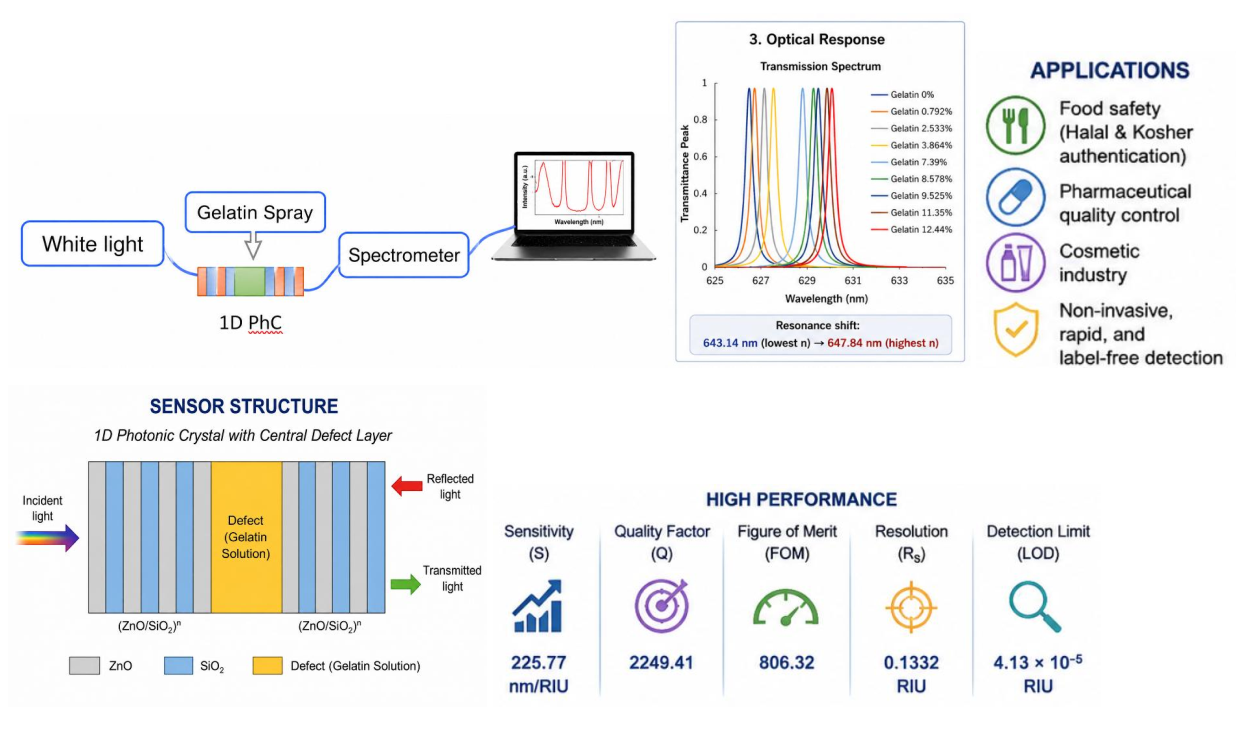
Gelatine is commonly found in food, pharmaceutical, health, and cosmetic products. However, its use has generated significant debate due to concerns about the numerous sources, particularly for religious reasons. For Muslims and Jews, gelatine derived from porcine sources must be avoided, as it is strictly prohibited by religious laws. The detection in these products is important, and this led to the design of an optical biosensor based on a one-dimensional (1D) photonic crystal (PhC) with a defect layer. The aim was to detect the distinctive characteristics of gelatine with high sensitivity. Additionally, the defect layer was placed in the center of the structure, where the gelatine solution was introduced. The designed PhC structure consisted of N layers of (ZnO/SiO₂)ᴺ/defect/(ZnO/SiO₂)ᴺ. The reflectance and transmittance characteristics of the PhC were calculated by using the transfer matrix method (TMM), performed with the MATLAB software. For simplicity, the normal incidence of light on the PhC was assumed to avoid the complexities of oblique angles. Sensor performance was evaluated by calculating sensitivity (S), quality factor (Q), figure of merit (FOM), resolution (RS), and detection limit (LOD). The biosensor achieved an average S, Q, FOM, RS, and LOD of 225.7694 nm/RIU, 2249.413, 806.3185, 0.1332, and 4.13 × 10⁻⁵, respectively. These metrics showed the simple PhC design was a highly sensitive, non-invasive detection platform for monitoring and identifying gelatine-based products that did not meet Halal and Kosher requirements. The novelty of the study centered on the application of a simple 1D PhC with a defect cavity to detect gelatine concentrations in both aqueous and oily solutions, a problem that had not been addressed in detail.
How to Cite
Ary Syahriar, Nafis Riffat Syahriar, Muhamad Giri Suada, Kun Mardiwati Rahayu, Octarina Nur samijayani , Ahmad Husin Lubis (2026). One-dimensional Photonic Crystal with Defects to Detect Gelatine Containing Water. Journal of Engineering and Technological Sciences, Vol. 58 No. 5 (2026): Vol. 58 No. 5(2026): October, 652-660. https://doi.org/10.5614/j.eng.technol.sci.2026.58.5.4
Metrics
References
Abadla, M. M., & Elsayed, H. A. (2020). Detection and sensing of hemoglobin using one-dimensional binary photonic crystals comprising a defect layer. Applied Optics, 59(2), 418–424.
Aalizadeh, M., Azmoudeh Afshar, M., Fan, X., et al. (2024). Machine-learning enabled multidimensional data utilization in multi-resonance biosensors: A pathway to enhanced accuracy. Preprint. https://arxiv.org/abs/2412.20245
Aliotta, F., Arcoleo, V., & Turco Liveri, M. L. G. (1996). Structural and dynamical investigation of gelatin containing water-in-oil microemulsions. Colloid and Polymer Science, 274, 989–994.
Alipala, J., Mohd Pu’ad, N. A. S., Lee, T. C., Nayan, N. H. M., Sahari, N., Basri, H., Idris, M. I., & Abdullah, H. Z. (2021). A review of gelatin: Properties, sources, process, applications, and commercialization. Materials Today: Proceedings, 42, 240–250.
Al-Dossari, M., Awasthi, S. K., Mohamed, A. M., Abd El-Gawaad, N. S., Sabra, W., & Aly, A. H. (2022). Bio-alcohol sensor based on one-dimensional photonic crystals for detection of organic materials in wastewater. Materials, 15, 4012.
Aly, A. H., Awasthi, S. K., Mohamed, A. M., Matar, Z. S., Mohaseb, M. A., Al-Dossari, M., Tammam, M. T., Zaky, Z. A., Amin, A. F., & Sabra, W. (2021). Detection of reproductive hormones in females by using 1D photonic crystal-based simple reconfigurable biosensing design. Crystals, 11, 1012.
Aly, A. H., Awasthi, S. K., Mohamed, D., Matar, Z. S., Al-Dossari, M., & Amin, A. F. (2021). Study on a one-dimensional defective photonic crystal suitable for organic compound sensing applications. RSC Advances, 11, 27115–27122.
Aly, A. H., Awasthi, S. K., Mohaseb, M. A., Matar, Z. S., & Amin, A. F. (2022a). MATLAB simulation-based theoretical study for detection of a wide range of pathogens using 1D defective photonic structure. Crystals, 11, 1208.
Aly, A. H., Awasthi, S. K., Mohaseb, M. A., Matar, Z. S., & Amin, A. F. (2022b). MATLAB simulation-based theoretical study for detection of a wide range of pathogens using 1D defective photonic structure. Crystals, 12, 220.
Aly, A. H., Mohamed, D., Zaky, Z. A., Matar, Z. S., El-Gawaad, N. S. A., Shalaby, A. S., Tayeboun, F., & Mohaseb, M. (2021). Novel biosensor detection of tuberculosis based on photonic band gap materials. Materials Research Express, 8, 085401.
Aly, A. H., Mohamed, B. A., Al-Dossari, M., & Mohamed, D. (2023). A temperature sensor based on Si/PS/SiO₂ photonic crystals. Scientific Reports, 13, 21560.
Ashour, H. S., Abohassan, K. M., & Abadla, M. M. (2021). Defective 1D quinary photonic crystal sensors for the detection of cancerous blood cells. Optical Engineering, 60(6), 127106.
Awasthi, S. K., Mishra, A., Malaviya, U., & Ojha, S. (2009). Wave propagation in a one-dimensional photonic crystal with metamaterial. Solid State Communications, 149, 1379–1383.
Bazian, M. (2021). Photonic crystal add–drop filter: A review on principles and applications. Photonic Network Communications, 41, 57–77.
Bond, W. L. (1965). Measurement of the refractive indices of several crystals. Journal of Applied Physics, 36(5), 1674–1677
Born, M., & Wolf, E. (1999). Principles of optics: Electromagnetic theory of propagation, interference and diffraction of light (7th ed.). Cambridge University Press.
Chaudhary, V., Kumar, M., Kumar, V., Sharma, S., Dhumal, S., & Maerescu, C. M. (2022). Spectroscopic techniques for authentication of animal origin foods. Frontiers in Nutrition, 9, 979205.
El-Aziz, O. A. A., Elsayed, H. A., & Sayed, M. I. (2016). One-dimensional defective photonic crystals for the sensing and detection of protein. Applied Optics, 55(29), 8309–8315.
Gandhi, S., Awasthi, S. K., & Aly, A. H. (2021). Biophotonic sensor design using a 1D defective annular photonic crystal for the detection of creatinine concentration in blood serum. RSC Advances, 11, 26655–26665.
Hassan, M., Hussain, D., Kawal, T., Xiao, H. M., & Musharraf, S. G. (2024). Method for detection and quantification of gelatin from different sources. Food Chemistry, 438, 137970.
John, S. (1987). Strong localization of photons in certain disordered dielectric superlattices. Physical Review Letters, 58, 2486–2489.
Kaviani, H., & Barvestani, J. (2022). Photonic crystal based biosensor with the irregular defect for detection of blood plasma. Optik, 250, 168109.
Kirubel, A., & Palani, S. (2020). A review on photonics and its applications. Materials Today: Proceedings, 33, 3372–3377.
Li, S., Feng, G., Liu, Y., Wu, M., Zhao, X., Sun, F., Gan, Z., Chen, Z., & Yang, Y. (2024). Omnidirectional near-infrared narrowband filters based on defective mirror-symmetry one-dimensional photonic crystals containing hyperbolic metamaterials. Optical and Laser Engineering, 176, 108107.
Li, T., Liu, G., Kong, H., Yang, G., Wei, G., & Zhou, X. (2023). Recent advances in photonic crystal-based sensors. Coordination Chemistry Reviews, 475, 214909.
Li, Y., Guo, Y., Chen, H., et al. (2024). Flexible wearable plasmonic paper-based microfluidics with expandable channel and adjustable flow rate for portable surface-enhanced Raman scattering sweat sensing. ACS Photonics, 11(2), 613–625.
Liu, R., Cai, Z., Zhang, Q., Yuan, H., Zhang, G., & Yang, D. (2022). Colorimetric two-dimensional photonic crystal biosensors for label-free detection of hydrogen peroxide. Sensors and Actuators B: Chemical, 354, 131211.
Mahfuz, M. A., Afroj, S., Hossain, M. A., Hossain, M. A., Rahman, A., & Habib, M. S. (2024). An ultra-sensitive visible–IR range fiber-based plasmonic refractive index sensor (arXiv:2401.10968). arXiv.
Mao, D., Chang, L., Lee, D., Yu, A. W., Maruca, B. A., Ullah, K., Matthaeus, W. K., Krainak, M. A., Dong, P., & Gu, T. (2024). Space-qualifying silicon photonic modulators and circuits. Science Advances, 10, eead9171.
Malaviya, U., & Ojha, S. P. (2006). Enhancement of omnidirectional total-reflection wavelength range by using one-dimensional ternary photonic bandgap material. Journal of the Optical Society of America B, 23, 2566–2571.
Mejia-Salazar, J. R., Cruz, K. R., Vasques, E. M. M., & de Oliveira, O. N., Jr. (2020). Microfluidic point-of-care devices: New trends and future prospects for e-health diagnostics. Sensors, 20, 1951.
Nguyen. D.T (2020), Modelling and design photonics by examples using MATLAB®, IOP Publishing Ltd.
Rizk, S., El-Naggar, A. M., Ahmed, A. M., Mehaney, A., Elsayed, H. A., & Aly, A. H. (2025). Photonic crystal biosensor featuring an eye-shaped cavity for precise identification of cancerous cells. Scientific Reports, 15, 21987.
Saini, S. K., & Awasthi, S. K. (2023). Sensing and detection capabilities of one-dimensional defective photonic crystal suitable for malaria infection diagnosis from preliminary to advanced stage: Theoretical study. Crystals, 13, 128.
Schrieber, H., & Gareis, H. (2007). Gelatine handbook: Theory and practice. Wiley-VCH.
Sharma, A., Singh, S., Mishra, A., et al. (2022). Photonic quasi-crystal fiber-based plasmonic biosensor: A platform for detection of coronavirus. Biosensors and Bioelectronics, 205, 114107.
Shen, H., Wang, Z., Wu, Y., & Yang, B. (2016). One-dimensional photonic crystals: Fabrication, responsiveness and emerging applications in 3D construction. RSC Adv., 6(6), 4505–4520.
Soltani, O., Francoeur, S., & Kanzari, M. (2023). Detecting cancerous human liver cells with high performances using photonic crystals. Physica B: Condensed Matter, 650, 414637.
Suthar, A. B., & Bhargava, A. (2021). Biosensor application of one-dimensional photonic crystal for malaria diagnosis. Plasmonics, 16, 59–63.
Tan, Y., Xue, J., Zhang, W., et al. (2015). Photonic crystal hydrogel enhanced plasmonic staining for multiplexed protein analysis. Biosensors and Bioelectronics, 74, 425–431.
Taya, S. A., Sharma, A., Doghmosh, N., & Colak, I. (2022). Detection of water concentration in ethanol solution using a ternary photonic crystal-based sensor. Materials Chemistry and Physics, 279, 125786.
Thomas, S. (2023). Material applications of gelatin. In Handbook of Biopolymers. Springer Nature Singapore.
Uddin, S. M. K., Johan, M. R., Hossain, M. A. M., Sagadevan, S., & Amin, M. (2021). Halal and kosher gelatin: Applications as well as detection approaches with challenges and prospects. Food Hydrocolloids, 44, 101422.
Wang, F., Meng, Z., Xuen, F., Xue, M., Lu, W., Chen, W., Wang, Q., & Wang, Y. (2014). Responsive photonic crystal for the sensing of environmental pollutants. TrAC Trends in Environmental Analytical Chemistry, 3, 1–6.
Wei, Q., Bi, D., Qi, X., Ren, M., & Wu, F. (2025). Angle-independent topological interface states in one-dimensional photonic crystal heterostructures containing hyperbolic metamaterials. Optics Letters, 50(2), 451–454.
Wu, F., Chen, M., & Xiao, S. (2022). Wide-angle polarization selectivity based on anomalous defect mode in photonic crystal containing hyperbolic metamaterials. Optics Letters, 47(9), 2153–2156.
Wu, F., She, Y., Jiang, H., Liu, G., Chen, G., & Xiao, S. (2025). Angle-immune strong coupling between two defect modes in a defective photonic hypercrystal. Optics and Lasers in Engineering, 186, 108842.
Yablonovitch, E. (1987). Inhibited spontaneous emission in solid-state physics and electronics. Physical Review Letters, 58, 2059–2062.
Yang, Y., Xiang, Y., & Qi, X. (2023). Design of photonic crystal biosensors for cancer cell detection. Micromachines, 14(7), 1478
Yeh, P. (2005). Optical waves in layered media. Wiley-Interscience.
Zaky, Z. A., Sharma, A., Alamri, S., Saleh, N., & Aly, A. H. (2022). Detection of fat concentration in milk using ternary photonic crystal. Silicon, 14, 6063–6073.
Zhang, Y., Yu, H., Dong, J., et al. (2019). All-silicon spectrally resolved interferometric circuit for multiplexed diagnostics: A monolithic lab-on-a-chip integrating all active and passive components. ACS Photonics, 6(7), 1694–1705.
Zheng, S., Dong, G., & Yang, Q. (2021). Ultra-compact photonic crystal couplers for optical switches based on band-edge resonance. Advanced Composites and Hybrid Materials, 4, 1179–1186.
License
Copyright (c) 2026 by Authors

This work is licensed under a Creative Commons Attribution 4.0 International License.
Downloads
Date Log
- Submitted
- December 22, 2025
- Accepted
- July 22, 2026
- Published
- August 11, 2026
Keywords
- 1D PhC with defects
- adulteration
- biosensors
- food
- gelatine
- halal
- kosher
- pharmaceutical


