
Analysis of the Effect of Permanent Magnet Width on Cogging Torque of Interior LSPMSM
Abstract
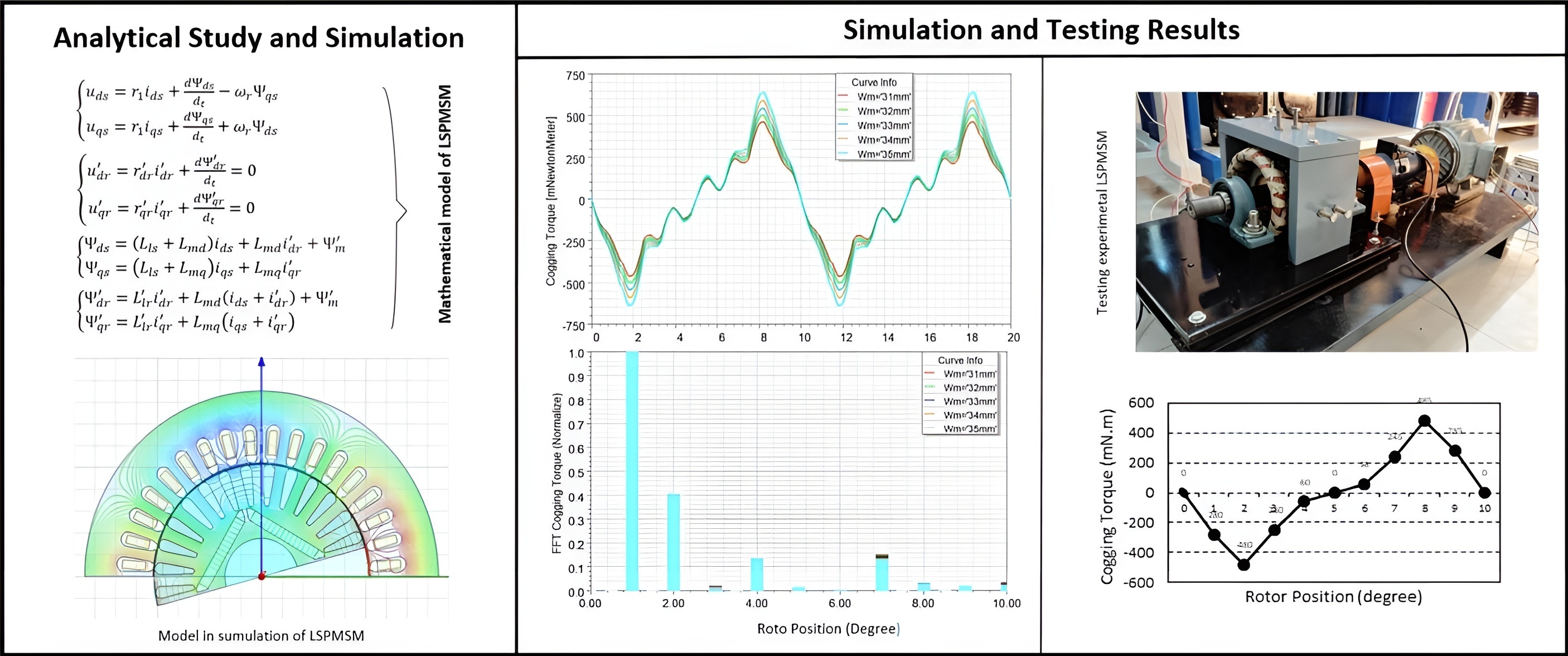
The line-start synchronous permanent magnet synchronous motors have the advantages of high efficiency and line-starting capability. However, this type of motor has the drawback of high cogging torque, which is the main cause of vibration and noise during operation. Analyzing the factors affecting cogging torque is essential and important in the design of these motors. This paper studies the impact of magnet width on cogging torque. Theoretical analysis and finite element method simulations for the test motor show that the cogging torque can be significantly high, reaching up to 5% of the rated torque of the motor. Research results indicate that cogging torque can be reduced by decreasing the width of the permanent magnet. However, reducing the magnet width adversely affects the startup characteristics, torque, and efficiency of the motor, demonstrating the existence of an optimal width that balances cogging torque and other parameters in motor design. Additionally, the research results have been validated through experimental modeling, showing a close correlation in the shape of the cogging torque and the back eletromotive force characteristics, with a small error of less than 5%.
How to Cite
Tuan Anh Le, Nhu Y Do (2026). Analysis of the Effect of Permanent Magnet Width on Cogging Torque of Interior LSPMSM. Journal of Engineering and Technological Sciences, Vol. 58 No. 5 (2026): Vol. 58 No. 5(2026): October, 697-713. https://doi.org/10.5614/j.eng.technol.sci.2026.58.5.8
Metrics
References
Abbaszadeh, K., Alam, F. R., & Saied, S. A. (2011). Cogging torque optimization in surface-mounted permanent-magnet motors by using design of experiment. Energy Conversion and Management, 52(10), 3075–3082. https://doi.org/10.1016/j.enconman.2011.04.009
Anh-Tuan, L., Duc-Hung, B., & Anh-Tuan, P. (2016). Saturable q-axis magnetizing inductance calculation of line start-permanent magnet synchronous motors using lumped parameter mode. In 2016 IEEE International Conference on Sustainable Energy Technologies (ICSET) (pp. 364–368). IEEE. https://doi.org/10.1109/ICSET.2016.7811811
Arehpanahi, M., & Kashe, H. (2018). Cogging torque reduction of interior permanent magnet synchronous motor (IPMSM). Tc, 50(4), 0. Scientia Iranica, 25(3), 1471–1477. https://doi.org/10.24200/sci.2017.4365
Baradieh, K., Al-Hamouz, Z., & Abido, M. (2018). ANN based broken rotor bar fault detection in LSPMS motors. J Electr Electron Syst, 7(273), 2332–0796. https://doi.org/10.3390/machines7010004
Behbahanifard, H., & Sadoughi, A. (2016). Cogging torque reduction in line start permanent magnet synchronous motor. Journal of Electrical Engineering and Technology, 11(4), 878–888. https://doi.org/10.5370/JEET.2016.11.4.878
Bianchini, C., Immovilli, F., Lorenzani, E., Bellini, A., & Davoli, M. (2012). Review of design solutions for internal permanent-magnet machines cogging torque reduction. IEEE Transactions on Magnetics, 48(10), 2685–2693. https://doi: 10.1109/TMAG.2012.2199509
Cao, Z., & Liu, J. (2020). Cogging torque reduction for outer rotor interior permanent magnet synchronous motor. In IECON 2020 The 46th Annual Conference of the IEEE Industrial Electronics Society, 2689–2693. IEEE. https://doi.org/10.1109/IECON43393.2020.9254887
Dajaku, G., & Gerling, D. (2014). New methods for reducing the cogging torque and torque ripples of PMSM. In 2014 4th International Electric Drives Production Conference (EDPC), 1–7. IEEE. https://doi.org/10.1109/EDPC.2014.6984396
De Almeida, A. T., Ferreira, F. J., & Fong, J. A. (2010). Standards for efficiency of electric motors. IEEE Industry Applications Magazine, 17(1), 12–19. https://doi.org/10.1109/MIAS.2010.939427
Do, N. Y., Le, T. A., & Ngo, X. C. (2022). Effect of Permanent Magnet Structure on The Performance of LSPMSM with a Power of 22 kW and 3000 rpm. In IOP Conference Series: Earth and Environmental Science, 1111(1), 012047. IOP Publishing. https://doi.org/10.1088/1755-1315/1111/1/012047
Do, N. Y., Thuy, T. B., & Cuong, N. X. (2024). Rotor Configuration for Improved Working Characteristics of Lspmsm in Mining Applications. Natsional'nyi Hirnychyi Universytet. Naukovyi Visnyk, (3), 79–86. https://doi.org/10.33271/nvngu/2024-3/079
Dosiek, L., & Pillay, P. (2007). Cogging torque reduction in permanent magnet machines. IEEE Transactions on industry applications, 43(6), 1565–1571. https://doi.org/10.1109/IAS.2006.256518
Gao, J., Wang, G., Liu, X., Zhang, W., Huang, S., & Li, H. (2017). Cogging torque reduction by elementary-cogging-unit shift for permanent magnet machines. IEEE Transactions on Magnetics, 53(11), 1–5. https://doi.org/10.1109/TMAG.2017.2712799
Gerstlberger, W., Præst Knudsen, M., & Stampe, I. (2014). Sustainable development strategies for product innovation and energy efficiency. Business Strategy and the Environment, 23(2), 131–144. https://doi.org/10.1002/bse.1777
Jing, L., Gong, J., & Lin, Y. (2019). Analysis and reduction of cogging torque of line-start permanent magnet motors. Progress In Electromagnetics Research M, 78, 115–124. https://doi.org/10.2528/PIERM18120902
Lin, B., & Li, Z. (2020). Is more use of electricity leading to less carbon emission growth? An analysis with a panel threshold model. Energy Policy, 137, 111121. https://doi.org/10.1016/j.enpol.2019.111121
Lin, M., Li, D., Zhao, Y., Ren, X., & Qu, R. (2020). Improvement of starting performance for line-start permanent magnet motors by winding reconfiguration. IEEE Transactions on Industry Applications, 56(3), 2441–2450. https://doi.org/10.1109/TIA.2020.2968277
Liu, Q., & Ren, J. (2020). Research on the building energy efficiency design strategy of Chinese universities based on green performance analysis. Energy and Buildings, 224, 110242. https://doi.org/10.1016/j.enbuild.2020.110242
Luu, P. T., Lee, J. Y., Hwang, W., & Woo, B. C. (2018). Cogging torque reduction technique by considering step-skew rotor in permanent magnet synchronous motor. In 2018 21st International Conference on Electrical Machines and Systems (ICEMS), 219–223. IEEE. https://doi.org/10.23919/ICEMS.2018.8549086
Maraaba, L., Al‐Hamouz, Z., Milhem, A., & Abido, M. (2018). Modelling of interior‐mount LSPMSM under asymmetrical stator winding. IET Electric Power Applications, 12(5), 693–700. https://doi.org/10.1049/iet-epa.2017.0525
Nian, S., Zhu, L., Luo, X., & Huang, Z. (2019). Analytical methods for optimal rotor step-skewing to minimize cogging torque in permanent magnet motors. In 2019 22nd International Conference on Electrical Machines and Systems (ICEMS), 1–5. IEEE. https://doi.org/10.1109/ICEMS.2019.8921502
Saidur, R. (2010). A review on electrical motors energy use and energy savings. Renewable and sustainable energy reviews, 14(3), 877–898. https://doi.org/10.1016/j.rser.2009.10.018
Song, S., Fang, G., Hei, R., Jiang, J., Ma, R., & Liu, W. (2020). Torque ripple and efficiency online optimization of switched reluctance machine based on torque per ampere characteristics. IEEE Transactions on Power Electronics, 35(9), 9608–9616. https://doi.org/10.1109/TPEL.2020.2974662
Stoia, D., Cernat, M., Jimoh, A. A., & Nicolae, D. V. (2009). Analytical design and analysis of line-start permanent magnet synchronous motors. In AFRICON 2009, 1–7. IEEE. https://doi.org/10.1109/AFRCON.2009.5308177
Ugale, R. T., & Chaudhari, B. N. (2020). Performance enhancement of line start permanent magnet synchronous motor with a special consequent pole rotor. IEEE Transactions on Energy Conversion, 36(3), 1972–1982. https://doi.org/10.1109/TEC.2020.3038725
Wan, X., Yang, S., Li, Y., Shi, Y., & Lou, J. (2022). Minimization of cogging torque for V-type IPMSM by the asymmetric auxiliary slots on the rotor. IEEE Access, 10, 89428-89436. https://doi.org/10.1109/ACCESS.2022.3201246
Wang, X., Yang, Y., & Fu, D. (2003). Study of cogging torque in surface-mounted permanent magnet motors with energy method. Journal of Magnetism and Magnetic Materials, 267(1), 80–85. https://doi.org/10.1016/S0304-8853(03)00324-X
Zhang, B. Y., Cui, G., Wang, S., & Feng, G. H. (2010). Study of cogging torque in line-start PMSM with proper fractional slot winding. In 2010 International Conference on E-Product E-Service and E-Entertainment, 1–4. IEEE. https://doi.org/10.1109/ICEEE.2010.5660985
Zhao, J., Wang, J., Zhou, L., Huang, W., Ma, Y., & Zhang, Z. (2019). Cogging torque reduction by stepped slot-opening shift for interior permanent magnet motors. In 2019 22nd International Conference on Electrical Machines and Systems (ICEMS), 1–4. IEEE. https://doi.org/10.1109/ICEMS.2019.8921448
Zhao, Y., Li, D., Lin, M., & Qu, R. (2019). A novel dual stator line-start permanent magnet synchronous machine. In 2019 IEEE International Electric Machines & Drives Conference (IEMDC) (pp. 1526–1531). IEEE. https://doi.org/10.1109/IEMDC.2019.8785230
License
Copyright (c) 2026 by Authors

This work is licensed under a Creative Commons Attribution 4.0 International License.
Downloads
Date Log
- Submitted
- April 22, 2025
- Accepted
- July 22, 2026
- Published
- September 2, 2026
Keywords
- cogging torque
- electric motor
- line-start permanent magnet synchronous motor
- permanent magnet
- permanent magnet synchronous motor


