Design Optimization of Automobile Wheel Rim by Using Taguchi-SAW Method
Downloads
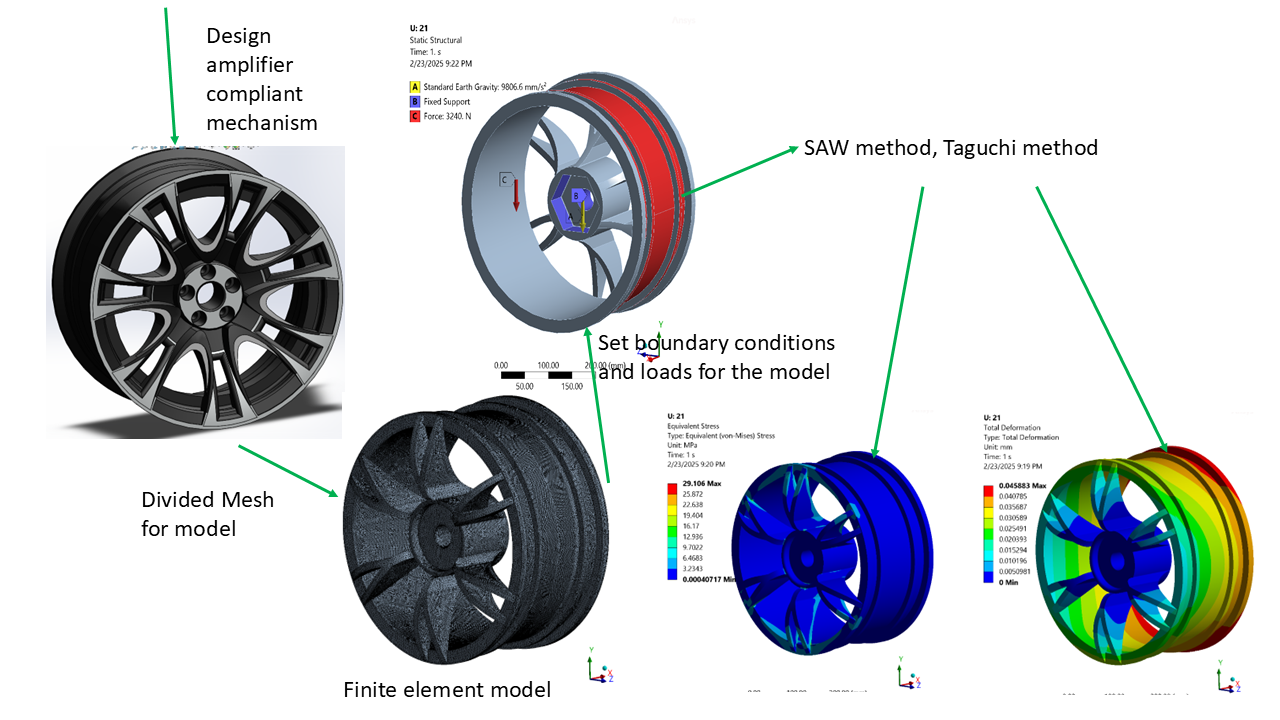
In the automotive industry, reducing vehicle weight while maintaining durability is crucial for improving fuel efficiency, reducing emissions, and enhancing overall vehicle performance. The wheel rim is a vital component that supports the vehicle’s load and influences unsprung mass, directly affecting ride quality and safety. Therefore, designing an optimized wheel rim that minimizes weight without compromising strength under heavy load conditions is essential. This research investigates three materials—aluminum alloy, magnesium alloy, and titanium alloy—known for their high strength-to-weight ratios and suitability for automotive applications. Three key geometric design variables were considered: spoke thickness (t), spoke width (w), and spoke radius (r), each tested at three different levels. Finite Element Analysis (FEA) was conducted using ANSYS software to evaluate stress distribution and deformation of various design configurations under typical operational loads. Optimization was performed using the Simple Additive Weighting (SAW) multi-criteria decision-making method to identify the most effective design balancing multiple objectives. To ensure the reliability of results, statistical methods including the Taguchi method, analysis of variance (ANOVA), interaction analysis, and regression analysis were applied for validation. The optimized wheel rim design achieved an 11% weight reduction compared to the baseline model, with maximum stress and deformation values of 29.106 MPa and 0.0459 mm, respectively. These closely matched the predicted values, showing errors of only 0.66% and 0.31%, confirming the accuracy of the model. This study demonstrates a successful approach to producing a lightweight, durable wheel rim that can contribute to improved vehicle efficiency and reduced manufacturing costs.
Abhiman, B., Kumar, M. Y., & Reddy, M. V. R. (2021). Optimization of car rim using designing and analysis softwares. International Journal of Research in Aeronautical and Mechanical Engineering, 9(8), 1–6. https://doi.org/10.5281/ZENODO.52703
Alfarisi, S., Ariyansah, R., & Mugisidi, D. (2024). Finite Element Analysis of Aluminum Based R22 Car Wheel Design Modification. Jurnal Asiimetrik: Jurnal Ilmiah Rekayasa dan Inovasi, 6(1–10). http://doi.org/10.35814/asiimetrik.v6i1.5077
Ashok, B., Naidu, M. K., & Rao, S. S. (2021). Design and weight optimization of aluminium alloy wheel rim for light weight four wheeled vehicle. International Journal of Engineering Research & Technology, 10(4), 484–490. https:// doi.org/10.5281/zenodo.18620583
Barragán-Trinidad, M., Guadarrama-Pérez, O., Guillén-Garcés, R. A., Bustos-Terrones, V., Trevino-Quintanilla, L. G., & Moeller-Chávez, G. (2023). The Grey–Taguchi Method, a Statistical Tool to Optimize the Photo-Fenton Process: A Review. Water, 15(15, 1–27). https://doi.org/10.3390/w15152685
Borchers, A., & Pieler, T. (2010). Programming pluripotent precursor cells derived from Xenopus embryos to generate specific tissues and organs. Genes (Basel), 1(3), 413–426. https://doi.org/10.3390/genes1030413
Ciardiello, F., & Genovese, A. (2023). A comparison between TOPSIS and SAW methods. Annals of Operations Research, 325(2), 967-994. https://doi.org/10.1007/s10479-023-05339-w
artificial neural network method based on finite element analysis results
Solazzi, L., & Cima, M. (2024). Development of a FEM procedure for evaluating the pressure profile in the industrial wheel and fatigue strength analyses. Journal of Applied Engineering Science, 22(2), 171–183. https://doi.org/10.5937/jaes0-48184
Dawson, J. W. (2025). Wheels integrity for UAH Moonbuggy ATHENA.
Fan, J., Lei, T., & Wu, M. (2024). MEREC-MABAC method based on cumulative prospect theory for picture fuzzy sets: Applications to wearable health technology devices. Expert Systems with Applications, 255, 414–422. https://doi.org/10.1016/j.eswa.2024.124749
Gebrehiwet, L., Negussie, Y., & Tadesse, A. (2022). Business Opportunity of Wheel Rim Manufacturing in Ethiopia. International Journal of Advances in Engineering and Management, 4(10), 1148–1159.
Gadwala, W. K., & Babu G, R. (2022). Modeling and analysis of car wheel rim for weight optimization to use additive manufacturing process. Materials Today: Proceedings, 62, 336–345. https://doi.org/10.1016/j.matpr.2022.03.430
Hisam, M. W., Dar, A. A., Elrasheed, M. O., Khan, M. S., Gera, R., & Azad, I. (2024). The Versatility of the Taguchi Method: Optimizing Experiments Across Diverse Disciplines. Journal of Statistical Theory and Applications, 23(4), 365–389. https://doi.org/10.1007/s44199-024-00093-9
Jakupi, K., Dukovski, V., & Abdullahu, F. (2024). Optimizing surface roughness of workpieces made of stainless steel 316L with DMLS technology: a Taguchi method approach. Engineering Research Express, 6(2), 1–7. https://doi.org/10.1088/2631-8695/ad3db0
Jazaudhi’fi, A., Vitianingsih, A. V., Kristyawan, Y., Lidya Maukar, A., & Yasin, V. (2024). Recommendation System to Determine Achievement Students Using Naïve Bayes and Simple Additive Weighting (SAW) Methods. Digital Zone: Jurnal Teknologi Informasi dan Komunikasi, 15(1), 67–79. https://doi.org/10.31849/digitalzone.v15i1.19746
Joglekar, A. A., Tripathi, V. K., Nagapurkar, S. J., & Netke, V. S. (2021). Design Optimization of Electric Vehicle Wheel using Composite Materials. International Journal of Engineering Sciences, 13(4), 152–158. https://doi.org/10.36224/ijes.130403
Karim, H., & Ku, P. X. (2022). Effect of design and material on structural rigidity of automobile wheel - an optimisation approach. Journal of Physics: Conference Series, 2222, 1–13. https://doi.org/10.1088/1742-6596/2222/1/012007
Kepekci, H., Agca, M., & Komatina, M. (2025). Thermal and mechanical analysis of wheel rim in Formula 1 vehicles. Thermal Science, 29(1 Part A), 325–335. https://doi.org/10.2298/tsci240721205k
Keshavarz-Ghorabaee, M. (2021). Assessment of distribution center locations using a multi-expert subjective-objective decision-making approach. Sci Rep, 11(1), 19461. https://doi.org/10.1038/s41598-021-98698-y
Keshavarz-Ghorabaee, M., Amiri, M., Zavadskas, E. K., Turskis, Z., & Antucheviciene, J. (2021). Determination of Objective Weights Using a New Method Based on the Removal Effects of Criteria (MEREC). Symmetry, 13(4), 525. https://doi.org/10.3390/sym13040525
Khatiwada, R., Giri, S., Khadka, R., & Mahat, C. (2025). Design, analysis and optimization of the wheel rim. International Journal Of Research In Aeronautical And Mechanical Engineering, 13(4), 1-13.
Kruzel, R., Dembiczak, T., & Wachowicz, J. (2023). Optimization of Spark Plasma Sintering Technology by Taguchi Method in the Production of a Wide Range of Materials: Review. Materials (Basel), 16(16), 1–18. https://doi.org/10.3390/ma16165539
Kumar, G. R. & Chandrashekhar, A. (2025). Design and analysis of a car wheel rim. International Journal of Environmental Sciences, 11(17s), 1010–1016. https://doi.org/10.64252/62agff53
Loganathan, K., & Subramani, S. K. V. S. (2023). Design and optimization of aluminium alloy wheel rim in automobile industry. Materials Today: Proceedings. https://doi.org/10.1016/j.matpr.2023.01.207
Majumder, H., Gajghate, S. S., Sahu, A. R., Behera, A. K., Limbadri, C., & Ukey, K. (2023). Finite element analysis of wheel rim by additive manufacturing materials. Materials Today: Proceedings. 28(2023), 341–349. https://doi.org/10.1016/j.matpr.2023.05.461
Montassir, S., Moustabchir, H., El Khalfi, A., Vlase, S., & Scutaru, M. L. (2024). Numerical Study of Crack Prediction and Growth in Automotive Wheel Rims. Materials (Basel), 17(5), 1-14. https://doi.org/10.3390/ma17051020
Özdemir, Y. B., Karpuzcu, Y., Çam, S., & Günpınar, E. (2022). Wheel Rim Design Parametrization and Its Effect on Optimization. Dokuz Eylul University Faculty of Engineering Journal of Science and Engineering, 24(72), 913–926. https://doi.org/https://doi.org/10.21205/deufmd.2022247220
Padmanabhan, S., Boopathi, B., Kumar, K. M., J. R, D., T, V. K., & S, B. (2023). Investigation of alloy materials on a sports bike wheel rim designs using finite element analysis. Multidisciplinary Science Journal, 6(2), 1–9. https://doi.org/10.31893/multiscience.2024013
Padmanabhan, S., Kumar, T. V., Thiagarajan, S., Krishna, B. G., & Sudheer, K. (2023). Investigation of lightweight wheel design using alloy materials through structural analysis. Materials Today: Proceedings. 2023, 1–10. https://doi.org/10.1016/j.matpr.2023.01.013
Parihar, Y. P. S., & Chakraborty, A. (2022). Dynamic Design and Analysis of Car Wheel Rim Using FEA Method. International Journal for Research in Applied Science and Engineering Technology, 10(5), 723–734. https://doi.org/10.22214/ijraset.2022.42319
Patil, G. H. & Chavan, H. A. (2023). Mathematical and Simulation Investigation of Automobile Wheel Rim Material. International Journal of Progressive Research in Engineering Management and Science, 3(5), 878–888. https://doi.org/10.58257/IJPREMS31359
Roy, R. K. (2010). A primer on the Taguchi method. Society of Manufacturing Engineers, Second edition.
Santos, V. R. I., Scinocca, F., Almeida, L. G. N. d., & Santos, F. L. (2025). Virtual Development of Automotive Wheels: Modal, Vertical Impact and Fatigue Analysis and Simulation, using the finite element method. Theoretical and Applied Engineering, 9(1), 1-20. https://doi.org/10.31422/taae.v9i1.63
Shanmugasundar, G., Sapkota, G., Čep, R., & Kalita, K. (2022). Application of MEREC in Multi-Criteria Selection of Optimal Spray-Painting Robot. Processes, 10(6), 1172. https://doi.org/10.3390/pr10061172
Sharma, A., Yadav, R., & Sharma, K. (2021). Optimization and investigation of automotive wheel rim for efficient performance of vehicle. Materials Today: Proceedings, 45, 3601–3604. https://doi.org/10.1016/j.matpr.2020.12.1110
Shinde, T., Jomde, A., Shamkuwar, S., Sollapur, S., Naikwadi, V., & Patil, C. (2022). Fatigue analysis of alloy wheel using cornering fatigue test and its weight optimization. Materials Today: Proceedings, 62, 1470–1474. https://doi.org/10.1016/j.matpr.2022.02.023
Somayaji, A., Marakala, N., Somayaji, S., & Hebbale, A. M. (2022). Studies on modal analysis of aluminium based carbon fibre reinforced optimized alloy wheel used in automotive sectors. Materials Today: Proceedings, 52, 274–277. https://doi.org/10.1016/j.matpr.2021.08.099
Song, J., Lan, J., Zhu, L., Jiang, Z., Zhang, Z., Han, J., & Ma, C. (2024). Finite Element Simulation and Microstructural Analysis of Roll Forming for DP590 High-Strength Dual-Phase Steel Wheel Rims. Materials (Basel), 17(15), 1–18. https://doi.org/10.3390/ma17153795
Tafazzoli, M., Hazrati, A., Shrestha, K., & Kisi, K. (2024). Enhancing Contractor Selection through Fuzzy TOPSIS and Fuzzy SAW Techniques. Buildings, 14(6), 1-24. https://doi.org/10.3390/buildings14061861
Taherdoost, H. (2023). Analysis of Simple Additive Weighting Method (SAW) as a MultiAttribute Decision-Making Technique: A Step-by-Step Guide. Journal of Management Science & Engineering Research, 6(1), 21–24. https://doi.org/10.30564/jmser.v6i1.5400
Vinchu, A. T. & Chaudhari, D. S. (2021). Weight Optimization of Vehicle Rim with Fatigue Tests. International Journal of Scientific Research & Engineering Trends, 7(3), 1680-1683.
Wacker, J. D., Laveuve, D., Contell Asins, C., & Büter, A. (2021). Design of a composite nose wheel for commercial aircraft. IOP Conf. Series: Materials Science and Engineering, 1024, 1–8. https://doi.org/10.1088/1757-899X/1024/1/012018
Wang, Z., Wang, C., Yang, G., & Wu, F. (2022). Innovative Design of Automobile Wheel Rim Based on Honeycomb Features. Journal of Engineering Management and Systems Engineering, 1(2), 67–75. https://doi.org/10.56578/jemse010204
Wijaya, V. I., Ariyansah, R., Agusman, D., & Heriyani, O. (2024). Analysis of vibration characteristics in 17-inch aluminum alloy wheel rims using finite element method. Jurnal Asiimetrik: Jurnal Ilmiah Rekayasa dan Inovasi, 6(2), 283–294. https://doi.org/10.35814/asiimetrik.v6i2.6620
Zanchini, M., Longhi, D., Mantovani, S., Puglisi, F., & Giacalone, M. (2023). Fatigue and failure analysis of aluminium and composite automotive wheel rims: Experimental and numerical investigation. Engineering Failure Analysis, 146, 1-20. https://doi.org/10.1016/j.engfailanal.2023.107064
Zhang, G., Tao, S., Zhou, Y., Ye, Z., Lu, J., Li, R., Li, S., Zhou, L., & Deng, T. (2025). Shape optimisation of rim structure of aluminium alloy car wheels based on 90 degrees impact test. Sci Rep, 15(1), 24623. https://doi.org/10.1038/s41598-025-07802-z
Zhang, S., Lu, D., Li, R., Xu, L., Jiang, H., Cao, Y., & Xu, W. (2023). Fatigue life optimization and lightweight design of wheel based on entropy weight grey relation analysis and modified NSGA-II. Advances in Mechanical Engineering, 15(8), 1–20. https://doi.org/10.1177/16878132231189119
Zhang, X., Liu, Y., & Wang, Z. (2025). Design and optimization of carbon fiber and magnesium alloy hybrid wheel rim. Journal of Magnesium and Alloys, 10(4), 1024–1035.
Copyright (c) 2026 Journal of Engineering and Technological Sciences

This work is licensed under a Creative Commons Attribution-NonCommercial-NoDerivatives 4.0 International License.