
Impact of Multi-Walled Carbon Nano Tubes in Diesel Engine Combustion with Hydrogen as Supplementary Fuel
Downloads
Contents
Abstract
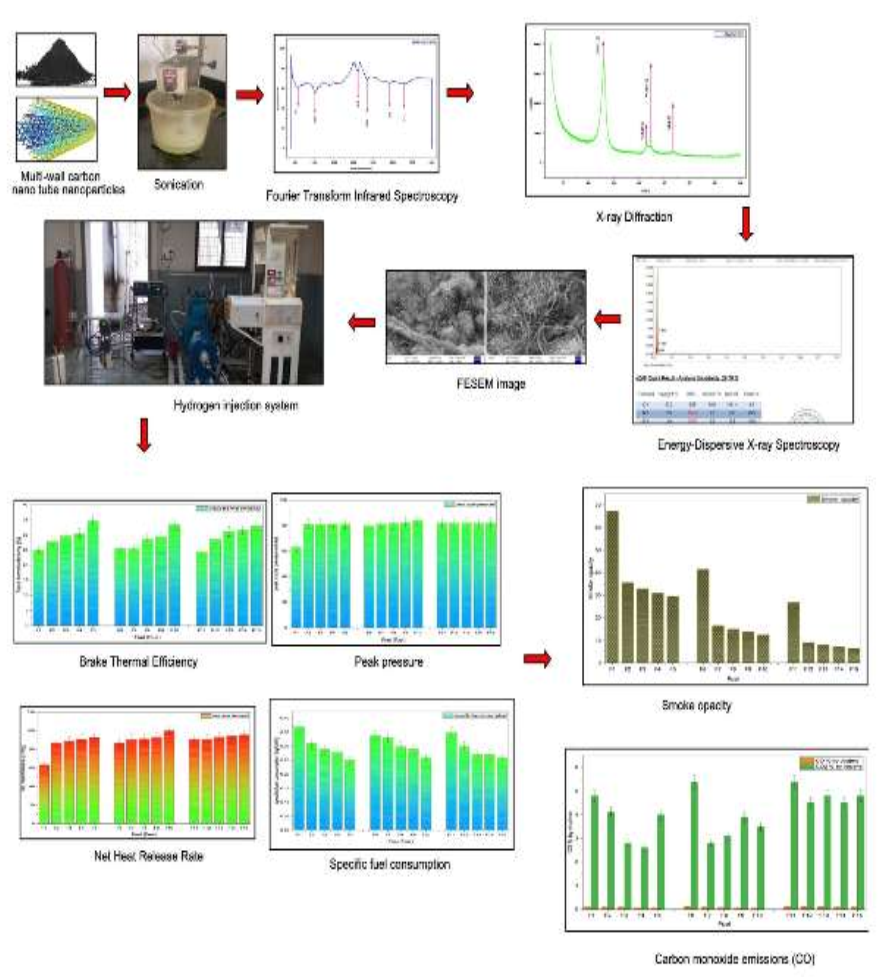
The objective of this experiment is to investigate the effect of multiwalled carbon nanotubes, combined with hydrogen as a supplementary fuel, on the efficiency, combustion, and emissions of a diesel engine test rig. In three phases, tests were conducted. In the initial attempt, pure diesel and hydrogen at 0.047, 0.077, 0.101, and 0.121 kg per hour (F1-F5). In the second phase, diesel with 60 ppm concentration of MWCNT and hydrogen at 0.047, 0.077, 0.101, and 0.121 kg per hour(F6-F10). In the third phase, diesel with 90 ppm concentration of MWCNT and hydrogen at 0.047, 0.077, 0.101, and 0.121 kg per hour (F11-F15). It was recorded that the output thermal efficiency improved with hydrogen injection at 0.121kg per hour in all three phases, to 27.65%, 23.47%, and 25.97% compared to diesel, diesel with 60 ppm, and diesel with 90 ppm. The specific fuel consumption was reduced by 32.43%,23.52% and 25.71%, respectively. CO emissions are reduced by 37.5%, 50%, and 27.27% in three phases, and CO2 emissions are reduced by 16.66%, 35%, and 11.11%, respectively. Hydrocarbon emissions were mitigated by 40%,55% and 65% compared to baseline fuels. Smoke emissions were also reduced by 56%,70% and 76%, whereas nitric oxide emissions were increased by 38.64%, 11.03% and 28.6% among the three phases compared to baseline fuels. As cylinder peak pressure are concerned in phase 1 the pressure was increase by 29.12%, in the second phase and third phase the pressures are recorded highest value of peak pressure of 85 bar at 371 crank angle and net heat release was increased by 46.14%,16.18% and 5.2% at crank angle 363 deg, in the third phase for all the hydrogen injection rates heat release was found very high.
Introduction
The exergetic assessment was done using jet fuel and hydrogen fuel on a turbojet engine. Parametric analysis concluded that exergy efficiency was reduced 1.67% when hydrogen fuel was used. With hydrogen operation, the ecological and environmental effect will be improved. Balli et al., 2018). Research was conducted using diesel and diesel plus hydrogen mixtures on an air-cooled engine at full load, and hydrogen was injected at 5,10,15 and 20%, after which the volumetric efficiency was compared. Batmaz (2013) . A thermodynamic bi-zonal model used for the analysis in K9K Renault engine operated at 2000 rpm and energy substitution was upto55% results recorded that hydrogen enhanced fuel atomization, accelerated mixture formation and vaporization with shorter ignition delay Cernat et al. (2020) and Pana et al. (2021). The supplementary fuels hydrogen and producer gas in an engine operating 1500 rpm and combustion parameters were studied at different load conditions the cycle pressure was increased when hydrogen was used nearly 30%. Still, when producer gas was used the pressure was reduced, Dhole et al. (2014, 2016a, 2016b).
Experiment was conducted on two different chambers hemispherical and re-entrant with dual fuel injection with hydrogen at 8 lpm and neem methyl ester was used to understand performance and emissions with an injection pressure of 600-1000bar, results recorded peak pressure and heat energy and brake efficiency was increased by 3.02% and reduction in emissions were observed whereas there was an increase in nitric oxide emissions Halewadimath et al. (2020). Due to flammability, faster diffusion rates and rapid characteristics of combustion and also enhances fuel burning in compression ignition engine hydrogen was considered as alternative fuel. The performance and emissions were focused by injecting hydrogen-rich air at a flow rate of 25lpm under an EGR system, and results recorded decrement of emissions significantly. Hoang and Pham, (2020), supplying hydrogen-rich air through the intake manifold using an integrated EGR system improved combustion efficiency and reduced particulate matter and NOx emissions. The enhanced combustion was attributed to hydrogen's high diffusivity, wide flammability limits, and fast burning velocity, which enable more complete combustion of the fuel–air mixture. Apart from performance and emission studies, some researchers have investigated the dynamic behaviour of engines operating with hydrogen-assisted fuels, Javed et al. (2016).
Researchers focussed on specific fuel consumption and emissions by injecting small quantities of hydrogen along with intake air into the inlet manifold of a diesel engine and the results were demonstrated reduction in specific fuel consumption by 11.53% and increment of BTE 4.85%, emissions were also decreased whereas slight increase in nitric oxide emissions with minimal change in combustion characteristics, Kamaraj et al. (2020). Studies focussed on supplementary fuel as hydrogen in diesel engine with a share of 30% of energy as like split injection first diesel then hydrogen, engine running at 100 rpm and the parameters were analysed at loads 40%,60% 75% and 100%. At partial loads, the performance and emissions were reduced, but NO was increased at full load. Hydrogen was injected at 25%,50%, and energy share through the intake manifold when the engine was running at 750 to 2100 rpm to analyse engine output parameters. Results recorded a reduction in emissions, whereas nitric oxide emissions were increased Karagöz et.al., (2015, 2016).
Experiments are conducted using a hydrogen energy supplement at 0.2- 0.8 litres per minute to understand engine output parameters. Results have shown reduced emissions at 0.8 lpm of hydrogen, whereas nitric oxide emissions are increased at higher loads, Koten et al. (2018). The impact of hydrgen and di-tert-butyl peroxide (DTBP) are used to to control nitric oxide emissions in a single cylinder engine with an rpm of 1500.Experiments were conducted with and without (DTBP). Results were recorded for 14% hydrogen 1% (DTBP). The temperature was decreased, and heat release was decreased by 10% and 2%, respectively. Studies evaluated ignition delay in a hydrogen diesel dual fuel engine with and without(DTBP). The delay values were compared with the Hardenberg–Hase equation and its modified form, the ignition delay values 6.6-21.22% and 1.2-11.96%, respectively. In addition, 5% DTBP significantly reduced the ignition delay, and the polytropic index was increased during combustion. Further, the studies have extended the effect of di-tert butyl peroxide additive in a hydrogen–diesel dual–fuel engine to improve performance and reduce emissions. Results recorded that the addition of 1-5% DTBP with 40% energy of hydrogen substitution significantly increased brake thermal efficiency at low load conditions. The addition of DTBP of 4% reduced NO emissions up to 33.82%, Kumar et.al.(2020a,2020b,2020c).
To predict combustion parameters, brake thermal efficiency, and mean gas temperature on a dual fuel engine using hydrogen, LPG and their mixtures as supplementary fuels. Using empirical equations, spray mixing, flame propagation, and equilibrium combustion products are processed. The values obtained are compared to the experimental values of multi cylinder turbocharged and single cylinder engines. The predicted values have shown close agreement with experimental readings. Studies focused on ignition delay on a 4D cylinder turbocharged diesel engine operable on hydrogen, LPG and mixtures of these as secondary fuels. The conduction of experiments and ignition delay were compared with the existing values. Results recorded the variations of about 6.56-14.6% for dual fuel and 33.3% for pure diesel. It's understood from the results that ignition delay depends on fuel type, gaseous fuel concentration, charge temperature, and oxygen concentration. Further studies have expanded to combustion characteristics of the same engine and same fuels as secondary, the results have demonstrated for 30% hydrogen substitution increased pressure and combustion duration compared to diesel operation similarly LPG substitution enhanced pressure but heat release was declined in the first combustion phase, but the hydrogen LPG mixture (70:30) proved better performance with effective impact on combustion parameters and reduced combustion durationLata, D. B. et. al, (2010,2011a,2011b).
Exhaust gas recirculation (EGR) along with hydrogen was studied on a single-cylinder dual-fuel system. In this study, the energy shares of hydrogen 0%,10% and 30%, and EGR rates from 0-10%. Results recorded without affecting the brake thermal efficiency, the emissions NO, CO2, CO, THC and PM are reduced by 27.4,33.4,32.3 and 20%, Nag, et al. (2019). Tamanu methyl ester (TME) ethanol blends with hydrogen induction were studied to improve performance and reduce emissions. Ethanol could be blended with biodiesel up to 30% have reduced emissions and improved performance without modifying the engine Parthasarathy, et al. (2015). Researchers focused on gaseous fuels to reduce emissions and consumption of liquid fuels, using natural gas, biogas, producer gas, methane, LPG and propane. Results declared that the dual fuel concept effectively reduced NO and PM emissions, and specific fuel consumption was increased at part loads; engine performance was improved at higher loads (Sahoo et al., U.K. 2009).
Studies investigated the usage of hydrogen diesel fuel combustion in a modified diesel engine at different engine speeds and injection strategies. Results recorded a reduction of smoke emissions and an increase in nitric oxide emissions. To control nitric oxide emissions, water was injected into the intake manifold, and a reduction of 50% and an efficiency of 37% was recorded Serrano, et.al (2019). Air fuel ratio significantly improves the efficiency of the engine and reduces the emission effect on the environment. It also improves the performance and emission parameters as the engine speed is increased, as hydrogen diffusion and air fuel homogeneity enhance the combustion process. Simultaneously, material selection and engine components, valves play an important role, Sing, L. K. (2015). Investigations have been done on a hydrogen–diesel dual fuel model with different hydrogen energy shares. Increasing the hydrogen consumption reduced the fuel consumption, and in turn improved performance, whereas nitric oxide emissions were increased significantly. Suzuki, et.al (2015).
Studies focused on engine simulation software. The combustion chamber was modelled using both the standard and modified configurations in AVL-FIRE at 2000 rpm. It was observed that the modern combustion chamber improved mixture formation and evaporation rate compared to the standard combustion chamber. Increased pressure, temperature, flame velocity and net heat release rate were observed; CO and NO emissions were also reduced by 6% and 32%, respectively, for the modern combustion chamber. Temizer, et al. (2021). Researchers used microalgae bio diesel, hydrogen and hydroxyl gas in a diesel engine, and the results show that emissions are reduced, but brake power and torque were also reduced, while CO2 was also increased. Uludamar, E. (2018).
A diesel–bio gas dual fuel engine with hydrogen as a supplement has been studied from 5-20% to improve performance and emissions. At higher loads, the hydrogen impact was greater when compared to low loads in terms of peak pressure and heat energy. The author also used exergy analysis to identify irreversibility in engine processes Verma et al., (2018). Substantial research has been conducted on dual fuel to improve the performance and emissions, however only limited studies have focusses on nanoparticles. In this research multi-walled carbon nano tubes at 60 and 90 ppm dosages per one litre with the injection of hydrogen at 0.047, 0.077, 0.101, and 0.121 kg per hour during suction stroke at a pressure of 2bar was investigated and the same hydrogen injection was done for pure diesel was experimented.
Table 1. Summary of introduction
Materials and Methods
To understand the functional groups and surface chemical characteristics of multiwall carbon nanotubes the analysis of Fourier Transform Infrared Spectoscipy was conducted. The obtained spectrum was examined for the selected wavenumber range to understand the bonding features of MWCNT showrn in Figure 1.The graphite structure of MWCNT at band 1644 cm⁻¹ which corresponds C=C stretching vibrations of sp²-hybridized carbon[Carbon 46 (2008) 833–840].The graphite framework of carbon was observed may also be attributed to aromatic C=C skeletal vibrations at peak 1541cm-1.The functional groups carbonyl, carboxyl, and hydroxyl groups on the surface of nanotubes were observed as the peaks are observed at 1746 cm⁻¹, 1368 cm⁻¹, and 1007 cm⁻¹[ Carbon 46 (2008) 833–840, Advanced Materials 17 (2005) 17–29]. The broad band 3279 correponds O–H stretching which signifies hydroxyl groups and adsorbed moisture.The C–H stretching vibration of aliphatic groups were observed at peak 2919 cm⁻¹. The The peak at 2340 cm⁻¹ corresponds to atmospheric CO₂ absorption, which is not intrinsic to the MWCNT sample.
Figure 1. Fourier transform infrared spectroscopy spectrum.
Table 2. FTIR phase identification
|
Peak position cm -1 |
Assignment |
Phase indicated |
|
3279 |
O-H Stretching |
Surface hydroxyl groups/ adsorbed |
|
2919 |
C-H Stretching |
Aliphatic hydrocarbon groups |
|
2340 |
CO2 Asymmetric stretching |
Atmospheric CO2 |
|
2113 |
Combination / overtone band |
Carbon framework vibration |
|
1746 |
C=O stretching |
Carbonyl/ carboxyl groups |
|
1644 |
C=C Stretching |
Graphite carbon structure |
|
1541 |
C=C Skeletal vibration |
Aromatic carbon frame work |
|
1368 |
C-O Stretching |
Oxygen containing functional groups |
|
1007 |
C-O Stretching |
Alcohol / ether groups |
|
575 |
c-c skeletal vibration |
Caron nanotube framework |
Figure 2 demonstrates the pattern of XRD of multi-walled carbon nanotubes confirming the successful formation of graphite carbon peaks. From the pattern at at 2θ= 25–26° a dominant peak correspoonds (002) to grphite carbon which inturn indicates well organized grpherne layers within MWCNT structue.it was understood that this peak indicates the presence of nanoscale crystallinity and partially structural disorder which normally obsrved in synthesized MWCNT through catalytic route.The broadening indicate defects and curvature of graphene walls and a finite crystalline dimensions of nanotubes. At 2θ ≈ 42–44° a weaker diffraction feature waso bseved and attributed to (100) graphitic carbon which in turn supports graphitic nano frame work. The synthesized MWCNT possesses good purity phase as stong impurity peaks were not obseved at higher diffraction region such as (Fe, Co, or Ni particles).The weak bonds are observed at 45-55 deg region which are the traces of amoupous carbon or residual metallic catalyst remnants. The diffraction profile demonstrates a partially crystalline graphitic structure with characteristic carbon ordering, which is advantageous for enhancing thermal conductivity, catalytic activity, and combustion enhancement when used as fuel nano-additives in diesel-based systems. The observed graphitic crystallinity may facilitate improved heat transfer and oxygen adsorption during combustion, thereby contributing to enhanced oxidation behaviour.
Figure 2. X-Ray diffraction of MWCNT.
Table 3. XRD profile parameters.
|
Position 2θ |
Height [cts] |
FWHM Left [°2θ] |
d- spacing [A°] |
Rel.Int.% |
|
26.1111 |
2764.47 |
0.4546 |
3.4128 |
100.00 |
|
43.0208 |
264.79 |
0.4546 |
2.10254 |
9.58 |
|
44.7924 |
240.3 |
0.3897 |
2.02341 |
8.69 |
|
53.48 |
67.52 |
0.7793 |
1.71319 |
2.44 |
FESEM Images of Multiwalled carbon nano tubes
Figure 3 dipicts the morphology of syntesized MWCNT, which was tested using field emission scanning electron microscopy. The obtained image confirms the presence of entangled and fibrous tubular nanostructues of MWCNT.These tubes are oriented randomly and interconnected network which is a characteristic morphology of MWCNT.These nanotubes exhibit high aspect ratio and cylindricl morphology which signifies concentric graphite walls . The strong vanderwalls in between adjacent nanotubes which refelects as agglomerated nanotubes. Despite of partial agglomeration the framework of tubes are clearly distingushable and demonstrating structural integrity and continuity of nanotube network. The image further exhibits porous and inter connected structure which provides effective surface area and enhanced adsorbption characteristics.This sort of morphology is very much benificial in fuel additive applications as it increases the surface interaction which promotes better fuel atomization , enhaced heat transfer and catalytic oxidation in the combustion process as there is no presence of bulky partilces too.
Figure 3. SEM images of MWCNT.
Figure 4 demonstrates the surface plot analysis of the multiwalled carbon nanotubes (MWCNTs), which revealed a highly irregular and heterogeneous topographical structure characterized by noticeable surface roughness and nanoscale height variations. The three-dimensional surface profile revealed interconnected nanotube networks with localized agglomerated regions, attributed to strong van der Waals interactions between adjacent nanotubes. Such surface irregularities indicate a high effective surface area, which is advantageous for enhanced physicochemical interactions. The observed topography further suggests the existence of a porous and non-uniform surface architecture, which may facilitate improved adsorption behaviour and enhanced catalytic activity during combustion applications. The elevated surface features and valleys observed in the surface plot indicate the presence of nanoscale structural complexity, which increases the number of active sites for fuel–nanoparticle interactions.
Figure 4. Surface plot of MWCNT at 100 nm.
Additionally, the rough surface texture of MWCNTs may improve dispersion and interfacial contact within fuel blends, thereby enhancing heat transfer and oxidation behaviour. The interconnected nanoscale morphology observed from the surface profile confirms the structural integrity of the nanotube network. It supports its suitability as a combustion-enhancing nano-additive in diesel engine applications. Overall, the surface plot confirms that the multiwalled carbon nanotubes exhibit a rough, porous, and interconnected nanoscale morphology with significant surface heterogeneity, which is expected to contribute positively toward combustion improvement, emission reduction, and fuel oxidation enhancement.
Methodology
The experimental investigation was conducted in three sequential phases to evaluate the individual and combined effects of hydrogen enrichment and multi-walled carbon nanotubes (MWCNTs) on the combustion, performance, and emission characteristics of the diesel engine. Phase 1 established the baseline performance of neat diesel and hydrogen-enriched diesel. Neat diesel was used as the reference fuel (F1), while hydrogen was subsequently introduced at mass flow rates of 0.047, 0.077, 0.101, and 0.121 kg h⁻¹, corresponding to test fuels F2–F5, respectively. The hydrogen was supplied to the engine through the designated hydrogen delivery system and its flow rate was controlled and monitored using a calibrated flow-measuring device. All other engine operating and measurement conditions were maintained identical to those used for the reference diesel condition.
In Phase 2, the effect of MWCNT addition and its combined interaction with hydrogen was investigated. MWCNTs were dispersed in neat diesel at a concentration of 60 ppm to obtain the F6 nanofuel. The MWCNT–diesel mixture was prepared using an appropriate dispersion procedure to minimize particle agglomeration and ensure uniform distribution throughout the fuel. The 60 ppm MWCNT fuel was subsequently tested with hydrogen supplementation at 0.047, 0.077, 0.101, and 0.121 kg h⁻¹, designated as F7–F10, respectively. Phase 3 followed the same experimental procedure using a higher MWCNT concentration of 90 ppm. Neat diesel containing 90 ppm MWCNT was designated F11, while F12–F15 represented the corresponding MWCNT–diesel fuel supplemented with hydrogen at 0.047, 0.077, 0.101, and 0.121 kg h⁻¹, respectively. Thus, a total of 15 fuel conditions were evaluated, enabling systematic assessment of the effects of hydrogen flow rate at two different MWCNT concentrations.
For each experimental condition, the prepared fuel was introduced into the engine under the same prescribed operating conditions, and sufficient time was allowed for the engine to reach steady-state before data acquisition. The fuel consumption, air-flow rate, engine load, and relevant temperature and pressure parameters were recorded using calibrated measurement instruments. Combustion characteristics were evaluated from the measured in-cylinder pressure data, while exhaust emissions were determined using the installed gas and smoke meter. The measured parameters were subsequently compared with those obtained using neat diesel to quantify the influence of MWCNT addition, hydrogen enrichment, and their combined application.
To ensure experimental reliability, the same fuel preparation, engine warm-up, stabilization, measurement, and data-recording procedures were followed for all 15 test conditions. Measurements are repeated under each condition, and the mean values should be reported together with the corresponding uncertainty or standard deviation. The experimental matrix is summarized in a systematic basis for evaluating the effects of MWCNT concentration (0, 60, and 90 ppm)and hydrogen flow rate (0, 0.047, 0.077, 0.101, and 0.121 kg h⁻¹) on engine performance, combustion behaviour, and exhaust emissions.
Diesel engine performance characteristics were evaluated to quantify the influence of multiwall carbon nano tubes(MWCNT)diesel blends on engine output key parameters under steady state operating conditions using standard diesel engine test rig in fig 5. Experimentation was conducted on Kirloskar TV1 engine, the injection of fuel with is at 23 bTDC with an injection pressure of 250 bar for all the test runs. The engine was allowed to reach steady state for 20 to 25 minutes prior to data acquisition to attain steady state operating conditions. Experimentation was done with neat diesel and subsequently with Nanoparticle blends at a dosage of 60 and 90ppm along with hydrogen. At each load the engine was stabilized for 5 min after performance parameters were recorded, fuel consumption was measured using a burette and stopwatch method while air flow was determined by means of an air box and a U tube manometer. Brake torque was measured by eddy current dynamometer.
Figure 5. Test rig schematic diagram.
Table 4. Engine specifications
|
Component of engine |
Specification |
|
Power output |
5.20kW |
|
Speed |
1500rpm |
|
Internal diameter |
87.50mm |
|
Length of the stroke |
110.00mm |
|
Conrod length |
234.00mm |
|
Ratio of compression |
17.50:1 |
|
Displacement of the Engine |
661cc |
Error Analysis
Using Standard Deviation (Variance) Method
Unpredictability in conduction of experiment is crucial for evaluating reliability and reproducibility of measured values. The overall error is incurred due to calibration of instruments, observational limits, environmental conditions and the procedures of the experiment are summarized in the table 4, resulting an overall error of 3.268% using root –sum-square approach.
The uncertainty of a dependent variable y with respect to independent variables x is expressed as:
Using Taylor series expansion, the combined uncertainty is given by:
The experimentation considers all parameters are statistically independent and sensitive coefficients are taken as unity, therefore the overall error reduced to the standard variance program form:
Unpredictability
The repeatability values of the measured parameters are considered as standard deviations
Table 5. Uncertainty values
|
Parameter |
Uncertainty |
|
Operating speed (S) |
±0.6 |
|
Applied Load (L) |
±0.2 |
|
Peak Pressure (cylinder) (P) |
±0.1 |
|
Mass flow of fuel (F) |
±1.0 |
|
Mass of air flow (A) |
±0.4 |
|
Tail pipe temperature (EGT) (E) |
±0.2 |
|
Consumption of fuel (specific) (B) |
±1.2 |
|
Carbon monoxide (C) |
±0.2 |
|
Hydro Carbon emissions (H) |
±0.2 |
|
Nitric Oxide emissions (N) |
±0.2 |
|
Smoke emission (SM) |
±0.1 |
|
Speed of the stirrer (SS) |
±1.0 |
|
Density of fuel (FD) |
±0.001 |
|
Flash point (FP) |
±2.0 |
|
Kinematic viscosity (KV) |
±0.1 |
|
Calorific value (CV) |
±0.2 |
|
Hydrogen mass flow (MF) |
±0.1 |
|
Density (Coriolis meter) (CM) |
±0.0005 |
|
Cetane number (CN) |
±1.0 |
Squaring each uncertainty:
= ± 3.268
Within any experimental investigation error analysis is crucial for revealing the magnitude of uncertainties associated with the measurement. Errors can occur due to various causes, including calibration, instrumentation, observation, environmental circumstances and test planning. Table 5 provides the percentage uncertainty for each individual parameter, and the total percentage of uncertainty was determined using equation1 to be ±3.268%.
Combustion Analysis Procedure
For combustion analysis, a piezoelectric pressure sensor mounted on the cylinder head was connected to a charge amplifier, in turn connected to a data acquisition system, which measures the in-cylinder pressure during the combustion process. The inside cylinder pressure was synchronized, and the crank angle signal was recorded using a data acquisition system, which is incorporated with combustion analysis software. The peak cylinder pressure and the actual crank angle were directly taken as a result of the pressure crank angle graph. The cumulative heat release was generated by taking the integration of the heat release rate within the range of the crank angle.
Emission Analysis Procedure
Emission evaluation was carried out on the diesel engine test rig operated with diesel as base line fuel, diesel- Nano blends and diesel. Nanoparticles were uniformly dispersed in diesel at the desired concentrations, and the engine was operated at a constant speed under different load conditions. Prior to measurement, the engine was allowed to attain a steady state condition. Exhaust emissions of hydrocarbons (HC), carbon monoxide (CO), carbon dioxide (CO₂), and oxides of nitrogen (NO/NOx) were measured using a calibrated multi-gas exhaust analyser as shown in Figure 6. Smoke opacity was determined by using standard smoke meter shown in Figure 6. At each point emission readings were recorded after analyser stabilization and averaged over a fixed sampling period. Each test was repeated for to ensure repeatability. The observed emissions were correlated with operating parameters such as load and fuel flow rate to evaluate the combined influence of nanoparticles on exhaust emissions characteristics.
Figure 6. Emission measuring equipment.
Experimental Setup
The test engine used for the experiment is a common-rail direct-injection engine with a pressure sensor to capture the peak cycle pressure as a function of crank angle. The necessary instrumentation, AVL 444 five-gas analyser, along with the smoke meter, was connected to measure emissions and smoke.
Figure 7. Engine test rig.
Figure 8. Sonicator.
Table 6. Properties of fuels
|
Sample/ Properties |
Density at 25 0C |
LCV Calorific Value |
HCV Calorific Value |
Flash Point |
Fire Point |
Kinematic Viscosity at 40 0C |
Dynamic Viscosity @400C |
|
Unit |
kg/m³ |
kJ/kg |
kJ/kg |
(°C) |
(°C) |
(cSt) |
(cP) |
|
ASTM Standard |
D287 |
D 4809 |
D 4809 |
D93- 58T |
D93- 58T |
D445 |
D445 |
|
Pure Diesel |
830 |
42000 |
46000 |
52 |
59 |
2.5 |
2.1 |
|
MWCNT 60ppm |
835 |
42500 |
46500 |
58 |
62 |
2.7 |
2.3 |
|
MWCNT 60ppm |
840 |
43500 |
47000 |
60 |
67 |
2.9 |
2.5 |
Results
The output thermal efficiency was improved for hydrogen injection at 0.121kg per hour in all the three phases with 27.65,23.47% and 25.97% when compared to diesel, diesel with 60ppm and diesel with 90ppm. The specific fuel consumption was reduced by 32.43%,23.52% and 25.71%, respectively. As cylinder peak pressure are concerned in phase 1 the pressure was increase by 29.12%, in the second phase and third phase the pressures are recorded highest value of peak pressure of 85 bars at 371 crank angle and net heat release was increased by 46.14%,16.18% and 5.2% at crank angle 363 deg, in the third phase for all the hydrogen injection rates heat release was found very high. CO emissions are decreased by 37.5%,50% and 27.27% co2 emissions are reduced by 16.66%,35% and 11.11%, respectively, in three phases. Hydrocarbon emissions were mitigated by 40%,55% and 65% compared to baseline fuels. Smoke emissions were also reduced by 56%,70% and 76%, whereas nitric oxide emissions were increased by 38.64%, 11.03% and 28.6% among the three phases compared to baseline fuels.
Specific fuel consumption calculates the fuel consumed to produce a unit brake power which in turn provides fuel economy and the insights of effectiveness of combustion process. In the present research at different loads the performance and emissions are studied with an auxiliary fuel of hydrogen blended with MWCNT. Figure 9 demonstrates the variation of specific fuel consumption(BSFC) for the fuel blends F1-F15 at full load. A comparative analysis of brake specific fuel consumption was performed between F1 –F5, F6-F10 and F11–F15, considering F1, F6 and F11 as reference fuel for comparison in three phases. A notable decline in BSFC was recorded with a value of 32.43%,23.52% and 25.71% in the three phases, respectively, with a hydrogen injection rate of 0.121kgh-1. The same trend was followed at 25,50 and 75% loads. The reduction in specific fuel consumption at a hydrogen flow rate of 0.121kg/ hour is due to an enhanced combustion mechanism. As hydrogen possesses a high heating value (120MJ/kg), low ignition energy, high flame speed and wide flammability limits compared to diesel. At moderate flow rates, participation of hydrogen in combustion is more rapid in the premixed combustion phase, which promotes more complete oxidation of the diesel spray. This will lead to more combustion efficiency and a reduction in unburned hydrocarbons. Since specific fuel consumption is inversely proportional to brake thermal efficiency, improvement in combustion characteristics directly reduces the mass of diesel required to produce a given brake power output. Multiwalled carbon nanotubes further intensify this improvement, which act as a nano-catalytic combustion promoter due to high surface area, good thermal conductivity and also oxygen buffering capacity Mesri et al. (2021).
Figure 9. Variation of specific fuel consumption.
The most important and key parameter in the combustion process is brake thermal efficiency which signified the conversion of chemical energy to brake power. In this research the variation of efficiency with different loads blended diesel with multiwalled carbon nanotubes with and without hydrogen as supplementary fuel.
Figure 10 represents the variation of brake thermal efficiency (BTE) for the fuel blends F1-F15 at full load. A comparative analysis of brake thermal efficiency was performed within F1 –F5, F6-F10 and F11 –F15 considering F1, F6 and F11 as reference fuel for comparison in three phases. A notable increment in BTE was recorded with a value of 38.22% %,30.68% and 35.08% in the three phases, respectively, with a hydrogen injection rate of 0.121kgh-1. The same trend was followed at 25,50 and 75% loads also. The gradual increase in brake thermal efficiency at 0.121kg/hr was due to combustion kinetics and effective utilization of energy within the cylinder. The hydrogen was injected with 2 bar pressure at 90ºCA after top dead centre during the suction stroke without disturbing the air intake inside the cylinder to avoid agglomeration during the suction stroke. Because of the high heating value of hydrogen, flammability limits, high diffusivity, and a more homogeneous mixture, which accelerates the initial stages of combustion initiated by pilot injection. The rapid flame propagation shortens combustion duration, improves completeness of oxidation and shifts a larger portion of the heat release towards the optimal crank angle close to top dead centre Kamaraj et al. (2021)
Figure 10. Variation of brake thermal efficiency.
Cylinder pressure is a fundamental parameter that reflects the in-cylinder combustion process and energy release characteristics of the engine. The variation of cylinder pressure with crank angle provides valuable insights into ignition delay, combustion phasing, and peak pressure development. In the present study, cylinder pressure profiles are analysed under different engine operating parameters to evaluate the influence of hydrogen enrichment and MWCNTs nanoparticle addition. Figure 11 represents the variation of peak cylinder pressure for all the tested fuels pure diesel with and without hydrogen, multiwall carbon nano tubes of 60ppm and 90ppm with and without hydrogen. In all three phases, the cylinder pressure was increased with a flow rate of 0.121 kg per hour compared to base fuels, diesel, diesel with multiwall 60 and 90 ppm. This gradual increase occurred when different flow rates of 0.047,0.077,0.101 and 0.121kg per hour were used. This gradual increase and maximum at 0.121kg per hour might be due to enhanced combustion reactivity and faster heat release characteristics. Hydrogen promotes rapid premixed combustion once initiated by pilot injection due to high flame speed, wide flammability limits and low ignition energy. These parameters accelerate the early combustion phase and improve the cycle peak pressure inside the combustion chamber. Due to the hydrogen injection, a more homogeneous mixture formation is responsible for high diffusivity, which ensures more uniform combustion and thereby an increase in pressure near top dead centre. Simultaneously, MWCNT improves the atomization process and shortens the ignition delay due to high thermal conductivity and catalytic surface activity Lata et al. (2011)
Figure 11. Variation of peak cycle pressure.
Figure 12 demonstrates the variations in heat release rate for the diesel and bleneded with diesel are tested with and without hydrogen. Among all the cycles for a flow rate of 0.121kg/hr achieved maximum heat release rate. When hydrogen was injected the net heat release rate and cumulative heat release rate was increases and inturn improved brake thermal efficiency near the optimal crank angle region. Simultaneously the this higher cumulative heat release rate is directly proportional to specific fuel consumption.
The redictopm in specific fuel consumption is due to improvement in combustion perfromance which is attributed to high flame speed , wide flammability limits due to hydroge and shorter ignition delay which inturn enhanced premixed combustion phase. The incomplete combustion is possible due to the injection of hydrogen as it imoroves the mixture homogeneity. The addition of multiwall carbon nanotubes improves atomization process and inturn it is helpful in secondary braekup of mixture particles which leads to better mixing. These results are in accordance with D.B.et al Latha(2011).
Figure 12. Variation of heat release rate.
When carbon-based liquid fuels are burned incompletely, hazardous carbon monoxide emissions are emitted. Fig. 13 demonstrates the carbon monoxide and carbon dioxide emissions at full load. It is understood and confirmed from the findings and discussion that the brake thermal efficiency, net heat release, and cylinder pressure are enhanced by hydrogen supplementation with multiwalled carbon nanotubes in diesel operation. Due to improved homogeneity of the mixture, the elevated cylinder temperatures cause the intermediate species of carbon monoxide emissions to decrease significantly through the oxidation process. The carbon monoxide was reduced by 37.5%,50% and 27.27% with an injection rate of 0.121kg per hour compared to base reference fuels, diesel, diesel with 60 ppm MWCNT and 90 ppm MWCNT (multiwalled carbon nano tubes). Carbon dioxide emissions are also reduced but comparatively less 16.66%,35% and 11.11 % respectively. The reason might be due to enhanced atomization and catalytic properties of MWCNTs convert co to co2, consequently carbon dioxide emissions increase slightly, indicating more complete combustion Ashok et al.(2021).
Figure 13. Variation in carbon emissions.
Figure 14 validates the variation of hydrocarbons and nitric oxide emissions. The observed increase in brake thermal efficiency, peak cylinder pressure, and net heat energy rate under hydrogen-enriched MWCNT–diesel operation indicates intensified premixed combustion and elevated in-cylinder temperature. The hydrocarbon emissions were reduced by 40%,55% and 65%, respectively, in three phases. The reduction in hydrocarbons might be enhanced in an oxidation environment by minimising the wall quenching effect, improving homogeneity and accelerating intermediate species. The catalytic and atomization properties of multiwalled carbon nanotubes enhance combustion completeness, particularly at 90ppm concentration. Conversely, the elevated peak temperatures and oxygen availability strongly promote thermal nitric oxide formation through the Zeldovich mechanism, increasing nitric oxide emissions. It was observed that Nitric oxide rise at 90ppm is attributed to higher combustion intensity and greater residence time for elevated temperature rise. Due to these reasons, the nitric oxide emissions were increased by 38.64%, 11.03% and 28.6% respectively for the three phases Kumar et al. (2020)
Figure 14. Variation in hydrocarbons and nitric oxide emissions.
Due to incomplete combustion of hydrocarbon fuels the formation of smoke occurs. The smoke constituents are strongly affected by fuel composition, mixing of fuel and air, combustion temperature and conditions of operation. During peak loads the availability of less oxygen and the formation of smoke at high levels. Improved mixing, atomization and enhanced oxygen the smoke emissions are controlled. Figure 15 Demonstrates the variation of smoke opacity. The smoke opacity was reduced by 56%.70% and 76% res [actively for the three phases with a hydrogen injection rate of 0.121kg /hr. The substantial decrement is primarily due to the carbon-free nature of hydrogen, which reduces the availability of carbon for soot precursor formation. Due to high diffusivity and flame speed of hydrogen, the air fuel mixture homogeneity is enhanced and the combustion phase is shortened, thereby suppressing locally rich zones responsible for soot nucleation. In addition to the elevated temperature in the combustion chamber, an increase in radical OH concentration promotes active soot oxidation. The hydrogen when combined with multi-walled carbon nano tubes, enhanced atomization, the synergetic interaction results in significant suppression of particulate formation Manigandan Manigandan et al. (2019).
Figure 15. Variation in smoke emissions.
Conclusion
Experimental evaluation was carried out in different cycles to accesses the impact of hydrogen gas in diesel fuel blended with multiwall carbon nanotubes to understand performance, combustion and emissions. In the first cycle pure diesel with different flow rates 0.047, 0.077, 0.101, and 0.121 kg h⁻¹ (F1–F5) of hydrogen was executed. In the second cycle diesel blended with 60ppm dosage of MWCNT with the same flow rates of hydrogen considered in the cycle1.In the second phase, diesel blended with 60 ppm MWCNTs was tested under the same hydrogen flow rates (F6–F10). In the third phase, diesel blended with 90 ppm MWCNTswas evaluated with hydrogen induction rates of 0.047, 0.077, 0.101, and 0.121 kg h⁻¹ (F11–F15)to investigate the combined influence of nanoparticle concentration and hydrogen supplementation on engine characteristics.
It was recorded that the brake thermal efficiency increased with hydrogen induction at a flow rate of 0.121 kg h⁻¹ across all three experimental phases. The maximum enhancement in brake thermal efficiency was recorded as 27.65%, 23.47%, and 25.97% for the respective fuel combinations when compared with pure diesel, diesel blended with 60 ppm MWCNTs, and diesel blended with 90 ppm MWCNTs. Among the tested conditions, hydrogen supplementation at 0.121 kg h⁻¹ exhibited the most notable improvement in engine efficiency. The results indicated a consistent increase in brake thermal efficiency under higher hydrogen induction rates.
The brake specific fuel consumption (BSFC) was observed to decrease by 32.43%, 23.52%, and 25.71%, respectively, across the three experimental phases. Similarly, CO emissions were reduced by 37.5%, 50%, and 27.27%, while CO₂ emissions decreased by 16.66%, 35%, and 11.11%, respectively. The reductions in fuel consumption and exhaust emissions were consistently observed under the tested operating conditions. These findings indicate noticeable variations in fuel utilization and emission characteristics across the three fuel phases.
Unburned hydrocarbon (UHC) emissions were reduced by 40%, 55%, and 65% compared with the corresponding baseline fuels across the three experimental phases. Similarly, smoke emissions decreased by 56%, 70%, and 76%, indicating a considerable reduction in exhaust opacity. However, nitric oxide (NO) emissions increased by 38.64%, 11.03%, and 28.6% relative to the baseline fuels, respectively. The observed emission characteristics varied across the three fuel phases under the tested operating conditions.
The cylinder peak pressure and net heat release characteristics exhibited noticeable variations across the three experimental phases under hydrogen induction. In the first phase, the cylinder peak pressure increased by 29.12% compared with the baseline fuel condition. In the second and third phases, the highest cylinder peak pressure of 85 bar was recorded at 371° CA, indicating enhanced combustion pressure development. Furthermore, the net heat release rate (NHRR) increased by 46.14%, 16.18%, and 5.2%, respectively, across the three phases, with the maximum heat release observed at approximately 363° crank angle. In thethird phase (90 ppm MWCNT blend), significantly higher heat release was observed at all tested hydrogen injection rates. The combustion profile demonstrated notable variations in pressure development and heat release behaviour with increasing hydrogen supplementation and nanoparticle concentration.
Despite the promising outcomes, the use of MWCNTs presents certain limitations that warrant further investigation. Their tendency to agglomerate and sediment can compromise fuel stability and combustion repeatability, highlighting the need for optimized surfactant concentrations and effective functionalization strategies. Nanoparticle deposition near the injector nozzle may contribute to clogging, wear, and altered injection characteristics, emphasizing the importance of injector optimization and long-term stability assessment. Non-uniform nanoparticle–fuel mixing may also introduce variability in combustion behaviour and should be addressed through improved dispersion techniques. In addition, the relatively high cost of MWCNTs and concerns regarding nanoparticle handling and environmental impacts remain important considerations for large-scale implementation. The limited availability of long-duration engine data further emphasizes the need for comprehensive investigations of durability, deposit formation, wear, and emission stability. Addressing these challenges through cost-effective material synthesis, optimized fuel formulations, and extended engine testing will strengthen the feasibility of MWCNT-based fuels for practical applications.
Future studies should focus on improving the long-term dispersion and stability of nanoparticles in diesel using suitable surfactants such as Tween 80 and Span 80. Functionalization of nanoparticles may further enhance fuel compatibility and suppress agglomeration, thereby improving combustion performance. Systematic optimization of nanoparticle dosage, hydrogen flow rate, injection pressure, and injection timing is required to achieve an improved NOx–PM trade-off. The combined application of nanoparticles, hydrogen, EGR, and after-treatment technologies should be explored for further emission reduction. Advanced combustion diagnostics, including mass fraction burned (MFB) and in-cylinder pressure analysis, can provide deeper insight into combustion mechanisms. Long-term engine durability, wear, and tribological studies are essential to establish practical applicability. Future research should also address the safe handling, environmental impact, and disposal of nanoparticles. The development of hybrid nanomaterials, particularly MWCNT–metal oxide combinations, offers a promising pathway toward simultaneously improving efficiency and reducing emissions.
Nomenclature
ASTM— American Standard Testing Method
BP— Brake Power
BTE — Brake Thermal Efficiency
CP— Cylinder Pressure
CR— Compression ratio
CHRR— Cumulative Heat Release Rate
CO— Carbon Monoxide
CO₂— Carbon Dioxide
DE— Diesel engine
EDX— Energy dispersive x-ray
FESEM— Field emission scanning electron microscope
FTIR— Fourier transform infrared
H2— Hydrogen
HC— Hydrocarbons
MFB— Mass Fraction Burned
HRR — Heat Release Rate
NOx— Oxides of Nitrogen
PM— Particulate matter
PCP — Peak Cylinder Pressure
SFC — Specific Fuel Consumption
XRD— X- ray diffraction
MWCNTs— multi-walled carbon nanotubes
Compliance with ethics guidelines
The authors declare they have no conflict of interest or financial conflicts to disclose.
This article contains no studies with human or animal subjects performed by the authors.
References
Balli, O., Sohret, Y., & Karakoc, H. T. (2018). The effects of hydrogen fuel usage on the exergetic performance of a turbojet engine. International Journal of Hydrogen Energy, 43(23), 10848–10858. https://doi.org/10.1016/j.ijhydene.2017.12.178
Banerjee, S., Hemraj-Benny, T., & Wong, S. S. (2005). Covalent surface chemistry of carbon nanotubes. Advanced Materials, 17, 17–29. https://doi.org/10.1002/adma.200401340
Batmaz, I. (2013). The impact of using hydrogen as fuel on engine performance and exhaust emissions in diesel engines. Energy Sources, Part A: Recovery, Utilization, and Environmental Effects, 35(6), 556–563. https://doi.org/10.1080/15567036.2010.513217
Cernat, A., Pana, C., Negurescu, N., Lazaroiu, G., & Nutu, C. (2020). The influence of hydrogen on vaporization, mixture formation and combustion of diesel fuel at an automotive diesel engine. Sustainability, 13(1), 202. https://doi.org/10.3390/su13010202
Cernat, A., Pana, C., Negurescu, N., Lazaroiu, G., Nutu, C., & Fuiorescu, D. (2020). Hydrogen—An alternative fuel for automotive diesel engines used in transportation. Sustainability, 12(22), 9321. https://doi.org/10.3390/su12229321
Datsyuk, V., Kalyva, M., Papagelis, K., Parthenios, J., Tasis, D., Siokou, A., Kallitsis, I., & Galiotis, C. (2008). Chemical oxidation of multiwalled carbon nanotubes. Carbon, 46, 833–840. https://doi.org/10.1016/j.carbon.2008.02.012
Dhole, A. E., Lata, D. B., & Yarasu, R. B. (2016). Effect of hydrogen and producer gas as secondary fuels on combustion parameters of a dual fuel diesel engine. Applied Thermal Engineering, 108, 764–773. https://doi.org/10.1016/j.applthermaleng.2016.07.157
Dhole, A. E., Yarasu, R. B., & Lata, D. B. (2016). Investigations on the combustion duration and ignition delay period of a dual fuel diesel engine with hydrogen and producer gas as secondary fuels. Applied Thermal Engineering, 107, 524–532. https://doi.org/10.1016/j.applthermaleng.2016.06.151
Dhole, A. E., Yarasu, R. B., Lata, D. B., & Baraskar, S. S. (2014). Mathematical modeling for the performance and emission parameters of dual fuel diesel engine using hydrogen as secondary fuel. International Journal of Hydrogen Energy, 39(24), 12991–13001. https://doi.org/10.1016/j.ijhydene.2014.06.084
Dhole, A. E., Yarasu, R. B., Lata, D. B., & Priyam, A. (2014). Effect on performance and emissions of a dual fuel diesel engine using hydrogen and producer gas as secondary fuels. International Journal of Hydrogen Energy, 39(15), 8087–8097. https://doi.org/10.1016/j.ijhydene.2014.03.085
Halewadimath, S. S., Yaliwal, V. S., Banapurmath, N. R., & Sajjan, A. M. (2020). Influence of hydrogen enriched producer gas (HPG) on the combustion characteristics of a CRDI diesel engine operated on dual-fuel mode using renewable and sustainable fuels. Fuel, 270, 117575. https://doi.org/10.1016/j.fuel.2020.117575
Hoang, A. T., & Pham, V. V. (2020). A study on a solution to reduce emissions by using hydrogen as an alternative fuel for a diesel engine integrated exhaust gas recirculation. AIP Conference Proceedings, 2235(1). https://doi.org/10.1063/5.0007492
Javed, S., Satyanarayana Murthy, Y. V. V., Baig, R. U., & Nagarjuna Rao, T. (2016). Vibration analysis of a diesel engine using biodiesel fuel blended with nanoparticles by dual fueling of hydrogen. Journal of Natural Gas Science and Engineering, 33, 217–230. https://doi.org/10.1016/j.jngse.2016.05.026
Kamaraj, N., Subburaj, A. K., Mohanraj, R. K., & Rasu, S. (2021). Experimental investigation on performance, combustion and emission characteristics of CI engine with on-site hydrogen generation. Materials Today: Proceedings, 46, 5469–5474. https://doi.org/10.1016/j.matpr.2020.09.199
Karagöz, Y., Sandalcı, T., Yüksek, L., & Dalkılıç, A. S. (2015). Engine performance and emission effects of diesel burns enriched by hydrogen on different engine loads. International Journal of Hydrogen Energy, 40(20), 6702–6713. https://doi.org/10.1016/j.ijhydene.2015.03.141
Karagöz, Y., Sandalcı, T., Yüksek, L., Dalkılıç, A. S., & Wongwises, S. (2016). Effect of hydrogen–diesel dual-fuel usage on performance, emissions and diesel combustion in diesel engines. Advances in Mechanical Engineering, 8(8), 1–13. https://doi.org/10.1177/1687814016664458
Koten, H. (2018). Hydrogen effects on the diesel engine performance and emissions. International Journal of Hydrogen Energy, 43(22), 10511–10519. https://doi.org/10.1016/j.ijhydene.2018.04.146
Kumar, C. B., & Lata, D. B. (2020). Effect of di-tert-butyl peroxide (DTBP) on combustion parameters and NOx in dual fuel diesel engine with hydrogen as a secondary fuel. International Journal of Hydrogen Energy, 46(5), 4507–4525. https://doi.org/10.1016/j.ijhydene.2020.10.235
Kumar, C. B., Lata, D. B., & Mahto, D. (2020). Analysis of ignition delay by taking di-tertiary-butyl peroxide as an additive in a dual fuel diesel engine using hydrogen as a secondary fuel. International Journal of Hydrogen Energy, 45(29), 14806–14820. https://doi.org/10.1016/j.ijhydene.2020.03.212
Kumar, C. B., Lata, D. B., & Mahto, D. (2020). Effect of addition of di-tert-butyl peroxide (DTBP) on performance and exhaust emissions of dual fuel diesel engine with hydrogen as a secondary fuel. International Journal of Hydrogen Energy, 46(14), 9595–9612. https://doi.org/10.1016/j.ijhydene.2020.12.129
Lata, D. B., & Misra, A. (2010). Theoretical and experimental investigations on the performance of dual fuel diesel engine with hydrogen and LPG as secondary fuels. International Journal of Hydrogen Energy, 35(21), 11918–11931. https://doi.org/10.1016/j.ijhydene.2010.08.039
Lata, D. B., & Misra, A. (2011). Analysis of ignition delay period of a dual fuel diesel engine with hydrogen and LPG as secondary fuels. International Journal of Hydrogen Energy, 36(5), 3746–3756. https://doi.org/10.1016/j.ijhydene.2010.12.075
Lata, D. B., Misra, A., & Medhekar, S. (2011). Investigations on the combustion parameters of a dual fuel diesel engine with hydrogen and LPG as secondary fuels. International Journal of Hydrogen Energy, 36(21), 13808–13819. https://doi.org/10.1016/j.ijhydene.2011.07.142
Nag, S., Sharma, P., Gupta, A., & Dhar, A. (2019). Experimental study of engine performance and emissions for hydrogen diesel dual fuel engine with exhaust gas recirculation. International Journal of Hydrogen Energy, 44(23), 12163–12175. https://doi.org/10.1016/j.ijhydene.2019.03.120
Parthasarathy, M., Ramesh Lalvani, J. I. J., Dhinesh, B., & Annamalai, K. (2015). Effect of hydrogen on ethanol–biodiesel blend on performance and emission characteristics of a direct injection diesel engine. Ecotoxicology and Environmental Safety, 134, 433–439. https://doi.org/10.1016/j.ecoenv.2015.11.005
Sahoo, B. B., Sahoo, N., & Saha, U. K. (2009). Effect of engine parameters and type of gaseous fuel on the performance of dual-fuel gas diesel engines—A critical review. Renewable and Sustainable Energy Reviews, 13(6–7), 1151–1184. https://doi.org/10.1016/j.rser.2008.08.003
Serrano, J., Jiménez-Espadafor, F. J., & López, A. (2019). Analysis of the effect of different hydrogen/diesel ratios on the performance and emissions of a modified compression ignition engine under dual-fuel mode with water injection. Energy, 172, 702–711. https://doi.org/10.1016/j.energy.2019.02.027
Sing, L. K. (2015). Design and development of hydrogen fueled engine (Technical report, 1–13). Retrieved from https://www.researchgate.net/publication/285057397
Suzuki, Y., Tsujimura, T., & Mita, T. (2015). The performance of multi-cylinder hydrogen/diesel dual fuel engine. SAE International Journal of Engines, 8(5), 2240–2252. https://doi.org/10.4271/2015-24-2458
Temizer, I., & Cihan, Ö. (2021). Analysis of different combustion chamber geometries using hydrogen/diesel fuel in a diesel engine. Energy Sources, Part A: Recovery, Utilization, and Environmental Effects, 43(1), 17–34. https://doi.org/10.1080/15567036.2020.1811808
Uludamar, E. (2018). Effect of hydroxy and hydrogen gas addition on diesel engine fuelled with microalgae biodiesel. International Journal of Hydrogen Energy, 43(38), 18028–18036. https://doi.org/10.1016/j.ijhydene.2018.01.075
Verma, S., Das, L. M., Kaushik, S. C., & Tyagi, S. K. (2018). An experimental investigation of exergetic performance and emission characteristics of hydrogen supplemented biogas-diesel dual fuel engine. International Journal of Hydrogen Energy, 43(4), 2452–2468. https://doi.org/10.1016/j.ijhydene.2017.12.032
License
License
Copyright (c) 2026 by Authors

This work is licensed under a Creative Commons Attribution 4.0 International License.


