
Combustion Characteristics of High Concentration Ammonia/Ethanol Blends under Varied Boost Pressures in a Spark-assisted Compression Ignition Engine with a Sub-chamber
Abstract
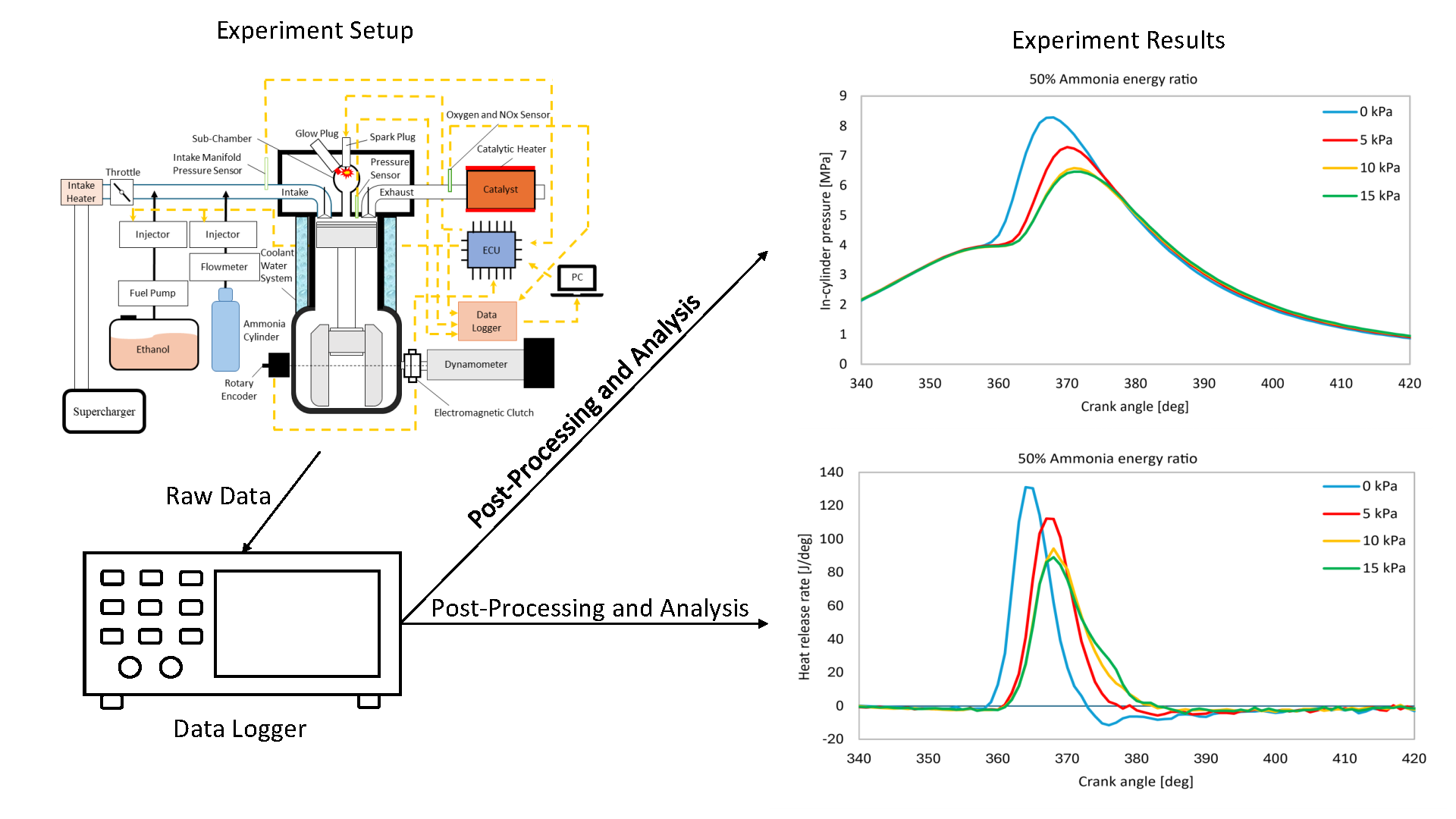
Ammonia (NH3) is a promising carbon-free fuel that offers higher volumetric energy density and easier transport than hydrogen. However, its direct combustion is limited by its slow burning rates and high ignition temperatures. Co-firing with a more reactive fuel, such as ethanol, can overcome these limitations. In this study, the combustion of ammonia/ethanol blends was evaluated in a customized spark-assisted compression ignition (SACI) engine featuring a sub-chamber and a 17.7 compression ratio. The experimental investigation focused on the interaction between boost pressures (5 to 15 kPa) and ammonia energy ratios (50% and 60%) at 1000 rpm and an excess air ratio of 1.2. The results suggest that increasing boost pressure reduced the thermal efficiency and indicated mean effective pressure (IMEP). Accordingly, this resulted in a lower in-cylinder pressure and heat release rate, which slowed down the combustion process. Such unusual behaviour can be attributed to an increase in the latent heat of vaporization of ethanol with pressure, which requires more heat energy for fuel vaporization and effectively cools the combustion chamber. Furthermore, while adopting lower ammonia energy ratios improved engine performance, it resulted in higher NOx emissions due to the lack of unburned NH3 in the exhaust to undergo the thermal DeNOx process, suggesting the need for careful adjustment of the boost pressure and ammonia energy ratio for the practical application of ammonia/ethanol fuels in combustion engines.
How to Cite
Takanobu Okada, Mitsuhisa Ichiyanagi, Emir Yilmaz, Rizal Mahmud, Christian Dennis Marcelo, Ferdinand Ronaldo Tjiotijono, Evan Widjaja, Jason Sutedjo, Gabriel Jeremy Gotama, Willyanto Anggono, Takashi Suzuki (2026). Combustion Characteristics of High Concentration Ammonia/Ethanol Blends under Varied Boost Pressures in a Spark-assisted Compression Ignition Engine with a Sub-chamber. Journal of Engineering and Technological Sciences, Vol. 58 No. 6 (2026): Vol. 58 No. 6(2026): December (In Progress), 745-761. https://doi.org/10.5614/j.eng.technol.sci.2026.58.6.1
Metrics
References
Anggono, W., Ikoma, W., Chen, H., Liu, Z., Ichiyanagi, M., & Suzuki, T. (2019). Effect of various supercharger boost pressure to in-cylinder pressure and heat release rate characteristics of direct injection diesel engine at various engine rotation. E3S Web of Conferences, 130, 01036. https://doi.org/10.1051/e3sconf/201913001036
Brandon, N., & Smith, J. (2021). The role of hydrogen and ammonia in meeting the net zero challenge (Briefing 4, pp. 1–13). The Royal Society. Retrieved February 15, 2025, from https://royalsociety.org/-/media/policy/projects/climate-change-science-solutions/climate-science-solutions-hydrogen-ammonia.pdf
Ding, Y., Pan, G., Han, D., & Huang, Z. (2025). Combustion and emissions of an ammonia-gasoline dual-fuel spark ignition engine: Effects of ammonia substitution rate and spark ignition timing. International Journal of Hydrogen Energy, 122, 348–358
Dong, P., Zhang, C. Y., & Wang, J. Y. (2024). Future zero carbon ammonia engine: Fundamental study on the effect of jet ignition system characterized by gasoline ignition chamber. Journal of Cleaner Production, 435, 140546. https://doi.org/10.1016/j.jclepro.2023.140546
Guo, B., Ichiyanagi, M., Kajiki, K., Aratake, N., Zheng, Q., Kodaka, M., & Suzuki, T. (2022). Combustion analysis of ammonia-fueled high compression ratio SI engine with glow plug and sub-chamber: Effects of ammonia content under condition of co-combustion with gasoline/ammonia/air. International Journal of Automotive Engineering, 13(1), 1–8. https://doi.org/10.20485/JSAEIJAE.13.1_1
Hamedani, A. E., & Abbasian, A. (2024). Hydrogen as an energy source: A review of production technologies and challenges of fuel cell vehicles. Energy Reports, 12, 3778–3794. https://doi.org/10.1016/j.egyr.2024.09.030
Hayakawa, A., Kobayashi, H., & Kudo, T. (2015). Laminar burning velocity and Markstein length of ammonia/air premixed flames at various pressures. Fuel, 159, 1–7. https://doi.org/10.1016/j.fuel.2015.06.070
Hohenberg, G. F. (1979). Advanced approaches for heat transfer calculations. SAE Technical Papers. https://doi.org/10.4271/790825
Hu, L., Wang, Y., & Zhang, J. (2024). Quantitative analysis of toxicity risks in the operation of ammonia-fueled tugboats. Ocean Engineering, 310, 118759. https://doi.org/10.1016/j.oceaneng.2024.118759
Huang, Y., Hong, G., & Huang, R. (2015). Investigation to charge cooling effect and combustion characteristics of ethanol direct injection in a gasoline port injection engine. Applied Energy, 160, 244-254. https://doi.org/10.1016/j.apenergy.2015.09.059
Ichiyanagi, M., Yilmaz, E., Suzuki, T., Okada, T., Yamamoto, H., Kodaka, M., Shiraishi, H., Mukae, S., Tamba, R., Widjaja, H., Jonathan, L., Gunawan, S., Gotama, G. J., & Anggono, W. (2024a). Combustion analysis of ammonia/gasoline mixtures at various injection timing conditions in a high compression ratio SI engine with sub-chamber. Automotive Experiences, 7(2), 321–332. https://doi.org/10.31603/ae.10533
Ichiyanagi, M., Yilmaz, E., Ohashi, T., Sanno, M., Lin, G., Gunawan, S., Widjaja, H., Jonathan, L., Gotama, G. J., Anggono, W., & Suzuki, T. (2024b). Experimental Investigation of Ammonia/Oxygen/Argon Combustion: The Role of Equivalence Ratio and Nozzle Shape in a Constant Volume Combustion Chamber with Sub-chamber. Journal of Engineering and Technological Sciences, 56(6), 704–715. https://doi.org/10.5614/j.eng.technol.sci.2024.56.6.3
Khalif, E., Tabataba, M., Demirkhan, A., & Aghbashlo, A. (2017). Impacts of additives on performance and emission characteristics of diesel engines during steady-state operation. Progress in Energy and Combustion Science, 59(201), 32–58.
Kumar, M., Singh, R., & Gupta, A. (2024). Statistical investigation of combustion and emission characteristics of biofuels according to their physical properties: A way to explore suitable alternative fuels. Fuel, 358, 130242. https://doi.org/10.1016/j.fuel.2023.130242
Lanni, D., & Rossi, M. (2022). Assessment of the operation of an SI engine fueled with ammonia. Energies, 15(22), 8583. https://doi.org/10.3390/en15228583
Lanni, D., D’Antuono, G., Galloni, E., Fontana, G., Contino, F., & Brequigny, P. (2025). Improving ammonia combustion in spark-ignition engines coupling hydrogen enrichment with multiple spark plugs. Energy & Fuels, 39(14), 7137–7150. https://doi.org/10.1021/acs.energyfuels.5c00320
Li, M., Zhu, D., He, X., Moshammer, K., Fernandes, R. X., & Shu, B. (2023). Experimental and kinetic modeling study on auto-ignition properties of ammonia/ethanol blends at intermediate temperatures and high pressures. Proceedings of the Combustion Institute, 39(1), 511-520. https://doi.org/10.1016/j.proci.2022.07.151
Lounici, M. S., & Bouzid, A. (2011). Investigation on heat transfer evaluation for a more efficient two-zone combustion model in the case of natural gas SI engines. Applied Thermal Engineering, 31(2–3), 1234–1242. https://doi.org/10.1016/j.applthermaleng.2010.09.012
Meng, X., Zhang, Y., & Li, J. (2024). Effects of ammonia addition and variable valve timing on knocking and engine performance of an ethanol pre-chamber engine with high compression ratio. Energy, 327, Article 136342. https://doi.org/10.1016/j.energy.2025.136342
Min, S.-H., & Suh, H.-K. (2024). The Effect of Combustion Phase According to the Premixed Ethanol Ratio Based on the Same Total Lower Heating Value on the Formation and Oxidation of Exhaust Emissions in a Reactivity-Controlled Compression Ignition Engine. Fire, 7(7), 258. https://doi.org/10.3390/fire7070258
Mohammed, A. G., Zhang, Y., & Li, J. (2024). Review on the ammonia-blend as an alternative fuel for micro gas turbine power generation. International Journal of Hydrogen Energy, 82, 428–447. https://doi.org/10.1016/j.ijhydene.2024.07.396
Moriarty, P., & Honnery, D. (2019). Prospects for hydrogen as a transport fuel. International Journal of Hydrogen Energy, 44(31), 16029–16037. https://doi.org/10.1016/j.ijhydene.2019.04.278
Okada, T., Ichiyanagi, M., Yilmaz, E., Suzuki, T., Shiraishi, H., Ngwompe Souop, E. L. R., Widjaja, E., Sutedjo, J., Marcelo, C. D., Tjiotijono, F. R., Gotama, G. J., & Anggono, W. (2025). The effect of ignition timing on combustion of ammonia/ethanol mixtures in spark-assisted compression ignition engine with a sub-chamber. Journal of Engineering and Technological Sciences, 57(6), 735–746. https://doi.org/10.5614/j.eng.technol.sci.2025.57.6.1
Pan, J., Chen, B., Tao, J., Fan, B., Liu, J., Li, Y., & Otchere, P. (2021). Experimental investigation on the effect of ethanol blending on gasoline combustion characteristics and idle performance in a rotary engine. International Journal of Thermal Sciences, 30, 1187–1198. https://doi:10.1007/s11630-021-1487-3
Pelé, R., Brequigny, P., Bellettre, J., & Mounaïm-Rousselle, C. (2024). Performances and pollutant emissions of spark ignition engine using direct injection for blends of ethanol/ammonia and pure ammonia. International Journal of Engine Research, 25(2), 320–333.
Pelé, R., Brequigny, P., Mounaim-Rousselle, C., Dayma, G., & Halter, F. (2022). Laminar flame speed of ethanol/ammonia blends—An experimental and kinetic study. Fuel Communications, 10, Article 100052. https://doi.org/10.1016/j.jfueco.2022.100052
Qian, F., Zhang, S., Wang, J., Zhu, N., Bao, X., Yang, H., Xu, X., Alshahrani, W. A., Helal, M. H., & Guo, Z. (2024). Ammonia energy fraction effect on the combustion and reduced NOₓ emission of ammonia/diesel dual fuel. Environmental Research, 261, Article 119530. https://doi.org/10.1016/j.envres.2024.119530
Sapnken, F. E., Tamba, J. G., Essiane, N., Koffi, F. D., & Njomo, D. (2024). The potential of green hydrogen fuel as an alternative in Cameroon’s road transport sector. International Journal of Hydrogen Energy, 49, 433–449. https://doi.org/10.1016/j.ijhydene.2023.08.339
Shih, C. F., Zhang, T., Li, J., & Bai, C. (2018). Powering the future with liquid sunshine. Joule, 2(10), 1925–1949. https://doi.org/10.1016/j.joule.2018.08.016
Sonawane, S., Sekhar, R., Warke, A., Thipse, S., Rairikar, S., & Varma, C. (2025). Experimental Investigation and Prediction of Combustion Parameters using Machine Learning in Ethanol - Gasoline Blended Engines. Journal of Engineering and Technological Sciences, 57(1), 27–47. https://doi.org/10.5614/j.eng.technol.sci.2025.57.1.3
Sun, J., Tang, Q., Wen, M., Huang, L., Liu, H., & Yao, M. (2024). Combustion characteristics and flame development of ammonia in an optical spark ignition engine. Fuel, 359, Article 129904.
Tian, J., Wang, L., Xiong, Y., Wang, Y., Yin, W., & et al. (2024). Enhancing combustion efficiency and reducing nitrogen oxide emissions from ammonia combustion: A comprehensive review. Process Safety and Environmental Protection, 183, 514–543. https://doi.org/10.1016/j.psep.2024.01.020
Uddeen, K., Tang, Q., Shi, H., & Turner, J. (2024). Performance and emission analysis of ammonia-ethanol and ammonia-methane dual-fuel combustion in a spark-ignition engine: An optical study. Fuel, 358, 130296. https://doi.org/10.1016/j.fuel.2023.130296
Uddeen, K., Tang, Q., Shi, H., Magnotti, G., & Turner, J. (2023). A novel multiple spark ignition strategy to achieve pure ammonia combustion in an optical spark-ignition engine. Fuel, 349, 128741. https://doi.org/10.1016/j.fuel.2023.128741
United States Environmental Protection Agency. (2023). Global greenhouse gas emissions data. Retrieved February 15, 2025, from https://www.epa.gov/ghgemissions/global-greenhouse-gas-emissions-data
Yang, H., Tian, J., Cui, Z., Ye, M., Zhang, X., Zhou, Q., Wei, K., & Wang, J. (2024). Experimental and numerical study of combustion characteristics of ammonia/ethanol mixture under high temperature and pressure. Fuel, 367, Article 131350. https://doi.org/10.1016/j.fuel.2024.131350
Yilmaz, E., Ichiyanagi, M., Zheng, Q., Guo, B., Aratake, N., Kodaka, M., Shiraishi, H., Okada, T., & Suzuki, T. (2023). Investigation of intake air temperature effect on co-combustion characteristics of NH₃/gasoline in naturally aspirated high compression-ratio engine with sub-chamber. Scientific Reports, 13(1), 11649. https://doi.org/10.1038/s41598-023-38883-3
Zhang, B., Rubio, M., Egolfopoulos, F., & Cronin, S. B. (2025). Stable combustion of ammonia in an internal combustion engine: A single fuel approach enabled by multi-pulse transient plasma ignition. Fuel, 381, 133502. https://doi.org/10.1016/j.fuel.2024.133502
Zhu, G., Liu, X., & Chen, Y. (2024). Optical diagnostic study of ammonia-kerosene dual-fuel engine combustion process. International Journal of Hydrogen Energy, 81, 110–126. https://doi.org/10.1016/j.ijhydene.2024.07.256
License
Copyright (c) 2026 by Authors

This work is licensed under a Creative Commons Attribution 4.0 International License.
Downloads
Date Log
- Submitted
- November 26, 2025
- Accepted
- July 22, 2026
- Published
- September 25, 2026
Keywords
- ammonia
- co-combustion
- engine performance
- ethanol
- boost pressure
- sub-chamber


