
A Comparative Study of Carbon Surface Modification Routes: Gamma Irradiation and Aqueous Oxidation using H2O2 for Advanced Carbon/MnO2 Nanocomposite Supercapacitor Electrode
Abstract
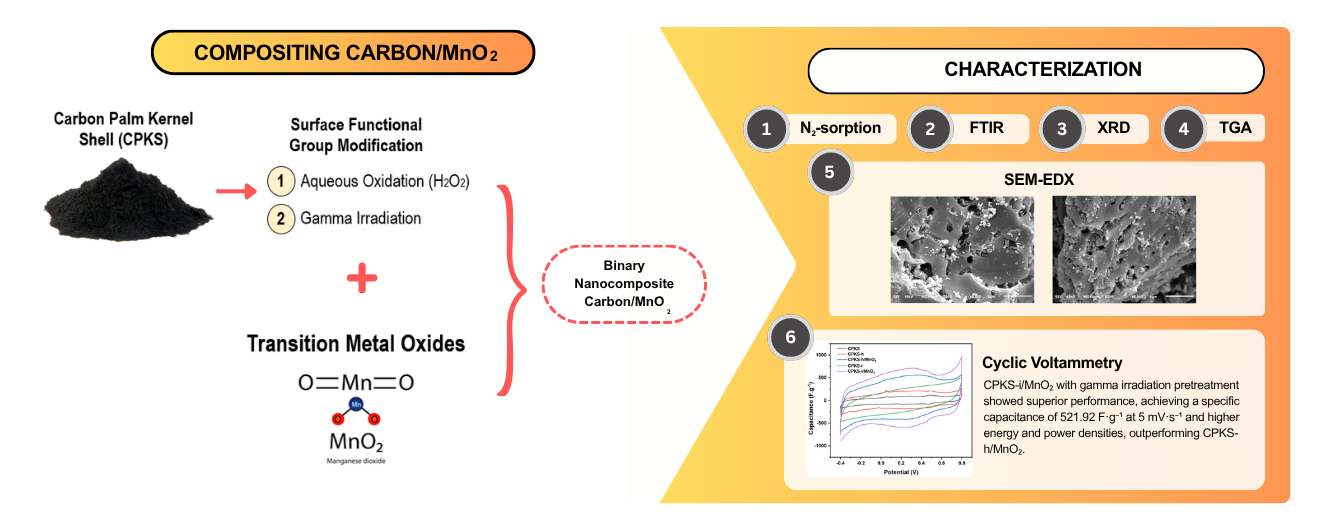
Supercapacitors have emerged as attractive energy storage devices due to their fast charging, long cycle life, and high-power density. However, their relatively low energy density remains a challenge, requiring optimization of electrode materials, particularly by increasing oxygen functional groups to improve specific capacitance. In this study, porous carbon derived from palm kernel shells (CPKS) was modified using two methods: conventional treatment using aqueous oxidation with 15% H2O2 (CPKS-h) compared with gamma irradiation (CPKS-i). MnO₂ was subsequently incorporated into both modified carbons via vacuum-assisted wet impregnation, yielding CPKS-h/MnO₂ and CPKS-i/MnO₂ nanocomposites. The samples were characterized using N₂-sorption analysis, FTIR, XRD, SEM-EDX, and TGA. The results showed that gamma irradiation better preserved the porous structure, with only a 0.99% reduction in surface area compared to 1.30% for aqueous oxidation. Both methods also increased oxygen functional groups on the carbon surface, as confirmed by FTIR and SEM-EDX analyses. Electrochemical performance was evaluated using cyclic voltammetry in a three-electrode system. Among the samples, CPKS-i/MnO₂ exhibited the best performance, achieving a specific capacitance of 521.92 F·g⁻¹ at 5 mV·s⁻¹, along with an energy density of 104.38 Wh·kg⁻¹ and a power density of 1.57 kW·kg⁻¹, outperforming CPKS-h/MnO₂. This enhanced performance is attributed to the preserved pore structure and improved surface chemistry induced by gamma irradiation, which enabled more uniform MnO₂ dispersion and promoted a synergistic combination of EDLC and pseudocapacitive mechanisms for efficient charge storage. Thus, gamma irradiation–based carbon modification combined with MnO₂ compositing offers a promising route for advancing supercapacitor research
How to Cite
Kyla Amalia Gala, Chaidir Pratama, Imam Prasetyo, Teguh Ariyanto (2026). A Comparative Study of Carbon Surface Modification Routes: Gamma Irradiation and Aqueous Oxidation using H2O2 for Advanced Carbon/MnO2 Nanocomposite Supercapacitor Electrode. Journal of Engineering and Technological Sciences, Vol. 58 No. 6 (2026): Vol. 58 No. 6(2026): December (In Progress), 781-797. https://doi.org/10.5614/j.eng.technol.sci.2026.58.6.3
Metrics
Download data is not yet available.
References
Adhamash, E., Pathak, R., Qiao, Q., Zhou, Y., & McTaggart, R. (2020). Gamma-radiated biochar carbon for improved supercapacitor performance. RSC Advances, 10(50), 29910–29917. https://doi.org/10.1039/D0RA05764A
Al Fuady, M. I., Rochmadi, Prasetyo, I., & Ariyanto, T. (2021). Surface-Modified Carbon Synthesized from Palm Kernel Shell for Electric Double-Layer Capacitor Applications. Key Engineering Materials, 884, 423–429. https://doi.org/10.4028/WWW.SCIENTIFIC.NET/KEM.884.423
Annisa, A., Prasetyo, I., Swantomo, D., & Ariyanto, T. (2021). Surface modification of nanoporous carbon using gamma irradiation treatment as supercapacitor material. AIP Conference Proceedings, 2349(1). https://doi.org/10.1063/5.0052360
Ariyanto, T., Sarwendah, R. A. G., Amimmal, Y. M. N., Laksmana, W. T., & Prasetyo, I. (2019). Modifying Nanoporous Carbon through Hydrogen Peroxide Oxidation for Removal of Metronidazole Antibiotics from Simulated Wastewater. Processes 2019, Vol. 7, Page 835, 7(11), 835. https://doi.org/10.3390/PR7110835
Azman, N. H. N., & Sulaiman, Y. (2022). Hierarchical Porous Materials for Supercapacitors. In Encyclopedia of Energy Storage: Volume 1-4 (Vols. 1–4, pp. 622–637). Elsevier. https://doi.org/10.1016/B978-0-12-819723-3.00022-6
Bardestani, R., Patience, G. S., & Kaliaguine, S. (2019). Experimental methods in chemical engineering: specific surface area and pore size distribution measurements—BET, BJH, and DFT. Canadian Journal of Chemical Engineering, 97(11), 2781–2791. https://doi.org/10.1002/cjce.23632
Cao, Y. J., Lu, C. Y., Wang, Z., Bai, R., & Liu, G. (2024). Fabrication of MnO2@Porous Carbons with High Energy and Power Density and Their Application in Supercapacitors. Advanced Energy and Sustainability Research, 5(8). https://doi.org/10.1002/AESR.202300164
Chang, L., & Hang Hu, Y. (2018). 2.21 Supercapacitors. Comprehensive Energy Systems: Volumes 1-5, 2, 663–695. https://doi.org/10.1016/B978-0-12-809597-3.00247-9
Dirican, M., Yanilmaz, M., Asiri, A. M., & Zhang, X. (2020). Polyaniline/MnO2/porous carbon nanofiber electrodes for supercapacitors. Journal of Electroanalytical Chemistry, 861. https://doi.org/10.1016/j.jelechem.2020.113995
Elsehsah, K. A. A. A., Zulkarnain, A. N., & Saman, N. M. (2024). Current insights and future prospects of graphene aerogel-enhanced supercapacitors: A systematic review. Heliyon, 10(17), e37071. https://doi.org/10.1016/j.heliyon.2024.e37071
Fan, Q., Fu, P., Bennett, E. L., Song, C., & Zhang, Y. (2023). Biomass-based 3D micro-meso-macroporous carbon for hybrid-capacitance characteristics and incredible energy density: Reversible charge transfer of multivalent Mn ions. Journal of Alloys and Compounds, 968, 172281. https://doi.org/10.1016/J.JALLCOM.2023.172281
Feng, L., Xuan, Z., Zhao, H., Bai, Y., Guo, J., Su, C. wei, & Chen, X. (2014). MnO2 prepared by hydrothermal method and electrochemical performance as anode for lithium-ion battery. Nanoscale Research Letters, 9(1), 290-. https://doi.org/10.1186/1556-276X-9-290
González, A., Goikolea, E., Barrena, J. A., & Mysyk, R. (2016). Review on supercapacitors: Technologies and materials. Renewable and Sustainable Energy Reviews, 58, 1189–1206. https://doi.org/10.1016/J.RSER.2015.12.249
He, Y., Zhang, Y., Li, X., Lv, Z., Wang, X., Liu, Z., & Huang, X. (2018). Capacitive mechanism of oxygen functional groups on carbon surface in supercapacitors. Electrochimica Acta, 282, 618–625. https://doi.org/10.1016/J.ELECTACTA.2018.06.103
Horn, M., MacLeod, J., Liu, M., Webb, J., & Motta, N. (2019). Supercapacitors: A new source of power for electric cars? Economic Analysis and Policy, 61, 93–103. https://doi.org/10.1016/J.EAP.2018.08.003
Hou, H., Xu, L., Yang, W., & Wong, W. Y. (2022). Applications of 1D Mesoporous Inorganic Nanomaterials in Supercapacitors. In Springer Series in Materials Science, 321, 129–141). Springer Science and Business Media Deutschland GmbH. https://doi.org/10.1007/978-3-030-89105-3_7
Hou, X., Song, Y., Zhao, Y., Li, W., Guo, Z., Tang, S., Ma, Y., Sun, R., Wang, Q., & Li, W. (2021). A Facile Route to Synthesis of Hierarchically Porous Carbon via Micelle System for Bifunctional Electrochemical Application. Frontiers in Chemistry, 9, 762103. https://doi.org/10.3389/FCHEM.2021.762103/BIBTEX
Hu, Y. R., Dong, X. L., Zhuang, H. K., Yan, D., Hou, L., & Li, W. C. (2021). Introducing Electrochemically Active Oxygen Species to Boost the Pseudocapacitance of Carbon-based Supercapacitor. ChemElectroChem, 8(16), 3073–3079. https://doi.org/10.1002/CELC.202100641;WGROUP:STRING:PUBLICATION
Khalafi, L., & Rafiee, M. (2017). Cyclic Voltammetry. In Encyclopedia of Physical Organic Chemistry. https://doi.org/10.1002/9781118468586.epoc4036
Kim, W. K., Verma, S., Ahmadi, Y., Cho, M. S., & Kim, K. H. (2024). The effects of metal-oxide content in MnO2-activated carbon composites on reactive adsorption and catalytic oxidation of formaldehyde and toluene in air. Science of The Total Environment, 926, 172137. https://doi.org/10.1016/J.SCITOTENV.2024.172137
Kour, S., Tanwar, S., & Sharma, A. L. (2022). MnO2 nanorod loaded activated carbon for high-performance supercapacitors. Journal of Alloys and Compounds, 910, 164834. https://doi.org/10.1016/J.JALLCOM.2022.164834
Kusuma, H. D., Rochmadi, Prasetyo, I., & Ariyanto, T. (2021). Mesoporous Manganese Oxide/Lignin-Derived Carbon for High Performance of Supercapacitor Electrodes. Molecules 2021, Vol. 26, Page 7104, 26(23), 7104. https://doi.org/10.3390/MOLECULES26237104
Kwamman, T., Anantachaisilp, S., Limmeechokchai, P., & Kanjana, K. (2022). Enhancements of surface functional groups and degree of graphitization in gamma irradiated activated carbon as an electrode material. Radiation Physics and Chemistry, 195, 110062. https://doi.org/10.1016/J.RADPHYSCHEM.2022.110062
Largeot, C., Portet, C., Chmiola, J., Taberna, P. L., Gogotsi, Y., & Simon, P. (2008). Relation between the Ion Size and Pore Size for an Electric Double-Layer Capacitor. Journal of the American Chemical Society, 130(9), 2730–2731. https://doi.org/10.1021/JA7106178
Li, X. Q., Chang, L., Zhao, S. L., Hao, C. L., Lu, C. G., Zhu, Y. H., & Tang, Z. Y. (2017). Research on carbon-based electrode materials for supercapacitors. Wuli Huaxue Xuebao/ Acta Physico - Chimica Sinica, 33(1), 130–148. https://doi.org/10.3866/PKU.WHXB201609012
Liu, H. Y., Wang, K. P., & Teng, H. (2005). A simplified preparation of mesoporous carbon and the examination of the carbon accessibility for electric double layer formation. Carbon, 43(3), 559–566. https://doi.org/10.1016/J.CARBON.2004.10.020
Luo, X. Y., Chen, Y., & Mo, Y. (2021). A review of charge storage in porous carbon-based supercapacitors. New Carbon Materials, 36(1), 49–68. https://doi.org/10.1016/S1872-5805(21)60004-5
Lv, Y., Wang, J., Ji, D., Li, J., Zhao, S., Zhao, Y., Cai, Z., He, X., & Sun, X. (2023). Carbonaceous electrode materials for supercapacitor: Preparation and surface functionalization. Frontiers in Energy Research, 10, 957032. https://doi.org/10.3389/FENRG.2022.957032/FULL
Meng, J., Wang, Y., Zhang, Q., Ye, G., & Zhou, X. (2023). Pore network model of low-temperature nitrogen adsorption-desorption in mesoporous materials. Huagong Xuebao/CIESC Journal, 74(2), 893–903. (Text in Chinese) https://doi.org/10.11949/0438-1157.20221406
Mishra, N., Shinde, S., Vishwakarma, R., Kadam, S., Sharon, M., & Sharon, M. (2013). MWCNTs synthesized from waste polypropylene plastics and its application in super-capacitors. AIP Conference Proceedings, 1538(1), 228–236. https://doi.org/10.1063/1.4810063
Mukti, N. I. F., Ariyanto, T., Sediawan, W. B., & Prasetyo, I. (2023). Efficacy of modified carbon molecular sieve with iron oxides or choline chloride-based deep eutectic solvent for the separation of CO2/CH4. RSC Advances, 13(33), 23158–23168. https://doi.org/10.1039/D3RA02890A
Prasetyo, I., Mukti, N. I. F., Cahyono, R. B., Prasetya, A., & Ariyanto, T. (2020). Nanoporous Carbon Prepared from Palm Kernel Shell for CO2/CH4 Separation. Waste and Biomass Valorization, 11(10), 5599–5606. https://doi.org/10.1007/S12649-020-01006-4
Pratama, C., Marlina, Munir, M., Setiawan, H., Saptiama, I., Imron, A. F., Ekaningsih, N. J. W., Triyatna, F., Prihatiningsih, M. C., Awaludin, R., Ariyanto, T., & Prasetyo, I. (2025). Development of C/Ag nanocomposites for adsorption and immobilization of iodine-131 (131I) from the urine of thyroid ablation therapy patients. Journal of Radioanalytical and Nuclear Chemistry 2025 334:5, 334(5), 3613–3630. https://doi.org/10.1007/S10967-025-10146-7
Qin, K., Liu, E., Li, J., Kang, J., Shi, C., He, C., He, F., Zhao, N., Qin, K., Liu, E., Li, J., Shi, C., He, C., He, F., Zhao, N., & Kang, J. (2016). Free‐Standing 3D Nanoporous Duct‐Like and Hierarchical Nanoporous Graphene Films for Micron‐Level Flexible Solid‐State Asymmetric Supercapacitors. Advanced Energy Materials, 6(18). https://doi.org/10.1002/AENM.201600755
Qiu, C., Jiang, L., Gao, Y., & Sheng, L. (2023). Effects of oxygen-containing functional groups on carbon materials in supercapacitors: A review. Materials and Design, 230. https://doi.org/10.1016/J.MATDES.2023.111952
Ran, F., Yang, X., Xu, X., Li, S., Liu, Y., & Shao, L. (2021). Green activation of sustainable resources to synthesize nitrogen-doped oxygen-riched porous carbon nanosheets towards high-performance supercapacitor. Chemical Engineering Journal, 412, 128673. https://doi.org/10.1016/J.CEJ.2021.128673
Rustamaji, H., Prakoso, T., Devianto, H., Widiatmoko, P., & Nurdin, I. (2022). Design, Fabrication, and Testing of Supercapacitor Based on Nanocarbon Composite Material. ASEAN Journal of Chemical Engineering, 22(1), 19–32. https://doi.org/10.22146/AJCHE.70139
Shao, Y., El-Kady, M. F., Sun, J., Li, Y., Zhang, Q., Zhu, M., Wang, H., Dunn, B., & Kaner, R. B. (2018). Design and Mechanisms of Asymmetric Supercapacitors. Chemical Reviews, 118(18), 9233–9280. https://doi.org/10.1021/ACS.CHEMREV.8B00252
Sun, B., Zhang, X., Fan, X., Wang, R., Bai, H., & Wei, X. (2022). Interface modification based on MnO2@N-doped activated carbon composites for flexible solid-state asymmetric supercapacitors. Energy, 249, 123659. https://doi.org/10.1016/J.ENERGY.2022.123659
Sunil, V., & Jose, R. (2021). Hybrid nanocomposite metal oxide materials for supercapacitor application. In Chemically Deposited Nanocrystalline Metal Oxide Thin Films: Synthesis, Characterizations, and Applications (pp. 673–724). Springer International Publishing. https://doi.org/10.1007/978-3-030-68462-4_25
Thommes, M., Kaneko, K., Neimark, A. V., Olivier, J. P., Rodriguez-Reinoso, F., Rouquerol, J., & Sing, K. S. W. (2015). Physisorption of gases, with special reference to the evaluation of surface area and pore size distribution (IUPAC Technical Report). Pure and Applied Chemistry, 87(9–10), 1051–1069. https://doi.org/10.1515/PAC-2014-1117/XML
Velo-Gala, I., López-Peñalver, J. J., Sánchez-Polo, M., & Rivera-Utrilla, J. (2014). Surface modifications of activated carbon by gamma irradiation. Carbon, 67, 236–249. https://doi.org/10.1016/J.CARBON.2013.09.087
Wang, X., Chen, S., Li, D., Sun, S., Peng, Z., Komarneni, S., & Yang, D. (2018). Direct Interfacial Growth of MnO2 Nanostructure on Hierarchically Porous Carbon for High-Performance Asymmetric Supercapacitors. ACS Sustainable Chemistry and Engineering, 6(1), 633–641. https://doi.org/10.1021/ACSSUSCHEMENG.7B02960
Weerasuk, B., Chutimasakul, T., Prigyai, N., Nilgumhang, K., Kaeopookum, P., & Sangtawesin, T. (2024). Structural and Electrochemical Evolution of Water Hyacinth-Derived Activated Carbon with Gamma Pretreatment for Supercapacitor Applications. Materials, 17(13). https://doi.org/10.3390/ma17133233
Xie, L., Su, F., Xie, L., Guo, X., Wang, Z., Kong, Q., Sun, G., Ahmad, A., Li, X., Yi, Z., & Chen, C. (2020). Effect of pore structure and doping species on charge storage mechanisms in porous carbon-based supercapacitors. Materials Chemistry Frontiers, 4(9), 2610–2634. https://doi.org/10.1039/D0QM00180E
Yahia, M. S., Youssef, H. F., Elfeky, A. S., Awad, M. B., & Elzaref, A. S. (2022). Induced effects of gamma irradiation on activated carbon derived from Hyphaene Thebaica husks as a potential adsorbent for Chlorpyrifos pesticide-air purification. Egyptian Journal of Chemistry, 65(4), 449–474. https://doi.org/10.21608/EJCHEM.2021.98168.4576
Zhang, X., Ding, P., & Liu, Y. (2026). Recent advances and applications of natural biomass-derived carbon in electrochemical energy storages. Journal of Solid State Electrochemistry. https://doi.org/10.1007/s10008-025-06468-x
Zhang, Y., Chen, G., Wang, F., Lu, S., Li, Y., Guo, S., Zhou, N., Li, W., & Zhang, P. (2025). N2 adsorption mechanism in shale nanopores and limitations of BET theory explored through experiment and molecular simulation. Scientific Reports, 15(1). https://doi.org/10.1038/s41598-025-04751-5
Zhao, J., Yu, L., Zhou, F., Ma, H., Yang, K., & Wu, G. (2021). Synthesis and characterization of activated carbon from sugar beet residue for the adsorption of hexavalent chromium in aqueous solutions. RSC Advances, 11(14), 8025–8032. https://doi.org/10.1039/D0RA09644J
License
Copyright (c) 2026 by Authors

This work is licensed under a Creative Commons Attribution 4.0 International License.
Downloads
Date Log
- Submitted
- January 28, 2026
- Accepted
- August 6, 2026
- Published
- September 25, 2026
Keywords
- gamma irradiation
- H2O2
- MnO2
- oxygen functional groups
- supercapacitor


