
Valorization of Banana Peel Extract for Green Synthesis of Silver Nanoparticles: Physicochemical Characterization and Antibacterial Performance
Abstract
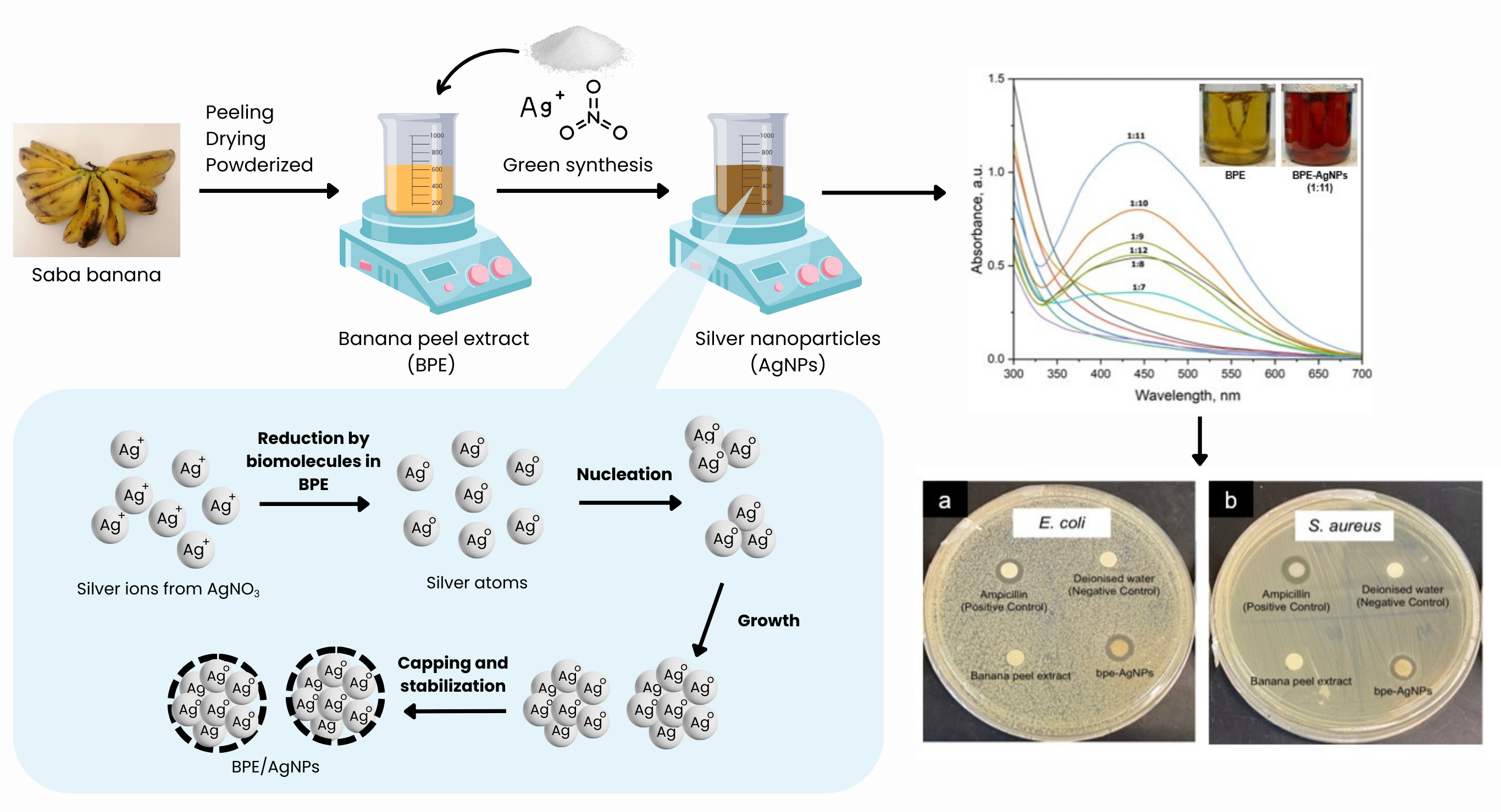
The growing demand for sustainable nanomaterial synthesis has driven interest in plant-mediated approaches that align with circular economy principles. This study presents a facile approach for generating silver nanoparticles (AgNPs) using Saba banana peel extract (Musa acuminata × balbisiana) as reducing and stabilizing agents. AgNPs were synthesised by reacting different ratios (1:1–1:12) of banana peel extract (BPE) with silver nitrate (AgNO₃, 1 mM) at 90°C for 2 h. Based on the UV-Visible spectra, the optimal BPE:AgNO₃ ratio was identified at 1:11. Fourier-transform infrared (FTIR) spectroscopy revealed that functional groups in the extract including hydroxyl, carbonyl and amine, were involved in the reduction of silver ions. Morphological analyses using Scanning electron microscopy (SEM) and Transmission Electron Microscopy (TEM) show the formation of spherical AgNPs with average size of 5.37 ± 1.36 nm, while energy-dispersive X-ray (EDX) analysis indicated a high silver content (73.87 wt%). The biosynthesised AgNPs displayed potent antibacterial activity against Staphylococcus aureus and Escherichia coli. These findings highlight the potential of Saba banana peel, an abundant and underutilized biomass, as a low-cost and sustainable resource for the green synthesis of AgNPs with promising antimicrobial properties and potential applications in biomedical, environmental, food and energy sectors.
How to Cite
Ivy Bazar Divina, Syafiqah Syazwani Jaffar, Wilter Kisin, Rovina Kobun, Suryani Saallah, Jumardi Roslan (2026). Valorization of Banana Peel Extract for Green Synthesis of Silver Nanoparticles: Physicochemical Characterization and Antibacterial Performance . Journal of Engineering and Technological Sciences, Vol. 58 No. 5 (2026): Vol. 58 No. 5(2026): October, 661-672. https://doi.org/10.5614/j.eng.technol.sci.2026.58.5.5
Metrics
References
Abd-elhamed, W., Mohamed, A. A., Saad, Z. H. (2025). Green synthesis of silver nanoparticles mediated by Solanum nigrum leaf extract and their antifungal activity against pine pathogens. Scientific Reports, 15, 35025. https://doi.org/10.1038/s41598-025-21291-0
Abonyi, M. N., Aniagor, C. O., Obi, C. C., & Nwadike, E. C. (2024). Green synthesis and characterisation of silver nanocomposites and nanoparticles derived from banana leaves. International Journal of Green Economics, 18(4), 410–423. https://doi.org/10.1504/IJGE.2024.142407
Ahmed, O., Sibuyi, N. R. S., Fadaka, A. O., Madiehe, M. A., Maboza, E., Meyer, M., & Geerts, G. (2022). Plant Extract-Synthesized Silver Nanoparticles for Application in Dental Therapy. Pharmaceutics, 14(2), 1–26. https://doi.org/10.3390/pharmaceutics14020380
Aktepe, N., & Baran, A. (2021). Biosynthesis of AgNPs by extract from waste leaves of Citrullus lanatus sp. (watermelon); Characterization, antibacterial and antifungal effects. Progress in Nutrition, 23(3). https://doi.org/10.23751/pn.v23i3.11907
Alsamhary, K. I. (2020). Eco-friendly synthesis of silver nanoparticles by Bacillus subtilis and their antibacterial activity. Saudi Journal of Biological Sciences, 27(8), 2185–2191. https://doi.org/10.1016/j.sjbs.2020.04.026
Arsène, M. M. J., Podoprigora, I. V., Davares, A. K. L., Razan, M., Das, M. S., & Senyagin, A. N. (2021). Antibacterial activity of grapefruit peel extracts and green-synthesized silver nanoparticles. Veterinary World, 14(5), 1330–1341. https://doi.org/10.14202/vetworld.2021.1330-1341
Chandhirasekar, K., Thendralmanikandan, A., Thangavelu, P., Nguyen, B. S., Nguyen, T. A., Sivashanmugan, K., Nareshkumar, A., & Nguyen, V. H. (2021). Plant-extract-assisted green synthesis and its larvicidal activities of silver nanoparticles using leaf extract of Citrus medica, Tagetes lemmonii, and Tarenna asiatica. Materials Letters, 287, 129265. https://doi.org/10.1016/j.matlet.2020.129265
Chouhan, S., & Guleria, S. (2020). Green synthesis of AgNPs using Cannabis sativa leaf extract: Characterization, antibacterial, anti-yeast and α-amylase inhibitory activity. Materials Science for Energy Technologies, 3(June), 536–544. https://doi.org/10.1016/j.mset.2020.05.004
Dakal, T. C., Kumar, A., Majumdar, R. S., & Yadav, V. (2016). Mechanistic basis of antimicrobial actions of silver nanoparticles. Frontiers in Microbiology, 7(NOV), 1–17. https://doi.org/10.3389/fmicb.2016.01831
de Aragão, A. P., de Oliveira, T. M., Quelemes, P. V., Perfeito, M. L. G., Araújo, M. C., Santiago, J. de A. S., Cardoso, V. S., Quaresma, P., de Souza de Almeida Leite, J. R., & da Silva, D. A. (2019). Green synthesis of silver nanoparticles using the seaweed Gracilaria birdiae and their antibacterial activity. Arabian Journal of Chemistry, 12(8), 4182–4188. https://doi.org/10.1016/j.arabjc.2016.04.014
Ejaz, U., Afzal, M., Mazhar, M., Riaz, M., Ahmed, N., Rizg, W. Y., Alahmadi, A. A., Badr, M. Y., Mushtaq, R. Y., & Yean, C. Y. (2024). Characterization, Synthesis, and Biological Activities of Silver Nanoparticles Produced via Green Synthesis Method Using Thymus Vulgaris Aqueous Extract. International Journal of Nanomedicine, 19, pp. 453–469). https://doi.org/10.2147/IJN.S446017
Flores-Contreras, E. A., González-González, R. B., Pablo Pizaña-Aranda, J. J., Parra-Arroyo, L., Rodríguez-Aguayo, A. A., Iñiguez-Moreno, M., González-Meza, G. M., Araújo, R. G., Ramírez-Gamboa, D., Parra-Saldívar, R., & Melchor-Martínez, E. M. (2024). Agricultural waste as a sustainable source for nanoparticle synthesis and their antimicrobial properties for food preservation. Frontiers in Nanotechnology, 6(February), 1–20. https://doi.org/10.3389/fnano.2024.1346069
Garibo, D., Borbón-Nuñez, H. A., de León, J. N. D., García Mendoza, E., Estrada, I., Toledano-Magaña, Y., Tiznado, H., Ovalle-Marroquin, M., Soto-Ramos, A. G., Blanco, A., Rodríguez, J. A., Romo, O. A., Chávez-Almazán, L. A., & Susarrey-Arce, A. (2020). Green synthesis of silver nanoparticles using Lysiloma acapulcensis exhibit high-antimicrobial activity. Scientific Reports, 10, 12805. https://doi.org/10.1038/s41598-020-69606-7
Gogoi, B., Kumar, R., Upadhyay, J., & Borah, D. (2020). Facile biogenic synthesis of silver nanoparticles (AgNPs) by Citrus grandis (L.) Osbeck fruit extract with excellent antimicrobial potential against plant pathogens. SN Applied Sciences, 2(10), 1–7. https://doi.org/10.1007/s42452-020-03529-w
Goh, H. T., Cheok, C. Y., & Yeap, S. P. (2023). Green synthesis of silver nanoparticles using banana peel extract and application on banana preservation. Food Frontiers, 4(1), 283–288. https://doi.org/10.1002/fft2.206
Gong, X., Jadhav, N. D., Lonikar, V. V., Kulkarni, A. N., Zhang, H., Sankapal, B. R., Ren, J., Xu, B. Bin, Pathan, H. M., Ma, Y., Lin, Z., Witherspoon, E., Wang, Z., & Guo, Z. (2024). An overview of green synthesized silver nanoparticles towards bioactive antibacterial, antimicrobial and antifungal applications. Advances in Colloid and Interface Science, 323(November 2023), 103053. https://doi.org/10.1016/j.cis.2023.103053
Gün Gök, Z., Karayel, M., & Yiğitoğlu, M. (2021). Synthesis of carrageenan coated silver nanoparticles by an easy green method and their characterization and antimicrobial activities. Research on Chemical Intermediates, 47(5), 1843–1864. https://doi.org/10.1007/s11164-021-04399-6
Hasan, W. L., Sari, R., & Hendradi, E. (2024). Green Synthesis of Antimicrobial Silver Nanoparticles using Green Tea Extract: The Role of Concentration and pH. Jurnal Sains Farmasi & Klinis, 11(1), 25–31. https://doi.org/10.25077/jsfk.11.1.25-31.2024
Hosny, S., Gaber, G. A., Ragab, M. S., Ragheb, M. A., Anter, M., & Mohamed, L. Z. (2025). A Comprehensive Review of Silver Nanoparticles (AgNPs): Synthesis Strategies, Toxicity Concerns, Biomedical Applications, AI-Driven Advancements, Challenges, and Future Perspectives. Arabian Journal for Science and Engineering, 51, 13667–13714. https://doi.org/10.1007/s13369-025-10612-0
Huq, M. A. (2020). Green synthesis of silver nanoparticles using pseudoduganella eburnea MAHUQ-39 and their antimicrobial mechanisms investigation against drug resistant human pathogens. International Journal of Molecular Sciences, 21(4), 1510. https://doi.org/10.3390/ijms21041510
Ibrahim, H. M. M. (2015). Green synthesis and characterization of silver nanoparticles using banana peel extract and their antimicrobial activity against representative microorganisms. Journal of Radiation Research and Applied Sciences, 8(3), 265–275. https://doi.org/10.1016/j.jrras.2015.01.007
Jaffar, S. S., Saallah, S., Misson, M., Siddique, S., Roslan, J., & Lenggoro, W. (2024). Green synthesis, characterization and antimicrobial efficacy of silver nanoparticles from Kappaphycus alvarezii extract. Research on Chemical Intermediates, 50(7), 3435–3452. https://doi.org/10.1007/s11164-024-05298-2
Jaffar, S. S., Saallah, S., Misson, M., Siddiquee, S., Roslan, J., & Lenggoro, W. (2023). Green Synthesis of Flower-Like Carrageenan-Silver Nanoparticles and Elucidation of Its Physicochemical and Antibacterial Properties. Molecules, 28(2), 907. https://doi.org/10.3390/molecules28020907
Kurul, F., Doruk, B., & Topkaya, S. N. (2025). Principles of green chemistry: building a sustainable future. Discover Chemistry, 2, 68. https://doi.org/10.1007/s44371-025-00152-9
Kokila, T., Ramesh, P.S. & Geetha, D. Biosynthesis of silver nanoparticles from Cavendish banana peel extract and its antibacterial and free radical scavenging assay: a novel biological approach. Applied Nanoscience, 5, 911–920. https://doi.org/10.1007/s13204-015-0401-2
Madhusudanan, M., Zhang, J., Pandit, S., Singh, P., Jeong, G., Khan, F., & Mijakovic, I. (2025). Green Synthesis of Silver Nanoparticles: A Review of Polymer and Antimicrobial Drug Combinations for Enhanced Antimicrobial Applications. Advanced NanoBiomed Research, 5(12), 2400194. https://doi.org/10.1002/anbr.202400194
Mishra, S. M. P. (2021). Synthesis of silver nanoparticles ( AgNPs ) using culinary banana peel extract for the detection of melamine in milk. Journal of Food Science and Technology, 58(2), 797–804. https://doi.org/10.1007/s13197-020-04791-x
Mohd Jamil, N. A., Jaffar, S. S., Saallah, S., Misson, M., Siddiquee, S., Roslan, J., & Lenggoro, W. (2022). Isolation of Cellulose Nanocrystals from Banana Peel Using One-Pot Microwave and Mild Oxidative Hydrolysis System. Nanomaterials, 12(19), 1–18. https://doi.org/10.3390/nano12193537
Molina, G. A., Esparza, R., López-Miranda, J. L., Hernández-Martínez, A. R., España-Sánchez, B. L., Elizalde-Peña, E. A., & Estevez, M. (2019). Green synthesis of Ag nanoflowers using Kalanchoe Daigremontiana extract for enhanced photocatalytic and antibacterial activities. Colloids and Surfaces B: Biointerfaces, 180(January), 141–149. https://doi.org/10.1016/j.colsurfb.2019.04.044
Onsang, N., El Pebrian, D., & Anggraini, F. (2023). Sustainability of Malaysian smallholder banana farming: an energy efficiency use-based audit. Agricultural Engineering International: CIGR Journal, 25(1), 111–122.
Pirtarighat, S., Ghannadnia, M., & Baghshahi, S. (2019). Green synthesis of silver nanoparticles using the plant extract of Salvia spinosa grown in vitro and their antibacterial activity assessment. Journal of Nanostructure in Chemistry, 9(1), 1–9. https://doi.org/10.1007/s40097-018-0291-4
Riaz, M., Sharafat, U., Zahid, N., Ismail, M., Park, J., Ahmad, B., Rashid, N., Fahim, M., Imran, M., & Tabassum, A. (2022). Synthesis of Biogenic Silver Nanocatalyst and their Antibacterial and Organic Pollutants Reduction Ability. ACS Omega, 7(17), 14723–14734. https://doi.org/10.1021/acsomega.1c07365
Ribeiro, A. I., Modic, M., Cvelbar, U., Dinescu, G., Mitu, B., Nikiforov, A., Leys, C., Kuchakova, I., De Vrieze, M., Felgueiras, H. P., Souto, A. P., & Zille, A. (2020). Effect of dispersion solvent on the deposition of PVP-silver nanoparticles onto DBD plasma-treated polyamide 6,6 fabric and its antimicrobial efficiency. Nanomaterials, 10(4), 607. https://doi.org/10.3390/nano10040607
Saallah, S., Roslan, J., Zakaria, N. N., Pindi, W., Siddiquee, S., Misson, M., Ongkudon, C. M., Mohd Jamil, N. H. A., & Lenggoro, W. (2020). Isolation of nanocellulose from Saba’ (Musa acuminata x balbisiana) banana peel by one-pot oxidation-hydrolysis system. Advances in Agricultural and Food Research Journal, 1(1), 1–14. https://doi.org/10.36877/aafrj.a0000096.
Savvidou, M. G., Kontari, E., Kalantzi, S., & Mamma, D. (2024). Green Synthesis of Silver Nanoparticles Using the Cell-Free Supernatant of Haematococcus pluvialis Culture. Materials, 17(1). https://doi.org/10.3390/ma17010187
Soshnikova, V., Kim, Y. J., Singh, P., Huo, Y., Markus, J., Ahn, S., Castro-Aceituno, V., Kang, J., Chokkalingam, M., Mathiyalagan, R., & Yang, D. C. (2018). Cardamom fruits as a green resource for facile synthesis of gold and silver nanoparticles and their biological applications. Artificial Cells, Nanomedicine and Biotechnology, 46(1), 108–117. https://doi.org/10.1080/21691401.2017.1296849
Tesfaye, M., Gonfa, Y., Tadesse, G., Temesgen, T., & Periyasamy, S. (2023). Green synthesis of silver nanoparticles using Vernonia amygdalina plant extract and its antimicrobial activities. Heliyon, 9(6), e17356. https://doi.org/10.1016/j.heliyon.2023.e17356
Thanh, N. C., Pugazhendhi, A., Chinnathambi, A., Alharbi, S. A., Subramani, B., Brindhadevi, K., Whangchai, N., & Pikulkaew, S. (2022). Silver nanoparticles (AgNPs) fabricating potential of aqueous shoot extract of Aristolochia bracteolata and assessed their antioxidant efficiency. Environmental Research, 208(January), 112683. https://doi.org/10.1016/j.envres.2022.112683
Thanikodi, S. & Solairaju, J.A. (2026). Green Synthesis and Process Optimization of Zinc Oxide Nanoparticles Using Pseudomonas fluorescens: Taguchi – ANN-Based Evaluation of Physico-Chemical Parameters. Turkish Journal of Engineering, 10(1), 204–212. https://doi.org/10.31127/10.31127/tuje.1804146
Thongnopkun, P., Jamkratoke, M., & Jitkam, Y. (2018). Green synthesis and characterization of silver nanoparticle using natural reducing sugar from cultivated banana peel. Journal of Physics: Conference Series, 1144(1), 3–7. https://doi.org/10.1088/1742-6596/1144/1/012159
Vallinayagam, S., Rajendran, K., & Sekar, V. (2021). Green synthesis and characterization of silver nanoparticles using Naringi crenulate leaf extract: Key challenges for anticancer activities. Journal of Molecular Structure, 1243, 130829. https://doi.org/10.1016/j.molstruc.2021.130829
Vanlalveni, C., Lallianrawna, S., Biswas, A., Selvaraj, M., Changmai, B., & Rokhum, S. L. (2021). Green synthesis of silver nanoparticles using plant extracts and their antimicrobial activities: a review of recent literature. RSC Advances, 11(5), 2804–2837. https://doi.org/10.1039/d0ra09941d
Venkatesan, J., Gupta, P. K., Eun, S., Won, S., Gi, H., & Seong, H. (2023). Silver-Based Hybrid Nanomaterials: Preparations, Biological, Biomedical, and Environmental Applications. Journal of Cluster Science, 34(1), 23–43. https://doi.org/10.1007/s10876-021-02212-3
Wan, H., Li, C., Mahmud, S., & Liu, H. (2021). Kappa carrageenan reduced-stabilized colloidal silver nanoparticles for the degradation of toxic azo compounds. Colloids and Surfaces A: Physicochemical and Engineering Aspects, 616, 126325. https://doi.org/10.1016/j.colsurfa.2021.126325
Weiming, G., Quanfeng, H., Jianxia, S., Dan, L., & Xuejuan, D. (2023). Green synthesis of silver nanoparticles using banana flower extract, and their antibacterial activity. International Food Research Journal, 30(3), 613–625. https://doi.org/10.47836/ifrj.30.3.06
Yi, C. W., Amran, S. I., Hussin, H., & Zawawi, N. A. (2022). Materials in Life Sciences Silver Nanoparticles Synthesis using Banana Peels Extract and Its in Silico Evaluation for Antibacterial Activity against Escherichia coli. Journal of Materials in Life Sciences, 1(1), 37–44. https://doi.org/10.11113/jomalisc.v1.23
License
Copyright (c) 2026 by Authors

This work is licensed under a Creative Commons Attribution 4.0 International License.
Downloads
Date Log
- Submitted
- January 30, 2026
- Accepted
- July 22, 2026
- Published
- August 11, 2026
Keywords
- antibacterial
- banana peel
- green synthesis
- nanomaterials
- silver nanoparticles


