
Defect-Engineered TiO2 Photocatalysts for Enhanced Methylene Blue Degradation
Abstract
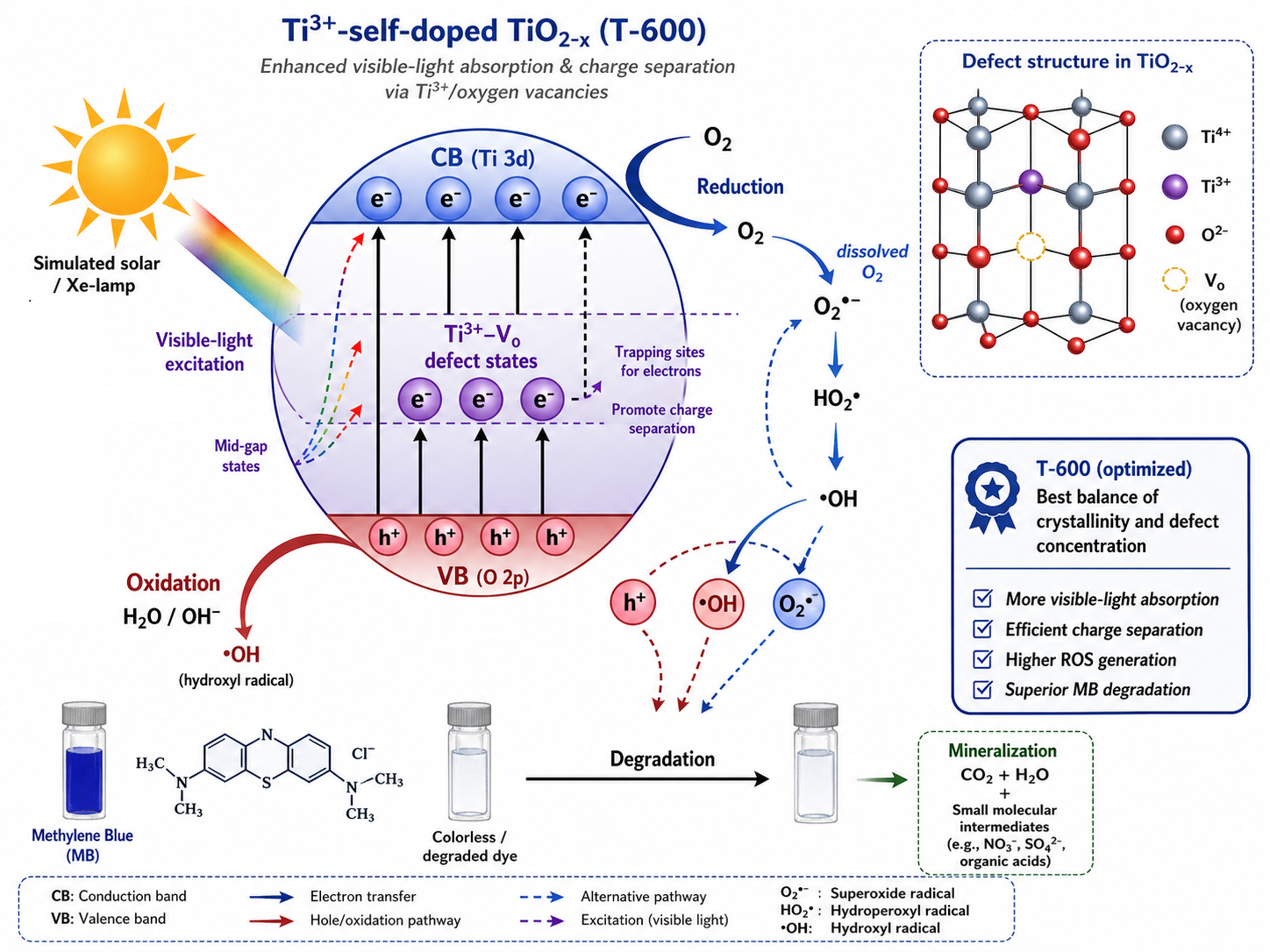
Textile wastewater containing synthetic dyes is a significant environmental concern due to its high color intensity, toxicity, chemical stability, and resistance to conventional treatment. This work prepared Ti3+ self-doped TiO2 photocatalysts using a simple sol-gel route combined with NaBH4-assisted calcination. The strategy was designed to generate intrinsic lattice defects, mainly Ti3+ centers and oxygen vacancies, in anatase TiO2 without the use of flammable reducing gases or complicated post-synthesis treatments. The influence of calcination temperature was examined by preparing samples at 200, 500, and 600 °C. XRD results showed that the selected samples maintained the anatase TiO2 phase, indicating that the reduction-calcination treatment did not produce detectable secondary crystalline phases. Higher calcination temperature increased the degree of crystallinity, with crystallinity values of 59.1%, 68.2%, and 69.6% for the samples of T-200, T-500, and T-600, respectively. Raman spectra confirmed the anatase framework and revealed features related to lattice disorder in the reduced samples, while EPR analysis directly confirmed Ti3+/oxygen-vacancy defect sites, with the strongest signal observed for T-600. UV-vis DRS demonstrated that the samples calcined at 500 and 600 °C absorbed more strongly in the visible region. The T-600 sample showed an effective band gap of 2.42 eV, evidencing that defect-related states contributed to broader light harvesting. Photocatalytic evaluation indicated that methylene blue degradation improved with increasing calcination temperature, and the best performance was obtained using T-600, with an apparent rate constant of 0.017 min-1. Reusability testing showed that T-600 retained activity for three cycles, although the rate constant decreased to 0.0116 and 0.0089 min-1 in the second and third cycles, respectively. The enhanced activity is attributed to the combined contribution of higher anatase crystallinity, improved visible-light response, and an appropriate concentration of Ti3+-oxygen vacancy sites that support charge separation and reactive oxygen species formation.
How to Cite
Tri Partono Adhi, Galang Ananta Dwipayana, Dwiwahju Sasongko, I Gede Wenten, Hary Devianto, Wibawa Hendra Saputera (2026). Defect-Engineered TiO2 Photocatalysts for Enhanced Methylene Blue Degradation. Journal of Engineering and Technological Sciences, Vol. 58 No. 5 (2026): Vol. 58 No. 5(2026): October, 732-744. https://doi.org/10.5614/j.eng.technol.sci.2026.58.5.10
Metrics
References
Abdullah, S. A., Sahdan, M. Z., Nayan, N., Embong, Z., Hak, C. R. C., & Adriyanto, F. (2020). Neutron beam interaction with rutile TiO2 single crystal (1 1 1): Raman and XPS study on Ti3+-oxygen vacancy formation. Materials Letters, 263, 127143. https://doi.org/https://doi.org/10.1016/j.matlet.2019.127143
Bharti, B., Kumar, S., Lee, H.-N., & Kumar, R. (2016). Formation of oxygen vacancies and Ti3+ state in TiO2 thin film and enhanced optical properties by air plasma treatment. Scientific Reports, 6(1), 32355. https://doi.org/10.1038/srep32355
Chen, S., Wang, Y., Li, J., Hu, Z., Zhao, H., Xie, W., & Wei, Z. (2018). Synthesis of black TiO2 with efficient visible-light photocatalytic activity by ultraviolet light irradiation and low temperature annealing. Materials Research Bulletin, 98, 280–287. https://doi.org/https://doi.org/10.1016/j.materresbull.2017.10.036
Chen, S., Xiao, Y., Wang, Y., Hu, Z., Zhao, H., & Xie, W. (2018). A Facile Approach to Prepare Black TiO2 with Oxygen Vacancy for Enhancing Photocatalytic Activity. Nanomaterials, 8(4). https://doi.org/10.3390/nano8040245
Deng, Y., & Zhao, R. (2015). Advanced Oxidation Processes (AOPs) in Wastewater Treatment. Current Pollution Reports, 1(3), 167–176. https://doi.org/10.1007/s40726-015-0015-z
Fang, W., Xing, M., & Zhang, J. (2014). A new approach to prepare Ti3+ self-doped TiO2 via NaBH4 reduction and hydrochloric acid treatment. Applied Catalysis B: Environmental, 160–161, 240–246. https://doi.org/https://doi.org/10.1016/j.apcatb.2014.05.031
Gao, Q., Si, F., Zhang, S., Fang, Y., Chen, X., & Yang, S. (2019). Hydrogenated F-doped TiO2 for photocatalytic hydrogen evolution and pollutant degradation. International Journal of Hydrogen Energy, 44(16), 8011–8019. https://doi.org/https://doi.org/10.1016/j.ijhydene.2019.01.233
Godoy Junior, A., Pereira, A., Gomes, M., Fraga, M., Pessoa, R., Leite, D., Petraconi, G., Nogueira, A., Wender, H., Miyakawa, W., Massi, M., & da Silva Sobrinho, A. (2020). Black TiO2 Thin Films Production Using Hollow Cathode Hydrogen Plasma Treatment: Synthesis, Material Characteristics and Photocatalytic Activity. Catalysts, 10(3). https://doi.org/10.3390/catal10030282
Guillemot, F., Porté, M. C., Labrugère, C., & Baquey, C. (2002). Ti4+ to Ti3+ Conversion of TiO2 Uppermost Layer by Low-Temperature Vacuum Annealing: Interest for Titanium Biomedical Applications. Journal of Colloid and Interface Science, 255(1), 75–78. https://doi.org/https://doi.org/10.1006/jcis.2002.8623
Hamdy, M. S., Saputera, W. H., Groenen, E. J., & Mul, G. (2014). A novel TiO2 composite for photocatalytic wastewater treatment. Journal of Catalysis, 310, 75–83. https://doi.org/https://doi.org/10.1016/j.jcat.2013.07.017
Jiménez, J. M., Zickler, G. A., Redhammer, G. J., & Berger, T. (2023). Chemical reduction of porous WO3 and TiO2 photoelectrocatalysts by atomic hydrogen. Applied Catalysis A: General, 658, 119163. https://doi.org/https://doi.org/10.1016/j.apcata.2023.119163
Langa, C., Tetana, Z. N., & Hintsho-Mbita, N. C. (2023). Effect of calcination temperature on the synthesis of TiO2 nanoparticles from Sutherlandia frutescence for the degradation of Congo red dye and antibiotics ciproflaxin and sulfamethoxazole. Chemical Physics Impact, 7, 100389. https://doi.org/https://doi.org/10.1016/j.chphi.2023.100389
Lee, J., Li, Z., Zhu, L., Xie, S., & Cui, X. (2018). Ti3+ self-doped TiO2 via facile catalytic reduction over Al(acac)3 with enhanced photoelectrochemical and photocatalytic activities. Applied Catalysis B: Environmental, 224, 715–724. https://doi.org/https://doi.org/10.1016/j.apcatb.2017.10.057
Li, J., Cheng, D., Chen, Z., Yang, L., Zheng, L., Wei, Z., Ma, T., Zhang, J., & Luo, Y. (2021). Oxygen vacancy/Ti3+ engineered TiO2 nanotube arrays prepared by in-situ exfoliation with H2 bubbles: A visible-light-driven self-supporting photocatalyst for detoxfication of chloraphenicol. Journal of Environmental Chemical Engineering, 9(6), 106670. https://doi.org/https://doi.org/10.1016/j.jece.2021.106670
Li, Z., Wang, S., Wu, J., & Zhou, W. (2022). Recent progress in defective TiO2 photocatalysts for energy and environmental applications. Renewable and Sustainable Energy Reviews, 156, 111980. https://doi.org/https://doi.org/10.1016/j.rser.2021.111980
Madima, N., Chauke, N. M., Ngqoloda, S., Mmelesi, O. K., & Raphulu, M. (2025). Recent advances in the development of defective black TiO2 nanomaterials for application in energy and environmental sustainability: A review. Results in Engineering, 26, 104868. https://doi.org/https://doi.org/10.1016/j.rineng.2025.104868
Ren, R., Wen, Z., Cui, S., Hou, Y., Guo, X., & Chen, J. (2015). Controllable Synthesis and Tunable Photocatalytic Properties of Ti3+-doped TiO2. Scientific Reports, 5(1), 10714. https://doi.org/10.1038/srep10714
Saputera, W. H., Amri, A. F., Mukti, R. R., Suendo, V., Devianto, H., & Sasongko, D. (2021). Photocatalytic Degradation of Palm Oil Mill Effluent (POME) Waste Using BiVO4 Based Catalysts. Molecules, 26(20). https://doi.org/10.3390/molecules26206225
Saputera, W. H., Mul, G., & Hamdy, M. S. (2015). Ti3+-containing titania: Synthesis tactics and photocatalytic performance. Catalysis Today, 246, 60–66. https://doi.org/https://doi.org/10.1016/j.cattod.2014.07.049
Saputera, W. H., Pranata, J. J., Jonatan, R., Widiatmoko, P., & Sasongko, D. (2023). Photocatalytic Simulation of Phenol Waste Degradation Using Titanium Dioxide (TiO2) P25-Based Photocatalysts. Journal of Engineering and Technological Sciences, 55(4), 419–433. https://doi.org/10.5614/j.eng.technol.sci.2023.55.4.6
Saputera, W. H., Sasongko, D., Widiatmoko, P., Yatasha Dewi, N., & Ardhistira, A. M. (2024). Simulation of photocatalytic degradation of methylene blue using titanium dioxide (TiO2) P25 as a photocatalyst. AIP Conference Proceedings, 3073(1), 080006. https://doi.org/10.1063/5.0194112
Shindhal, T., Rakholiya, P., Varjani, S., Pandey, A., Ngo, H. H., Guo, W., Ng, H. Y., & Taherzadeh, M. J. (2021). A critical review on advances in the practices and perspectives for the treatment of dye industry wastewater. Bioengineered, 12(1), 70–87. https://doi.org/10.1080/21655979.2020.1863034
Ullattil, S. G., & Ramakrishnan, R. M. (2018). Defect-Rich Brown TiO2–x Porous Flower Aggregates: Selective Photocatalytic Reversibility for Organic Dye Degradation. ACS Applied Nano Materials, 1(8), 4045–4052. https://doi.org/10.1021/acsanm.8b00824
Wajid Shah, M., Zhu, Y., Fan, X., Zhao, J., Li, Y., Asim, S., & Wang, C. (2015). Facile Synthesis of Defective TiO2−x Nanocrystals with High Surface Area and Tailoring Bandgap for Visible-light Photocatalysis. Scientific Reports, 5(1), 15804. https://doi.org/10.1038/srep15804
Wang, T., Li, W., Xu, D., Wu, X., Cao, L., & Meng, J. (2017). Strong visible absorption and excellent photocatalytic performance of brown TiO2 nanoparticles synthesized using one-step low-temperature process. Chinese Journal of Catalysis, 38(7), 1184–1195. https://doi.org/https://doi.org/10.1016/S1872-2067(17)62855-9
Xin, X., Xu, T., Yin, J., Wang, L., & Wang, C. (2015). Management on the location and concentration of Ti3+ in anatase TiO2 for defects-induced visible-light photocatalysis. Applied Catalysis B: Environmental, 176–177, 354–362. https://doi.org/https://doi.org/10.1016/j.apcatb.2015.04.016
Xu, C., Rangaiah, G. P., & Zhao, X. S. (2014). Photocatalytic Degradation of Methylene Blue by Titanium Dioxide: Experimental and Modeling Study. Industrial & Engineering Chemistry Research, 53(38), 14641–14649. https://doi.org/10.1021/ie502367x
Xu, Y., Wu, S., Wan, P., Sun, J., & Hood, Z. D. (2017). Introducing Ti3+ defects based on lattice distortion for enhanced visible light photoreactivity in TiO2 microspheres. RSC Advances, 7(52), 32461–32467. https://doi.org/10.1039/C7RA04885H
Zhu, Q., Peng, Y., Lin, L., Fan, C.-M., Gao, G.-Q., Wang, R.-X., & Xu, A.-W. (2014). Stable blue TiO2−x nanoparticles for efficient visible light photocatalysts. Journal of Materials Chemistry A, 2(12), 4429–4437. https://doi.org/10.1039/C3TA14484D
Zywitzki, D., Jing, H., Tüysüz, H., & Chan, C. K. (2017). High surface area, amorphous titania with reactive Ti3+ through a photo-assisted synthesis method for photocatalytic H2 generation. Journal of Materials Chemistry A, 5(22), 10957–10967. https://doi.org/10.1039/C7TA01614J
License
Copyright (c) 2026 by Authors

This work is licensed under a Creative Commons Attribution 4.0 International License.
Downloads
Date Log
- Submitted
- May 6, 2026
- Accepted
- July 22, 2026
- Published
- September 3, 2026
Keywords
- defect
- methylene blue
- oxygen vacancy
- photocatalysis
- TiO2
- wastewater


