
A Comparative Study of Carbon Surface Modification Routes: Gamma Irradiation and Aqueous Oxidation using H2O2 for Advanced Carbon/MnO2 Nanocomposite Supercapacitor Electrode
Downloads
Contents
Abstract
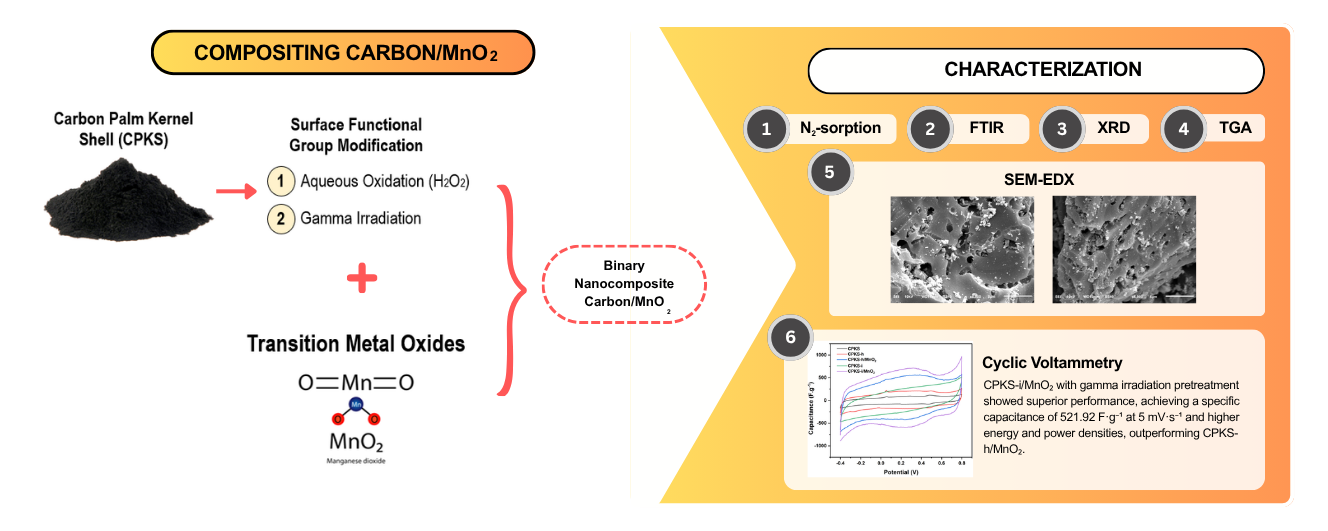
Supercapacitors have emerged as attractive energy storage devices due to their fast charging, long cycle life, and high-power density. However, their relatively low energy density remains a challenge, requiring optimization of electrode materials, particularly by increasing oxygen functional groups to improve specific capacitance. In this study, porous carbon derived from palm kernel shells (CPKS) was modified using two methods: conventional treatment using aqueous oxidation with 15% H2O2 (CPKS-h) compared with gamma irradiation (CPKS-i). MnO₂ was subsequently incorporated into both modified carbons via vacuum-assisted wet impregnation, yielding CPKS-h/MnO₂ and CPKS-i/MnO₂ nanocomposites. The samples were characterized using N₂-sorption analysis, FTIR, XRD, SEM-EDX, and TGA. The results showed that gamma irradiation better preserved the porous structure, with only a 0.99% reduction in surface area compared to 1.30% for aqueous oxidation. Both methods also increased oxygen functional groups on the carbon surface, as confirmed by FTIR and SEM-EDX analyses. Electrochemical performance was evaluated using cyclic voltammetry in a three-electrode system. Among the samples, CPKS-i/MnO₂ exhibited the best performance, achieving a specific capacitance of 521.92 F·g⁻¹ at 5 mV·s⁻¹, along with an energy density of 104.38 Wh·kg⁻¹ and a power density of 1.57 kW·kg⁻¹, outperforming CPKS-h/MnO₂. This enhanced performance is attributed to the preserved pore structure and improved surface chemistry induced by gamma irradiation, which enabled more uniform MnO₂ dispersion and promoted a synergistic combination of EDLC and pseudocapacitive mechanisms for efficient charge storage. Thus, gamma irradiation–based carbon modification combined with MnO₂ compositing offers a promising route for advancing supercapacitor research
Introduction
In recent years, supercapacitors have gained considerable attention as advanced energy storage devices due to their distinctive ability to bridge the performance characteristics of traditional capacitors and rechargeable batteries (Elsehsah et al., 2024). Unlike batteries, which often suffer from limited cycle life and slow charge–discharge rates, supercapacitors offer exceptionally high-power density, rapid charging–discharging capability, and long-term cycling stability (Elsehsah et al., 2024; Horn et al., 2019) . However, their lower energy density when benchmarked against batteries remains a critical limitation that restricts broader applications (González et al., 2016). Despite this challenge, supercapacitors have gained increasing attention and are now widely employed in diverse fields such as short-term energy storage, electric vehicles, and regenerative braking systems (Rustamaji et al., 2022).
The key components of a supercapacitor are electrodes, electrolytes, and separators, among which the electrode material plays the most critical role in determining overall device performance (Li et al., 2017). Carbon-based materials derived from biomass waste have attracted considerable attention as electrode candidates due to their abundance, sustainability, and tunable porosity (X. Zhang et al., 2026). Among the available biomass precursors, carbon palm kernel shell (CPKS) stands out as a particularly promising option. CPKS is an agricultural byproduct of palm oil processing that is widely available in tropical regions. Its high carbon content and inherently porous structure make it a suitable precursor for producing activated carbon electrodes with well-developed pore networks (Azman & Sulaiman, 2022; Luo et al., 2021; Prasetyo et al., 2020) . Furthermore, utilizing CPKS offers an economical route to high-performance electrode materials while simultaneously contributing to biomass waste valorization.
Despite these advantages, carbon-based materials generally possess limited specific capacitance and a relatively low energy density. These limitations restrict their practical application in high-performance supercapacitors (X. Hou et al., 2021). To address these limitations, transition metal oxides have been widely impregnated into carbon-based materials to form composite electrodes. Among the available transition metal oxides, MnO₂ is a preferred candidate due to its natural abundance, relatively low cost compared to other transition metals, and high theoretical specific capacitance of 1110 F.g-1. Furthermore, MnO₂ contributes additional capacitance through redox mechanisms within the nanocomposite (Dirican et al., 2020). However, MnO₂ alone is limited by its poor electrical conductivity, which constrains charge transport and rate capability. Compositing MnO₂ with carbon matrix addresses this issue through a synergistic mechanism. The carbon framework enables rapid electron transfer via an electric double-layer capacitance (EDLC) mechanism, whereas MnO₂ provides additional Faradaic charge storage associated with pseudocapacitance (Al Fuady et al., 2021; Dirican et al., 2020; Sunil & Jose, 2021) .
In addition to material selection, surface chemistry plays a crucial role in determining the capacitive behavior of electric double-layer capacitors (EDLCs). The functionalization of porous carbon is commonly achieved through the impregnation of oxygen-containing groups into the carbon matrix, which enhances the density of active sites and improves surface wettability (Xie et al., 2020). Several approaches have been developed for oxygen doping, including aqueous oxidation, ozone treatment, and gamma irradiation (Annisa et al., 2021). While conventional methods such as gaseous oxidation and ozone treatment are effective in introducing new functional groups, they are often associated with limitations, including the use of aggressive chemical reagents and the potential for uncontrolled modifications of the pore structure (Velo-Gala et al., 2014).
Among these methods, gamma irradiation has become an attractive modification technique through its capability of generating highly reactive radical intermediates through the ionization and excitation of water molecules, which subsequently interact with the carbon surface to introduce functional groups without requiring additional chemical reagents (Velo-Gala et al., 2014). Furthermore, this method provides notable benefits, such as homogeneous treatment, reduced energy demand, and promising scalability for practical applications (Weerasuk et al., 2024). The introduction of oxygen-containing functional groups improves wettability, facilitates ion diffusion within the pore network, and enhances redox activity, thereby significantly boosting the electrochemical performance of porous carbon materials (He et al., 2018).
Despite these advantages, studies directly comparing gamma irradiation with conventional oxidation methods in the context of porous carbon/MnO₂ nanocomposites remain limited. Furthermore, the synergistic effects between surface modification via gamma irradiation and MnO₂ impregnation on both structural and electrochemical properties have not been comprehensively elucidated. Previous studies have reported various carbon/MnO₂ composites, such as activated carbon/MnO₂ (Kour et al., 2022; Wang et al., 2018) and jujube shell-derived carbon/MnO₂ (Fan et al., 2023), demonstrating enhanced electrochemical performance. However, these works have not specifically addressed the role of surface modification in optimizing the carbon matrix. On the other hand, previous studies by Annisa et al. (2021) have demonstrated the application of gamma irradiation to CPKS for supercapacitor applications. Even so, this approach has not yet been extended to composite systems involving additional active materials. Therefore, this study aims to investigate the role of gamma irradiation in modifying porous carbon and to compare its effectiveness with aqueous oxidation using H₂O₂ in the synthesis of porous carbon/MnO₂ nanocomposites.
This study introduces a novel approach by employing gamma irradiation as a surface modification strategy combined with MnO₂ impregnation to enhance both EDLC and pseudocapacitive contributions. This approach provides new insights into the relationship between surface chemistry, pore structure, and electrochemical performance. It is expected that the resulting nanocomposites will exhibit improved surface characteristics and superior electrochemical performance, including enhanced specific capacitance, energy density, and power density. Overall, this study contributes to the development of sustainable and high-performance electrode materials for next-generation supercapacitor applications.
Methods
Synthesis of Nanocomposite CPKS/MnO2
The materials used in nanocomposite CPKS/MnO2 synthesis included palm kernel shell-derived carbon, hydrogen peroxide (H₂O₂), ultrapure water, manganese nitrate tetrahydrate (Mn(NO₃)₂·4H₂O), and ethanol. The nanoporous carbon derived from palm kernel shell, hereafter referred to as CPKS, was produced through pyrolysis at 800 °C following the procedure reported by Prasetyo et al. (2020). CPKS was then ground to obtain a particle size below 400 mesh. The 15% H₂O₂ solution was prepared by diluting 30% H₂O₂ obtained from Merck with distilled water, while the ultrapure water used in this study was supplied by a Sartorius Stedim Biotech Arium 611VF system with a resistivity of up to 18 MΩ·cm at 25 °C ± 1 °C. Manganese nitrate tetrahydrate (Mn(NO₃)₂·4H₂O) and ethanol were obtained from Merck.
After the preparation of CPKS, further treatment was carried out to modify its surface properties and incorporate transition metal oxides. Surface modification of the CPKS was conducted using two methods: (i) aqueous oxidation with a 15% H2O2 solution (CPKS-h) and (ii) gamma irradiation using a Gamma Cell/Gamma Chamber-BRIN equipped with a Co-60 source at a total dose of 50 kGy with a dose rate of 1.9–2.1 kGy h⁻¹ in ultrapure water as the medium (CPKS-i). Based on the applied dose rate, the irradiation time was approximately 24–26 hours, depending on the dose rate used during the process. The treated material was subsequently filtered and dried. The incipient wetness impregnation process involved degassing the CPKS powder under vacuum at a temperature of 150 °C. To achieve a target MnO₂ loading of 5 wt% relative to the carbon mass, an appropriate amount of Mn(NO₃)₂·4H₂O was dissolved in a 70% ethanol solution. This solution was then slowly dripped onto the degassed CPKS powder under vacuum conditions maintained at room temperature of 30 °C. The resulting slurry was dried in an oven at 70 °C for 6 hours and subsequently subjected to calcination in a furnace at 300 °C for 6 hours under a continuous nitrogen flow. Calcination induced the thermal breakdown of Mn(NO₃)₂, leading to the formation of MnO₂ particles embedded in the carbon matrix. The final material consisted of a CPKS/MnO₂ composite.
Characterization of Materials
The primary characterizations of the material consisted of evaluation of pore structures, functional groups, and thermal stabilities. The pore structures were determined by nitrogen adsorption–desorption measurements conducted with a Quantachrome NOVA 2000 analyzer, while the Brunauer-Emmett-Teller (BET) method was employed to determine the specific surface area (SSA). Functional group analysis was carried out with a Nicolet Avatar 360 Fourier Transform Infrared (FTIR) spectrometer, which provided spectra with characteristic absorption bands corresponding to the functional groups present in the material. The morphology of materials was analyzed using a Scanning Electron Microscope (SEM) coupled with an Energy Dispersive X-ray (EDX) spectrometer JEOL JSM-6510 LA. In addition, the thermal stability of the samples was assessed through Thermogravimetric Analysis (TGA) with a Linseis STA PT1000 analyzer under a nitrogen atmosphere.
Electrochemical Measurements
Electrochemical characterization of the material’s specific capacitance was performed using a three-electrode configuration through Cyclic Voltammetry (CV). The materials used for the specific capacitance measurements included the synthesized CPKS/MnO₂ nanocomposite, Nafion 117 obtained from Sigma-Aldrich, isopropanol 99.9% from Smart Lab, and a 1 M H₂SO₄ aqueous electrolyte prepared by diluting 95–97% H₂SO₄ from Merck with distilled water.
The capacitance measurements were carried out using a µStat 400 portable bipotentiostat from DropSens. In this system, the synthesized CPKS/MnO₂ nanocomposite served as the material for the working electrode, platinum (Pt) was applied as the counter electrode, and Ag/AgCl (immersed in 3 M KCl solution) functioned as the reference electrode. A glassy carbon electrode was employed as the current collector. To set up the working electrode, 10 mg of the nanocomposite was dispersed in a mixture containing 20 μL Nafion 117 and 1 mL isopropanol. Nafion 117 acted as a polymeric binder, while isopropanol provided a volatile medium for dispersion. The suspension was sonicated to obtain a homogeneous ink with a concentration of 10 mg.mL⁻¹. A volume of 0.01 mL of the ink was used for deposition by drop-casting onto the surface of the glassy carbon electrode, followed by drying at room temperature. The resulting active mass loading on the working electrode from the deposition process was 0.1 mg. Specific capacitance measurements were conducted in a 1 M H₂SO₄ aqueous electrolyte over a potential range of –0.40 V to 0.80 V at scan rates of 5, 10, 25, 50, and 100 mV·s⁻¹.
The specific capacitance was calculated from the cyclic voltammetry curves using Eq. (1).
where is the specific capacitance in F.g⁻¹, is the current as a function of voltage, is the mass of the active material in grams, is the potential window in volts, and is the scan rate in V.s⁻¹.
The energy density was calculated using Eq. (2).
where is the energy density in Wh.kg⁻¹.
The power density was determined using Eq. (3).
where is the power density in kW.kg⁻¹.
Results
FTIR Characterization of Surface Functional Groups
Figure 1 presents the normalized FTIR spectra of CPKS, CPKS-h, CPKS-i, CPKS-h/MnO₂, and CPKS-i/MnO₂. All samples exhibited a broad absorption band centered at approximately 3400 cm⁻¹. Compared with pristine CPKS, the intensity of this band increased after H₂O₂ oxidation and gamma irradiation treatments. Additional absorption features were observed in the 1700–1500 cm⁻¹ region and became more pronounced after surface modification, particularly for CPKS-h and the MnO₂-containing samples. Increased absorption intensity was also detected within the 1250–1000 cm⁻¹ region following both oxidation and irradiation treatments. After MnO₂ impregnation, the overall spectral profiles of CPKS-h/MnO₂ and CPKS-i/MnO₂ remained similar to those of their respective carbon supports, indicating the retention of the characteristic absorption bands generated during the pretreatment stage. Collectively, the FTIR spectra indicate differences in the intensity and distribution of absorption bands among the investigated samples following surface modification and MnO₂ impregnation.
Figure 1. FTIR spectra of CPKS, CPKS-h, CPKS-i, CPKS-h/MnO2, and CPKS-i/MnO2.
Textural Analysis of Materials
The nitrogen adsorption–desorption isotherms of CPKS, CPKS-h, CPKS-i, CPKS-h/MnO₂, and CPKS-i/MnO₂ are presented in Figure 2. All samples exhibited a steep nitrogen uptake at low relative pressures, followed by a gradual increase in adsorption capacity at intermediate and high relative pressures. The adsorption profiles of CPKS, CPKS-h, and CPKS-i were highly similar and largely overlapped throughout the measured pressure range. In contrast, lower nitrogen uptake was observed after MnO₂ impregnation, particularly for CPKS-h/MnO₂.
The pore size distributions of all samples are shown in Figure 3. A dominant peak centered near 1 nm was observed for all materials. Additional contributions were detected within the 2–5 nm region. The pristine CPKS sample exhibited a sharp peak near 1 nm, while similar pore size distribution profiles were observed for CPKS-h, CPKS-h/MnO₂, CPKS-i, and CPKS-i/MnO₂.
The textural properties of all samples are summarized in Table 1. Pristine CPKS exhibited a specific surface area of 708.18 m².g⁻¹, a micropore volume of 0.25 cm³.g⁻¹, and a total pore volume of 0.33 cm³.g⁻¹. Following pretreatment, only slight changes in the textural parameters were observed. The specific surface area decreased to 698.97 m²·g⁻¹ for CPKS-h and 701.14 m²·g⁻¹ for CPKS-i, corresponding to reductions of 1.30% and 0.99%, respectively. The micropore volume was 0.24 cm³·g⁻¹ for CPKS-h and 0.25 cm³·g⁻¹ for CPKS-i, while the total pore volume increased slightly to 0.34 cm³·g⁻¹ for both modified samples. These results indicate that the gamma-irradiated sample retained its specific surface area slightly better than the H₂O₂-treated sample after pretreatment.
After MnO₂ impregnation, reductions in specific surface area, micropore volume, and total pore volume were observed for both composite samples. The specific surface area decreased to 560.10 m².g⁻¹ for CPKS-h/MnO₂ and 629.54 m².g⁻¹ for CPKS-i/MnO₂. Similarly, the micropore volume decreased to 0.20 cm³.g⁻¹ and 0.22 cm³.g⁻¹, while the total pore volume decreased to 0.29 cm³.g⁻¹ and 0.31 cm³.g⁻¹ for CPKS-h/MnO₂ and CPKS-i/MnO₂, respectively. The mean pore diameter increased from 1.97 nm to 2.08 nm after MnO₂ impregnation in CPKS-h, whereas it remained nearly unchanged at 1.96 nm for CPKS-i before and after MnO₂ loading. The textural parameters show larger reductions in specific surface area, micropore volume, and total pore volume for CPKS-h/MnO₂ than for CPKS-i/MnO₂ after MnO₂ impregnation.
Figure 2. Nitrogen adsorption-desorption isotherms of CPKS, CPKS-h, CPKS-h/MnO2, CPKS-i, and CPKS-i/MnO2.
Figure 3. Pore size distributions of CPKS, CPKS-h, CPKS-h/MnO2, CPKS-i, and CPKS-i/MnO2.
Table 1. Summarized pore characteristics of samples
|
Samples |
Specific Surface Area (m 2 .g -1 ) |
Mean Pore Diameter (nm) |
Micropore Volume (cm 3 .g -1 ) |
Total Pore Volume (cm 3 .g -1 ) |
|
CPKS |
708.18 |
1.87 |
0.25 |
0.33 |
|
CPKS-h |
698.97 |
1.97 |
0.24 |
0.34 |
|
CPKS-h/MnO2 |
560.10 |
2.08 |
0.20 |
0.29 |
|
CPKS-i |
701.14 |
1.96 |
0.25 |
0.34 |
|
CPKS-i/MnO2 |
629.54 |
1.96 |
0.22 |
0.31 |
XRD Analysis of Materials
The XRD patterns of the samples are presented in Figure 4. Pristine CPKS exhibited two broad diffraction peaks centered at 24.26° and 43.58°. Following MnO₂ impregnation, the broad peak near 24.26° became weaker and shifted slightly to 23.16°, while the diffraction feature around 43.58° decreased in intensity. Additional diffraction peaks were observed at 32.30° and 36.02° in the MnO₂-loaded sample. These changes indicate distinct differences between the diffraction patterns of pristine CPKS and the corresponding MnO₂-containing composite.
Figure 4. XRD spectra of CPKS and CPKS-h/MnO2.
SEM-EDX Analysis of Materials
Figure 5 presents the surface and particle morphologies of CPKS before and after gamma irradiation treatment. The SEM images were obtained at a magnification of 5000×. Both samples exhibited irregularly shaped particles with non-uniform geometries. Visible cavities were observed on the surfaces of both materials, as indicated by the red outlines in Figure 5. No substantial differences in particle morphology or cavity distribution were observed between the untreated and irradiated samples.
The elemental compositions of CPKS before and after gamma irradiation are summarized in Table 2. The untreated sample contained 61.34% carbon and 38.66% oxygen, whereas the irradiated sample contained 59.74% carbon and 40.26% oxygen. An increase in oxygen content was observed after gamma irradiation treatment.
Figure 5. SEM image of: (a) CPKS and (b) CPKS-i.
Table 2. Result of EDX mapping of samples
|
Samples |
Element (%) | |
|
C |
O | |
|
CPKS |
61.34 |
38.66 |
|
CPKS-i |
59.74 |
40.26 |
Thermal Behavior and Stability of Materials
The thermogravimetric profiles of CPKS, CPKS-i, and CPKS-i/MnO₂ are presented in Figure 6. CPKS and CPKS-i exhibited a single weight-loss region within the temperature range of 0–100 °C. In contrast, CPKS-i/MnO₂ displayed two distinct weight-loss regions occurring at 0–100 °C and 100–300 °C. At higher temperatures, only minor mass changes were observed for all samples. At 700 °C, CPKS-i/MnO₂ retained nearly its original mass, exhibiting a total weight loss of only 0.16%.
Figure 6. Thermogravimetric Analysis of CPKS, CPKS-i, and CPKS-i/MnO2.
Electrochemical Properties
Figure 7 presents the cyclic voltammetry (CV) curves of CPKS, CPKS-h, CPKS-h/MnO₂, CPKS-i, and CPKS-i/MnO₂ recorded at scan rates of 5, 10, 25, 50, and 100 mV.s⁻¹. The carbon-based samples (CPKS, CPKS-h, and CPKS-i) exhibited near-rectangular CV profiles with minor distortions, whereas the MnO₂-containing composites displayed broader quasi-rectangular profiles with larger enclosed areas and more pronounced humps in both anodic and cathodic regions. For a clearer comparison, the CV curves obtained at 5 mV.s⁻¹ are shown in Figure 8. Differences in the enclosed CV areas were observed among the investigated materials, with the MnO₂-containing composites exhibiting substantially larger curve areas than the corresponding carbon materials. Based on the CV curve areas at 5 mV.s⁻¹, the calculated specific capacitance values are summarized in Table 3. The specific capacitances of CPKS, CPKS-h, CPKS-i, CPKS-h/MnO₂, and CPKS-i/MnO₂ were 71.91 F.g⁻¹, 162.04 F.g⁻¹, 216.01 F.g⁻¹, 383.56 F.g⁻¹, and 521.92 F.g⁻¹, respectively. Among all investigated samples, CPKS-i/MnO₂ exhibited the highest specific capacitance.
Figure 7. Cyclic Voltammetry at All Scan Rate for: (a) CPKS, (b) CPKS-h, (c) CPKS-i, (d) CPKS-h/MnO2, and (e) CPKS-i/MnO2.
Figure 8. Cyclic Voltammetry at Scan Rate of 5 mV.s⁻¹ for CPKS, CPKS-h, CPKS-h/MnO2, CPKS-i, and CPKS-i/MnO2.
Table 3. Specific Capacitance for CPKS, CPKS-h, CPKS-h/MnO₂, CPKS-i, and CPKS-i/MnO₂ at 5 mV·s⁻¹.
|
Samples |
CPKS |
CPKS-h |
CPKS-i |
CPKS-h/MnO 2 |
CPKS-i/MnO 2 |
|
Specific Capacitance (F.g -1 ) |
71.91 |
162.04 |
216.01 |
383.56 |
521.92 |
Figure 9 shows the variation of specific capacitance as a function of scan rate. All samples exhibited a gradual decrease in capacitance with increasing scan rate, although the overall trend remained similar for both carbon materials and MnO₂-containing composites. The Ragone plots shown in Figure 10 illustrate the relationship between energy density and power density for the investigated materials. The energy densities of CPKS, CPKS-h, CPKS-h/MnO₂, CPKS-i, and CPKS-i/MnO₂ at 5 mV.s⁻¹ were 14.38 Wh.kg⁻¹, 32.41 Wh.kg⁻¹, 76.71 Wh.kg⁻¹, 43.20 Wh.kg⁻¹, and 104.38 Wh.kg⁻¹, respectively, while the corresponding power densities were 0.22 kW.kg⁻¹, 0.49 kW.kg⁻¹, 1.15 kW.kg⁻¹, 0.65 kW.kg⁻¹, and 1.57 kW.kg⁻¹. Among all samples, CPKS-i/MnO₂ achieved the highest energy density and power density.
Figure 9. Capacitance vs scan rate of CPKS, CPKS-h, CPKS-h/MnO2, CPKS-i, and CPKS-i/MnO2.
Figure 10. Ragone plot of CPKS, CPKS-h, CPKS-h/MnO2, CPKS-i, and CPKS-i/MnO2 derived from CV measurements (three-electrode system).
Discussion
Surface Oxygen Functionalization and Its Functional Implications
The FTIR spectra provide clear evidence of surface chemical modification following both H₂O₂ oxidation and gamma irradiation treatments. The broad absorption band centered at approximately 3400 cm⁻¹ is assigned to the stretching vibration of hydroxyl (-OH) groups and adsorbed water molecules on the carbon surface (Mukti et al., 2023). In addition, the enhanced absorption feature observed within the 1700–1500 cm⁻¹ region is associated with carbonyl-containing functionalities (C=O) (Kwamman et al., 2022; Pratama et al., 2025; Yahia et al., 2022) , while the bands detected in the 1250–1000 cm⁻¹ range correspond to C–O stretching vibrations originating from phenolic, alcoholic, ether, and carboxylic functional groups (Kwamman et al., 2022). The increased intensity of these bands after H₂O₂ oxidation and gamma irradiation indicates that both treatments promoted the incorporation of oxygen-containing functional groups onto the carbon surface. The EDX results further support this interpretation by showing an increase in oxygen content after irradiation treatment. Collectively, these findings confirm the successful enrichment of oxygen-containing functionalities on the modified carbon materials.
Although both modification routes generated similar oxygen-containing functionalities, the mechanisms responsible for their formation differ considerably. During H₂O₂ oxidation, oxygen-containing groups are introduced through direct oxidation reactions occurring at defect sites on the carbon surface. The oxidation process promotes the incorporation of oxygen atoms into the carbon framework, resulting in the formation of hydroxyl, carbonyl, and carboxyl functionalities. Consequently, the enhanced absorption intensity observed in the O–H, C=O, and C–O regions reflect the successful oxidation of the carbon surface and the enrichment of oxygen-containing species (Kwamman et al., 2022; Yahia et al., 2022) .
Gamma irradiation modifies the carbon surface through a fundamentally different pathway. When water is exposed to gamma radiation, radiolysis occurs and generates highly reactive species such as hydroxyl radicals (•OH) and oxygen radicals (•O). Among these species, hydroxyl radicals play the most significant role in carbon surface functionalization because they readily react with active sites and structural defects on the carbon surface. These reactions promote the formation of oxygen-containing functionalities without requiring strong chemical oxidants. Velo-Gala et al. (2014) reported that this radical-mediated process enables efficient oxygen functionalization while minimizing damage to the carbon framework. Similar observations have been reported by (Annisa et al., 2021) and (Pratama et al., 2025), who demonstrated that gamma irradiation effectively enriches oxygen-containing surface functionalities on palm-kernel-shell-derived carbon materials.
The increase in oxygen content detected by EDX analysis further supports the FTIR observations. The oxygen percentage increased from 38.66% for pristine CPKS to 40.26% after gamma irradiation, confirming that oxygen-containing species were successfully incorporated onto the carbon surface. This result is consistent with previous studies showing that gamma irradiation promotes oxygen enrichment while maintaining the structural integrity of porous carbon materials (Pratama et al., 2025; Velo-Gala et al., 2014) . A similar trend was reported by Adhamash et al. (2020), who observed that gamma irradiation enhanced the abundance of oxygen-containing functional groups and improved the surface properties of porous carbon materials intended for electrochemical applications.
The retention of O–H, C=O, and C–O absorption bands after MnO₂ incorporation indicates that the oxygen-containing functionalities generated during pretreatment remained stable throughout the impregnation and calcination processes. These functional groups play an important role in facilitating interactions between the carbon surface and manganese oxide species by providing favorable anchoring sites for metal oxide nucleation and growth (Pratama et al., 2025). Consequently, the preservation of these functionalities is expected to improve MnO₂ dispersion and strengthen interfacial interactions between the carbon matrix and the active metal oxide phase.
From an electrochemical perspective, oxygen-containing functional groups provide several advantages. First, they improve the hydrophilicity and wettability of the carbon surface, allowing electrolyte ions to access internal pore structures more effectively and enhancing the interaction between the electrode surface and the electrolyte (Hu et al., 2021; Lv et al., 2023; Qiu et al., 2023) . Second, oxygen-containing functionalities may participate in reversible surface redox reactions, providing additional pseudocapacitive charge storage alongside conventional electric double-layer capacitance (Hu et al., 2021; Qiu et al., 2023) . Third, the presence of oxygen-containing surface functionalities enhances the affinity of carbon toward MnO₂ deposition by providing favorable anchoring sites for manganese oxide species, thereby facilitating the formation of stable carbon-supported MnO₂ composites (Pratama et al., 2025).
The beneficial role of these oxygen-containing functionalities is further reflected in the electrochemical results. Compared with pristine CPKS, which exhibited a specific capacitance at 5 mV·s⁻¹ of 71,91 F.g⁻¹, the capacitance increased to 162.04 F.g⁻¹ after H₂O₂ treatment (CPKS-h) and further increased to 216.01 F.g⁻¹ after gamma irradiation (CPKS-i). The substantial improvement in capacitance following both surface modification treatments confirms that the introduction of oxygen-containing functional groups contributes positively to charge-storage performance through enhanced electrolyte accessibility and additional pseudocapacitive contributions (Hu et al., 2021; Lv et al., 2023; Qiu et al., 2023) . Therefore, the oxygen enrichment generated through both H₂O₂ oxidation and gamma irradiation not only improves the intrinsic surface properties of carbon materials but also contributes to enhanced electrochemical performance and facilitates the successful incorporation of MnO₂ in the subsequent composite preparation stage (Pratama et al., 2025; Velo-Gala et al., 2014) .
Influence of Surface Oxygen Functionalization on Pore Structure and Electrochemical Performance
The nitrogen adsorption–desorption isotherms and pore size distribution analyses indicate that all investigated samples retained predominantly microporous characteristics after surface modification. The adsorption isotherms exhibit a steep nitrogen uptake at low relative pressures, followed by a gradual increase in adsorption capacity at higher relative pressures. Such behavior is characteristic of porous carbons dominated by micropores with a limited contribution from larger pores (Thommes et al., 2015). The highly overlapping isotherms observed for CPKS, CPKS-h, and CPKS-i suggest that both H₂O₂ oxidation and gamma irradiation preserved the overall adsorption behavior and pore architecture of the carbon material.
The pore size distribution results further support this observation. All samples exhibited a dominant pore population centered near 1 nm, confirming that micropores remained the primary structural feature after both modification treatments. In addition, minor contributions within the 2–5 nm region indicate the presence of a limited fraction of mesopores or interparticle voids. Since micropores contribute substantially to the available surface area and charge-storage sites, the preservation of this pore network is beneficial for electrochemical applications (Xie et al., 2020).
Although the overall pore structure remained largely unchanged, differences became evident when the textural parameters were compared. H₂O₂ treatment resulted in a slightly larger reduction in specific surface area than gamma irradiation. The specific surface area decreased from 708.18 m².g⁻¹ for pristine CPKS to 698.97 m².g⁻¹ for CPKS-h, whereas CPKS-i retained a slightly higher value of 701.14 m².g⁻¹. Similar trends were observed for micropore volume and total pore volume. The greater reduction observed after H₂O₂ treatment is consistent with previous studies reporting that oxygen-containing functional groups generated through chemical oxidation may partially obstruct pore entrances or reduce pore accessibility through localized pore blocking effects (Velo-Gala et al., 2014).
In contrast, gamma irradiation introduces oxygen-containing functional groups primarily through radical-mediated reactions occurring at active surface sites, thereby minimizing structural disruption of the carbon framework (Velo-Gala et al., 2014). As a result, the original microporous structure and accessible surface area are better preserved. This distinction becomes important because electrochemical performance depends not only on the abundance of oxygen-containing functional groups but also on the accessibility of surface area and ion-transport pathways within the porous network (Hu et al., 2021; Lv et al., 2023) .
The beneficial effect of preserving pore accessibility is reflected in the electrochemical results. Both modification routes enhanced the specific capacitance relative to pristine CPKS, which exhibited a capacitance of 71.91 F.g⁻¹. However, the gamma-irradiated sample achieved a capacitance of 216.01 F.g⁻¹, exceeding the value of 162.04 F.g⁻¹ obtained for the H₂O₂-treated sample. These results indicate that gamma irradiation provides a more favorable balance between oxygen functionalization and structural preservation, allowing oxygen-containing functional groups to be introduced while maintaining the accessibility of the porous structure (Pratama et al., 2025; Velo-Gala et al., 2014) . Such a combination promotes additional pseudocapacitive contributions and efficient ion transport, both of which are important for maximizing EDLC-based charge storage performance (Lv et al., 2023; Qiu et al., 2023) . Therefore, compared with H₂O₂ oxidation, gamma irradiation represents a more effective strategy for improving the electrochemical performance of porous carbon through surface oxygen functionalization.
Influence of MnO₂ Impregnation on Material Properties and Electrochemical Performance of Carbon/MnO2 Nanocomposite
The successful incorporation of MnO₂ into the carbon matrix was first confirmed by XRD analysis. Pristine CPKS exhibited broad diffraction peaks centered at approximately 24° and 43°, which are characteristic of amorphous carbon structures with a low degree of graphitization (Zhao et al., 2021). Following MnO₂ impregnation, additional diffraction peaks emerged at approximately 32° and 36°, indicating the presence of manganese oxide phases on the carbon surface. In particular, the reflection near 36° corresponds to the (211) plane of α-MnO₂ reported in previous studies (Feng et al., 2014). Simultaneously, the attenuation of the broad carbon reflections suggests partial coverage of the carbon framework by manganese oxide particles, as commonly observed in supported metal oxide systems (Cao et al., 2024). These observations collectively confirm the successful formation of carbon-supported MnO₂ composites.
The successful incorporation of MnO₂ was further supported by thermal analysis. Compared with pristine CPKS and CPKS-i, which exhibited a single weight-loss stage below 100 °C associated with the evaporation of physically adsorbed moisture, the CPKS-i/MnO₂ composite displayed an additional weight-loss region between 100-300 °C. This additional thermal event is attributed to the desorption of surface-bound molecules and residual species associated with MnO₂ impregnation and composite formation (Kim et al., 2024). Despite the presence of this second weight-loss stage, the composite exhibited exceptional thermal stability at elevated temperatures. At 700 °C, CPKS-i/MnO₂ experienced a total mass loss of only 0.16% relative to its initial weight, indicating that the carbon framework and supported MnO₂ phase remained highly stable during heating. Such a small mass loss is noteworthy because metal oxide impregnation commonly introduces thermally labile surface species that can lead to more significant decomposition at elevated temperatures. Therefore, the minimal weight loss observed for CPKS-i/MnO₂ suggests that the impregnation and calcination processes produced a structurally robust composite with strong interactions between the carbon matrix and MnO₂ particles.
The incorporation of MnO₂ significantly influenced the textural properties of the carbon materials. Following impregnation, decreases in specific surface area, micropore volume, and total pore volume were observed, indicating partial pore blocking by MnO₂ particles deposited within the porous structure (Cao et al., 2024). However, the extent of these reductions differed between the two pretreatment routes. After MnO₂ loading, the specific surface area decreased from 698.97 to 560.10 m².g⁻¹ for CPKS-h and from 701.14 m².g⁻¹ to 629.54 m².g⁻¹ for CPKS-i. Similarly, the total pore volume decreased from 0.34 cm³.g⁻¹ to 0.29 cm³.g⁻¹ for CPKS-h and from 0.34 cm³.g⁻¹ to 0.31 cm³.g⁻¹ for CPKS-i, while the micropore volume decreased from 0.24 cm³.g⁻¹ to 0.20 cm³.g⁻¹ and from 0.25 cm³.g⁻¹ to 0.22 cm³.g⁻¹, respectively. These results indicate that MnO₂ incorporation caused more severe pore blockage in the H₂O₂-treated carbon than in the gamma-irradiated carbon.
The improved preservation of textural properties observed for CPKS-i/MnO₂ can be linked to the oxygen-containing functional groups introduced during gamma irradiation. These functionalities provide favorable anchoring sites for MnO₂ nucleation and growth, promoting stronger interactions between the carbon support and manganese oxide particles (Pratama et al., 2025). As a result, MnO₂ can be dispersed more homogeneously across the carbon framework rather than accumulating at specific locations and causing localized pore blockage. This interpretation is supported by the smaller reductions in surface area and pore volume observed for CPKS-i/MnO₂ compared with CPKS-h/MnO₂.
These physicochemical characteristics strongly influenced the electrochemical behavior of the resulting composites. Prior to MnO₂ impregnation, the capacitance enhancement observed for CPKS-h and CPKS-i was mainly attributed to oxygen-containing functional groups that improved electrolyte wettability and contributed additional pseudocapacitive charge storage. Following MnO₂ impregnation, the CV profiles became broader and exhibited more pronounced humps in both anodic and cathodic regions, indicating the emergence of reversible Faradaic reactions associated with manganese oxide. This behavior confirms the coexistence of electric double-layer capacitance (EDLC) from the porous carbon matrix and pseudocapacitance originating from MnO₂ redox processes (Sunil & Jose, 2021). Consequently, MnO₂ impregnation significantly enhanced the specific capacitance of both materials. The capacitance increased from 162.04 F.g⁻¹ to 383.56 F.g⁻¹ for CPKS-h and CPKS-h/MnO₂, respectively, while a larger increase was observed for the gamma-irradiated samples, rising from 216.01 F.g⁻¹ for CPKS-i to 521.92 F.g⁻¹ for CPKS-i/MnO₂. The superior performance of CPKS-i/MnO₂ indicates that gamma irradiation created a more favorable surface environment for MnO₂ deposition by simultaneously enriching oxygen-containing functionalities and preserving pore accessibility.
Table 4 compares the electrochemical performance of the CPKS-i/MnO₂ electrode with previously reported carbon/MnO₂ composites. The CPKS-i/MnO₂ exhibits a high specific capacitance of 521.92 F.g⁻¹ at 5 mV.s⁻¹, exceeding most reported counterparts, which is consistent with its larger CV curve area (Figure 7). The energy density of 104.38 Wh.kg⁻¹ is comparable to the best literature values reported for activated carbon/MnO₂-based materials. The relatively high-power density of 1.57 kW kg⁻¹ reflects rapid charge–discharge kinetics associated with surface-controlled electrochemical processes (H. Hou et al., 2022). However, this value remains lower than that reported by Kour et al. (2022), who achieved a power density of 2000 W kg⁻¹ using activated carbon/MnO₂ composites. Moreover, the electrochemical parameters reported in this work should be interpreted cautiously because they were derived from CV measurements using a three-electrode configuration and therefore represent electrode-level estimations rather than full-device performance (Chang & Hang Hu, 2018). Compared with previously reported carbon/MnO₂ systems, the superior performance of CPKS-i/MnO₂ can be attributed to the synergistic contribution of EDLC from the porous carbon framework and pseudocapacitance from MnO₂ (Sunil & Jose, 2021), together with improved MnO₂ dispersion and pore accessibility induced by gamma irradiation (Pratama et al., 2025; Velo-Gala et al., 2014) . Due to its combined EDLC and pseudocapacitive charge-storage mechanisms, CPKS-i/MnO₂ is suitable for both symmetric and asymmetric supercapacitor configurations. In asymmetric systems, it can serve as the cathode paired with an activated carbon anode, enabling a wider operating voltage window and higher energy density (Shao et al., 2018). Nevertheless, direct comparison with literature remains limited by differences in electrolytes, testing conditions, active mass loading, and cell configurations. Therefore, further validation through galvanostatic charge–discharge (GCD), electrochemical impedance spectroscopy (EIS), and long-term cycling stability measurements is required to evaluate practical device performance. Overall, the results indicate that CPKS-i/MnO₂ is a competitive carbon-based electrode material within the current state of the art.
Table 4. Electrochemical performance comparison of the present work with literature reports
|
Sample |
Electrolyte |
Specific Capacitance |
Energy Density |
Power Density |
|
3D duct-like graphene/MnO2 |
2 M LiNO3 |
255 F.g-1 at 5 mV.s-1 |
28.2 mWh .cm-3 |
55.7 W.cm-3 |
|
Activated carbon/MnO2 (Kour et al., 2022) |
6 M KOH |
398.5 F.g-1 at 1 A.g-1 |
105.2 Wh.kg-1 |
2000 W.kg-1 |
|
Jujube Shell-carbon based/MnO2 |
1 M KOH |
310.6 F.g-1 at 1 A.g-1 |
42.4 Wh.kg-1 |
1425 W.kg-1 |
|
N-doped activated carbon /MnO2 |
PVA-KOH |
408.5 F.g-1 at 0.5 A.g-1 |
26.7 Wh.kg-1 |
400 W.kg-1 |
|
Activated Carbon/MnO2 |
1 M Na2SO4 |
345.1 F.g-1 at 0.5 A.g-1 |
31 Wh.kg-1 |
500 W.kg-1 |
|
CPKS-i/MnO2 (this work) |
1 M H2SO4 |
521.92 F.g-1 at 5 mV.s-1 |
104.38 Wh.kg⁻¹ |
1.57 kW.kg⁻¹ |
Conclusion
The nanocomposite CPKS/MnO₂ was successfully synthesized through a series of processes, including functional group modification pretreatment, MnO₂ impregnation, and calcination. The resulting nanocomposite was evaluated as a supercapacitor electrode material and characterized using N₂-sorption, FTIR, SEM-EDX, and TGA analysis. Based on N₂-sorption results, CPKS-i demonstrated a smaller reduction in surface area compared to CPKS-h. In particular, gamma irradiation effectively introduced oxygen-containing functional groups onto the carbon surface while preserving the pore structure, as evidenced by a smaller reduction in specific surface area (10.2%) relative to H₂O₂ treatment (19.9%). FTIR and XRD analysis further confirmed the successful impregnation of MnO₂ onto the CPKS framework. The impregnation of MnO₂ also influenced the thermal stability of the electrode material, as evidenced by TGA analysis. SEM–EDX analysis showed that gamma irradiation preserved the carbon morphology and pore structure while increasing surface oxygen content, thereby enabling more uniform MnO₂ dispersion and improved pore accessibility.
From the two distinct functional group modification routes, two composite samples were obtained: CPKS-h/MnO₂ and CPKS-i/MnO₂. Among all samples, the CPKS-i/MnO₂ nanocomposite exhibited the best supercapacitor performance, delivering a high specific capacitance of 521.92 F·g⁻¹ at 5 mV·s⁻¹, along with an energy density of 104.38 Wh·kg⁻¹ and a power density of 1.57 kW·kg⁻¹. This enhancement in electrochemical properties is largely derived from the EDLC contribution of the porous carbon matrix. This effect is further supported by gamma irradiation, which improves surface functional groups, wettability, and pore accessibility, as well as by the additional pseudocapacitive contribution from MnO₂. These values are competitive with many previously reported porous carbon/MnO₂ materials, highlighting the effectiveness of gamma irradiation-assisted carbon modification as a promising and sustainable strategy for developing high-performance supercapacitor electrodes.
Nevertheless, several challenges remain to be addressed in future work. The electrochemical properties reported here were obtained from a three-electrode configuration, which tends to overestimate practical device performance. To substantiate these findings, further investigations involving galvanostatic charge–discharge testing, electrochemical impedance spectroscopy, and prolonged cycling stability assessments in a two-electrode cell are needed. In addition, optimizing the MnO₂ loading content, irradiation dose, and electrode fabrication process are important directions for scaling this approach toward practical supercapacitor device applications.
Acknowledgement
The research was financially supported by the Directorate of Higher Education under the Ministry of Education, Culture, Research, and Technology of the Republic of Indonesia through the Postgraduate Research Grant (No. 2650/UN1/DITLIT/Dit-Lit/PT.01.03/2025). K.A.G also gratefully acknowledges Department of Chemical Engineering and the Carbon Materials Research Group, Universitas Gadjah Mada, for Fast Track scholarships.
Compliance with ethics guidelines
The authors declare they have no conflict of interest or financial conflicts to disclose.
This article contains no studies with human or animal subjects performed by the authors.
References
- Elsehsah, Khaled Abdou Ahmed Abdou; Zulkarnain, Ahmad Noorden; Saman, Norhafezaidi Mat. 2024. Current insights and future prospects of graphene aerogel-enhanced supercapacitors: A systematic review. Heliyon. 10(17). https://doi.org/10.1016/J.HELIYON.2024.E37071
- Horn, Michael; MacLeod, Jennifer; Liu, Meinan; Webb, Jeremy; Motta, Nunzio. 2019. Supercapacitors: A new source of power for electric cars?. Economic Analysis and Policy. 61. https://doi.org/10.1016/J.EAP.2018.08.003
- González, Ander; Goikolea, Eider; Barrena, Jon Andoni; Mysyk, Roman. 2016. Review on supercapacitors: Technologies and materials. Renewable and Sustainable Energy Reviews. 58. https://doi.org/10.1016/J.RSER.2015.12.249
- Rustamaji, Heri; Prakoso, Tirto; Devianto, Hary; Widiatmoko, Pramujo; Nurdin, Isdiriayani. 2022. Design, Fabrication, and Testing of Supercapacitor Based on Nanocarbon Composite Material. ASEAN Journal of Chemical Engineering. 22(1). https://doi.org/10.22146/AJCHE.70139
- Li, Xue Qin; Chang, Lin; Zhao, Shen Long; Hao, Chang Long; Lu, Chen Guang; Zhu, Yi Hua et al. 2017. Research on carbon-based electrode materials for supercapacitors. Wuli Huaxue Xuebao/ Acta Physico - Chimica Sinica. 33(1). https://doi.org/10.3866/PKU.WHXB201609012
- Zhang, Xueping; Ding, Peng; Liu, Yunjian. 2026. Recent advances and applications of natural biomass-derived carbon in electrochemical energy storages. Journal of Solid State Electrochemistry. https://doi.org/10.1007/s10008-025-06468-x
- Prasetyo, Imam; Mukti, Nur Indah Fajar; Cahyono, Rochim Bakti; Prasetya, Agus; Ariyanto, Teguh. 2020. Nanoporous Carbon Prepared from Palm Kernel Shell for CO2/CH4 Separation. Waste and Biomass Valorization. 11(10). https://doi.org/10.1007/S12649-020-01006-4
- Luo, Xian You; Chen, Yong; Mo, Yan. 2021. A review of charge storage in porous carbon-based supercapacitors. New Carbon Materials. 36(1). https://doi.org/10.1016/S1872-5805(21)60004-5
- Azman, Nur Hawa Nabilah; Sulaiman, Yusran. 2022. Hierarchical Porous Materials for Supercapacitors. Encyclopedia of Energy Storage: Volume 1-4. 1-4. https://doi.org/10.1016/B978-0-12-819723-3.00022-6
- Hou, Xiaojian; Song, Yi; Zhao, Yueju; Li, Wenxiu; Guo, Zanwu; Tang, Shaoru et al. 2021. A Facile Route to Synthesis of Hierarchically Porous Carbon via Micelle System for Bifunctional Electrochemical Application. Frontiers in Chemistry. 9. https://doi.org/10.3389/FCHEM.2021.762103/BIBTEX
- Dirican, Mahmut; Yanilmaz, Meltem; Asiri, Abdullah M.; Zhang, Xiangwu. 2020. Polyaniline/MnO2/porous carbon nanofiber electrodes for supercapacitors. Journal of Electroanalytical Chemistry. 861. https://doi.org/10.1016/j.jelechem.2020.113995
- Sunil, Vaishak; Jose, Rajan. 2021. Hybrid nanocomposite metal oxide materials for supercapacitor application. Chemically Deposited Nanocrystalline Metal Oxide Thin Films: Synthesis, Characterizations, and Applications. https://doi.org/10.1007/978-3-030-68462-4_25
- Fuady, Muhammad Iqbal; Rochmadi; Prasetyo, Imam; Ariyanto, Teguh. 2021. Surface-Modified Carbon Synthesized from Palm Kernel Shell for Electric Double-Layer Capacitor Applications. Key Engineering Materials. 884. https://doi.org/10.4028/WWW.SCIENTIFIC.NET/KEM.884.423
- Xie, Lijing; Su, Fangyuan; Xie, Longfei; Guo, Xiaoqian; Wang, Zhenbing; Kong, Qingqiang et al. 2020. Effect of pore structure and doping species on charge storage mechanisms in porous carbon-based supercapacitors. Materials Chemistry Frontiers. 4(9). https://doi.org/10.1039/D0QM00180E
- Annisa, Annisa; Prasetyo, Imam; Swantomo, Deni; Ariyanto, Teguh. 2021. Surface modification of nanoporous carbon using gamma irradiation treatment as supercapacitor material. AIP Conference Proceedings. 2349(1). https://doi.org/10.1063/5.0052360
- Velo-Gala, Inmaculada; López-Peñalver, Jesús J.; Sánchez-Polo, Manuel; Rivera-Utrilla, José. 2014. Surface modifications of activated carbon by gamma irradiation. Carbon. 67. https://doi.org/10.1016/J.CARBON.2013.09.087
- Weerasuk, Bordin; Chutimasakul, Threeraphat; Prigyai, Nicha; Nilgumhang, Kewalee; Kaeopookum, Piriya; Sangtawesin, Tanagorn. 2024. Structural and Electrochemical Evolution of Water Hyacinth-Derived Activated Carbon with Gamma Pretreatment for Supercapacitor Applications. Materials. 17(13). https://doi.org/10.3390/ma17133233
- He, Yitao; Zhang, Yaohui; Li, Xifei; Lv, Zhe; Wang, Xianjie; Liu, Zhiguo et al. 2018. Capacitive mechanism of oxygen functional groups on carbon surface in supercapacitors. Electrochimica Acta. 282. https://doi.org/10.1016/J.ELECTACTA.2018.06.103
- Kour, Simran; Tanwar, Shweta; Sharma, A. L.. 2022. MnO2 nanorod loaded activated carbon for high-performance supercapacitors. Journal of Alloys and Compounds. 910. https://doi.org/10.1016/J.JALLCOM.2022.164834
- Wang, Xi; Chen, Shuai; Li, Daohao; Sun, Shenglei; Peng, Zhi; Komarneni, Sridhar et al. 2018. Direct Interfacial Growth of MnO2 Nanostructure on Hierarchically Porous Carbon for High-Performance Asymmetric Supercapacitors. ACS Sustainable Chemistry and Engineering. 6(1). https://doi.org/10.1021/ACSSUSCHEMENG.7B02960
- Fan, Qingwen; Fu, Peng; Bennett, Elliot L.; Song, Chaoyun; Zhang, Yuchun. 2023. Biomass-based 3D micro-meso-macroporous carbon for hybrid-capacitance characteristics and incredible energy density: Reversible charge transfer of multivalent Mn ions. Journal of Alloys and Compounds. 968. https://doi.org/10.1016/J.JALLCOM.2023.172281
- Mukti, Nur Indah Fajar; Ariyanto, Teguh; Sediawan, Wahyudi Budi; Prasetyo, Imam. 2023. Efficacy of modified carbon molecular sieve with iron oxides or choline chloride-based deep eutectic solvent for the separation of CO2/CH4. RSC Advances. 13(33). https://doi.org/10.1039/D3RA02890A
- Kwamman, Tanagorn; Anantachaisilp, Suranan; Limmeechokchai, Passavorn; Kanjana, Kotchaphan. 2022. Enhancements of surface functional groups and degree of graphitization in gamma irradiated activated carbon as an electrode material. Radiation Physics and Chemistry. 195. https://doi.org/10.1016/J.RADPHYSCHEM.2022.110062
- Pratama, Chaidir; Marlina; Munir, Miftakul; Setiawan, Herlan; Saptiama, Indra; Imron, Anas Fahmi et al. 2025. Development of C/Ag nanocomposites for adsorption and immobilization of iodine-131 (131I) from the urine of thyroid ablation therapy patients. Journal of Radioanalytical and Nuclear Chemistry 2025 334:5. 334(5). https://doi.org/10.1007/S10967-025-10146-7
- Yahia, M. S.; Youssef, H. F.; Elfeky, A. S.; Awad, M. B.; Elzaref, A. S.. 2022. Induced effects of gamma irradiation on activated carbon derived from Hyphaene Thebaica husks as a potential adsorbent for Chlorpyrifos pesticide-air purification. Egyptian Journal of Chemistry. 65(4). https://doi.org/10.21608/EJCHEM.2021.98168.4576
- Adhamash, Ezaldeen; Pathak, Rajesh; Qiao, Qiquan; Zhou, Yue; McTaggart, Robert. 2020. Gamma-radiated biochar carbon for improved supercapacitor performance. RSC Advances. 10(50). https://doi.org/10.1039/D0RA05764A
- Hu, You Ren; Dong, Xiao Ling; Zhuang, Hong Kun; Yan, Dong; Hou, Lu; Li, Wen Cui. 2021. Introducing Electrochemically Active Oxygen Species to Boost the Pseudocapacitance of Carbon-based Supercapacitor. ChemElectroChem. 8(16). https://doi.org/10.1002/CELC.202100641;WGROUP:STRING:PUBLICATION
- Lv, Yaokang; Wang, Juncheng; Ji, Dingwei; Li, Jianhang; Zhao, Suaisuai; Zhao, Yingjian et al. 2023. Carbonaceous electrode materials for supercapacitor: Preparation and surface functionalization. Frontiers in Energy Research. 10. https://doi.org/10.3389/FENRG.2022.957032/FULL
- Qiu, Chunjuan; Jiang, Lili; Gao, Yige; Sheng, Lizhi. 2023. Effects of oxygen-containing functional groups on carbon materials in supercapacitors: A review. Materials and Design. 230. https://doi.org/10.1016/J.MATDES.2023.111952
- Thommes, Matthias; Kaneko, Katsumi; Neimark, Alexander; Olivier, James P.; Rodriguez-Reinoso, Francisco; Rouquerol, Jean et al. 2015. Physisorption of gases, with special reference to the evaluation of surface area and pore size distribution (IUPAC Technical Report). Pure and Applied Chemistry. 87(9-10). https://doi.org/10.1515/PAC-2014-1117/XML
- Zhao, Jiaming; Yu, Lihua; Zhou, Feng; Ma, Huixia; Yang, Kongyan; Wu, Guang. 2021. Synthesis and characterization of activated carbon from sugar beet residue for the adsorption of hexavalent chromium in aqueous solutions. RSC Advances. 11(14). https://doi.org/10.1039/D0RA09644J
- Feng, Lili; Xuan, Zhewen; Zhao, Hongbo; Bai, Yang; Guo, Junming; Su, Chang wei et al. 2014. MnO2 prepared by hydrothermal method and electrochemical performance as anode for lithium-ion battery. Nanoscale Research Letters 2014 9:1. 9(1). https://doi.org/10.1186/1556-276X-9-290
- Cao, Yuan Jia; Lu, Cui Ying; Wang, Zhen; Bai, Rui; Liu, Guanghui. 2024. Fabrication of MnO2@Porous Carbons with High Energy and Power Density and Their Application in Supercapacitors. Advanced Energy and Sustainability Research. 5(8). https://doi.org/10.1002/AESR.202300164
- Kim, Won Ki; Verma, Swati; Ahmadi, Younes; Cho, Myeon Seong; Kim, Ki Hyun. 2024. The effects of metal-oxide content in MnO2-activated carbon composites on reactive adsorption and catalytic oxidation of formaldehyde and toluene in air. Science of The Total Environment. 926. https://doi.org/10.1016/J.SCITOTENV.2024.172137
- Hou, Huilin; Xu, Linli; Yang, Weiyou; Wong, Wai Yeung. 2022. Applications of 1D Mesoporous Inorganic Nanomaterials in Supercapacitors. Springer Series in Materials Science. 321. https://doi.org/10.1007/978-3-030-89105-3_7
- Chang, Liang; Hang Hu, Yun. 2018. 2.21 Supercapacitors. Comprehensive Energy Systems: Volumes 1-5. 2. https://doi.org/10.1016/B978-0-12-809597-3.00247-9
- Shao, Yuanlong; El-Kady, Maher F.; Sun, Jingyu; Li, Yaogang; Zhang, Qinghong; Zhu, Meifang et al. 2018. Design and Mechanisms of Asymmetric Supercapacitors. Chemical Reviews. 118(18). https://doi.org/10.1021/ACS.CHEMREV.8B00252
- Qin, Kaiqiang; Liu, Enzuo; Li, Jiajun; Kang, Jianli; Shi, Chunsheng; He, Chunnian et al. 2016. Free‐Standing 3D Nanoporous Duct‐Like and Hierarchical Nanoporous Graphene Films for Micron‐Level Flexible Solid‐State Asymmetric Supercapacitors. Advanced Energy Materials. 6(18). https://doi.org/10.1002/AENM.201600755
- Sun, Bingkang; Zhang, Xiaoyun; Fan, Xing; Wang, Ruiyu; Bai, Hongcun; Wei, Xianyong. 2022. Interface modification based on MnO2@N-doped activated carbon composites for flexible solid-state asymmetric supercapacitors. Energy. 249. https://doi.org/10.1016/J.ENERGY.2022.123659
License
License
Copyright (c) 2026 by Authors

This work is licensed under a Creative Commons Attribution 4.0 International License.


