
Comparison of PI and PID Controllers for UPQC Integrated Hybrid Renewable Energy System
Abstract
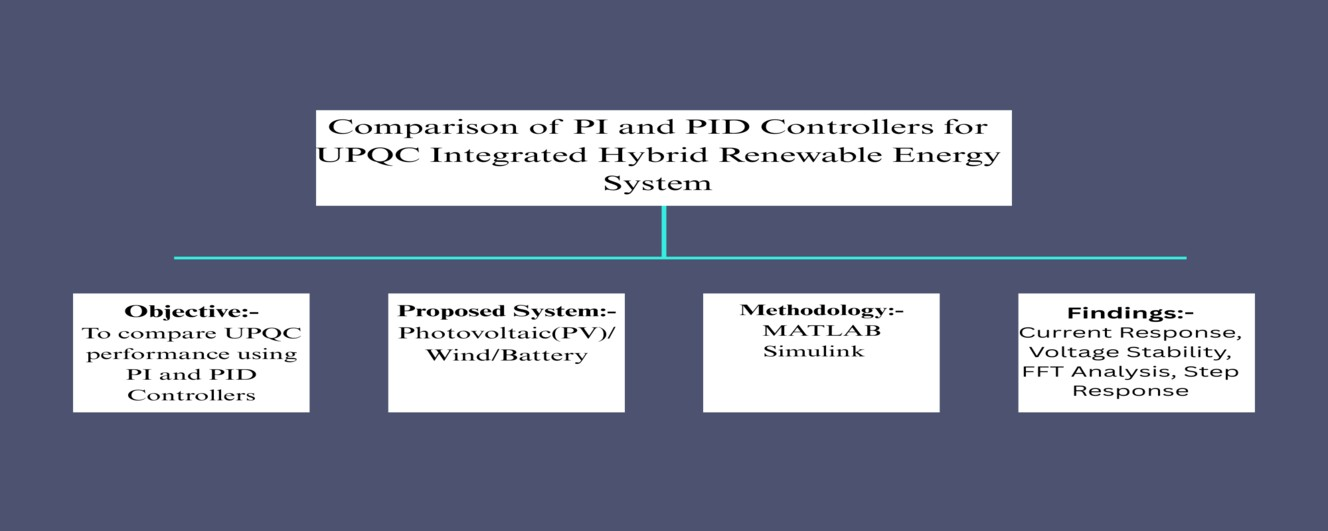
Unified Power Quality Conditioner (UPQC) plays a key role in improving power quality by alleviating voltage and current troubles in electrical distribution systems. The ability of UPQC to respond effectively to power quality turbulences is essentially determined by its control technique. The proportional-integral (PI) and proportional-integral-derivative (PID) controllers are the two most popular control techniques for UPQC. The primary objective of this article is to present a comparative analysis of UPQC performance using PI and PID controllers. The proposed system integrates a photovoltaic system, wind turbine and battery energy storage with UPQC. The PI and PID controllers are employed to regulate the dynamic response of the system. The comparative analysis of the controllers is done on the basis of qualitative parameters such as current response, voltage stability, fast fourier transform (FFT) analysis, step response and quantitative parameters such as total harmonic distortion, maximum overshoot, settling time, power factor, voltage regulation and DC-link deviation. Qualitatively, PID offers smoother current and voltage responses, stronger damping, better harmonic mitigation, and faster transient recovery. Quantitatively, the PID achieves 48% lower THD, 50% reduction in overshoot, halved settling time, improved power factor (0.99 vs. 0.95), and improved voltage regulation (1.7% vs. 4.2%).
How to Cite
Manpreet Singh, Lakhwinder Singh (2026). Comparison of PI and PID Controllers for UPQC Integrated Hybrid Renewable Energy System. Journal of Engineering and Technological Sciences, Vol. 58 No. 4 (2026): Vol. 58 No. 4(2026): August, 501-513. https://doi.org/10.5614/j.eng.technol.sci.2026.58.4.3
Metrics
References
Alajrash, B.H., Salem, M., Swadi, M., Senjyu, T., Kamarol, M., & Motahhir, S. (2024). A comprehensive review of FACTS devices in modern power systems: addressing power quality, optimal placement, and stability with renewable energy penetration. Energy Reports, 11, 5350–5371, https://doi.org/10.1016/j.egyr.2024.05.011.
Aldosary, A. (2024). Power quality conditioners-based fractional-order PID controllers using hybrid jellyfish search and particle swarm algorithm for power quality enhancement. Fractal and Fractional, 8(3), 140, https://doi.org/10.3390/fractalfract8030140.
Alqahtani, S., Ganesan, S., & Zohdy, M. A. (2020). The comparison between PI and PID controllers in engine speed control model. IEEE International Conference on Electro Information Technology, 629–634, https://doi.org/10.1109/EIT48999.2020.9208313.
Borase, R.P., Maghade, D.K., Sondkar, S.Y., & Pawar, S.N. (2021). A review of PID control, tuning methods and applications. International Journal of Dynamics and Control, 9, 818–827. https://doi.org/10.1007/s40435-020-00665-4.
Choudhury, S., & Sahoo, G.K. (2024). A critical analysis of different power quality improvement techniques in micro-grid. Advances in Electrical Engineering, Electronics and Energy, 8, 100520. https://doi.org/10.1016/j.prime.2024.100520.
Elkasem, A.H.A., Kamel, S., Khamies, M., & Nasrat, L. (2024). Frequency regulation in a hybrid renewable power grid: an effective strategy utilizing load frequency control and redox flow batteries. Scientific Reports, 14(1), 9576. https://doi.org/10.1038/s41598-024-58189-2.
Gulzar, M.M., Iqbal, A., Statin, D., & Khalid, M. (2023). An innovative converter-less solar PV control strategy for a grid connected hybrid PV/wind/fuel-cell system coupled with battery energy storage. IEEE Access, 11, 23245–23259. https://doi.org/10.1109/ACCESS.2023.3252891
Hazarathaiah, Y., Chaithanya, U., Tabrez, K. M., Arjun, K. N., Basha, S.J., & Naik B. P. (2023). Performance enhancement of unified power quality conditioner with PID controllers. International Conference on Innovative Mechanisms for Industry Application, 1519–1523. https://doi.org/10.1109/ICIMIA60377.2023.10426368
Izci, D., Hekimoglu, B., & Ekinci, S. (2022). A new artificial ecosystem-based optimization integrated with Nelder-Mead method for PID controller design of buck converter. Alexandria Engineering Journal, 61(3), 2030–2044, https://doi.org/10.1016/j.aej.2021.07.037.
Jeevanantham, Y. A., & Srinath, S. (2022). ANN based reduced switch multilevel inverter in UPQC for power quality improvement. Intelligent Automation & Soft Computing, 33(2), 909–921, https://doi.org/10.32604/iasc.2022.022907.
Joshi, A., Gaganambha, Dharshan, B. G., Varsha, V., Shamala, Spoorthi, S. N., & Reshma. (2024). Comparative analysis of dynamic voltage restorer based on PI and ANN control strategies in order to improve the voltage quality under non-linear loads. World Journal of Advanced Research and Reviews, 22(3), 292–303. https://doi.org/10.30574/wjarr.2024.22.3.1706
Kakani, D. R., Subendran, D., & Singh, S. J. (2024). Comparative analysis of PI and PID controllers for level and flow control in coupled tank systems. Technical Report, 1–10. https://doi.org/10.48550/arXiv.2410.22176
Kashani, H. N., Ardeshiri, R. R., Gheisarnejad, M., & Khooban, M. H. (2022). Optimal cascade non-integer controller for shunt active filter: real-time implementations. Designs, 6(2), 32, https://doi.org/10.3390/designs6020032.
Lei, T., Riaz, S., Zanib, N., Batool, M., Pan, F., & Zhang, S. (2022). Performance analysis of grid-connected distributed generation system integrating a hybrid wind-PV farm using UPQC. Complexity, 2022, 1–14, https://doi.org/10.1155/2022/4572145.
Nicola, M., Nicola, C., Sacerdotianu, D., & Vintila, A. (2023). Comparative performance of UPQC control system based on PI-GWO, fractional-order controllers and reinforcement learning agent. Electronics, 12(3), 494. https://doi.org/10.3390/electronics12030494
Prasad, T.N., Devakirubakaran, S., Muthubalaji, S., Srinivasan, S., Karthikeyan, B., Palanisamy, R., Bajaj, M., Zawbaa, H.M., & Kamel, S. (2022). Power management in hybrid ANFIS PID based AC–DC microgrids with EHO based cost optimized droop control strategy. Energy Reports, 8(19), 15081–15094. https://doi.org/10.1016/j.egyr.2022.11.014
Ranjan, A., & Choudhary, J. (2024). Power quality enhancement in grid-connected energy system with UPQC using hybrid PSO-GWO optimization technique. Advances in Data-Driven Computing and Intelligent Systems, ADCIS 2023. Lecture Notes in Networks and Systems, 890, 22–37, Springer, Singapore. https://doi.org/10.1007/978-981-99-9531-8_3
Rekioua, D., Rekioua, T., Elsanabary, A., & Mekhilef, S. (2023). Power management control of an autonomous photovoltaic/wind turbine/battery system. Energies, 16(5), 2286. https://doi.org/10.3390/en16052286
Saggu, T.S., Singh, L., & Gill, B. (2017). Harmonics mitigation in a steel industry using 11-level cascaded multilevel inverter-based DSTATCOM. Canadian Journal of Electrical and Computer Engineering, 40(2), 110–115. https://doi.org/10.1109/CJECE.2017.2681686.
Saggu, T.S., Singh, L., Gill, B., & Malik, O.P. (2018). Effectiveness of UPQC in mitigating harmonics generated by an induction furnace. Electric Power Components and Systems, 46(6), 629–636. https://doi.org/10.1080/15325008.2018.1460641
Singh, A.R., Dashtdar, M., Bajaj, M., Garmsiri, R., Blazek, V., Prokop, L., & Misak, S. (2024). AI-Enhanced power quality management in distribution systems: implementing a dual-phase UPQC with adaptive neural networks and optimized PI controllers. Artificial Intelligence Review, 57, 311. https://doi.org/10.1007/s10462-024-10959-0
Soomro, A.H., Larik, A.S., Mahar, M.A., & Sahito, A.A. (2022). Simulation-based comparison of PID with sliding mode controller for matrix-converter-based dynamic voltage restorer under variation of system parameters to alleviate the voltage sag in distribution system. Sustainability, 14(21), 14661. https://doi.org/10.3390/su142114661.
Srilakshmi, K., Kondreddi, K., Ramadevi, A., Muniraj, R., & Vangalapudi, R. (2025). Grid connected and standalone renewable source fed UPQC: a hybrid control technique for power quality enhancement. Discover Applied Sciences, 7, 1–19. https://doi.org/10.1007/s42452-025-06562-9.
Trivedi, T., Jadeja, R., Bhatt, P., Long, C., Sanjeevikumar, P., & Ved, A. (2024). Sliding mode-based direct power control of unified power quality conditioner. Heliyon, 10(20), e39597. https://doi.org/10.1016/j.heliyon.2024.e39597.
Ucchas, M.T.W., Nuhas, M.M., Toufiquzzaman, M., Mahmud, A.J., & Islam, M.F. (2022). Performance and comparative analysis of PI and PID controller-based single phase PWM inverter using MATLAB simulink for variable voltage. International Conference on Advances in Electrical, Computing, Communication and Sustainable Technologies, 1–6, https://doi.org/10.1109/ICAECT54875.2022.9807857.
Venkatesan, R., Kumar, C., Balamurugan, C.R., & Senjyu, T. (2024). Enhancing power quality in grid-connected hybrid renewable energy systems using UPQC and optimized O-FOPID. Frontiers in Energy Research, 12, 1–26, https://doi.org/10.3389/fenrg.2024.1425412
Warrier, P., Shah, P., & Sekhar, R.A. (2024). Comparative performance evaluation of a complex-order PI controller for DC-DC converters. Results in Control and Optimization, 15, 100414. https://doi.org/10.1016/j.rico.2024.100414
Yadav, S.K., Patel, A., & Mathur H.D. (2020). Comparison of power losses for different control strategies of UPQC. 2020 IEEE 9th Power India International Conference, 1–6, https://doi.org/10.1109/PIICON49524.2020.9113005.
Yadav, S.K., & Yadav, K.B. (2023). FOPI controller with chicken swarm optimization for power quality improvement of HES system integrated UPQC. Computational Vision and Bio-Inspired Computing: Proceedings of ICCVBIC 2022 Springer Nature Singapore, Advances in Intelligent Systems and Computing, 1439, 367–378, https://doi.org/10.1007/978-981-19-9819-5_28.
Yu, Y., Li, D., & Chu, Y. (2024). Compensation characterization of the UPQC system under an improved nonlinear controller based on the MSTOGI-PLL device. Front. Energy Res., 12, 1393629, https://doi.org/10.3389/fenrg.2024.1393629.
License
Copyright (c) 2026 by Authors

This work is licensed under a Creative Commons Attribution 4.0 International License.
Downloads
Date Log
- Submitted
- May 5, 2025
- Accepted
- January 14, 2026
- Published
- July 2, 2026
Keywords
- pi controller
- pid controller
- power quality
- renewable energy
- unified power quality conditioner


