
Electroencephalogram-Based Multi-Class Driver Fatigue Detection using Power Spectral Density and Lightweight Convolutional Neural Networks
Abstract
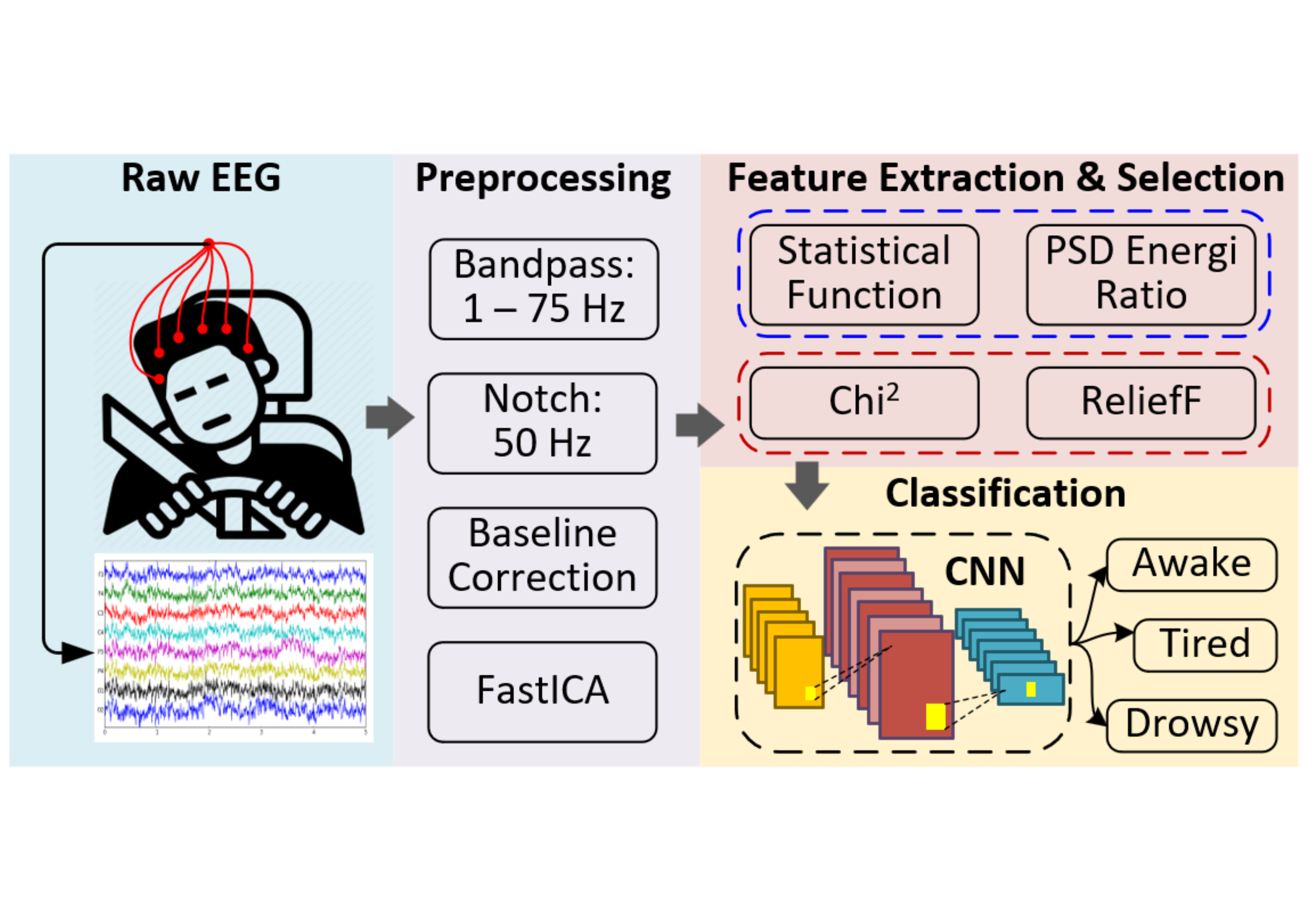
Driver fatigue is the primary factor contributing to traffic accidents globally. To address this challenge, the electroencephalogram (EEG) has been proven reliable for assessing sleepiness, fatigue, and performance levels. Although alertness monitoring through EEG analysis has shown progress, its use is affected by complicated methods of collecting data and labelling more than two classes. Based on previous research, the original form of EEG signals or power spectral density (PSD) has been extensively applied to detect driver fatigue. This method needs a large, deep neural network to produce valuable features, requiring significant computational training resources. More observations regarding feature extraction and classification models are needed to reduce computational cost and optimize accuracy values. Therefore, this research aimed to propose a PSD-based feature optimization on a lightweight convolutional neural network (CNN) model. Five types of statistical functions and four types of signal power ratios were applied, and the best features were selected based on ranking algorithms. The results showed that feature optimization using the Relief Feature (ReliefF) algorithm had the highest accuracy. The proposed lightweight CNN model obtained an average intra-subject accuracy of 71.01%, while the cross-subject accuracy was 69.07%.
How to Cite
Wiwit Suprihatiningsih, Dedik Romahadi, Aberham Genetu Feleke (2025). Electroencephalogram-Based Multi-Class Driver Fatigue Detection using Power Spectral Density and Lightweight Convolutional Neural Networks. Journal of Engineering and Technological Sciences, Vol. 57 No. 4 (2025): Vol. 57 No. 4 (2025): August , 445-457. https://doi.org/10.5614/j.eng.technol.sci.2025.57.4.2
Metrics
References
Alasmari, N., Alohali, M. A., Khalid, M., Almalki, N., Motwakel, A., Alsaid, M. I., Osman, A. E., & Alneil, A. A. (2023). Improved metaheuristics with deep learning based object detector for intelligent control in autonomous vehicles. Computers and Electrical Engineering, 108, 108718. https://doi.org/10.1016/J.COMPELECENG.2023.108718
Al-Qazzaz, N. K., Sabir, M. K., Md Ali, S. H., Ahmad, S. A., & Grammer, K. (2021). The role of spectral power ratio in characterizing emotional EEG for gender identification. Proceedings - 2020 IEEE EMBS Conference on Biomedical Engineering and Sciences, IECBES 2020, 334–338. https://doi.org/10.1109/IECBES48179.2021.9398737
Apicella, A., Arpaia, P., De Blasiis, P., Calce, A. Della, Fullin, A., Gargiulo, L., Maffei, L., Mancino, F., Moccaldi, N., Pollastro, A., & Vallefuoco, E. (2022). EEG-based system for Executive Function fatigue detection. 2022 IEEE International Workshop on Metrology for Extended Reality, Artificial Intelligence and Neural Engineering, MetroXRAINE 2022 - Proceedings, 656–660. https://doi.org/10.1109/METROXRAINE54828.2022.9967542
Chen, K., Chai, S., Xie, T., Liu, Q., & Ma, L. (2024). EEG spatial inter-channel connectivity analysis: A GCN-based dual stream approach to distinguish mental fatigue status. Artificial Intelligence in Medicine, 157, 102996. https://doi.org/10.1016/J.ARTMED.2024.102996
Chen, K., Li, Z., Ai, Q., Liu, Q., & Wang, L. (2021). An improved CNN model based on fused time-frequency features for mental fatigue detection in BCIs. IISA 2021 - 12th International Conference on Information, Intelligence, Systems and Applications. https://doi.org/10.1109/IISA52424.2021.9555518
Cicchino, J. B. (2017). Effectiveness of forward collision warning and autonomous emergency braking systems in reducing front-to-rear crash rates. Accident Analysis & Prevention, 99, 142–152. https://doi.org/10.1016/J.AAP.2016.11.009
Cui, J., Lan, Z., Liu, Y., Li, R., Li, F., Sourina, O., & Müller-Wittig, W. (2022). A compact and interpretable convolutional neural network for cross-subject driver drowsiness detection from single-channel EEG. Methods, 202, 173–184. https://doi.org/10.1016/J.YMETH.2021.04.017
Feng, X., Dai, S., & Guo, Z. (2025). Pseudo-label-assisted subdomain adaptation network with coordinate attention for EEG-based driver drowsiness detection. Biomedical Signal Processing and Control, 101, 107132. https://doi.org/10.1016/J.BSPC.2024.107132
Gupta, A., Agrawal, R. K., Kirar, J. S., Andreu-Perez, J., DIng, W. P., Lin, C. T., & Prasad, M. (2021). On the Utility of Power Spectral Techniques with Feature Selection Techniques for Effective Mental Task Classification in Noninvasive BCI. IEEE Transactions on Systems,
Man, and Cybernetics: Systems, 51(5), 3080–3092. https://doi.org/10.1109/TSMC.2019.2917599
Jantan, S., Ahmad, S. A., Soh, A. C., Ishak, A. J., & Adnan, R. N. E. R. (2022). A Multi-Model Analysis for Driving Fatigue Detection using EEG Signals. 7th IEEE-EMBS Conference on Biomedical Engineering and Sciences, IECBES 2022 - Proceedings, 183–188. https://doi.org/10.1109/IECBES54088.2022.10079534
Jiang, X., Bian, G. Bin, & Tian, Z. (2019). Removal of Artifacts from EEG Signals: A Review. Sensors (Basel, Switzerland), 19(5). https://doi.org/10.3390/S19050987
Kaur, P., & Sobti, R. (2018). Sensor Fusion Algorithm for Software Based Advanced Driver-Assistance Intelligent Systems. ICSCCC 2018 - 1st International Conference on Secure Cyber Computing and Communications, 457–460. https://doi.org/10.1109/ICSCCC.2018.8703269
Khatun, S., Mahajan, R., & Morshed, B. I. (2016). Comparative Study of Wavelet-Based Unsupervised Ocular Artifact Removal Techniques for Single-Channel EEG Data. IEEE Journal of Translational Engineering in Health and Medicine, 4, 2000108. https://doi.org/10.1109/JTEHM.2016.2544298
Li, R., Wang, L., & Sourina, O. (2022). Subject matching for cross-subject EEG-based recognition of driver states related to situation awareness. Methods, 202, 136–143. https://doi.org/10.1016/J.YMETH.2021.04.009
Liu, Q., Zhou, W., Zhang, Y., & Fei, X. (2021). Multi-target Detection based on Multi-sensor Redundancy and Dynamic Weight Distribution for Driverless Cars. 2021 IEEE 3rd International Conference on Communications, Information System and Computer Engineering, CISCE 2021, 229–234. https://doi.org/10.1109/CISCE52179.2021.9446002
Liu, S., Wang, J., Li, S., & Cai, L. (2023). Epileptic Seizure Detection and Prediction in EEGs Using Power Spectra Density Parameterization. IEEE Transactions on Neural Systems and Rehabilitation Engineering, 31, 3884–3894. https://doi.org/10.1109/TNSRE.2023.3317093
Nandavar, S., Kaye, S. A., Senserrick, T., & Oviedo-Trespalacios, O. (2023). Exploring the factors influencing acquisition and learning experiences of cars fitted with advanced driver assistance systems (ADAS). Transportation Research Part F: Traffic Psychology and Behaviour, 94, 341–352. https://doi.org/10.1016/J.TRF.2023.02.006
Paulo, J. R., Pires, G., & Nunes, U. J. (2021). Cross-Subject Zero Calibration Driver’s Drowsiness Detection: Exploring Spatiotemporal Image Encoding of EEG Signals for Convolutional Neural Network Classification. IEEE Transactions on Neural Systems and Rehabilitation Engineering: A Publication of the IEEE Engineering in Medicine and Biology Society, 29, 905–915. https://doi.org/10.1109/TNSRE.2021.3079505
Phan, A. C., Trieu, T. N., & Phan, T. C. (2023). Driver drowsiness detection and smart alerting using deep learning and IoT. Internet of Things, 22, 100705. https://doi.org/10.1016/J.IOT.2023.100705
Pion-Tonachini, L., Kreutz-Delgado, K., & Makeig, S. (2019). ICLabel: An automated electroencephalographic independent component classifier, dataset, and website. NeuroImage, 198, 181. https://doi.org/10.1016/J.NEUROIMAGE.2019.05.026
Pranoto, H., Wahab, A., Adriansyah, A., & Feriyanto, D. (2023). Internet of thing development for fatigue analyzer device control for truck and bus engine. AIP Conference Proceedings, 2671(1). https://doi.org/10.1063/5.0116314
Rahman, W., Ruman, M. R., Roushan Jahan, K., Roni, M. J., Foyjur Rahman, M., & Hasnat Shahriar, M. A. (2020). Vehicle
Speed Control and Accident Avoidance System Based on Arm M4 Microprocessor. 2020 International Conference on Industry 4.0 Technology, I4Tech 2020, 154–158. https://doi.org/10.1109/I4TECH48345.2020.9102693
Raveena, C. S., Sravya, R. S., Kumar, R. V., & Chavan, A. (2020). Sensor Fusion Module Using IMU and GPS Sensors for Autonomous Car. 2020 IEEE International Conference for Innovation in Technology, INOCON 2020. https://doi.org/10.1109/INOCON50539.2020.9298316
Romahadi, D., Feleke, A. G., & Youlia, R. P. (2024). Evaluation of Laplacian Spatial Filter Implementation in Detecting Driver Vigilance Using Linear Classifier. International Journal of Technology, 15(6), 1712–1729. https://doi.org/10.14716/IJTECH.V15I6.7166
Shen, M., Zou, B., Li, X., Zheng, Y., Li, L., & Zhang, L. (2021). Multi-source signal alignment and efficient multi-dimensional feature classification in the application of EEG-based subject-independent drowsiness detection. Biomedical Signal Processing and Control, 70, 103023. https://doi.org/10.1016/J.BSPC.2021.103023
Song, R., Horridge, P., Pemberton, S., Wetherall, J., Maskell, S., & Ralph, J. (2019). A Multi-Sensor Simulation Environment for Autonomous Cars. FUSION 2019 - 22nd International Conference on Information Fusion. https://doi.org/10.23919/FUSION43075.2019.9011278
Spicer, R., Vahabaghaie, A., Bahouth, G., Drees, L., Martinez von Bülow, R., & Baur, P. (2018). Field effectiveness evaluation of advanced driver assistance systems. Traffic Injury Prevention, 19(sup2), S91–S95. https://doi.org/10.1080/15389588.2018.1527030
Statista. (2023). Number of fatalities in traffic accidents in China 2009-2019. https://www.statista.com/statistics/276260/number-of-fatalities-in-traffic-accidents-in-china/
Teng, T., & Bi, L. (2017). A novel EEG-based detection method of emergency situations for assistive vehicles. 7th International Conference on Information Science and Technology, ICIST 2017 - Proceedings, 335–339. https://doi.org/10.1109/ICIST.2017.7926780
Wang, C., Liu, L., Zhuo, W., & Xie, Y. (2024). An Epileptic EEG Detection Method Based on Data Augmentation and Lightweight Neural Network. IEEE Journal of Translational Engineering in Health and Medicine, 12, 22–31. https://doi.org/10.1109/JTEHM.2023.3308196
WHO. (2022). Global status Report on Road Safety. https://www.afro.who.int/publications/global-status-report-road-safety-time-action
Xia, Y., Geng, M., Chen, Y., Sun, S., Liao, C., Zhu, Z., Li, Z., Ochieng, W. Y., Angeloudis, P., Elhajj, M., Zhang, L., Zeng, Z., Zhang, B., Gao, Z., &
Chen, X. (Michael). (2023). Understanding common human driving semantics for autonomous vehicles. Patterns, 100730. https://doi.org/10.1016/J.PATTER.2023.100730
Xu, Q., Fu, R., Wu, F., Wang, B., & Chen, T. (2023). A speed limit advisory system provided by in-vehicle HMI considering auditory perception characteristics for connected environment. Transportation Research Part F: Traffic Psychology and Behaviour, 92, 353–368. https://doi.org/10.1016/J.TRF.2022.12.004
Yang, L., Chao, S., Zhang, Q., Ni, P., & Liu, D. (2021). A Grouped Dynamic EEG Channel Selection Method for Emotion Recognition. Proceedings - 2021 IEEE International Conference on Bioinformatics and Biomedicine, BIBM 2021, 3689–3696. https://doi.org/10.1109/BIBM52615.2021.9669889
Yang, Y., Gao, Z., Li, Y., Cai, Q., Marwan, N., & Kurths, J. (2021). A Complex Network-Based Broad Learning System for Detecting Driver Fatigue from EEG Signals. IEEE Transactions on Systems, Man, and Cybernetics: Systems, 51(9), 5800–5808. https://doi.org/10.1109/TSMC.2019.2956022
Yue, L., Abdel-Aty, M., Wu, Y., & Wang, L. (2018). Assessment of the safety benefits of vehicles’ advanced driver assistance, connectivity and low level automation systems. Accident Analysis & Prevention, 117, 55–64. https://doi.org/10.1016/J.AAP.2018.04.002
Yue, M., Geng, X., Wang, L., & Zhang, X. (2022). An artifact removing method fusing FastICA and CNN for EEG signal. Proceedings - 2022 International Conference on Intelligent Transportation, Big Data and Smart City, ICITBS 2022, 22–25. https://doi.org/10.1109/ICITBS55627.2022.00014
Zhang, Y., Guo, H., Zhou, Y., Xu, C., & Liao, Y. (2023). Recognising drivers’ mental fatigue based on EEG multi-dimensional feature selection and fusion. Biomedical Signal Processing and Control, 79, 104237. https://doi.org/10.1016/J.BSPC.2022.104237
Zheng, W. L., & Lu, B. L. (2017). A multimodal approach to estimating vigilance using EEG and forehead EOG. Journal of Neural Engineering, 14(2), 026017. https://doi.org/10.1088/1741-2552/aa5a98
License
Copyright (c) 2025 by Authors

This work is licensed under a Creative Commons Attribution 4.0 International License.
Downloads
Date Log
- Submitted
- July 6, 2024
- Accepted
- May 26, 2025
- Published
- July 25, 2025
Keywords
- convolutional neural networks
- electroencephalogram
- fatigue detection
- multi-class classification
- power spectral density


