
Classifying Rockburst Events and Intensity in Underground Mines using Grey Wolf Optimization–Support Vector Machine and Extreme Gradient Boosting
Abstract
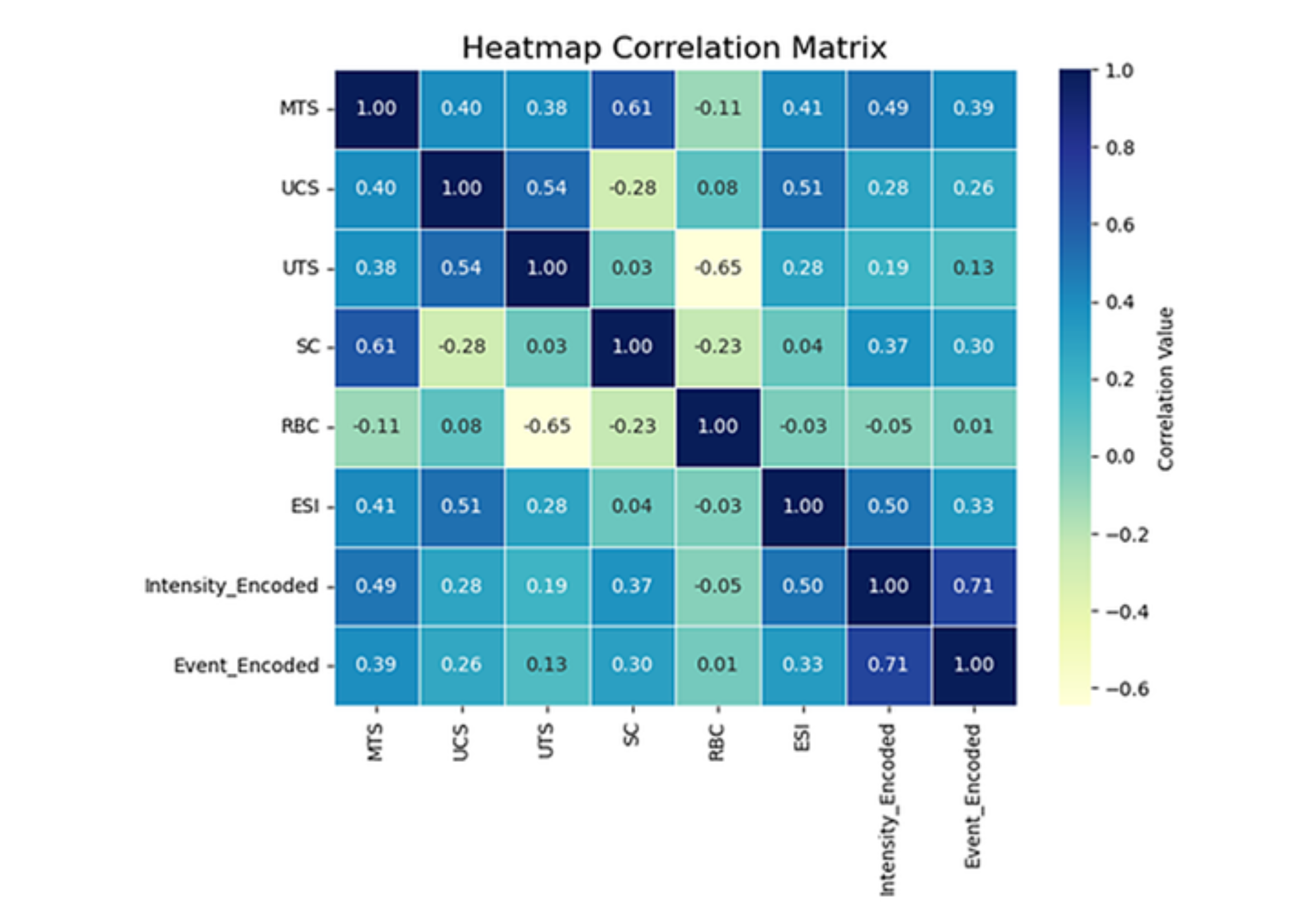
Rockbursts are destructive accidents that often occur in underground mines. With the advancement of technology, machine learning has emerged as an alternative solution that can be used for rockburst mitigation. In this research, we classify rockburst events and their intensities in underground mines using two machine learning models: grey wolf optimization–support vector machine (GWO–SVM) and extreme gradient boosting (XGBoost). Rockburst events are classified into two categories: Existent and None. Meanwhile, the intensities are classified into three categories: weak, moderate, and strong. The implementation used 476 cases of rockbursts with six variables: maximum tangential stress, uniaxial compressive strength, uniaxial tensile strength, stress coefficient, rock brittleness coefficient, and elastic strain index. Both models can better predict the “Existent” rockburst class with a “Weak” intensity compared with the other intensity classes. The performances of the models are evaluated using different proportions of training data, ranging from 50% to 90%. Both models have the same performance for rockburst event classification with 97.53% accuracy, 0.9444 precision, 0.9846 recall, and 0.9628 F1-score. Meanwhile, for intensity classification, XGBoost outperforms GWO-SVM with its 88.24% accuracy, 0.8413 precision, 0.9137 recall, and 0.8651 F1-score.
How to Cite
Adhitya Dwi Nugraha, Ridho Kresna Wattimena, Bevina Desjwiandra Handari, Gatot Hertono (2025). Classifying Rockburst Events and Intensity in Underground Mines using Grey Wolf Optimization–Support Vector Machine and Extreme Gradient Boosting. Journal of Engineering and Technological Sciences, Vol. 57 No. 6 (2025): Vol. 57 No. 6 (2025): December, 817-830. https://doi.org/10.5614/j.eng.technol.sci.2025.57.6.6
Metrics
References
Adach-Pawelus, K., & Pawelus, D. (2021). Application of hydraulic backfill for rockburst prevention in the mining field with remnant in the Polish underground copper mines. Energies, 14(13), 3869. https://doi.org/10.3390/en14133869
He, M., Cheng, T., Qiao, Y., & Li, H. (2023). A review of rockburst: Experiments, theories, and simulations. Journal of Rock Mechanics and Geotechnical Engineering, 15(5), 1312–1353. https://doi.org/10.1016/j.jrmge.2022.07.014
Hertono, G. F., Wattimena, R. K., Mendrofa, G. A., & Handari, B. D. (2024). Classifying coal mine pillar stability areas with multiclass SVM on ensemble learning models. Journal of Engineering and Technological Sciences, 56(1), 95–109. https://doi.org/10.5614/j.eng.technol.sci.2024.56.1.8
James, G., Witten, D., Hastie, T., & Tibshirani, R. (2013). An introduction to statistical learning: With applications in R (1st ed.). Springer.
Li, Y., Wang, C., & Liu, Y. (2023). Classification of coal bursting liability based on support vector machine and imbalance sample set. Minerals, 13(1), 15. https://doi.org/10.3390/min13010015
Lippmann-Pipke, J., Erzinger, J., Zimmer, M., Kujawa, C., Boettcher, M., van Heerden, E., Bester, A., Moller, H., Stroncik, N. A., & Reches, Z. (2011). Geogas transport in fractured hard rock: Correlations with mining seismicity at 3.54 km depth, TauTona gold mine, South Africa. Applied Geochemistry, 26(12), 2134–2146. https://doi.org/10.1016/j.apgeochem.2011.07.011
Mine Safety and Health Administration. (2023). Coal fatalities for 1900 through 2022. United States Department of Labor. https://arlweb.msha.gov/stats/centurystats/coalstats.asp
Mirjalili, S., Mirjalili, S. M., & Lewis, A. (2014). Grey wolf optimizer. Advances in Engineering Software, 69, 46–61. https://doi.org/10.1016/j.advengsoft.2013.12.007
Our World in Data. (2023, March 22). Coal consumption. https://ourworldindata.org/grapher/coal-consumption-by-country-terawatt-hours-twh
Singh, R. P., Mandal, P. K., & Pal, S. K. (2010). Analysis of stress distribution in underground coal mine at different depths. International Journal of Rock Mechanics and Mining Sciences, 47(6), 974–989.
Ullah, B., Kamran, M., & Rui, Y. (2022). Predictive modeling of short-term rockburst for the stability of subsurface structures using machine learning approaches: t-SNE, k-means clustering and XGBoost. Mathematics, 10(3), 449. https://doi.org/10.3390/math10030449
Wang, D. C., Song, D., Zhang, C., Liu, L., Zhou, Z., & Huang, X. (2019). Research on the classification model of coal’s bursting liability based on database with large samples. Arabian Journal of Geosciences, 12(13), 411. https://doi.org/10.1007/s12517-019-4562-2
Wang, J., Ma, H., & Yan, X. (2022). Rockburst intensity classification prediction based on multi-model ensemble learning algorithms. Mathematics, 11(4), 838. https://doi.org/10.3390/math11040838
Wojtecki, Ł., Iwaszenko, S., Apel, D. B., & Cichy, T. (2021). An attempt to use machine learning algorithms to estimate the rockburst hazard in underground excavations of hard coal mine. Energies, 14(21), 6928. https://doi.org/10.3390/en14216928
Xue, Y., Bai, C., Qiu, D., Kong, F., & Li, Z. (2020). Predicting rockburst with database using particle swarm optimization and extreme learning machine. Tunnelling and Underground Space Technology, 98, 103287. https://doi.org/10.1016/j.tust.2020.103287
Xue, Y., Li, Z., Li, S., Qiu, D., Tao, Y., Wang, L., Yang, W., & Zhang, K. (2019). Prediction of rockburst in underground caverns based on rough set and extensible comprehensive evaluation. Bulletin of Engineering Geology and the Environment, 78(1), 417–429. https://doi.org/10.1007/s10064-017-1117-1
Zheng, X., Lai, W., Zhang, L., & Xue, S. (2023). Quantitative evaluation of the indexes contribution to coal and gas outburst prediction based on machine learning. Fuel, 338, 127389. https://doi.org/10.1016/j.fuel.2023.127389
Zhou, J., Li, X., & Shi, X. (2012). Long-term prediction model of rockburst in underground openings using heuristic algorithms and support vector machines. Safety Science, 50(4), 629–644. https://doi.org/10.1016/j.ssci.2011.08.065
License
Copyright (c) 2025 by Authors

This work is licensed under a Creative Commons Attribution 4.0 International License.
Downloads
Date Log
- Submitted
- October 27, 2024
- Accepted
- October 3, 2025
- Published
- November 5, 2025
Keywords
- extreme gradient boosting
- grey wolf optimization
- rockburst
- support vector machine
- underground mines


