
Decision Tree Machine Learning Approach for the Performance Prediction of Asphalt Mixes Modified with Waste Tyre Metal Fibre
Abstract
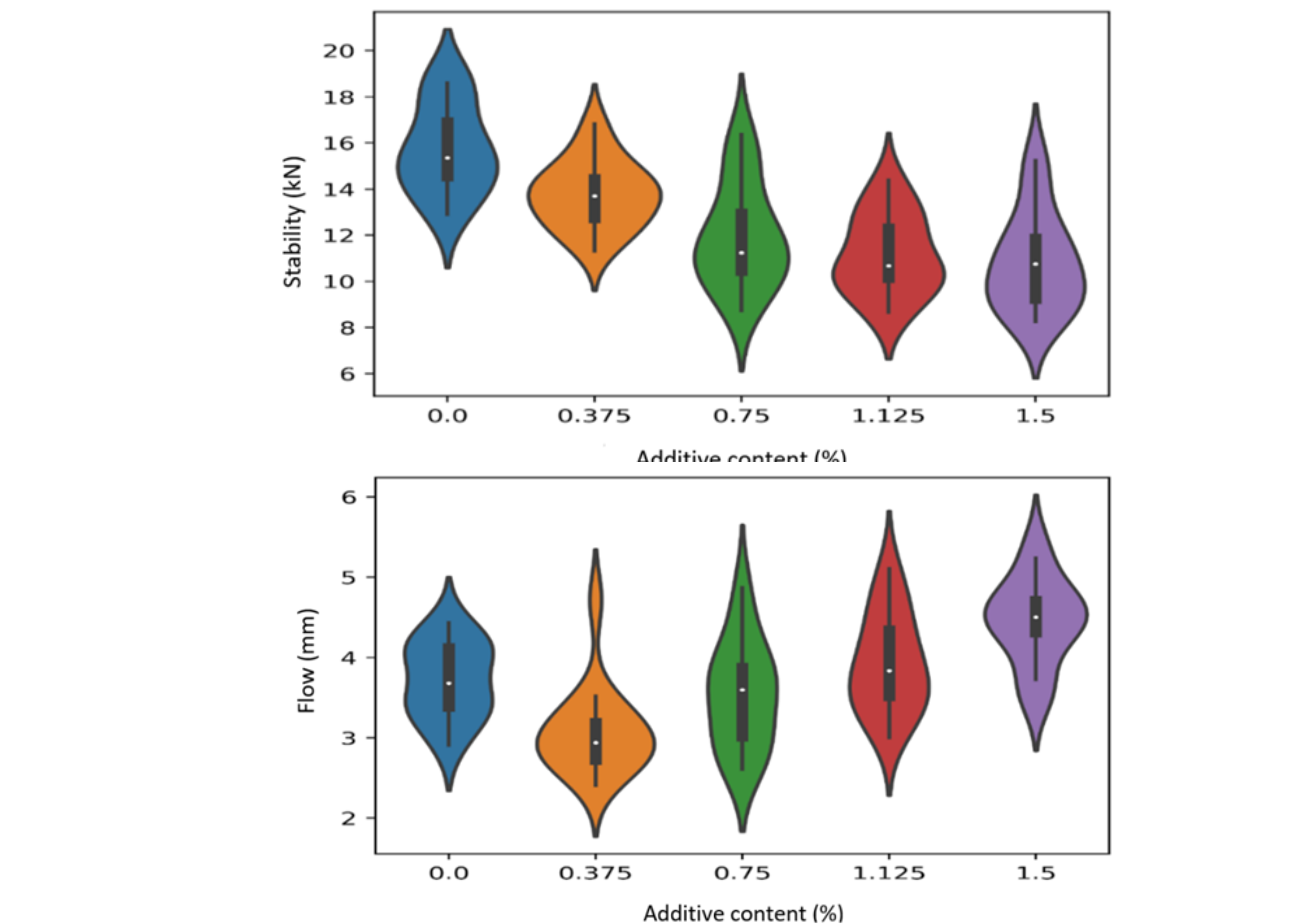
The Marshall stability and flow of asphalt mixes are key performance indicators of their durability and suitability for use in the pavement industry. Achieving the optimal bitumen content and volumetric properties through mix design is critical and depends on the characteristics of the materials used. Recycling waste materials in asphalt is also vital for promoting environmental sustainability. The development of machine learning models plays a crucial role in predicting the performance of such asphalt mixes. This study explores the use of a machine learning approach to predict the performance of waste tyre metal fibre-modified asphalt mixes. A dataset consisting of 75 experimental data points from various mix proportions was compiled to train and test the model. The study used 60/70 penetration grade bitumen and five modified mixes with waste tyre metal fibre (WTMF) contents of 0%, 0.375%, 0.75%, 1.125%, and 1.5%. Decision tree regression was effectively employed to establish the relationship between the input variables. The predictive ability of the model was assessed using R-squared, adjusted R-squared, and mean absolute error. The input parameters included fibre content, bitumen content, aggregate percentage, and porosity. Analysis of the input variables showed that stability decreased while flow increased with higher fibre and bitumen contents. With an R² of 0.901 for training and 0.937 for testing phases, decision tree regression proved to be an effective model for predicting the performance of these modified asphalt mixes.
How to Cite
Arsalaan Khan, Muslich Hartadi Sutanto, Nasir Khan, Abdullah O. Baarimah, Mohamed Mubarak Abdul Wahab, Muhammad Imran Khan, Madhusudhan Bangalore Ramu, Rawid Khan (2025). Decision Tree Machine Learning Approach for the Performance Prediction of Asphalt Mixes Modified with Waste Tyre Metal Fibre. Journal of Engineering and Technological Sciences, Vol. 57 No. 3 (2025): Vol. 57 No. 3 (2025): June, 303-314. https://doi.org/10.5614/j.eng.technol.sci.2025.57.3.2
Metrics
References
Abdualla, H., Ceylan, H., Kim, S., Mina, M., Gopalakrishnan, K., Sassani, A., Taylor, P. C., & Cetin, K. S. (2017). Configuration of Electrodes for Electrically Conductive Concrete Heated Pavement Systems Airfield and Highway Pavements 2017. https://ascelibrary.org/doi/abs/10.1061/9780784480946.001
Awan, H. H., Hussain, A., Javed, M. F., Qiu, Y., Alrowais, R., Mohamed, A. M., Fathi, D., & Alzahrani, A. M. (2022). Predicting Marshall Flow and Marshall Stability of Asphalt Pavements Using Multi Expression Programming. Buildings, 12(3), 314. https://doi.org/10.3390/buildings12030314
Cao, L., Zhou, J., Zhou, T., Dong, Z., & Tian, Z. (2022). Utilization of iron tailings as aggregates in paving asphalt mixture: A sustainable and eco-friendly solution for mining waste. Journal of Cleaner Production, 375, 134126. https://doi.org/10.1016/j.jclepro.2022.134126
Chen, F., & Balieu, R. (2020). A state-of-the-art review of intrinsic and enhanced electrical properties of asphalt materials: Theories, analyses and applications. Materials & Design, 195, 109067. https://doi.org/10.1016/j.matdes.2020.109067
Chen, Z., Liu, R., Hao, P., Li, G., & Su, J. (2019). Developments of Conductive Materials and Characteristics on Asphalt Concrete: A Review. ASTM Journal of Testing and Evaluation, 48(3), 2144–2161. https://doi.org/10.1520/JTE20190179
Dong, Z., Ullah, S., Zhou, T., Yang, C., Luan, H., & Khan, R. (2022). Self-Monitoring of Damage Evolution in Asphalt Concrete Based on Electrical Resistance Change Method. ASTM Journal of Testing and Evaluation, 50(5), 2698–2717. https://doi.org/10.1520/JTE20220037
Fakhri, M., Bahmai, B. B., Javadi, S., & Sharafi, M. (2020). An evaluation of the mechanical and self-healing properties of warm mix asphalt containing scrap metal additives. Journal of Cleaner Production, 253, 119963. https://doi.org/10.1016/j.jclepro.2020.119963
González, A., Norambuena-Contreras, J., Storey, L., & Schlangen, E. (2018). Self-healing properties of recycled asphalt mixtures containing metal waste: An approach through microwave radiation heating. Journal of Environmental Management, 214, 242–251. https://doi.org/10.1016/j.jenvman.2018.03.001
Gürer, C., Düşmez, C., & Boğa, A. R. (2022). Effects of different aggregate and conductive components on the electrically conductive asphalt concrete's properties. International Journal of Pavement Engineering, 24(1), 2068547. https://doi.org/10.1080/10298436.2022.2068547
Gürer, C., Fidan, U., & Korkmaz, B. E. (2022). Investigation of using conductive asphalt concrete with carbon fiber additives in intelligent anti-icing systems. International Journal of Pavement Engineering, 24(1), 2077941. https://doi.org/10.1080/10298436.2022.2077941
Hasan, R., Ali, A., Decarlo, C., Elshaer, M., & Mehta, Y. (2021). Laboratory Evaluation of Electrically Conductive Asphalt Mixtures for Snow and Ice Removal Applications. Transportation Research Record, 2675(8), 48–62. https://doi.org/10.1177/0361198121995826
Karbassi, A., Mohebi, B., Rezaee, S., & Lestuzzi, P. (2014). Damage prediction for regular reinforced concrete buildings using the decision tree algorithm. Computers & Structures, 130, 46–56. https://doi.org/10.1016/j.compstruc.2013.10.006
Karimi, M. M., Amani, S., Jahanbakhsh, H., Jahangiri, B., & Alavi, A. H. (2021). Induced heating-healing of conductive asphalt concrete as a sustainable repairing technique: A review. Cleaner Engineering and Technology, 4, 100188. https://doi.org/10.1016/j.clet.2021.100188
Karimi, M. M., Darabi, M. K., Jahanbakhsh, H., Jahangiri, B., & Rushing, J. F. (2020). Effect of steel wool fibers on mechanical and induction heating response of conductive asphalt concrete. International Journal of Pavement Engineering, 21(14), 1755–1768. https://doi.org/10.1080/10298436.2019.1567918
Khan, M. I., Khan, N., Hashmi, S. R. Z., Yazid, M. R. M., Yusoff, N. I. M., Azfar, R. W., Ali, M., & Fediuk, R. (2023). Prediction of compressive strength of cementitious grouts for semi-flexible pavement application using machine learning approach. Case Studies in Construction Materials, 19, e02370. https://doi.org/10.1016/j.cscm.2023.e02370
Khuntia, S., Das, A. K., Mohanty, M., & Panda, M. (2014). Prediction of Marshall Parameters of Modified Bituminous Mixtures Using Artificial Intelligence Techniques. International Journal of Transportation Science and Technology, 3(3), 211-227. https://doi.org/https://doi.org/10.1260/2046-0430.3.3.211
Le, J.-L., Marasteanu, M., Matias De Oliveira, J., Calhoon, T., Turos, M., & Zanko, L. (2022). Investigations of electrical conductivity and damage healing of graphite nano-platelet (GNP)-taconite modified asphalt materials. Road Materials and Pavement Design, 23(sup1), 196–207. https://doi.org/10.1080/14680629.2022.2050784
Leon, L. P., & Gay, D. (2019). Gene expression programming for evaluation of aggregate angularity effects on permanent deformation of asphalt mixtures. Construction and Building Materials, 211, 470-478. https://doi.org/https://doi.org/10.1016/j.conbuildmat.2019.03.225
Li, Z., Guo, T., Chen, Y., Lu, Y., Niu, X., Yang, X., & Jin, L. (2022). Study on Road Performance and Electrothermal Performance of Poured Conductive Asphalt Concrete. Advances in Materials Science and Engineering, 2022, 2462126. https://doi.org/10.1155/2022/2462126
Liu, L., Zhang, X., Xu, L., Zhang, H., & Liu, Z. (2021). Investigation on the piezoresistive response of carbon fiber-graphite modified asphalt mixtures. Construction and Building Materials, 301, 124140. https://doi.org/10.1016/j.conbuildmat.2021.124140
Liu, Y., Liao, H., Fang, Z., & Huang, X. (2021). The Thermoelectric Effect and High-Temperature Characteristics of Carbon Nanotubes Modified Asphalt Concrete 21st COTA International Conference of Transportation Professionals (CICTP 2021), Xi’an, China. https://ascelibrary.org/doi/abs/10.1061/9780784483565.081
Messaoud, M., Glaoui, B., & Abdelkhalek, O. (2022). The Effect of Adding Steel Fibers and Graphite on Mechanical and Electrical Behaviors of Asphalt Concrete [Research Articles]. Civil Engineering Journal, 8(2), 348–361. https://doi.org/10.28991/CEJ-2022-08-02-012
Nitsche, P., Stütz, R., Kammer, M., & Maurer, P. (2014). Comparison of Machine Learning Methods for Evaluating Pavement Roughness Based on Vehicle Response. Journal of Computing in Civil Engineering, 28(4), 04014015. https://doi.org/https://doi.org/10.1061/(ASCE)CP.1943-5487.0000285
Notani, M. A., Arabzadeh, A., Ceylan, H., Kim, S., & Gopalakrishnan, K. (2019). Effect of Carbon-Fiber Properties on Volumetrics and Ohmic Heating of Electrically Conductive Asphalt Concrete. Journal of Materials in Civil Engineering, 31(9), 04019200. https://doi.org/10.1061/(ASCE)MT.1943-5533.0002868
Nyirandayisabye, R., Li, H., Dong, Q., Hakuzweyezu, T., & Nkinahamira, F. (2022). Automatic pavement damage predictions using various machine learning algorithms: Evaluation and comparison. Results in Engineering, 16, 100657. https://doi.org/https://doi.org/10.1016/j.rineng.2022.100657
Pal, A., Ahmed, K. S., Hossain, F. Z., & Alam, M. S. (2023). Machine learning models for predicting compressive strength of fiber-reinforced concrete containing waste rubber and recycled aggregate. Journal of Cleaner Production, 423, 138673. https://doi.org/https://doi.org/10.1016/j.jclepro.2023.138673
Rew, Y., Baranikumar, A., Tamashausky, A. V., El-Tawil, S., & Park, P. (2017). Electrical and mechanical properties of asphaltic composites containing carbon based fillers. Construction and Building Materials, 135, 394–404. https://doi.org/10.1016/j.conbuildmat.2016.12.221
Rizvi, H. R., Khattak, M. J., Madani, M., & Khattab, A. (2016). Piezoresistive response of conductive Hot Mix Asphalt mixtures modified with carbon nanofibers. Construction and Building Materials, 106, 618–631. https://doi.org/10.1016/j.conbuildmat.2015.12.187
Ruidong, W., Yu, S., Juanhong, L., Linian, C., Guangtian, Z., & Yueyue, Z. (2021). Effect of Iron Tailings and Slag Powders on Workability and Mechanical Properties of Concrete [Original Research]. Frontiers in Materials, 8, 723119. https://doi.org/10.3389/fmats.2021.723119
Ruiz-Riancho, N., Saadoon, T., Garcia, A., Grossegger, D., & Hudson-Griffiths, R. (2021). Optimisation of self-healing properties for asphalts containing encapsulated oil to mitigate reflective cracking and maximize skid and rutting resistance. Construction and Building Materials, 300, 123879. https://doi.org/10.1016/j.conbuildmat.2021.123879
Schuster, L., Staub de Melo, J. V., & Villena Del Carpio, J. A. (2023). Effects of the associated incorporation of steel wool and carbon nanotube on the healing capacity and mechanical performance of an asphalt mixture. International Journal of Fatigue, 168, 107440. https://doi.org/10.1016/j.ijfatigue.2022.107440
Shishegaran, A., Daneshpajoh, F., Taghavizade, H., & Mirvalad, S. (2020). Developing conductive concrete containing wire rope and steel powder wastes for route deicing. Construction and Building Materials, 232, 117184. https://doi.org/10.1016/j.conbuildmat.2019.117184
Standard Specification for Road Works - Section 4: Flexible Pavement. (2008).
Ullah, S., Wan, S., Yang, C., Ma, X., & Dong, Z. (2022). Self-stress and deformation sensing of electrically conductive asphalt concrete incorporating carbon fiber and iron tailings. Structural Control and Health Monitoring, 29(9), e2998. https://doi.org/10.1002/stc.2998
Ullah, S., Yang, C., Cao, L., Wang, P., Chai, Q., Li, Y., Wang, L., Dong, Z., Lushinga, N., & Zhang, B. (2021). Material design and performance improvement of conductive asphalt concrete incorporating carbon fiber and iron tailings. Construction and Building Materials, 303, 124446. https://doi.org/10.1016/j.conbuildmat.2021.124446
Upadhya, A., Thakur, M. S., Sharma, N., & Sihag, P. (2022). Assessment of Soft Computing-Based Techniques for the Prediction of Marshall Stability of Asphalt Concrete Reinforced with Glass Fiber. International Journal of Pavement Research and Technology, 15(6), 1366-1385. https://doi.org/https://doi.org/10.1007/s42947-021-00094-2
Wang, H., Yang, J., Liao, H., & Chen, X. (2016). Electrical and mechanical properties of asphalt concrete containing conductive fibers and fillers. Construction and Building Materials, 122, 184–190. https://doi.org/10.1016/j.conbuildmat.2016.06.063
Wang, L., Shen, A., Wang, W., Yang, J., He, Z., & Zhijie, T. (2022). Graphene/nickel/carbon fiber composite conductive asphalt: Optimization, electrical properties and heating performance. Case Studies in Construction Materials, 17, e01402. https://doi.org/10.1016/j.cscm.2022.e01402
Wang, Y.-Y., Tan, Y.-Q., Liu, K., & Xu, H.-N. (2022). Preparation and electrical properties of conductive asphalt concretes containing graphene and carbon fibers. Construction and Building Materials, 318, 125875. https://doi.org/10.1016/j.conbuildmat.2021.125875
Wu, S., Haji, A., & Adkins, I. (2022). State of art review on the incorporation of fibres in asphalt pavements. Road Materials and Pavement Design, 1–36. https://doi.org/10.1080/14680629.2022.2092022
Yang, C., Wu, S., Xie, J., Amirkhanian, S., Liu, Q., Zhang, J., Xiao, Y., Zhao, Z., Xu, H., Li, N., Wang, F., & Zhang, L. (2022). Enhanced induction heating and self-healing performance of recycled asphalt mixtures by incorporating steel slag. Journal of Cleaner Production, 366, 132999. https://doi.org/10.1016/j.jclepro.2022.132999
Yang, D., Karimi, H. R., & Aliha, M. R. M. (2021). Comparison of Testing Method Effects on Cracking Resistance of Asphalt Concrete Mixtures. Applied Sciences, 11(11), 5094. https://doi.org/10.3390/app11115094
Yang, H., Ouyang, J., Cao, P., Chen, W., Han, B., & Ou, J. (2022). Effect of Steel Wool and Graphite on the Electrical Conductivity and Pavement Properties of Asphalt Mixture. Journal of Materials in Civil Engineering, 34(3), 04021466. https://doi.org/10.1061/(ASCE)MT.1943-5533.0004105
Yousafzai, A. K., Sutanto, M. H., Khan, M. I., Yaro, N. S. A., Baarimah, A. O., Khan, N., Memon, A. M., & Sani Abubakar, A. (2024). Systematic Literature Review and Scientometric Analysis on the Advancements in Electrically Conductive Asphalt Technology for Smart and Sustainable Pavements. Transportation Research Record, 0(0), 03611981241260703. https://doi.org/10.1177/03611981241260703
Yousafzai, A. K., Sutanto, M. H., Khan, M. I., Yaro, N. S. A., Memon, A. M., Khan, M. T., & Arshad, M. A. (2024). A review of conductive additives for enhancing the electrical properties of self-sensing asphalt. IOP Conference Series: Earth and Environmental Science, 1347(1), 012043. https://doi.org/10.1088/1755-1315/1347/1/012043
Yousafzai, A. K., Sutanto, M. H., Khan, N., Wahab, M. M. A., Khan, M. I., Abubakar, A. S., & Al-Nawasir, R. (2024). Performance Prediction of Waste Tire Metal Fiber-Modified Asphalt Mixes Using a Decision Tree Machine Learning Technique. Journal of Hunan University Natural Sciences, 51(7), 29-43. https://doi.org/10.55463/issn.1674-2974.51.7.3
Yousif, R. A., Tayh, S. A., Al-Saadi, I. F., & Jasim, A. F. (2022). Physical and Rheological Properties of Asphalt Binder Modified with Recycled Fibers. Advances in Civil Engineering, 2022, 1223467. https://doi.org/10.1155/2022/1223467
Zadri, Z., Glaoui, B., & Abdelkhalek, O. (2022). Enhancement of Electrical and Mechanical Properties of Modified Asphalt Concrete with Graphite Powder [Research Articles]. Civil Engineering Journal, 8(1). https://www.civilejournal.org/index.php/cej/article/view/2880
Zhao, Y., & Zhang, Y. (2008). Comparison of decision tree methods for finding active objects. Advances in Space Research, 41(12), 1955-1959. https://doi.org/https://doi.org/10.1016/j.asr.2007.07.020
License
Copyright (c) 2025 by Authors

This work is licensed under a Creative Commons Attribution 4.0 International License.
Downloads
Date Log
- Submitted
- April 15, 2024
- Accepted
- February 10, 2025
- Published
- March 27, 2025
Keywords
- asphalt mixes
- decision tree
- flow
- marshall stability
- metal fibre


