
The Effect of Chain Tacticity on the Thermal Conductivity of Isotactic and Syndiotactic Polystyrene
Abstract
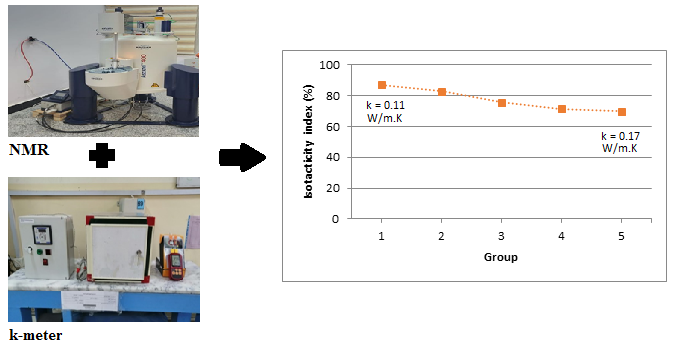
This study looks into the influence of tacticity on the heat conduction through isotactic and syndiotactic polystyrene. The experimental work includes the collection of five different batches of polystyrene pellets with different tacticity. The molecular weight, isotacticity index and coefficient of thermal conductance were measured using gel permeation chromatography (GPC), nuclear magnetic resonance (NMR) and thermal conductivity apparatus, respectively. The results have indicated that there are relationships between these parameters for certain conditions. The obtained data show that isotacticity index enhanced by increasing the molecular weight of polystyrene. Subsequently, the isotacticity index affected the value of thermal conductivity of polystyrene. It was observed that the decrease of isotacticity in the syndiotactic polystyrene leads to reduce its thermal conductivity by 15-20%. But, the thermal conductivity of syndiotactic polystyrene is still higher than that of isotactic mode by 30-40% in average. The NMR analysis shows that the presence of random phenyl groups in the polymer decreases its isotacticity
How to Cite
Dalmn Y. Taha, Israa Z. Ahmed, Tawfeeq Mohammed (2025). The Effect of Chain Tacticity on the Thermal Conductivity of Isotactic and Syndiotactic Polystyrene. Journal of Engineering and Technological Sciences, Vol. 57 No. 1 (2025): Vol. 57 No. 1 (2025): February, 93-104. https://doi.org/10.5614/j.eng.technol.sci.2025.57.1.7
Metrics
References
Allcock, H. R., Lampe, F. W., & Mark, J. E. (2003). Contemporary polymer Chemistry. Prentice Hall.
Alshaiban, A. (2011). Propylene polymerization using 4th generation Ziegler-Natta catalysts: Polymerization kinetics and polymer microstructural investigation [PhD dissertation, University of Waterloo]. https://dspacemainprd01.lib.uwaterloo.ca/server/api/core/bitstreams/dbd84190-746a-430a-8c90-bff819302c3d/content
Anh, L. D. H., & Pásztory, Z. (2021). An overview of factors influencing thermal conductivity of building insulation materials. Journal of Building Engineering, 44, 102604. https://doi.org/10.1016/j.jobe.2021.102604
Annunziata, L., Monasse, B., Rizzo, P., Guerra, G., Duc, M., & Carpentier, J. (2013). On the crystallization behavior of syndiotactic-b-atactic polystyrene stereodiblock copolymers, atactic/syndiotactic polystyrene blends, and aPS/sPS blends modified with sPS-b-aPS. Materials Chemistry and Physics, 141(2–3), 891–902. https://doi.org/10.1016/j.matchemphys.2013.06.020
Brandrup, J., Immergut, E., & Grulke, E. (2003). Polymer handbook (4th ed.). Wiley-Interscience.
Chat, K., Tu, W., Unni, A. B., & Adrjanowicz, K. (2021). Influence of tacticity on the glass-transition dynamics of Poly(methyl methacrylate) (PMMA) under elevated pressure and geometrical nanoconfinement. Macromolecules, 54(18), 8526–8537. https://doi.org/10.1021/acs.macromol.1c01341
Chen, K., Harris, K., & Vyazovkin, S. (2007). Tacticity as a factor contributing to the thermal stability of polystyrene. Macromolecular Chemistry and Physics, 208(23), 2525–2532. https://doi.org/10.1002/macp.200700426
Danilov, D., Sedghamiz, E., Fliegl, H., Frisch, H., Barner-Kowollik, C., & Wenzel, W. (2020). Tacticity dependence of single chain polymer folding. Polymer Chemistry, 11(20), 3439–3445. https://doi.org/10.1039/d0py00133c
Drzeżdżon, J., Białek, M., Parnicka, P., & Zaleska‐Medynska, A. (2024). Dipicolinate Oxovanadium(IV) complexes – Well‐defined, universal precatalysts for ethylene polymerization and polar monomers oligomerization. ChemistrySelect, 9(4). https://doi.org/10.1002/slct.202303255
Eastmond, G. (2001). Group transfer polymerization. In Elsevier eBooks (pp. 3658–3665). https://doi.org/10.1016/b0-08-043152-6/00653-7
Figueroa-Campos, J. L., Monroy-Barreto, M., & Palacios-Alquisira, J. (2017). Characterization and study of microwave activation effects on the polystyrene tacticity. International Journal of Polymer Analysis and Characterization, 22(3), 266–274. https://doi.org/10.1080/1023666x.2017.1283570
Fritz, D., Harmandaris, V. A., Kremer, K., & Van Der Vegt, N. F. A. (2009). Coarse-grained polymer melts based on isolated atomistic chains: simulation of polystyrene of different tacticities. Macromolecules, 42(19), 7579–7588. https://doi.org/10.1021/ma901242h
Grigoriadi, K., Westrik, J. B. H. M., Vogiatzis, G. G., Van Breemen, L. C. A., Anderson, P. D., & Hütter, M. (2019). Physical ageing of polystyrene: Does tacticity play a role? Macromolecules, 52(15), 5948–5954. https://doi.org/10.1021/acs.macromol.9b01042
Hamieh, T. (2024). Effect of tacticity on London dispersive surface energy, polar free energy and Lewis acid-base surface energies of poly methyl methacrylate by inverse gas chromatography. Macromol—A Journal of Macromolecular Research, 4(2), 356–375. https://doi.org/10.3390/macromol4020020
Hikosaka, S., & Ohki, Y. (2011). Effect of tacticity on the dielectric properties of polystyrene. IEEJ Transactions on Electrical and Electronic Engineering, 6(4), 299–303. https://doi.org/10.1002/tee.20660
Hitachi. (1995). DSC measurements of polystyrene: The effects of molecular weight on glass transition. (TA No. 68). https://www.hitachi-hightech.com/file/global/pdf/products/science/appli/ana/thermal/application_TA_068e.pdf (18 March 2023)
Huang, C., Chen, Y., Hsiao, T., Tsai, J., & Wang, C. (2011). Effect of tacticity on viscoelastic properties of polystyrene. Macromolecules, 44(15), 6155–6161. https://doi.org/10.1021/ma200695c
Kawamura, T., Toshima, N., & Matsuzaki, K. (1994). Comparison of 13C NMR spectra of polystyrenes having various tacticities and assignment of the spectra. Macromolecular Rapid Communications, 15(6), 479–486. https://doi.org/10.1002/marc.1994.030150606
Kiessling, A., Simavilla, D. N., Vogiatzis, G. G., & Venerus, D. C. (2021). Thermal conductivity of amorphous polymers and its dependence on molecular weight. Polymer, 228, 123881. https://doi.org/10.1016/j.polymer.2021.123881
Kol, R., Denolf, R., Bernaert, G., Manhaeghe, D., Bar-Ziv, E., Huber, G. W., Niessner, N., Verswyvel, M., Lemonidou, A., Achilias, D. S., & De
Meester, S. (2024). Increasing the dissolution rate of polystyrene waste in Solvent-Based recycling. ACS Sustainable Chemistry & Engineering, 12(11), 4619–4630. https://doi.org/10.1021/acssuschemeng.3c08154
Laur, E., Kirillov, E., & Carpentier, J. (2017). Engineering of Syndiotactic and Isotactic polystyrene-based copolymers via stereoselective catalytic polymerization. Molecules, 22(4), 594. https://doi.org/10.3390/molecules22040594
Lee. (2020). Enhancing thermal conductivity of amorphous polymers [MSc thesis, Graduate School of UNIST].
Li, Q., He, H., Fan, Z., Zhao, R., Chen, F., Zhou, R., & Ning, X. (2020). Preparation and performance of ultra-fine polypropylene antibacterial fibers via melt electrospinning. Polymers, 12(3), 606. https://doi.org/10.3390/polym12030606
Lin, Y., Bilotti, E., Bastiaansen, C. W., & Peijs, T. (2020). Transparent semi‐crystalline polymeric materials and their nanocomposites: A review. Polymer Engineering and Science, 60(10), 2351–2376. https://doi.org/10.1002/pen.25489
Ma, H., & Tian, Z. (2015). Effects of polymer chain confinement on thermal conductivity of ultrathin amorphous polystyrene films. Applied Physics Letters, 107(7). https://doi.org/10.1063/1.4929426
Moad, G. (2015). Radical polymerization. In Elsevier eBooks. https://doi.org/10.1016/b978-0-12-803581-8.01346-1
Mofrad, N. F., Bahadori, P., & Raos, G. (2024). Ultimate molecular mechanical properties of polyolefin chains. Macromolecules, 57(9), 3901–3913. https://doi.org/10.1021/acs.macromol.3c02609
Mohammadi, M., Fazli, H., Karevan, M., & Davoodi, J. (2017). The glass transition temperature of PMMA: A molecular dynamics study and comparison of various determination methods. European Polymer Journal, 91, 121–133. https://doi.org/10.1016/j.eurpolymj.2017.03.056
Mohammed, T. (2021). Insulation Materials: Principles And Applications. Mustansiriyah University.
Nabhan, B. J., Mohammed, T. W., Al-Moameri, H. H., & Ghalib, L. (2024). The effect of chain tacticity on the thermal energy parameters of isotactic and syndiotactic polypropylene. Tikrit Journal of Engineering Sciences, 31(2), 117–127. https://doi.org/10.25130/tjes.31.2.11
Negash, S., Tatek, Y. B., & Tsige, M. (2018). Effect of tacticity on the structure and glass transition temperature of polystyrene adsorbed onto solid surfaces. The Journal of Chemical Physics, 148(13). https://doi.org/10.1063/1.5010276
Noble, B. B. (2016). Towards stereocontrol in radical polymerization. Theses, Australian National University. https://doi.org/10.25911/5d723e5a7c412
Pasztor, A., Landes, B., & Karjala, P. (1991). Thermal properties of syndiotactic polystyrene. Thermochimica Acta, 177, 187–195. https://doi.org/10.1016/0040-6031(91)80095-z
Rashidi, V., Coyle, E., Kieffer, J., & Pipe, K. (2016). Engineering thermal conductivity in polymer blends. Proceeding of APS March Meeting 2016, USA, E42.004. https://meetings.aps.org/Meeting/MAR16/Session/E42.4
Rungswang, W., Jarumaneeroj, C., Patthamasang, S., Phiriyawirut, P., Jirasukho, P., Soontaranon, S., Rugmai, S., & Hsiao, B. S. (2019). Influences of tacticity and molecular weight on crystallization kinetic and crystal morphology under isothermal crystallization: Evidence of tapering in lamellar width. Polymer, 172, 41–51. https://doi.org/10.1016/j.polymer.2019.03.052
Simpson, A., Rattigan, I., Kalavsky, E., & Parr, G. (2020). Thermal conductivity and conditioning of grey expanded polystyrene foams. Cellular Polymers, 39(6), 238–262. https://doi.org/10.1177/0262489320934263
Stephens, R., Cieloszyk, G., & Salinger, G. (1972). Thermal conductivity and specific heat of non-crystalline solids: Polystyrene and polymethyl methacrylate. Physics Letters A, 38(3), 215–217. https://doi.org/10.1016/0375-9601(72)90483-5
Stevens, M. P. (1999). Polymer chemistry: an introduction. Choice Reviews Online, 36(10), 36–5698. https://doi.org/10.5860/choice.36-5698
Torres‐Regalado, P., Santiago‐Calvo, M., Gimeno, J., & Rodríguez‐Pérez, M. A. (2023). Thermal conductivity aging and mechanical properties of polyisocyanurate (PIR) foams produced with different contents of HFO. Journal of Applied Polymer Science, 140(40), 1–14. https://doi.org/10.1002/app.54504
Van Krevelen, D., & Nijenhuis, K. T. (2009). Properties of polymers: their correlation with chemical structure; their numerical estimation and prediction from additive group contributions. Elsevier.
Van Opdenbosch, D., Kretschmer, M., Lieleg, O., & Zollfrank, C. (2022). Free volumes in mixed-tacticity poly(3-hydroxybutyrate) determined by viscosimetry and their correlations with structural features and mechanical properties. Applied Rheology, 32(1), 56–68. https://doi.org/10.1515/arh-2022-0125
Vasilenko, I. V., Kostjuk, S. V., Kaputsky, F. N., Nedorezova, P. M., & Aladyshev, A. M. (2008). Effect of different aluminum alkyls on the Metallocene/Methylaluminoxane catalyzed polymerization of higher α‐Olefins and styrene. Macromolecular Chemistry and Physics, 209(12), 1255–1265. https://doi.org/10.1002/macp.200800024
Xu, H., Song, G., Zhang, L., Zhao, Z., Liu, Z., Du, T., Song, J., Yang, Y., Cheng, Y., Wei, Y., & Li, X. (2021). Preparation and performance evolution of enhancement polystyrene composites with graphene oxide/carbon nanotube hybrid aerogel: mechanical properties, electrical and thermal conductivity. Polymer Testing, 101, 107283. https://doi.org/10.1016/j.polymertesting.2021.107283
Xu, T., Zhang, J., Qu, L., Dai, X., Li, P., Sui, Y., & Zhang, C. (2019). Fabrication of polysiloxane foam with a pendent phenyl group for improved thermal insulation capacity and thermal stability. New Journal of Chemistry, 43(16), 6136–6145. https://doi.org/10.1039/c9nj00782b
Young, R. J. (2011). Introduction to polymers. CRC Press.
Zaki, N., & Salih, T. (2021). The effect of crystallinity on the thermal conductivity of polymers. Journal of Engineering and Sustainable Development. Special issue for the 2nd Online Scientific Conference for Graduate Engineering Students, 2-25–2-32.
Zheng, W., Han, M., Zhao, Y., Shao, H., & He, A. (2020). An improved method for the high isotacticity measurement of polybutene-1. Polymer Testing, 94, 107011. https://doi.org/10.1016/j.polymertesting.2020.107011
Zhu, S. N., Yang, X. Z., & Chûjô, R. (1983). 13C NMR chemical shifts in polypropylene and the Bi-Catalytic propagation mechanism in polymerization. Polymer Journal, 15(12), 859–868.
Ziaee, F., Nekoomanesh, M., Mobarakeh, H. S., & Arabi, H. (2008). The effect of temperature on tacticity for bulk thermal polymerization of styrene. e-Polymers, 8(1). https://doi.org/10.1515/epoly.2008.8.1.466
License
Copyright (c) 2025 by Authors

This work is licensed under a Creative Commons Attribution 4.0 International License.
Downloads
Date Log
- Submitted
- June 11, 2024
- Accepted
- January 9, 2025
- Published
- January 31, 2025
Keywords
- isotactic
- polystyrene
- syndiotactic
- tacticity
- thermal conductivity


