
Influence of Machining Parameters on Surface Roughness in Trochoidal Milling of Ti-6Al-4V via Response Surface Methodology
Abstract
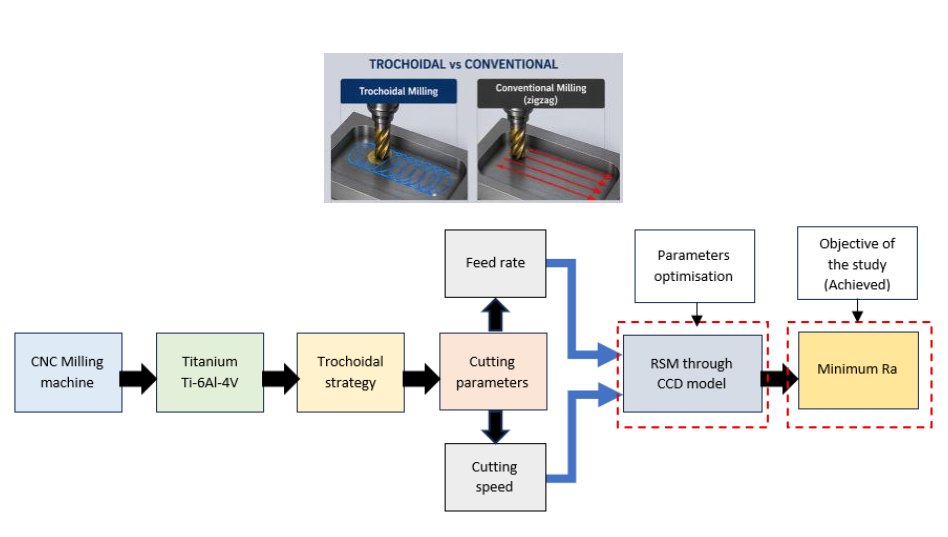
Machining of Ti-6Al-4V titanium alloy poses significant challenges, mainly due to its low thermal conductivity and tendency to form a built-up edge (BUE), which can lead to high surface roughness (Ra) and rapid tool wear. In this context, the trochoidal milling strategy emerges as a promising solution, as it can reduce thermal and mechanical loads by using a spiral-shaped tool path with intermittent contact between the tool and Ti-6Al-4V. Therefore, this research aims to evaluate the effectiveness and optimise the machining parameters, specifically, cutting speed (vc) and feed rate (vf), when using the trochoidal strategy for machining Ti-6Al-4V, with the primary objective of minimising Ra. The methodology used is Response Surface Methodology (RSM) with a Central Composite Design (CCD) to model the nonlinear relationships among vc, vf, and Ra. The experiment was conducted using a 3-axis CNC machining centre with carbide cutting tools. Based on the optimisation results, the optimal parameter combination to minimise Ra is 155 m/min for vc and 124 mm/min for vf. Experimental validation tests of the predicted optimal parameters yielded an Ra value of 0.118 μm, with an error of 2.47% relative to the RSM-predicted value, confirming the model’s applicability. In conclusion, this research confirms that targeted parameter optimisation using RSM is highly effective in improving the surface quality of Ti-6Al-4V, further proving the potential of the trochoidal strategy as an efficient method for critical applications in the aerospace and biomedical sectors where surface integrity is a prerequisite.
How to Cite
Nur Aina Farhanah Aziz, Norfauzi Tamin, Kahirol Mohd Salleh, Hairizal Osman, Tun Danish Tun Mohamed Kamarul (2026). Influence of Machining Parameters on Surface Roughness in Trochoidal Milling of Ti-6Al-4V via Response Surface Methodology. Journal of Engineering and Technological Sciences, Vol. 58 No. 5 (2026): Vol. 58 No. 5(2026): October, 641-651. https://doi.org/10.5614/j.eng.technol.sci.2026.58.5.3
Metrics
References
Altintas, Y., Stepan, G., Budak, E., Schmitz, T., & Kilic, Z. M. (2020). Chatter Stability of machining operations. Journal of Manufacturing Science and Engineering, 142(11), 110801. ASME International. https://doi.org/10.1115/1.4047391
Amaro, P., Ferreira, P., & Simões, F. (2018). Tool wear analysis during duplex stainless steel trochoidal milling. AIP Conference Proceedings, 1960, 070001. https://doi.org/10.1063/1.5034897
Asalekar, A. J., & Rama Sastry, D. V. A. (2024). Enhancing high-speed CNC milling performance of Ti6Al4V alloy through the application of ZnO-Ag hybrid nanofluids. Engineering Research Express. 6(2), 025532. https://doi.org/10.1088/2631-8695/ad476d
Bakar, H. A., Naim, F., Faiz, M., Tamin, N. F., Umar, A., Adam, A. A., Raja, I., and Shahir, K. (2018). Fabrication and machining performance of powder compacted alumina-based cutting tool. MATEC Web of Conferences, 150, 04009. https://doi.org/10.1051/matecconf/201815004009
Bui, L.V., Mac, T.B., & Nguyen, D.-T. (2023). Surface roughness investigation through interplay of cutting speed and thermal-assisted machining in high-speed machining of SKD11 steel. Journal of Machine Engineering, 23(4), 33–42. https://doi.org/10.36897/jme/170980
Cagan, S. C., & Buldum, B. B. (2023). A green machining study to investigate the effect of nano-cutting fluid environments on the machinability of Ti6Al4V titanium alloy. Proceedings of the Institution of Mechanical Engineers, Part J: Journal of Engineering Tribology, 237 (9), 1841–1853. https://doi.org/10.1177/13506501231188358
Datri, S. A., Nataraj, K. S., & Lakshmana, R. A. (2023). Response surface methodology statistical tool for the optimization of responses. Global Journal of Addiction & Rehabilitation Medicine, 7(1), 555705. https://doi.org/10.19080/gjarm.2023.07.555705.
Deng, Q., Chen, Z. C., Chang, Z., Shen, R., & Zhou, Y. (2020). A model for investigating the temperature of trochoidal machining. Journal of Industrial and Production Engineering, 37(4), 194–203. https://doi.org/10.1080/21681015.2020.1769749
Faiz, M. M., Hairizal, M., Hadzley, A. B., Naim, M. F., Norfauzi, T., Umar, U. A.A., Aziz, A. A., & Noorazizi, S. (2019). Effect of hydraulic pressure on hardness, density, tool wear and surface roughness in the fabrication of alumina-based cutting tool. Journal of Advanced Manufacturing Technology, 13(1), 23–37, 2019.
Grguras, D., Kern, M., & Pusavec, F. (2019). Cutting performance of solid ceramic and carbide end milling tools in machining of nickel-based alloy Inconel 718 and stainless steel 316L. Advances in Production Engineering & Management, 14(1), 27–38. https://doi.org/10.14743/apem2019.1.309
Grimm, T. J., Kharat, N. A., Potthoff, N., Mears, L., & Wiederkehr, P. (2021). Stability performance of a stochastic toolpath in machining. Volume 2A: Advanced Manufacturing. American Society of Mechanical Engineers, IMECE2021-69264, V02AT02A035. https://doi.org/10.1115/imece2021-69264
Hoyne, A. C., Nath, C., & Kapoor, S. G. (2015). Cutting temperature measurement during titanium machining with an atomization-based cutting fluid spray system. Journal of Manufacturing Science and Engineering, 137(2), 024502. https://doi.org/10.1115/1.4028898
Jalaluddin, M.L., Azlan, U.A.A. Rashid, M.W.A., Tamin, N. (2024). Effect of sintering temperatures on the physical, structural properties and microstructure of mullite-based ceramics. Aims Materials Science, 11(2), 243–255. 10.3934/matersci.2024014.
Javidikia, M., Sadeghifar, M., Songmene, V., & Jahazi, M. (2021). 3D FE modeling and experimental analysis of residual stresses and machining characteristics induced by dry, MQL, and wet turning of AA6061-T6. Machining Science and Technology, 25 (6), 957–983. https://doi.org/10.1080/10910344.2021.1971709.
Jin, B., Wang, Q., Zhao, L., Pan, A., Ding, X., Gao, W., Song, Y., & Zhang, X. (2023). A review of additive manufacturing techniques and post-processing for high-temperature titanium alloys. Metals, 13(8), 1327. https://doi.org/10.3390/met13081327
Józwik, J. (2019). Analysis of the effect of trochoidal milling on the surface roughness of aluminium alloys after milling. Manufacturing Technology, 19(5), 772–779. https://doi.org/10.21062/ujep/370.2019/a/1213-2489/mt/19/5/772
Khelfaoui, F., Athmane Yallese, M., Boucherit, S., Boumaaza, H., & Ouelaa, N. (2023). Minimizing tool wear, cutting temperature, and surface roughness in the intermittent turning of AISI D3 steel using the DF and GRA method. Tribology in Industry, 45(1), 89–101. https://doi.org/10.24874/ti.1395.10.22.01
Korpysa, J., Zagórski, I., Weremczuk, A., & Habrat, W. (2024). Process stability analysis during trochoidal milling of AZ91D magnesium alloy using different toolholder types. Applied Sciences, 14(9), 3616. https://doi.org/10.3390/app14093616
Kraynev, D. V., Tikhonova, Zh. S., Islamov, A. M., & Bondarev, A. A. (2023). Evaluation of the influence of the instability of the cutting process on the roughness parameters of the treated surface. Izvestia Volgograd State Technical University, 8(279), 21–24. https://doi.org/10.35211/1990-5297-2023-8-279-21-24
Kumar, R., & Reji, M. (2023). Response surface methodology (RSM): An overview to analyze multivariate data. Indian Journal of Microbiology Research, 9(4), 241–248. https://doi.org/10.18231/j.ijmr.2022.042
Li, Z., He, D., Xu, K., Xie, F., & Tang, K. (2021). Kinematics-based five-axis trochoidal milling process planning for deep and curved three-dimensional slots. Journal of Manufacturing Science and Engineering, 144(2), 021005. https://doi.org/10.1115/1.4051707.
Lin, Y. C., Wu, K. D., Shih, W. C., Hsu, P. K., & Hung, J. P. (2020). Prediction of surface roughness based on cutting parameters and machining vibration in end milling using regression method and artificial neural network. Applied Sciences, 10(11), 3941. https://doi.org/10.3390/app10113941
Mgherony, A. W., Mikó, B., & Drégelyi-Kiss, Á. (2020). Design of experiment in investigation regarding milling machinery. Cutting & Tools in Technological System, 92, 68–84. https://doi.org/10.20998/2078-7405.2020.92.09
Olt, J., Liyvapuu, A., Madissoo, M., & Maksarov, V. (2016). Dynamic simulation of chip formation in the process of cutting. International Journal of Materials and Product Technology, 53(1), 1-14. https://doi.org/10.1504/ijmpt.2016.076363
Osman, M. H., Tamin, N. F., Ahmad, M. N., Ab. Rahman, M. H., Wahid, M. K., Maidin, N. A., Abu Bakar, M. H., & Azahar, A. A. (2018). Effect of cutting parameters on surface roughness in dry drilling of AISI D2 tool steel by using the Taguchi method. Journal of Advance Manufacturing Technology, 12(1), 535–546.
Paengchit, P., & Saikaew, C. (2018). Effects of cutting speed and feed rate on surface roughness in hard turning of AISI 4140 with mixed ceramic cutting tool. Key Engineering Materials, 779, 153–158. https://doi.org/10.4028/www.scientific.net/kem.779.153
Pathapalli, V. R., Reddigari, M. R., Anna, E. K., Srinivasa Rao, P., & Ramana Reddy, D. V. (2021). Modeling of the machining parameters in turning of Al-5052/TiC/SiC composites: a statistical modeling approach using grey relational analysis (GRA) and response surface methodology (RSM). Multidiscipline Modeling in Materials and Structures, 17(5), 990–1006. Emerald. https://doi.org/10.1108/mmms-01-2021-0017
Patil, A., Sunnapwar, Prof. V. K., Bhole, Prof. K. S., Ingle, S., & Singh, D. (2024). Machinability of Ti6Al4V Alloy: tackling challenges in milling operations. Qeios, 6(7), 1-16. https://doi.org/10.32388/5o46nj.3
Rashidi, I. F., Tamin, N., Rani, R., Azlan, U. A., Wahab, N., Ismail, A., & Darmawan, A. S. (2025). Low machining parameters produce high cutting performance when machining AISI 1045 at dry cutting conditions using a CNC lathe machine. Journal of Engineering and Technological Sciences, 57(5), 590–598. https://doi: 10.5614/j.eng.technol.sci.2025.57.5.2.
Šramhauser, K., Kraus, P., Špalek, F., Černý, P., Ufitikirezi, J. de D. M., Zoubek, T., Strob, M., Kononets, Y., Kříž, P., & Vochozka, V. (2024). Intercomparison of indexable cutting inserts’ wear progress and chip formation during machining hardened steel AISI 4337 and austenitic stainless steel AISI 316 L. Materials, 17(22), 5418. https://doi.org/10.3390/ma17225418
Tamin, N. F., Azlan, U. A. A., Hadzley, M., Remle, N. S., & Osman, M. H. (2017). Study on surface integrity of AISI 1045 carbon steel when machined by carbide cutting tool, MATEC Web Conference, 01075(97), 2–6. doi: 10.1051/matecconf/20179701075
Ueda, T., Suzuki, K., & Shamoto, E. (2020). Fundamental study on cutting temperature in high speed cutting of difficult-to-cut materials. Proceedings of the Machining Innovations Conference (MIC). SSRN Electronic Journal. Elsevier BV, 086-092. https://doi.org/10.2139/ssrn.3724109
Wu, Y. (2022). Application of aluminum alloy in aircraft. Journal of Physics: Conference Series, 2228(1), 012024. https://doi.org/10.1088/1742-6596/2228/1/012024
License
Copyright (c) 2026 by Authors

This work is licensed under a Creative Commons Attribution 4.0 International License.
Downloads
Date Log
- Submitted
- November 17, 2025
- Accepted
- May 4, 2026
- Published
- August 11, 2026
Keywords
- CNC milling
- parameters
- surface roughness
- Ti-6Al—4V
- trochoidal


