Detection of Food Freshness in Chicken Meat Based on Weight Variations Using ZnO Gas Sensor
Downloads
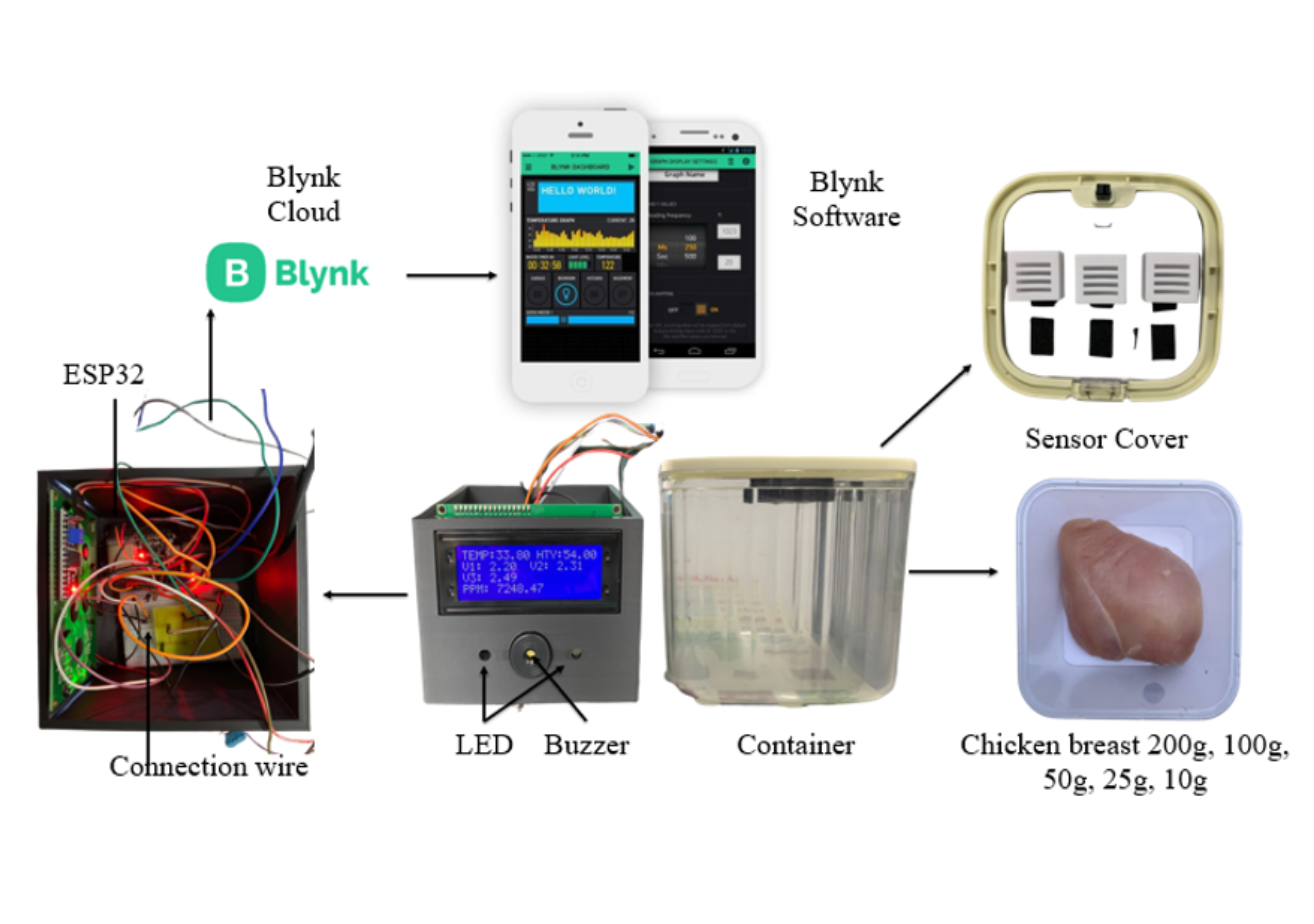
In today's food industry, ensuring the safety and quality of chicken meat is important for protecting the public's health and top priority for both consumers and producers. Reliable detection methods are important to address concerns about eating low-quality chicken meat, especially when determining its freshness or food contamination. Therefore, this study proposed a gas sensor as a device to sense the released gas from the chicken meat at a certain time. The ZnO gas sensor was exposed to the chicken meat based on various weights: 200 g, 100 g, 50 g, 25 g, and 10 g at room temperature for 24 hours. The ZnO gas sensor was fabricated using a screen-printing method on a Kapton film. Integrating the gas sensor with an IoT platform by using the Blynk application makes it easier to monitor and identify freshness in real-time applications. The results highlighted that the highest sensing response value was 55 by ZnO-3 when exposed to the 200 g chicken breast. The average time for chicken breast to be spoiled was approximately 20 hours for all weights of chicken breast, which are 200 g, 100 g, 50 g, 25 g, and 10 g. The results showed that the fabricated ZnO gas sensor outperformed the commercial sensor, MQ137, in detecting the gas released from the chicken meat. Thus, this gas sensor can be used to sense odor gases from the chicken meat.
Alam, M. W., Sharma, A., Sharma, A., Kumar, S., Mohammad Junaid, P., & Awad, M. (2024). VOC Detection with Zinc Oxide Gas Sensors: A Review of Fabrication, Performance, and Emerging Applications. Electroanalysis, 37(1), 1–18. https://doi.org/10.1002/elan.202400246
Al Isyrofie, A. I. F., Kashif, M., Aji, A. K., Aidatuzzahro, N., Rahmatillah, A., Winarno, Susilo, Y., Syahrom, A., & Astuti, S. D. (2022). Odor clustering using a gas sensor array system of chicken meat based on temperature variations and storage time. Sensing and Bio-Sensing Research, 37, 100508. https://doi.org/10.1016/j.sbsr.2022.100508
An, D., Dai, J., Zhang, Z., Wang, Y., Liu, N., & Zou, Y. (2024). rGO/SnO2 nanocomposite based sensor for ethanol detection under low temperature. Ceramics International, 50(9), 16272–16283. https://doi.org/10.1016/j.ceramint.2024.02.107
Astuti, S. D., Tamimi, M. H., Pradhana, A. A. S., Alamsyah, K. A., Purnobasuki, H., Khasanah, M., Susilo, Y., Triyana, K., Kashif, M., & Syahrom, A. (2021). Gas sensor array to classify the chicken meat with E. coli contaminant by using random forest and support vector machine. Biosensors and Bioelectronics: X, 9, 100083. https://doi.org/10.1016/j.biosx.2021.100083
Bhati, V. S., Hojamberdiev, M., & Kumar, M. (2020). Enhanced sensing performance of ZnO nanostructures-based gas sensors: A review. Energy Reports, 6, 46–62. https://doi.org/10.1016/j.egyr.2019.08.070
Brous, P., Janssen, M., & Herder, P. (2020). The dual effects of the Internet of Things (IoT): A systematic review of the benefits and risks of IoT adoption by organizations. International Journal of Information Management, 51, 101952. https://doi.org/10.1016/j.ijinfomgt.2019.05.008
Chachuli, S. A. M., Hamidon, M. N., Ertugrul, M., Mamat, S., Coban, O., & Shamsudin, N. H.(2022). Comparative analysis of hydrogen sensing based on treated‑TiO2 in thick film gas sensor. Applied Physics A. https://doi.org/10.1007/s00339-022-05738-z
Chachuli, S. A. M., Muhammad ‘Azmi, N. A., Shamsudin, N. H., Coban, O., & Aziz, S. A. C. (2025). Impact of Chitosan as a Binder in Graphene Gas Sensor for Volatile Organic Compound Detection. ChemistrySelect, 10(4), 1–14. https://doi.org/10.1002/slct.202405111
Chachuli, S. A. M., Ying, W. H., Shamsudin, N. H., & Coban, O. (2024). Real-time Monitoring of Carbon Dioxide with IoT ThingSpeak using TiO2 Thick Film Gas Sensor. Journal of Engineering and Technological Sciences, 56(5), 593–602. https://doi.org/10.5614/j.eng.technol.sci.2024.56.5.4
Chu, S., Guo, L., Yang, H., Li, Y., & Wang, X. (2025). Recent advancement in flexible gas sensing system for monitoring fruit ripeness in the cold chain storage and transportation. Journal of Cleaner Production, 501, 145270. https://doi.org/10.1016/j.jclepro.2025.145270
Fernández-Ramos, M. D., Arenas-Martínez, A., Pastrana-Martínez, L. M., Cruz, C., Pérez-Poyatos, L. T., Morales-Torres, S., & Maldonado-Hódar, F. J. (2025). Flexible chemoresistive ethylene gas sensor at room temperature for rapid determination of the ripening state in perishable food. Microchemical Journal, 218, 115291. https://doi.org/10.1016/j.microc.2025.115291
Fletcher, B., Mullane, K., Platts, P., Todd, E., Power, A., Roberts, J., Chapman, J., Cozzolino, D., & Chandra, S. (2018). Advances in meat spoilage detection: A short focus on rapid methods and technologies. CYTA - Journal of Food, 16(1), 1037–1044. https://doi.org/10.1080/19476337.2018.1525432
Goel, N., Kunal, K., Kushwaha, A., & Kumar, M. (2023). Metal oxide semiconductors for gas sensing. Engineering Reports, 5(6), 1–22. https://doi.org/10.1002/eng2.12604
Guo, W., Liu, T., Zhang, H., Sun, R., Chen, Y., Zeng, W., & Wang, Z. (2012). Gas-sensing performance enhancement in ZnO nanostructures by hierarchical morphology. Sensors and Actuators, B: Chemical, 166–167, 492–499. https://doi.org/10.1016/j.snb.2012.02.093
Guo, Y. Y., Zheng, X. H., Bo, L. B., Gu, Z. Q., Zhang, C., & Liu, Y. F. (2025). UV-activated gas sensor based on ordered mesoporous ZnO–TiO2 heterogeneous composites for trace NO2 detection at room temperature. Talanta, 285, 127415. https://doi.org/10.1016/j.talanta.2024.127415
Guvvala, M. V., & Ch, D. (2023). ThingSpeak Based Air Pollution Monitoring System Using Raspberry Pi. 2023 3rd Asian Conference on Innovation in Technology, ASIANCON 2023, 1–6. https://doi.org/10.1109/ASIANCON58793.2023.10269833
Haidry, A. A., Wang, Y., Weng, Y., Raza, A., & Yusuf, K. (2025). Excellent acetone sensing enabled by tunable metal organic framework derived TiO2 nanodisks. Talanta, 287, 127547. https://doi.org/10.1016/j.talanta.2025.127547
Han, B., Rupam, T. H., Chakraborty, A., & Saha, B. B. (2024). A comprehensive review on VOCs sensing using different functional materials: Mechanisms, modifications, challenges and opportunities. Renewable and Sustainable Energy Reviews, 196, 114365. https://doi.org/10.1016/j.rser.2024.114365
Husin, N., Zulkhairi, M., Rahim, A., Azizan, M., Noor, M., Fitry, I., Rashedi, M., & Hassan, N. (2020). Real-Time Monitoring Of Food Freshness Using Delphinidin-Based Visual Indicator. Malaysian Journal of Analytical Sciences, 24(4), 558–569.
Jena, B., Kumar Pradhan, S., Jha, R., Goel, S., & Sharma, R. (2023). LPG gas leakage detection system using IoT. Materials Today: Proceedings, 74, 795–800. https://doi.org/10.1016/j.matpr.2022.11.172
Juel, M. T. I., Ahmed, M. S., & Islam, T. (2019). Design of IoT Based Multiple Hazards Detection and Alarming System. 2019 4th International Conference on Electrical Information and Communication Technology, EICT 2019, 1–5. https://doi.org/10.1109/EICT48899.2019.9068782
Khan, M. W. A., Shaalan, N. M., Ahmed, F., Sherwani, S., Aljaafari, A., Alsukaibi, A. K. D., Alenezi, K. M., & Al-Motair, K. (2024). Gas Sensing Performance of Zinc Oxide Nanoparticles Fabricated via Ochradenus baccatus Leaf. Chemosensors, 12(2), 28. https://doi.org/10.3390/chemosensors12020028
Kumar, M., & Lamba, V. K. (2019). The morphological effect on structural and optical properties of ZnO nanostructure. AIP Conference Proceedings, 2142. https://doi.org/10.1063/1.5122546
Li, Z., Li, P., Yin, P., Zhao, X., Hu, Y., Sun, F., Sun, X., & Wang, Z. (2025). Jackfruit-like ZnO gas sensor for monitoring ethyl formate emissions from fish meal Ethyl acetate. Sensor Review 45/5, 45(5), 598–609. https://doi.org/10.1108/SR-01-2025-0014
Liang, J., Tian, W., Gao, F., Zhao, Z., Hui, B., Zhang, D., & Zhang, K. (2025). Silver nanowire-tungsten oxide hybrids : Rapid-kinetic amine sensor for food freshness monitoring. Sensors and Actuators B: Chemical, 444, 138394. https://doi.org/10.1016/j.snb.2025.138394
Ma, M., Yang, X., Ying, X., Shi, C., Jia, Z., & Jia, B. (2023). Applications of Gas Sensing in Food Quality Detection: A Review. Foods, 12(21), 3966. https://doi.org/10.3390/foods12213966
Nami, M., & Deen, M. J. (2025). Flexible and high performance Py-rGO/PANI pH sensor for food quality monitoring : a study on chicken meat. Microchemical Journal, 219, 115798. https://doi.org/10.1016/j.microc.2025.115798
Narayana, T. L., Venkatesh, C., Kiran, A., J, C. B., Kumar, A., Khan, S. B., Almusharraf, A., & Quasim, M. T. (2024). Advances in real time smart monitoring of environmental parameters using IoT and sensors. Heliyon, 10(7), e28195. https://doi.org/10.1016/j.heliyon.2024.e28195
Omran, M. A., Hamza, B. J., & Saad, W. K. (2022). The design and fulfillment of a Smart Home (SH) material powered by the IoT using the Blynk app. Materials Today: Proceedings, 60, 1199–1212. https://doi.org/10.1016/j.matpr.2021.08.038
Park, S. J., Lee, S. M., Oh, M., Huh, Y. S., & Jang, H. W. (2024). Sustainable Food Technology sensors : achievements and future perspectives. Sustainable Food Technology, 2, 266–280. https://doi.org/10.1039/d3fb00196b
Raudienė, E., Gailius, D., Vinauskienė, R., Eisinaitė, V., Balčiūnas, G., Dobilienė, J., & Tamkutė, L. (2018). Rapid Evaluation of Fresh Chicken Meat Quality by Electronic Nose. Czech Journal of Food Sciences, 36(5), 420–426. https://doi.org/10.17221/419/2017-CJFS
Reddy, S., Sarada, V. V, & Bahadur, A. (2025). Sol – gel drop coated ZnO/SnO2 nanostructure thin film heterojunction on glass substrate for ethanol sensing. Applied Physics A, 131(5), 1–15. https://doi.org/10.1007/s00339-025-08481-3
Rouger, A., Tresse, O., & Zagorec, M. (2017). Bacterial contaminants of poultry meat: Sources, species, and dynamics. Microorganisms, 5(3), 50. https://doi.org/10.3390/microorganisms5030050
Sayuti, M. A., Mohd Chaculi, S. A., Coban, O., & Shamsudin, N. H. (2025). Optimization of methane sensing response of a ZnO-graphene composite using the response surface method : sensing area and annealing temperature. RSC Advances, 15, 49968–49980. https://doi.org/10.1039/d5ra07597a
Siciliano, S., Lopresto, C. G., Carnì, D. L., & Lamonaca, F. (2025). Measurement : Food Optical gas sensors in smart food bio-packaging : Innovation for monitoring the product freshness and safety. Measurement: Food, 19, 100245. https://doi.org/10.1016/j.meafoo.2025.100245
Silva, F. A.G. S., Bento de Carvalho, T., Dourado, F., Gama, M., Teixeira, P., & Poças, F. (2023). Performance of bacterial nanocellulose packaging film functionalised in situ with zinc oxide: Migration onto chicken skin and antimicrobial activity. Food Packaging and Shelf Life, 39, 260389566. https://doi.org/10.1016/j.fpsl.2023.101140
Tang, X., & Yu, Z. (2020). Rapid evaluation of chicken meat freshness using gas sensor array and signal analysis considering total volatile basic nitrogen. International Journal of Food Properties, 23(1), 297–305. https://doi.org/10.1080/10942912.2020.1716797
Tayagornkul, N., & Nimsuk, N. (2018). Analysis of chicken meat degradation using electronic nose technology. ECTI-CON 2018 - 15th International Conference on Electrical Engineering/Electronics, Computer, Telecommunications and Information Technology, 356–359. https://doi.org/10.1109/ECTICon.2018.8619920
Yamini, B., G, P., D, K., M, J., G, J., & G S, U. (2024). Theoretical study and analysis of advanced wireless sensor network techniques in Internet of Things (IoT). Measurement: Sensors, 33, 101098. https://doi.org/10.1016/j.measen.2024.101098
Yong, K., Su, L., Liu, H., Xu, C., & Zhang, H. (2025). Co3O4/SnO2 heterojunctions formed as porous nanocubes with remarkable sensitivity and selectivity to acetone gas. Materials Letters, 384, 138118. https://doi.org/10.1016/j.matlet.2025.138118
Copyright (c) 2026 Journal of Engineering and Technological Sciences

This work is licensed under a Creative Commons Attribution-NonCommercial-NoDerivatives 4.0 International License.